Consider the case of Denver Broncos wide receiver Brandon Stokley who recently demonstrated what is perhaps the best evidence of transfer of training from a video game to the workplace that I have ever seen. In this case, the workplace is the football field, but the principle remains the same.
According to a recent article in Wired, in the first game of the 2009 season, Stokley performed a surprising game-winning play – a touchdown that started 87 yards down the field. But those sorts of miracles happen in a lot of games – what doesn’t usually happen is Stokley’s move right before the end zone. Rather than running straight in for the touchdown, he cuts 90 degrees and runs parallel to the end zone before cutting in for the goal.
In football played on pro fields, that’s a little odd. Normally, if you’re about to score a goal, you simply run right into the end zone: the goal-scoring area. Instead, Stokley replicated something he’d done countless times before, but not on the field – in a video game called Madden NFL.
In training terms, this is quite compelling. Madden NFL is essentially a football simulator. It replicates the field, player actions, coach strategies and so on down to the finest details. In playing Madden, Stokley was testing theories about what kinds of plays would work and seeing them in action, all without having to leave his couch. And the result? According to the Wired article:
When I caught up with Stokley by telephone a few weeks later, I asked him point-blank: “Is that something out of a videogame?” “It definitely is,” Stokley said. “I think everybody who’s played those games has done that” — run around the field for a while at the end of the game to shave a few precious seconds off the clock. Stokley said he had performed that maneuver in a videogame “probably hundreds of times” before doing it in a real NFL game. “I don’t know if subconsciously it made me do it or not,” he said.
He tested and perfected a technique in a video game and then applied it on the field. What better evidence of transfer of training from video games can there be?
This recent Dilbert cartoon provides an important lesson on the use of statistics in business.

“No one trusts statistics” is probably a little too specific. A more general statement may be more appropriate: “people trust their own instincts over that of experts they don’t know.” Admittedly, Catbert likely does have ill intentions in this cartoon, but I’m betting most statisticians do not.
Expertise is really a by-product of specialization, a process that helped bring about modern civilization. Before specialization, in tribal societies, each member of the community would do virtually everything. Each person would be responsible for hunting food, cooking, cleaning, and so on, as it was needed in the moment. The first specializations in human society were along gender lines – males tended to take certain jobs and females tended to take others.
As society progressed, specialization became more complex – farmers, blacksmiths, cooks, millers, and so on. Because specialization allowed a person to devote their entire lives to a particular skill, those people became much better than everyone else in their village or town at that skill. So, for example, a person whose job is to be a cook will be a much better at cooking than a farmer will. This is common sense.
A side effect of specialization is that multiple specialists could advance their craft faster than generalists could. Farming is an excellent example. In the beginning, it was simply the planting of found seeds and hoping they sprouted. Over time, the technologies that we all learned about in high school were developed, like crop rotation. Fast forward to now, when the field of food science is extremely complicated and full of mind-numbingly complex statistics on planting schedules, soil compositions, seasonal variation, and pH levels.
Every field of study undergoes this same specialization and increasing complexity over time. As it happens, the realities of those fields get further and further away from what the layman can easily understand. For centuries, this has worked out fine – each person had their own specialization and trusted that other specialists would be similarly skilled. It was a perfectly natural evolution of human thought over time. So why don’t people trust it now? What’s changed?
- The average amount of time teens spend online now exceeds the number of hours the average adult spends working (53 hours per week of online time for teens), although that includes 4.5 hours per day watching TV and only 38 minutes per day reading on the web. It was taken from students voluntarily recording “media diaries,” however, so selection bias may be at play here.
- The uncanny valley – or the theoretical dip in attractiveness when robots are nearly human-like but not quite human enough – may not really exist.
- The master password for Facebook, which could be used to log into any Facebook account, was “Chuck Norris”. Don’t worry – they don’t use it anymore. And anyway, Chuck Norris doesn’t use Facebook, because if you ever read Chuck Norris’ status, it’d only say one of these various facts.
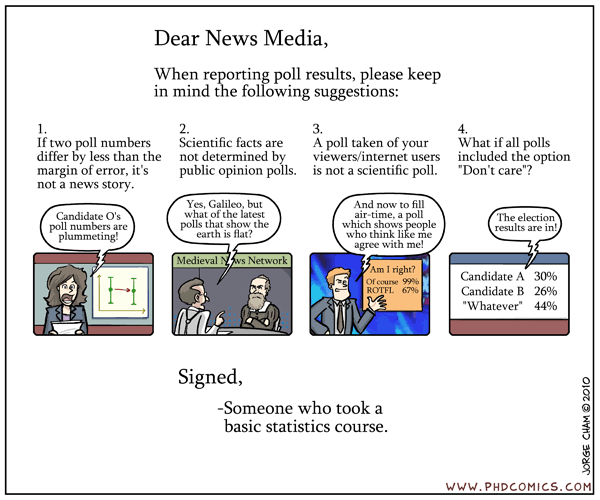
- Jorge Cham of PhD Comics gives a fantastic primer on statistics for news outlets:
- Rickets, a disease due to Vitamin D deficiency not really seen since the Victorian era, is on the rise. The blame is going to video games, surprise surprise. You can get enough Vitamin D to avoid rickets by going in the sun just a few minutes each day. Based on the study I described in #1, the problem isn’t video games – it’s the Internet. And parents who don’t encourage their kids to go outside for 5 minutes a day.
- An electromagnetic pulse gun is being developed that could be used by police in chases to knock out all of the electronics (like, for example, power steering) in a fleeing vehicle.
- SAS, the well-known developer of statistical software, has been named Fortune’s Best Company to Work For.
- A graduate student at the University of Manitoba failed comprehensive exams twice but was reinstated due to “test anxiety.”