
 A recent article in Psychological Science1 investigates the use of violent video games by people to experience catharsis – a “release” associated with pent-up aggressive energy. They found that when angered, people are more likely to seek violent video games for an emotional release, despite the fact that playing violent video games does not seem to actually provide that release.
If you’re not familiar with the idea of catharsis, consider this quote from a participant in the study: “How could I squelch the urge to set my manager on fire if I couldn’t set people on fire in video games?”
To test this experimentally, researchers conducted two experiments.
In Experiment 1:
- 120 college students read a newspaper article about one of three topics: refuting catharsis, supporting catharsis, or unrelated to catharsis.
- Participants wrote an essay about a time they became very angry and received one of two pieces of handwritten feedback afterward: “This is one of the worst essays I’ve read!” or “This is one of the best essays I’ve read!” This has been previously validated to elicit an anger response.
- Participants completed a survey about the attractiveness of playing four violent and four non-violent games.
They found:
- Participants primed to be angry and also primed to think that catharsis was effective led them to rate violent video games as more attractive.
- Participants primed to think that catharsis was not effective led all participants to rate violent video games as less attractive.
In other words, when angry people were led to believe that catharsis helps you feel better when angry, they wanted to play violent video games.
The researchers partially replicated and expanded on this concept in Experiment 2:
- 155 college students completed a beliefs-about-catharsis questionnaire.
- As in Experiment 1, participants then wrote an essay about a time they became very angry and received one of two pieces of handwritten feedback afterward: “This is one of the worst essays I’ve read!” or “This is one of the best essays I’ve read!” This has been previously validated to elicit an anger response.
- As in Experiment 1, participants then completed a survey about the attractiveness of playing four violent and four non-violent games.
Thus, the only difference between Experiment 1 and Experiment 2 was that catharsis beliefs were not primed, but the same effect was elicited. Angry people seek out video games if they believe it will be cathartic, despite a lack of evidence that catharsis works.
Of course, any time we talk about video games, it’s important to list some caveats, lest the hardline anti-video-game folks take it too far. This study doesn’t mean that all video game players are violent, nor does it mean that video games cause violence. Instead, it shows that already-angry people might seek out video games to let out their pent-up aggressions and frustrations out only to find that it doesn’t really help.
- Bushman, B.J. & Whitaker, J.L. (2010). Like a magnet: Catharsis beliefs attract
angry people to violent video games. Psychological Science : 10.1177/0956797610369494 [↩]
I am normally a fan of articles from Mashable, the popular blog focused on discussing social media as a source of inspiration for discussions of technology applied to work. But a recent article by Sharlyn Lauby on Foursquare’s use to improve the employee experience in the workplace as an HR intervention struck me as absolutely ridiculous.
 For those of you unfamiliar with Foursquare, the basic idea is that people with smartphones can log into the Foursquare website to “check in” for points when physically going to location in their city. For example, when you go to your favorite bar, you “check in” at the bar via GPS location services or text messaging, which adds to your point total for appearing at the bar. Whenever you have the most points in a particular location, you become “mayor” of that location. This creates a natural system for people to compete to get the most points to remain the mayor of their favorite locations, which mimics a basic mechanic in many video games. Users can also post status updates, which allows them to broadcast to the world not only where they are but also what they’re doing there.
I’ll go through each of their points in turn.
- Orientation
Lauby argues that because universities like Harvard and UNC Charlotte have successfully used Foursquare as part of their orientation process (by checking in at various campus buildings and services), organizations are a logical next step. But they’re not. Lauby rightly mentions employee privacy concerns (summarized well here), but additionally, you must consider the realities of organizations. The fun of Foursquare is that you are competing against other people. Most organizations simply aren’t large enough for this to feasible. And of those that are, do you really want your employees checking in at the break room as many times per day as they can? And if you add Foursquare check-in points absolutely everywhere (in each office, in the break room, in the copy room, at the receptionist’s desk, at the time clock), just how much total time is being wasted across your organization? - Making Work Easier
This argument is that by using Foursquare, you can attract more customers, which will make your employees’ jobs easier. This just doesn’t make any sense. What it’s really saying is that Foursquare can be used as a effective marketing tool, which I certainly agree with. But that has relatively little to do with the experience of your employees. - Recognition
Here, Lauby argues that employees will want the recognition associated with being mayor of a location. Here is the example given:Tiedje mentioned he’s currently the mayor at the Sun Sentinel. “I’ve been trading back and forth with one of our page designers. I lost it after going on vacation. Actually not sure how I got it back!”
The vital piece of information you need here is that Tiedja is the social media coordinator for the Sun Sentinel. If you just did a double-take, you had the correct reaction. He’s mentioning with some enthusiasm that he is mayor of his own workplace. What does that mean? He goes to work more often than anyone else does? He leaves the office and comes back more often than anyone else? Why is it such a good thing to go to work more often than other people? Isn’t that just the job, and if you don’t do that, don’t you get fired? It also creates a culture where you are ultimately rewarding the person that’s worked at your organization the longest and also happens to remember to check in every time. What is really the value in that?
- Morale
Apparently using Foursquare can create a positive organizational culture. Let me explain something – if you think you need a technological gimmick to establish a positive organizational culture, you’ve got bigger problems than Foursquare can solve.
I am big supporter of social media in workplace, but this Mashable article just represents another in a long string of opinions that throwing technology into an organization can magically solve its problems. It is never, never, never that simple. Don’t start with a technology and think of a way to shoehorn it into your organization, or it will create no value. Instead, start with the problem you’re trying to solve, determine which technologies are available that could solve your problem, and move strategically from there.
Augmented reality (AR) is a new technology where information is virtually layered on top of reality. For example, you might point your smartphone’s camera at a Washington D.C. landmark and see not only a live video feed of that landmark on your phone, but also information about that landmark (size, age, hours of operation, etc.) on top of the video.
As a very new technology, there’s not much research available on AR, and even less psychological research. But one study appeared in Cyberpsychology, Behavior, and Social Networking that caught my eye. It’s called “An augmented reality system validation for the treatment of cockroach phobia.”1
Bugs don’t bug me as much some people I know, but this system creeps me out. Participants in the study sit at a desk with a computer wearing a virtual reality headset. The headset has a camera attached, such that the person wearing it will see a video representation of the desk that they’re looking at. But with cockroaches.
That’s right. You sit at a desk, wear a virtual reality headset, and then see the desk that you’re sitting at covered in cockroaches.
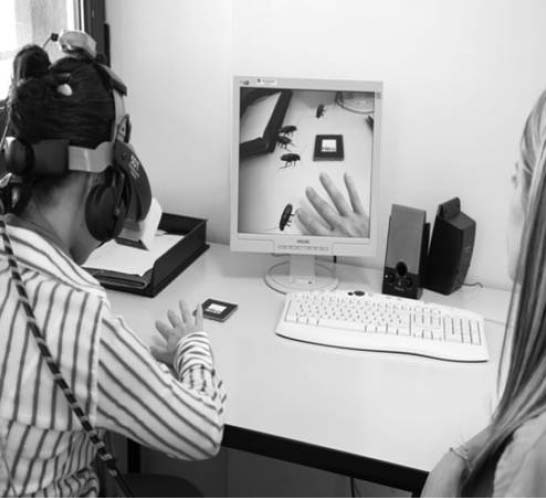
My operational definition of this is "creepy." (picture from the article)
That sounds a lot more horrible than it probably is. One major therapy technique for treating phobias is called exposure therapy, which is the gradual exposure of a person with a phobia to the source of that phobia – essentially “facing your fears,” a little bit at a time. A therapist in control of this system would make judgments as to what level of cockroach exposure the patient was ready for, gradually increasing the prevalence of cockroaches over many sessions. So over time, the patient would see more and more cockroaches but nothing bad would ever happen to them as a result, and eventually, their phobia is extinguished.
This article is only a first step. Their goal was to elicit a realistic phobia response using simulated cockroaches, and that seems to have worked. Six female participants with cockroach phobia reported extremely high anxiety levels when presented with the simulated cockroaches. Thus by using the AR system, participants experienced symptoms similar to what they would experience with real cockroaches. That’s important, because if people with cockroach phobia don’t really think cockroaches are near them, there’s no way for them to face their fear.
There are only six participants in this study, which I think is most likely the result of difficulty in finding people with cockroach phobias, which may limit the generalizability of this system in provoking fear responses. But I do think it’s enough evidence to move on to the more important question anyway: Does exposure therapy on phobias using AR work as well as traditional exposure therapy? If so, it opens up the possibility of simulating even more phobias virtually that are difficult for therapists to expose to patients without risk or high cost, like fears of falling, flying, heights, and dead things.
- Breton-Lopez, J., Quero, S., Botella, C., Garcia-Palacios, A., Banos, R.M. & Alcaniz, M. (2010). An augmented reality system validation for the treatment of cockroach phobia. Cyberpsychology, Behavior and Social Networking, 1-16 : 10.1089/cyber.2009.0170 [↩]