 In a fascinating article in the Industrial-Organizational Psychologist, Scott Highhouse1 discusses why legal protections provided to women under Title VII of the Civil Rights Act of 1964 might have been included by lawmakers as a joke – or more specifically, as a way to make the bill so ridiculous that it would not pass a congressional vote.
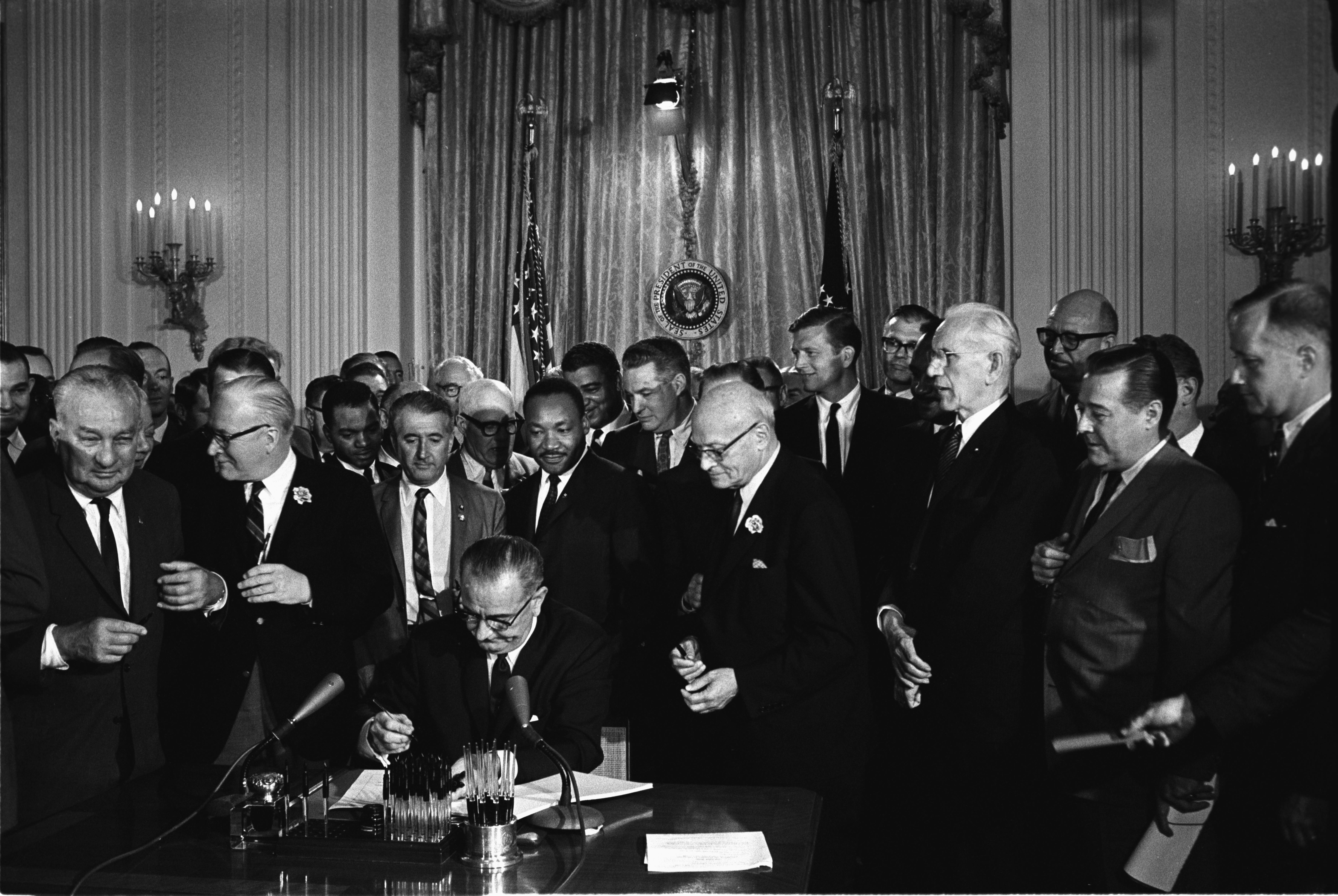
President Lyndon Johnson signs the Civil Rights Act of 1964 into law under the eyes of Martin Luther King, Jr. and other leaders of the civil rights movement.
If you’re unfamiliar with this legislation, the CRA of 1964 was landmark legislation at the height of the US Civil Rights Movement that defined illegal discrimination of a variety of types. The focus of the CRA was the end of segregation – the legal requirement of people of different races to use different buses, restaurants, restrooms, and so on. Title VII was the section of the CRA of 1964 dealing with employment rights.
Protections for women were only added to the bill in its 11th hour by Democratic Representative Howard Smith of Virginia. According to the congressional record, when Smith introduced the amendment to include women, Congress laughed.
Highhouse describes it this way:
One can imagine this scene playing out like an episode of Mad Men, a fictional television series set in the 1960s. Indeed, it seems that Judge Smith was introducing this amendment because it would be seen, in 1964, as completely absurd to provide protection to women against unfair treatment in the workplace. After all, Smith ultimately voted against the Civil Rights Act of 1964.
It’s difficult to say this definitively; Smith later did in fact support women’s rights in other non-race-related legislation. But this may in fact explain his behavior; Smith was a vocal supporter of “white superiority” and spoke of his concern that the passage of the CRA of 1964 might disadvantage white women. By introducing his amendment, he could protect this group even if the CRA passed (which it did). Smith died in 1976, so it’s unlikely that we’ll ever know for sure.
The full article in TIP is available for free; if you’d like more detail on this issue, have a look!
- Highhouse, S. (2011). The history corner: Was the addition of sex to Title VII a joke? Two viewpoints.
The Industrial-Organizational Psychologist, 48 (3), 102-107 [↩]
It’s that season again, so Neo-Academic will be taking a posting break until after the New Year. This is also a strategic decision so that I can get some writing done. Stay tuned!
In a recent issue of the Journal of Virtual Worlds Research, Minocha, Tran and Reeves (2010)1 discuss considerations when conducting research in the 3D virtual world, Second Life. They cover a pretty large array of information, including how to explain virtual worlds to IRBs, additional ethical concerns when interacting with natives in virtual worlds, differences between the rights of the avatar versus the rights of the player, recruitment techniques, data types, and specific researcher skills required.
In addition to my own research into selection and training technology in the workplace, I’m teaching a doctoral course in technology skills for psychology researchers next semester, one day of which covers 3D virtual environments. While this paper focuses on qualitative research, many of the concerns are common to all types of research in this domain. The authors of this paper discuss these in the context of two of their own projects: one in an educational context, and another with a focus on consumer psychology.
Both studies were conducted “inworld” (study participants were native users of Second Life, rather than, for example, undergraduate volunteers taking part in a 2-hour study for course credit), which shapes the issues they discuss. This raises some interesting parallels to research IRL (“in real life”). For example, they describe the process of setting up interviews in Second Life, and it is very similar to what would be conducted in a college setting: securing an interview location, ensuring that it is quiet and comfortably decorated, scheduling a time to “meet” the avatar of the study participants, and so on. Apparently explaining this context to an IRB can be a little tricky – especially the idea of identity creation.
Because Second Life is itself a vibrant virtual world where people quite literally spend their lives (though this life may be virtual, it is quite “real” to residents), it’s important for researchers to portray themselves as people to be trusted, which involves the careful crafting of a persona. This involves everything that might be involved in a laboratory study and more: from explaining the research study and its purpose clearly (including RL identity) to creating appropriate hair, body and clothing style.
Ethically, we enter several gray areas that will need to be worked out in the coming years. When an avatar in Second Life provides informed consent (the voluntary release of information collected for research purposes), are they giving permission to share their avatar’s identity or their real selves? And critically for research purposes, when they answer questions, who is answering them – the person or the character that person has created? An added dimension to this is the medium of communication – what differences arise as a result of spoken interviews (using the in-game voice chat functions) versus text? Does this confuse the avatar/player distinction even further?
Overall, Minocha et al. gives an excellent introduction to conducting research in the world of Second Life. While reading this will not give you the technical skills to jump right in and start, it certainly covers all of the major areas to think about with two illustrative case studies. Best of all, the article is free – so get reading!
- Minocha, S., Tran, M. Q., & Reeves, A. J. (2010). Conducting empirical research in virtual worlds: Experiences from two projects in Second Life. Journal of Virtual Worlds Research, 3 (1). [↩]