 In a recent article in the International Journal of Selection and Assessment, De Goede, Van Vianen, and Klehe1 examine the role of web site design in the formation of opinions about organizations to which they plan to apply to work. They do so in the context of fit – a concept defined as the congruence between a person’s values, beliefs, traditions, etc. and those of an organization or other entity.
This means that for any particular job, an applicant “fits” differently with different aspects of that job. In this article, De Geode and colleagues discuss two specific kinds of fit: person-organization fit and person-industry fit. While person-organization fit is as I described above, person-industry fit refers to the congruence between the person’s values, beliefs, traditions, etc. and their stereotypes about industry culture.
Most industries have a certain stereotypical culture about them. Programmers, for example, are stereotyped as working day and night, eyes on the monitor, somewhat asocial, and only pausing for a few sips of Mountain Dew. When a programmer applies for a new job, that programmer already has preconceived notions about what “being a programmer” means and what jobs for programmers typically look like. The extent to which that programmer is comfortable with that sort of lifestyle is person-industry fit.
For any particular organization, there will be deviance from the stereotype. Google, for example, advertises itself to potential employees with all sorts of atypical cultural elements – food service at work, on-site daycare, lots of flextime, personal projects, pets at work, casual environment, etc – which is uses to distance itself from the typical programming job. Life at Google is better – at least that’s how they want you to feel about it.
But what about smaller organizations? When you don’t have a multimillion dollar HR/employee wellness budget, pretty much the only thing prospective employees will see is the your website. So how do people’s perceptions of a potential employer change as a result of seeing these websites? If they already have a poor perception of person-industry fit, how can that perception change?
De Goede et al. examined this question by collecting two samples. In the first, 80 Master’s students in I/O Psychology provided their values for organizations, and 5 weeks later, they observed the websites of and provided their perceptions of the values of four I/O Psychology firms to which they could potentially apply. This allowed for an assessment of person-organization fit, by examining differences between personal values and perceived organizational values.
In the second sample, the researchers examined person-industry fit by asking 37 additional I/O Psychology students made assessments of values of the I/O Psychology industry. This sample was used as a reference for the first sample, since the researchers did not want to contaminate either set of ratings (individual web sites or industry stereotypes) by having participants make ratings on both.
Here’s what they found:
- Consistent with prior research, the greater person-organization fit, the greater the perception of that organization being an attractive place to work.
- Also consistent with prior research, better website design was correlated with organizational attractiveness.
- Person-industry fit was related to person-organization fit were correlated (the better your perception of the industry, the more you like organizations within that industry).
- The relationship between website design and organization-industry similarity (how well the values of the organization match those of the industry stereotype) was negative, but was stronger when person-industry fit was low.
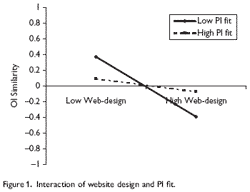
Interaction of web design and fit predicting org-industry similarity.
That last bullet is the most important one here, so let’s explore it a little more carefully. What this means is that when an applicant feels like she really belong in an industry (high person-industry fit), web design quality does not really influence the applicant’s perception of how well the organization fits in that industry. But when an applicant feels like they don’t belong in an industry (low person-industry fit), web design quality does matter. In fact, if there are negative stereotypes surrounding your industry (as in the case of programmers), a well-designed website can lead an applicant to believe that your organization is different (and hopefully better) than the rest of the industry.
So even if an applicant would be a great employee, they may never even apply to your organization if they’ve developed a poor impression of the industry and your website does nothing to combat that stereotype. Instead, they’ll just lump you in with the rest of them, which is just like handing over your top talent to the competition.
- De Goede, M., Van Vianen, A., & Klehe, U. (2011). Attracting Applicants on the Web: PO fit, industry culture stereotypes, and website design International Journal of Selection and Assessment, 19 (1), 51-61 DOI: 10.1111/j.1468-2389.2010.00534.x [↩]
 In recent research appearing in Simulation & Gaming, Rodrigo1 explores the cognitive-affective states students experience over the course of a learning game by observing 30 Filipino students at 12 intervals playing a pre-algebra game called Math Blaster (for Ages 9-12). Most surprisingly from this research, it was discovered that the state of confusion leads to student engagement.
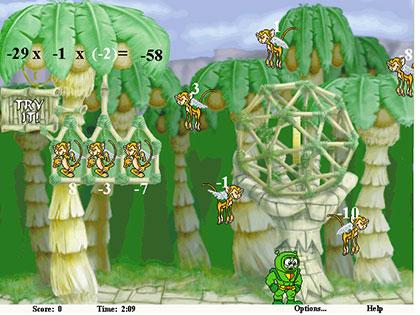
Math Blaster Ages 9-12 by Knowledge Adventure
Evidence for seven general states was found:
- Boredom
- Confusion
- Delight
- Engagement
- Frustration
- Surprise
- Neutral (none of the above)
For learning to occur, we generally want students to maintain the engagement state, where they are immersed and focused on the material. In Math Blaster, engagement was most common, followed by boredom, followed by delight.
But the states themselves are not as interesting as the transitions between them. Which states precede learning? Which states precede other states?
Most critically, boredom begets boredom. Once a student entered the boredom state, it was somewhat probable that they would stay bored, and highly probably that they would not transition to engagement.
But most interestingly, confusion begets engagement. If a student becomes confused, it is highly probably that they will transition to an engagement state. The author claims that this follows from previous research suggesting a correlation between confusion and achievement, but it is not explored deeply in the paper.
I personally believe this is more closely related to the experience of accomplishment – the student is confused, overcomes that confusion, and then is motivated to move forward by that victory. This seems related to the psychological theory of motivation by goal setting. Accomplishing goals motivates us to accomplish other goals.
Generally, this speaks to an important game design principle for learning games – they can’t be too easy. If we consider the engagement state to be where most learning occurs, we must design learning games to push users to that state. There are generally two options to go about this: 1) start easy and gradually ramp up the difficulty or 2) start difficult (but not too difficult!) and provide the player with advice and guidance to improve their skills to that level. From this research, it appears that the second approach is preferable – at least with children. Further research should examine this with older populations to see if these principles generalize to adults and college students.
- Rodrigo, M. (2010). Dynamics of student cognitive-affective transitions during a mathematics game. Simulation & Gaming, 42 (1), 85-99. doi: 10.1177/1046878110361513 [↩]
There are four general classifications of social network site (SNS) users, according to recent research from Alarcon-del-Amo, Lorenzo-Romero, and Gomez-Borja1 in Cyberpsychology, Behavior, and Social Networking. Using a latent segmentation approach, they found evidence for the Introvert, the Novel User, the Versatile User, and the Expert-Communicator.
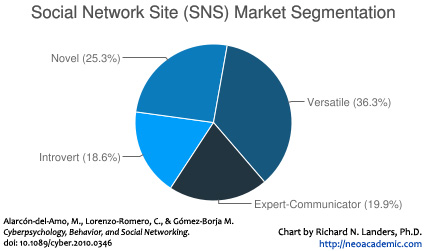
- The Introvert (18.62%)
The least active user, the Introvert uses SNS primarily as a replacement for e-mail. He may update his profile, but most communication with other users occurs via private messaging. Introverts usually have fewer than 50 SNS friends and generally these friends are all people they know from their “real lives.” Introverts generally only have accounts on one SNS (I suspect it is usually Facebook). - The Novel User (25.25%)
The second least active user, the Novel User logs in for between 1 and 5 hours per week, again with fewer than 50 SNS friends. A little more active than the Introvert, these users will update their profiles, actively seek out information (e.g. groups, what friends are doing), and spend time tagging photos. On average, the Novel User will have accounts on two SNS. - The Versatile User (36.25%)
The second most active user, the Versatile User is the most common type of user, and uses SNS broadly – sending public and private messages, commenting on discussion threads, updating their profiles, and sharing links with their contacts. These users tend to have fewer than 100 SNS friends, but actively engage with those friends. They don’t use many applications, though they might try one occasionally, and they spend between 1 and 5 hours per day on SNS. More users in this group use SNS for professional activities (e.g. networking with business contacts) than in other groups. - The Expert-Communicator (19.88%)
The most active SNS user, the Expert-Communicator is the power user of the SNS world. The majority of this group is made up of women, aged 25 to 35. These users typically log in several times per day for more than 5 hours total per day. They typically have more than 100 SNS friends (often many more) and are actively engaged in most services provided by the SNS, including participating in communities surrounding products they enjoy in order to stay updated on those products and using event scheduling. Unlike the other three types of users, this group engages mostly with people they do not interact with much in person, using SNS primarily to stay in contact with those they don’t otherwise interact with.
Latent segmentation is a fairly common technique used to determine market segments – core groups of users which interact with a product differently. So theoretically, this means that if you are planning to use social media as part of a marketing campaign, or if you are designing a social media intervention for whatever other reason, you should consider that these four groups are likely to engage with your efforts quite differently.
In terms of my own research on social media’s potential for collaborative employee training and undergraduate education, this paper makes me wonder if we will be equally effective across these four groups… definitely something worth further investigation.
- Alarcón-del-Amo, M., Lorenzo-Romero, C., & Gómez-Borja, M. (2011). Classifying and Profiling Social Networking Site Users: A Latent Segmentation Approach. Cyberpsychology, Behavior, and Social Networking DOI: 10.1089/cyber.2010.0346 [↩]