Grad School Series: Applying to Graduate School in Industrial/Organizational Psychology
Starting Sophomore Year: Should I get a Ph.D. or Master’s? | How to Get Research Experience
Starting Junior Year: Preparing for the GRE | Getting Recommendations
Starting Senior Year: Where to Apply | Traditional vs. Online Degrees | Personal Statements
Alternative Path: Managing a Career Change to I/O | Pursuing a PhD Post-Master’s
Interviews/Visits: Preparing for Interviews | Going to Interviews
In Graduate School: What to Expect First Year
Rankings/Listings: PhD Program Rankings | Online Programs Listing
So you want to go to graduate school in industrial/organizational (I/O) psychology? Lots of decisions, not much direction. I bet I can help!
While my undergraduate students are lucky to be at a school with I/O psychologists, many students interested in I/O psychology aren’t at schools with people they can talk to. I/O psychology is still fairly uncommon in the grand scheme of psychologists; there are around 7,000 members of SIOP, the dominant professional organization of I/O, compared to the 150,000 in the American Psychological Association. As a result, many schools simply don’t have faculty with expertise in this area, leading many promising graduate students to apply elsewhere. That’s great from the perspective of I/O psychologists – lots of jobs – but not so great for grad-students-to-be or the field as a whole.
As a faculty member at ODU with a small army of undergraduate research assistants, I often find myself answering the same questions over and over again about graduate school. So why not share this advice with everyone?
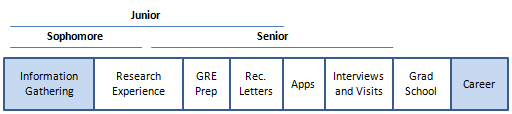
This week, I’d like to talk about a Big Decision: Should I get a Master’s or Ph.D. in I/O Psychology?
This falls under two categories in my grad school timeline above: Information Gathering and Career. This is a decision you should try to make during your sophomore year of college, and the decision should be driven by what kind of career you ultimately want.
Careers in I/O psychology are a little different than in most fields. Because we are so small (in the grand scheme of things), there is less public advertisement of positions than typical in most fields. You probably won’t find a position for an “I/O psychologist” on Monster.com, for example. Many positions that I/O psychologists end up in are also not called “I/O psychologist.” As the “science behind human resources,” I/O psychologists end up in a wide variety of career paths. This is because the skill set developed as a I/O psychologist in training prepares you for virtually any job involving “people at work,” including consultants, professors, assessors, directors, and CEOs. For a few examples, see these resources from SIOP.
So when you think about the difference between Master’s and Ph.D.-level training, you’re not comparing specific careers – rather, you are considering different approaches to training. In a Master’s program, you are training to become an I/O professional. An I/O professional will consider how to apply the principles of I/O psychology to solve specific organizational problems. In a Ph.D. program, you are training to become an I/O scholar. An I/O scholar will do the same tasks as the I/O professional, but will also use those experiences to advance our general understanding of I/O through research.
Thus, I/O professionals (Master’s) are trained to help organizations. I/O scholars (Ph.D.’s) are trained to advance organizational science, helping organizations along the way. Master’s students are trained to practice I/O psychology. Ph.D. students are trained to conduct research in I/O psychology.
In practice, this means that an I/O psychology Ph.D. will generally have more responsibility than an I/O with a Master’s. If you are in an organization with lots of I/O psychologists, the Ph.D.’s will generally be making “the big decisions,” while the I/Os with Master’s will aid with implementation or conduct background research. Since many modern organizational problems are at the frontiers of our current understanding of organizations, a person with Master’s level training will generally not be prepared to conduct research within the organization to help answer these questions. Of course, there are many I/O’s with Master’s that start their own consulting agencies or work as the only I/O psychologist in an organization – but this is a matter of experience and personal drive.
And of course, if you want to be a professor, the only suitable degree is a Ph.D.
All I/O training, regardless of level, centers around (or rather, should center around) the scientist-practitioner model. This is one of the key differences between an MBA in Human Resources and a degree in I/O Psychology. While the MBA will make an informed decision, usually based on reasoning from case studies and their own experience as managers (often anecdotal evidence or recommendations from more experienced businesspeople), an I/O will reference the current scholarly research literature to make this same judgment from scientific evidence. While an MBA simply wants to solve a problem, an I/O wants to understand that problem based on our scientific understanding of human behavior and then solve it.
If you are having a hard time making a decision, assume you’ll go for a Ph.D. The preparation you’ll do over the next three years for a Ph.D. will be sufficient for a Master’s too, but the preparation needed for a Master’s won’t be enough for a Ph.D. Better safe than sorry!
Please also note that the guidelines given here are based on “typical” programs – there are certainly scholarship-focused Master’s programs and practitioner-focused Ph.D. programs, but the majority of them follow the model here.
Once you have a degree in mind, you should tailor your efforts to prepare to apply to programs accordingly. Check out the links at the top of this post for more resources to help you make more decisions along this path. And if you’re considering a Ph.D. program, please think about applying to my school, Old Dominion University.
If you are a long-term reader, you may remember that in January, I applied for a grant from the National Science Foundation to produce SOCL, the Social network for Online Community-based Learning, which incorporates online social community and gameification elements to produce positive outcomes for college students.
We won’t hear about the results of that for several months, but for now, I’ve entered the idea into Houghton Mifflin Harcourt’s Global Education Challenge. Here is the purpose of the GEC from their webpage:
Through the Global Education Challenge, we hope to find truly original ideas that can become tangible tools to improve student outcomes across the globe–both inside and outside the classroom. We’re building a community of innovators who share our goal, and together we’ll discuss ideas for groundbreaking solutions to help transform student learning, foster family engagement, and enhance teacher effectiveness.
I’m writing now to ask you to please create an account at GEC and “thumb up” SOCL. This increases the changes that the SOCL platform will be recognized and funded – and the concept expanded to include elementary, middle, and high schools. I’ve received a lot of feedback from high school teachers especially that they are interested in the SOCL concept for their students, but funding from NSF would not be sufficient for us to expand in this direction. Winning GEC would help us make this happen.
So to support the SOCL concept, please create an account here and then “thumb up” the SOCL idea here. And certainly, if education is something you’re passionate about, please submit your own ideas and review the others you find.
 In a recent issue of the Journal of Virtual Worlds Research, Beck et al.1 examine the role of the psychological construct “presence” in the context of virtual enviornments (VE). They do this by exploring the study of presence across several disciplines of study. I’ll summarize them here:
- Mass Communication: This is a discipline studying how mass media can be used to communicate to large groups. Researchers in this field discuss presence in terms of “being there” as a part of the virtual environment, a concept called “sentient presence” (SP).
- Human-Computer Interaction: HCI is a discipline combining elements of both human factors engineering and human factors psychology, with a focus on how humans experience computers. In HCI, discussion surrounds a “sense of being there,” called “non-sentient presence” (NSP). This line explains it fairly clearly: “People are considered present in a VE when they report a sensation of being inside the virtual world.” SP is still a part of HCI, but focuses on multi-user VEs (MUVEs). HCI also quanties NSP in terms of four dimensions of immersion: inclusiveness, extensiveness, surrounding, and vividness.
- Education: Definitions of presence is derived from mass communication and HCI, although it has been studied as a function of both media and participants in media. An interesting dimension within this field is the study of SP as the ability of the VE resident to project a realistic persona into the VE. One education researcher even found that increased SP was related to increased learning in online courses.
- Psychology: In my field, presence is also discussed in terms of “being there.” Greater presence in a VE is indicated by the perception of virtual objects and experiences as “real.” NSP is examined from three perspectives: focus of attention, locus of attention, and sensus of attention.
Probably the most basic problem I see with this article is that even after reading it, I am not totally clear on what SP and NSP refer to. The researchers attempt to synthesize these perspectives into definitions of both SP and NSP, but do this by listing one sentence from each field, creating two paragraph-long definitions. Which doesn’t really accomplish anything useful, as far as definitions go.
My best guess at this is that NSP refers to immersive presence, i.e. feeling like you are a part of the simulation/VE, while SP refers to an awareness of a living, breathing virtual world around your avatar. One would need SP in order to achieve NSP, by this defintion. But I am not quite convinced that these are both best conceptualized as “presence.”
SP seems similar to the old media construct of suspension of disbelief – that feeling you get when you are really engrossed in a good movie or book and forget/fail to notice that some things aren’t quite realistic. When we watch Star Wars, for example, we don’t stop to question “that doesn’t make sense!” because we have been drawn into the narrative. The same principle seems to apply to virtual worlds, and at least one study in psychology explores this by examining the extent to which VE participants try to interact with computer-controlled characters and constructs as if they were real. This certainly makes sense to me – people high in suspension of disbelief (i.e. SP) are willing to forget that the virtual world is a computer program, and instead think of it as a real virtual world that they can explore.
My personal definition of presence, then, is closer to NSP – when a person loses track of the fact that they are playing a game/participating in a simulation, becoming wholly drawn into the virtual world. The same experience that an actor might have when fully immersed in a role – a total and complete willingness to participate in the narrative. When you have this sense of presence, you feel disoriented and surprised to be pulled out of that world. Is it this level of engagement that virtual worlds enables – and it looks we’re getting pretty close to creating such experiences with the VEs currently available.
Now we just need some scales to measure it!
- Beck, D., Fishwick, P., Kamhawi, R., Coffey, A. J., & Henderson, J. (2011). Synthesizing presence: A multidisciplinary review of the literature. Journal of Virtual Worlds Research, 3 (3) [↩]