Day 1 was busy, but still got some tweets out. I’ve noticed that every year, I randomly run into people. Which is great, but it takes so much time from presentations! Archive of my Twitter activity is below:
| 7:58 AM | On the way to pick up my badge at #siop12… Then opening plenary! | |
| 8:27 AM | I wonder if the background music pre-plenary is designed to put everyone back to sleep… #siop12 | |
| 8:31 AM | So who knows the wifi password? #siop12 | |
| 8:32 AM | About 4000ish registered for #siop12… Not a high year, but not bad | |
| 8:43 AM | I don’t think I ever thought before about the ridiculous number of awards given by #siop – that’s a lot of committees! #siop12 | |
| 9:18 AM | Congrats to all 23 new #siop fellows at #siop12, especially @OldDominionUniv’s own Debra Major!! http://t.co/yUCGYdY0 | |
| 10:11 AM | RT @emilyalice21: the thought of seeing bandura @ the conclusion of #siop12 makes me feeel like ill be seeing elvis. | |
| 10:27 AM | At Do You Speak Technology? at #siop12 | |
| 10:51 AM | Good to see growing awareness among I/Os about the need for translation between IO and IT people #siop12 | |
| 11:24 AM | Got some interesting advice on how to structure my technology class for IO PhD students to better communicate with IT #siop12 | |
| 12:07 PM | At presentation on personality driven by many meta-analyses, it’s like a Minnesota explosion #siop12 | |
| 12:18 PM | Seems self efficacy is quite complex, even in its relationships with itself #siop12 | |
| 12:39 PM | Warmth seems to be a compound agreeableness/extraversion personality trait, predicts many customer reactions to service emps #siop12 | |
| 1:39 PM | At new investigations in applicant reactions to websites research… Meta up first #siop12 | |
| 1:59 PM | interviewing advice on website interacts with gender to predict org attractiveness (women want support, men want no support) #siop12 | |
| 2:04 PM | Blogs potentially serve as a recruitment channel by portraying leaders as relationship-oriented #siop12 | |
| 2:19 PM | Organizational website quality matters much more for lesser known company companies; Fortune 100 can ride their reputations #siop12 | |
| 2:36 PM | @lsinger it’s: Beeco & Raymark, Effectiveness of CEO blogs as a recruiting tool, which is presentation 59 at #siop12 http://t.co/leOs0Hon | |
| 2:45 PM | Phew! Time for a break at #siop12 | |
| 6:56 PM | Ended up chatting with a colleague and missed some sessions! Whoops!! But that is what #siop12 is all about |
As in 2010 and 2011, I’ll be live-blogging the SIOP conference, which begins Thursday, April 26 and runs through Saturday, April 28. This post contains a list of all the sessions that I am interested in attending, which are generally focused on technology, training, and assessment. My live blogging will likely occur on Twitter, with a permanent record stored here. The biggest enemy in such efforts is battery life!
In the graphic below, symposia that I am chairing and presenting in are colored red (plus the doctoral program chair’s meeting), and poster sessions are marked as “free” (little white bar on the left). As you can see, it’s a bit packed, so I won’t be attending all of these – and midday Friday is particularly bad – but this is everything I’m interested in. If you’d like to meet up at any of these events, or if you think I missed something that I should definitely attend, please let me know!
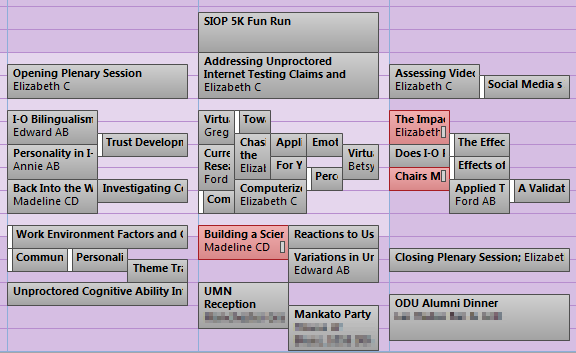
The first list contains symposia and interactive poster sessions. My sessions are bolded and highlighted in grey.
| No. | Day | Start | End | Session Title | Room | Session Type |
|---|---|---|---|---|---|---|
| 1 | 4/26/2012 | 8:30 AM | 10:00 AM | Opening Plenary Session | Elizabeth C | Special Events |
| 8 | 4/26/2012 | 10:30 AM | 12:00 PM | I-O Bilingualism: Do you Speak Technology? | Edward AB | Panel Discussion |
| 27 | 4/26/2012 | 12:00 PM | 1:30 PM | Personality in I-O: New Meta-Analytic Contributions to Unexamined, Neglected Issues | Annie AB | Symposium/Forum |
| 48-3 | 4/26/2012 | 1:30 PM | 2:30 PM | Investigating Conflict Escalation in FTF and Virtual Teamwork Over Time | America’s Cup AB | Poster |
| 59 | 4/26/2012 | 1:30 PM | 3:00 PM | Back Into the Web: New Directions in Applicant Attraction Research | Madeline CD | Symposium/Forum |
| 92 | 4/26/2012 | 5:00 PM | 6:00 PM | Theme Track: Scholarly Reflections on the Past, Present, and Future of Discrimination | Elizabeth H | Special Events |
| 98-16 | 4/26/2012 | 6:00 PM | 7:00 PM | Unproctored Cognitive Ability Internet Testing: Does Cheating Pay Off? | Elizabeth D | Poster |
| 102 | 4/27/2012 | 8:00 AM | 10:00 AM | Addressing Unproctored Internet Testing Claims and Fears: Founded or Unfounded? | Elizabeth C | Symposium/Forum |
| 134 | 4/27/2012 | 10:30 AM | 12:00 PM | Virtual Organizational Effectiveness | Gregory AB | Symposium/Forum |
| 138-4 | 4/27/2012 | 11:30 AM | 12:30 PM | Emoticons at Work: Does Gender Affect Their Acceptability? | America’s Cup AB | Poster |
| 138-3 | 4/27/2012 | 11:30 AM | 12:30 PM | Applicants’ and Recruiters’ Perceptions of Social-Networking Web Sites in Selection | America’s Cup AB | Poster |
| 140 | 4/27/2012 | 11:30 AM | 1:30 PM | Chasing the Tortoise: Zeno’s Paradox in Technology-Based Assessment | Elizabeth C | Symposium/Forum |
| 143 | 4/27/2012 | 12:00 PM | 1:30 PM | Virtual Teams: Exploring New Directions in Research and Practice | Betsy BC | Symposium/Forum |
| 153 | 4/27/2012 | 12:00 PM | 2:00 PM | Current Research in Advanced Assessment Technologies | Ford AB | Symposium/Forum |
| 158-4 | 4/27/2012 | 12:30 PM | 1:30 PM | For Your Eyes Only? Reactions to Internet-Based Multimedia SJTs | America’s Cup AB | Poster |
| 170 | 4/27/2012 | 1:30 PM | 3:00 PM | Computerized Adaptive Testing: A Primer on Benefits, Design, and Implementation | Elizabeth C | Master Tutorial |
| 181-3 | 4/27/2012 | 3:30 PM | 4:30 PM | Reactions to Using Social Networking Web Sites in Preemployment Screening | America’s Cup AB | Poster |
| 199 | 4/27/2012 | 3:30 PM | 5:00 PM | Building a Science of Learner Control in Training: Current Perspectives | Madeline CD | Symposium/Forum |
| 203 | 4/27/2012 | 4:30 PM | 6:00 PM | Variations in Unproctored Internet Testing: The Good, Bad, and Ideal | Edward AB | Panel Discussion |
| 229 | 4/28/2012 | 8:30 AM | 10:00 AM | Assessing Video Resumés: Valuable and/or Vulnerable to Biased Decision Making? | Elizabeth C | Symposium/Forum |
| 249 | 4/28/2012 | 10:30 AM | 12:00 PM | The Impact of Social Media on Work | Elizabeth H | Symposium/Forum |
| 294 | 4/28/2012 | 1:30 PM | 3:00 PM | Applied Technology: The I-O Psychologist as Customer | Ford AB | Symposium/Forum |
| 316 | 4/28/2012 | 4:30 PM | 5:30 PM | Closing Plenary Session | Elizabeth C | Special Events |
This second list contains posters that I will drop by if I have time.
| No. | Day | Start | End | Session Title |
|---|---|---|---|---|
| 23-21 | 4/26/2012 | 11:30 AM | 12:30 PM | Trust Development in Computer-Mediated Teams |
| 72-1 | 4/26/2012 | 3:30 PM | 4:30 PM | Work Environment Factors and Cyberloafing: A Follow-Up to Askew |
| 87-8 | 4/26/2012 | 4:30 PM | 5:30 PM | Communication in Virtual Teams: The Role of Emotional Intelligence |
| 87-13 | 4/26/2012 | 4:30 PM | 5:30 PM | Personality Predicts Acceptance of Electronic Performance Monitoring at Work |
| 123-3 | 4/27/2012 | 10:30 AM | 11:30 AM | Toward a Theory of Technology Embeddedness |
| 160-2 | 4/27/2012 | 1:00 PM | 2:00 PM | Perceptions of Internet Threats: Behavioral Intent to Click Again |
| 176-24 | 4/27/2012 | 2:00 PM | 3:00 PM | Commitment and Regulation in Web-Based Instruction |
| 234-29 | 4/28/2012 | 9:00 AM | 10:00 AM | Social Mediaâ€&™s Influence on Social Support, Efficacy, and Life Satisfaction |
| 258-12 | 4/28/2012 | 11:30 AM | 12:30 PM | The Effectiveness of Three Techniques for Detecting Faking |
| 278-32 | 4/28/2012 | 12:30 PM | 1:30 PM | Effects of Survey Progress Bars on Data Quality and Enjoyment |
| 284-1 | 4/28/2012 | 1:30 PM | 2:30 PM | A Validation Study of Tablet Use in a Medical Setting |
 A recent study by Giumetti et al1 examines cyber incivility, which is defined as low intensity “rude and discourteous” behavior that takes place through an internet or intranet-based communications system (e.g. e-mail, chat, or Facebook). They found that those reporting having experienced cyber incivility were more likely to skip work, burn out, and report their intention to look for a new job.
Incivility differs from traditional interpersonal organizational deviance in that it is less severe and more casual. While a person engaging in interpersonal deviance might steal their coworker’s stapler in order to annoy them, incivility might be expressed simply by that coworker making seemingly off-hand negative comments about their coworker’s workspace. Deviance is much easier to detect because it is generally obvious and with clear purpose; it is immediately clear that someone was acting inappropriately. Incivility, on the other hand, might be purposeful or it might not – it is difficult to know for sure, even for the victim.
As an example of cyber incivility, consider this scenario: a supervisor assigns work over the weekend to a subordinate. On Monday morning, the supervisor shoots off a quick e-mail that only says, “I hope you had a good weekend.” The subordinate is unclear on how to interpret this, as it might 1) be a half-hearted apology for assigning work over the weekend, 2) indicate that the supervisor didn’t remember or didn’t care about the extra work, or 3) represent the supervisor sarcastically rubbing in that s/he ruined the subordinates weekend. Thus, this is incivililty; the supervisor should not have sent the e-mail at all, or if it was not ill-intentioned, should have been more clear about the apology.
To examine their hypotheses, the authors collected surveys from two samples: 1) 407 university staff members and 2) 207 business school alumni. They modified a standard incivility questionnaire (the Workplace Incivility Scale) by adding the word “online” to the end of each statement. In addition to the effects of incivility on absenteeism, burnout, and intention to quit, the researchers also found these relationships to be moderated by neuroticism, i.e. the relationship between experienced incivility by a supervisor and burnout/intention to quit was stronger for people higher in neuroticism.
As a survey study, we can’t use this to conclude that supervisors acting rudely to their employees online causes these negative outcomes (it is equally plausible that there is a third variable predicting both), but it does explicitly link negative employee outcomes with the experience of a boss acting rudely online.
- Giumetti, G., McKibben, E., Hatfield, A., Schroeder, A., & Kowalski, R. (2012). Cyber Incivility @ Work: The New Age of Interpersonal Deviance Cyberpsychology, Behavior, and Social Networking, 15 (3), 148-154 DOI: 10.1089/cyber.2011.0336 [↩]