Valve Software is one of the videogaming industry’s most prominent and successful companies. It is responsible for some of videogaming’s most prominent games and game platforms, including Half-Life, Team Fortress, Counterstrike, Half-Life 2, Portal, and Left 4 Dead. They also run the enormously popular Steam digital game distribution system, which allows PC gamers to purchase and download traditional retail and indie games. The company has a reputation for innovation and creativity, which is quite far from the reputation of other major players in the videogame industry, like publishing behemoth Electronic Arts.
Last week, someone leaked the New Employee Handbook from Valve, and it provides a fascinating glimpse into the structure of this enormously popular company. Contrary to how many videogame developers are structured, Valve is almost a 100% flat organization, despite boasting nearly 300 employees. Here’s what the handbook says:
That’s why Valve is flat. It’s our shorthand way of saying that we don’t have any management, and nobody “reports to” anybody else. We do have a founder/president, but
even he isn’t your manager. This company is yours to steer—toward opportunities and away from risks. You have the power to green-light projects. You have the power to
ship products.
In many ways, it’s the job characteristics model at its logical conclusion: complete and absolute autonomy, variety, identity, significance, and feedback for every employee. Each employee decides the projects s/he will work on (autonomy). If they get bored with one project, they can instantly switch to another with no job-related consequences (variety). Each employee tries to gain support from coworkers to work on their personal projects (feedback), which then can be brought to fruition with sufficient effort (identity, significance).
Commentary among videogame blogs on this approach has been mixed, with some suggesting that this approach could never work with other companies. Outside of videogaming and other creative enterprises, that’s probably true. Videogame development is itself essentially a creative process. If a product doesn’t ship on time, the company may lose money, but it is unlikely to lose clients. Players will buy the game regardless of when it comes out, as long as it is of high quality. And quality is clearly a major objective at Valve. The attitude toward how employees spend their time is quite clear in this statement on what happens when employees make mistakes:
Screwing up is a great way to find out that your assumptions were wrong or that your model of the world was a little bit off. As long as you update your model and move forward with a better picture, you’re doing it right. Look for ways to test your beliefs. Never be afraid to run an experiment or to collect more data.
For Valve, spending more time is always justified if it means you’ll do a better job. A management system like this in a service organization could falter easily; imagine a project due for a client tomorrow only for your coworker to say, “I’ve decided to drop this project; you’ll need to find someone else.” In videogame development, this is still a roadblock, but it does not grind business to a halt.
One might think that this everyone-runs-the-organization kind of approach would be risky. And to some extent, that’s true – Valve even admits it:
So if every employee is autonomously making his or her own decisions, how is that not chaos? How does Valve make sure that the company is heading in the right direction? When everyone is sharing the steering wheel, it seems natural to fear that one of us is going to veer Valve’s car off the road.
The key to solving this problem is finding excellent people to work at your company. And this is clearly objective #1 at Valve:
Hiring well is the most important thing in the universe. Nothing else comes close. It’s more important than breathing. So when you’re working on hiring—participating in an interview loop or innovating in the general area of recruiting—everything else you could be doing is stupid and should be ignored!
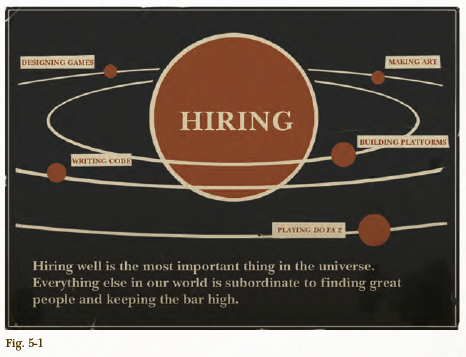
Importance of hiring at Valve, p. 43 of handbook
Valve goes so far as to encourage new employees to take part in the interview process immediately after they themselves were hired, so that they can get a better sense of the kind of traits valuable to success at Valve. The interview process is not explained in much detail, however the discussion makes it clear that it is structured and carefully thought out. The hiring process actually echoes some sentiments well-explored in I/O Psychology:
Hiring is fundamentally the same across all disciplines. There are not different sets of rules or criteria for engineers, artists, animators, and accountants. Some details are different—like, artists and writers show us some of their work before coming in for an interview. But the actual interview process is fundamentally the same no matter who we’re talking to.
The key at Valve, as in all good selection processes, it to identify qualified individuals who fit with the company. It also only hires the very best:
In these conditions, hiring someone who is at least capable seems (in the short term) to be smarter than not hiring anyone at all. But that’s actually a huge mistake. We can always bringon temporary/contract help to get us through tough spots, but we should never lower the hiring bar.
The company is 100% focused on recruiting and selecting a committed, high performing workforce. It keeps its selection ratio as low as possible – even if there is more work to do than there are employees – to ensure that the permanent employees it retains are excellent and unlikely to bring the company crashing down around them.
The third day had a good amount of coverage on technology-driven assessment. Our social media symposium was in the middle of the day, so there’s a little gap there. Wrap-up incoming soon!
| time | status | |
| 7:59 AM | NeoAcademic: SIOP 2012: Day 3 Live-Blog (http://t.co/2xu5rnwM) #siop12 | |
| 8:23 AM | Off to an 8:30AM session at #siop12 – really curious what attendance will look like! | |
| 8:42 AM | At Assessing video resums at #siop12 | |
| 8:50 AM | Extraction and narcissism predict attitudes toward video resumes, but not behavior #siop12 | |
| 9:04 AM | Ethnic minorities perceive video resumes as being more fair #siop12 | |
| 9:05 AM | Video resumes as being more fair than paper, but disappears when controlling for education (more education = paper more fair) #siop12 | |
| 9:07 AM | When applicant accent is strong in vid resumes, low prejudice reviewers rate job suitability much higher, not clear why #siop12 | |
| 9:12 AM | Self promotion in vid resumes may result in lower evaluation of applicant (less credible, more manipulative and annoying) #siop12 | |
| 9:18 AM | Men negatively view women in vid resumes when they engage in self promotion (violating gender norms) #siop12 | |
| 9:33 AM | Our #siop12 symposium on social media is coming up at 10:30 in Elizabeth H – come on by! | |
| 9:36 AM | @K_Anderson_Eval all vid resume presenters seem to indicate they are at the cutting edge, not much if any published work #siop12 #siop | |
| 10:38 AM | Nearly 100 people at our social media symposium in Elizabeth H! #siop12 http://t.co/MC6rYL8Y | |
| 12:13 PM | Ended up with over 125 attendees and a flood of questions! Running to next session on future of IO as an academic discipline #siop12 | |
| 12:24 PM | @budworth several touched on the idea in symposium 229 – I think you might want to contact Annemarie Hiemstra or Marie Waung #siop12 | |
| 12:31 PM | Some concern from panel about losing IO people to business schools, more career opps in business schools so more attractive #siop12 | |
| 1:36 PM | Saw fascinating poster on progress bars on web surveys – short answer: USE THEM; increases focus and enjoyment #siop12 | |
| 1:47 PM | At presentation on how to create homegrown tech for accomplishing IO objectives – sounds familiar! #siop12 | |
| 1:53 PM | People of any level of tech expertise can start learning tech skills useful to IO; Excel is good entry point #siop12 | |
| 2:16 PM | MTurk workers useful for small practitioner jobs – pay $.25 per response for pilot study work #siop12 | |
| 4:34 PM | Met with collaborators and now with several thousand psychologists to listen to talk by Albert Bandura #psychology #siop12 | |
| 4:38 PM | Bandura speaks! #siop12 #psychology http://t.co/ZXa6H2BL | |
| 4:49 PM | Interesting idea by Bandura: individuals as coauthors of action with environment and behavior #siop12 #psychology | |
| 7:35 PM | So ends #siop12 – safe travels everyone! | |
Today was busy, with our learner control symposium taking up most of the afternoon (hard to tweet while talking!).
| time | status |
| 5:36 AM | At 5AM, it’s much harder to see why registering for the #siop12 5K was a good idea…. Blegh |
| 7:49 AM | Did not beat Paul Sackett’s time (my goal) but still a respectable 31 mins for the #siop12 5K. Not bad for my 1st 5K! |
| 8:38 AM | NeoAcademic: SIOP 2012: Day 2 Live-Blog (http://t.co/oP3fAbly) #siop12 |
| 10:19 AM | Whew… Recovered from Fun Run, met with potential collaborators and finally SITTING to hear about virtual org effectiveness #siop12 |
| 10:38 AM | Apparently virtual teams perform better when members are isolated (fewer distractions) #siop12 |
| 11:09 AM | Media richness changes how leadership is expressed in virtual teams #siop12 |
| 11:34 AM | At Chasing the Tortoise: Zeno’s Paradox in Technology-based Assessment #siop12 |
| 11:40 AM | Tech moves forward as research moves forward to understand it; never ending cycle #siop12 |
| 11:46 AM | Org context/purpose is inflexible while specific user experience is flexible; so when implementing new tech, consider context first #siop12 |
| 12:08 PM | No practical diffs between mobile and non mobile assessment – unless candidates took it on Nintendo Wii #siop12 (weird) |
| 12:11 PM | Less than 1% of applicants used mobile devices to complete assessment in sample of 1 million #siop12 |
| 12:17 PM | Older adults more likely to take assessments on mobile devices; younguns prefer computers #siop12 |
| 12:20 PM | Personality tests don’t have diff scores, but cog ability scores do – mobile scores lower d=-.5 (non experimental study) #siop12 |
| 12:54 PM | Zickar on cyber vetting and looking up job applicants on Facebook: just don’t do it. #siop12 |
| 9:08 PM | Just had a great #siop12 dinner with our awesome ODU alums! |