Trust, Shared Values, Reputation of Online Reviewers Influence Purchase Decisions
 In a recent issue of Cyberpsychology, Behavior, and Social Networking, Chang and Hsiao1 tried to determine why people do or do not follow recommendations provided by social recommendation systems – think of reviews on Amazon.com. Researchers have already identified that, in general, people do pay attention to such recommendations. But what is left unanswered is why some people don’t.
The researchers decided that social exchange theory provided a valuable framework for investigating this issue. According to social exchange theory, people share information about themselves with others in order to obtain a variety of benefits from those people. For example, you might share an intimate story about yourself with another person in order to encourage a deeper friendship with that person, which should in turn grant you some sort of benefit (more time spent together doing fun things, greater reliance on that person in times of need, etc.). In the context of social recommendation systems, the researchers theorize that people share information for many of the same reasons.
When people respond to such sharing, several attributes of the relationship or person come into play before the exchange is completed. Namely, we make an evaluation of trust. For example, if someone shared an intimate story with you, you would have to evaluate if you believed that story to be true and that the sharer was making an honest overture of friendship. Two other factors influence this evaluation of trust: the reputation of the sharer and the extent to which you share the same values as that person.
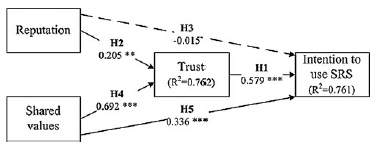 The researchers hypothesized that these three factors – reputation and shared values as mediated by trust – also play a role in intentions to follow social recommendation systems. They tested this by collecting 355 questionnaires from online forum members. After removing incomplete surveys, only 221 questionnaires were used for analyses. Path modeling was used to test hypotheses, as seen in the image to the right.
The primary limitation to this study, in my mind, is that path modeling was used instead of full structural equations modeling. As a result, the fit statistics were not stellar (for example, RMSEA was just a hair under .08, and the confidence interval would be quite wide, although this wasn’t reported). Mediations were also not tested explicitly, although they were included in the overall model. There’s no way to know the resulting changes on the model as a result of this from the reported results alone.
From their results, trust and shared values directly influence intentions to use the social recommendation system, while reputation acts only through the mediating effect on trust (although the overall effect here is somewhat small).
I believe this has important implications for any online system (for example, gamified instructional systems) where a designer is trying to encourage people to do something they wouldn’t normally do through learner testimonials. If they user doesn’t trust the recommender, they are unlikely to listen to their advice. But a more subtle finding emerges: we might be able to improve the likelihood that people believe online recommendations if we demonstrate the recommender shares values and beliefs with the reader. Some online recommendation systems already do this. For example, Newegg.com requires recommenders to present additional information about themselves, like computer expertise. Apparently, when someone is more like me, I am more likely to trust what they have to say (for better or worse!).
- Chang, T., & Hsiao, W. (2013). Factors Influencing Intentions to Use Social Recommender Systems: A Social Exchange Perspective Cyberpsychology, Behavior, and Social Networking DOI: 10.1089/cyber.2012.0278 [↩]
In a recent study appearing in Cyberpsychology, Behavior, and Social Networking, Moskaliuk, Bertram and Cress1 examined the value of virtual training environments for training effective coordination between ground police officers and a helicopter crew. This study thus applied virtual environments to one of the situations that I have previously argued is ideal for the application of virtual worlds: a training context where the outcome is highly complex and real-world training would be expensive and dangerous. In this case, in-person training would require helicopters! What better reason do you need to use a virtual world?
So did it work? Here’s the short version: the virtual world-based training was as effective as traditional (lecturer plus simulation) training in teaching the officers facts and information about the exercise. But more critically, officers completing the virtual training were better able to later apply what they learned to real situations. Thus, virtual environments were more effective than a traditional in-person simulation at teaching officers needed real-world skills. As suggested by Gardner’s most recent depiction of the hype cycle, it seems we are finally entering the Slope of Enlightenment for virtual worlds.
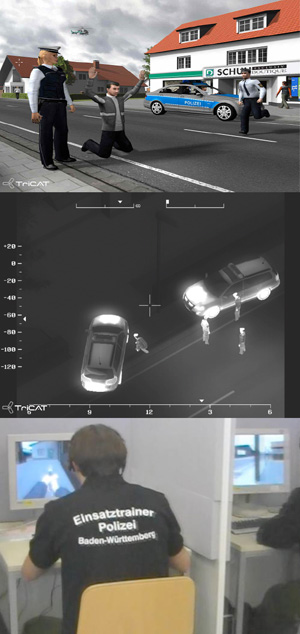 To test their hypotheses, the researchers assigned 47 German federal police officers to 8-person teams, which were in turn assigned to one of three conditions. Trainees all received in-person training on strategies and rules for the exercise followed by the treatment of their particular condition:
- Traditional training. Officers completed in-person training with a trainer, in which communication with the helicopter was simulated.
- Virtual training. Officers completed the VTE Police Force simulation while wearing headsets to communicate with each other (see images to the right).
- Control condition. Officers completed a distraction task (completed a group activity based on an unrelated handout).
In the spirit of the Kirkpatrick model, reactions, knowledge, and transfer were next measured. Reactions and learning were measured with surveys, while transfer was measured by evaluating written responses by officers to 11 video vignettes. Reaction outcomes were lower for traditional training; trainees did not feel like virtual training was as realistic or as applicable to real life in comparison to virtual training. Despite this, knowledge outcomes were similar between training conditions. 22% of the variance in transfer performance was explained by variance in conditions, with transfer from virtual training significantly higher than the traditional training and the control.
Overall, this provides compelling evidence that virtual worlds are a viable – and perhaps even preferable – setting for complex training tasks. The only negative outcome was the motivational component – although trainees had similar knowledge and superior transfer from virtual training, they felt like the traditional training was superior. But as Rachel Callan and I recently suggested, training targeted at increasing virtual world acceptance by trainees may be the solution to this one remaining barrier.
Note. Images in this blog post were taken from another paper by the authors2.
- Moskaliuk, J., Bertram, J., & Cress, U. (2013). Impact of Virtual Training Environments on the Acquisition and Transfer of Knowledge Cyberpsychology, Behavior, and Social Networking DOI: 10.1089/cyber.2012.0416 [↩]
- Moskaliuk, J., Bertram, J., & Cress, U. (2011). Training in virtual training environments: Connecting theory to practice. Connecting Computer-Supported Collaborative Learning to Policy and Practice: CSCL2011 Conference Proceeding, Vol 1., 192-199 [↩]
There has been quite a bit of hype about MOOCs lately. If you haven’t been following the craze – and it is definitely a craze, just as much as Big Data is – a MOOC is a Massively Open Online Course. I’ve written about them before – in this post, I provide a checklist to let instructors know if a MOOC can replace them. MOOCs are marked by several key features, at least as they are implemented now:
- Anyone can enroll in a MOOC. They are massively open in that anyone in the world can take the course for free.
- They are online courses. The only way to get information to the masses at a very low per-head cost is to do so online.
- They rely on peer involvement to facilitate. When taking a MOOC, you will almost certainly never meet, speak to, or email the instructor. Help for assignments is typically provided by other people in the class.
MOOC fervor is getting even more intense, with the New York Times declaring 2012 the year of the MOOC and some universities granting credit for completion of MOOC courses. It seems all is coming up roses for MOOC providers like edX and Coursera. Proponents of MOOCs have taken on a certain fervor, promoting the idea that MOOCs are the “solution” to college – that all students will one day be enrolled in single massive MOOC for each course they need, and the current-day idea of “college” will be rendered obsolete.
I say: not so fast. We heard similar rhetoric when online courses in general were introduced, and while many students do opt for online courses instead of in-person courses, most don’t. The predicted mass exodus of students from in-person classrooms to the glorious Internet did not happen. That’s because the in-person classroom still offers a lot of benefits that are difficult to provide online – at least, not without a lot of time and dedication on the part of the instructor.
In my research, I’ve even come across stories about the introduction of correspondence courses with the same sort of rhetoric as we see with MOOCs. Correspondence courses were presented as the solution to over-crowded classrooms, and a way to get more people to go to college who otherwise would not have. After all, why go to a college classroom when you can complete a course by mail? As it turns out – there are a lot of reasons. And there are a lot of reasons why you wouldn’t want to rely on MOOCs for your college education either.
I’ve noticed that proponents of MOOCs tend to not be in higher education. This is a critical problem of perspective. They make claims like, “We saw the Internet completely flip the music industry on its head; this must happen to higher education as well.” Because of this perspective, they make several assumptions that upon scrutiny turn out to be unwise.
- Given: MOOCs rely on automated grading to evaluate student progress.
Unwise assumption: If one class can be graded automatically, all classes can be graded automatically.Regardless of your personal stance on the value of grades for learning, they do provide a benchmark for progress (albeit an imperfect one). Universities use grades to rank student comprehension of course material; a student with an “A” should come out of a course with greater skill than student with a “B”. MOOCs can only grade questions where there is a single correct answer or where an algorithm can be used to derive all correct answers. That means algebra is easy to grade; architectural design is not. The most problematic area is writing. Although an algorithm can be used to automatically grade written material, those algorithms, on the whole, are awful. At best, they assess sentence structure, spelling, and complexity. They cannot evaluate if your writing made any sense, which is really the only aspect of the writing most instructors actually care about (except perhaps English instructors!). Artificial intelligence is not yet sophisticated enough to evaluate writing quality or logic, and it will probably be decades before we even start to be able to do this. Think of it this way: how long have we been trying to create accurate translation software that actually converts the meaning of one language into another as effectively as a human translator can? Hint: IT’S BEEN A LONG TIME.
- Given: MOOCs are effective at teaching basic skills that can be assessed automatically.
Unwise assumption: The skills that can be assessed automatically are the ones we want to teach at the college level.I completely agree that MOOCs can effectively replace some basic skills training currently taught in colleges (e.g. spelling and grammar, basic mathematics, etc.). But it does not follow that MOOCs can effectively replace all training currently taught in colleges. I will even go so far as to say that the introduction of MOOCs is an excellent opportunity for universities to do away with all those courses. Let me be clear: if course material can be taught and assessed effectively in a MOOC, it should probably no longer be a college course. It should be a required prerequisite before the student even gets to college. That way, time can be devoted in college to the skills that we actually want students to gain in a liberal arts environment: creativity, problem solving, and critical thinking. If a student is paying for college credits to learn how to add and subtract effectively, they are wasting their money on college after already having been failed by K12. We should not be spending instructional resources at the college level teaching these skills if a MOOC can deliver them equally effectively.
- Given: MOOCs will create a marketplace for learning skills without the need for degree programs. People can pick the knowledge they want to gain and gain only that.
Unwise assumption: Credentialing is not valuable.A common perspective is that MOOCs will make degrees obsolete – that somehow having a worldwide marketplace of courses that provide specific skills will be sufficient to prepare people for the careers they want. But this assumes that the credential – possession of a degree – does not provide useful information in that worldwide marketplace. But it does. Possession of a college degrees acts as a signal to potential employers: “This person was able to organize their schedule, choose a program of study, and stick to it for multiple years at a sufficient degree of success for this institution to proclaim that they have earned a degree and for us to support that proclamation.” This is why people have judgments about the quality of college someone attends – there is a belief that a more rigorous college will provide a more rigorous education, and the degree signals that. While I agree that many employers put a little too much faith in what those degrees imply, this doesn’t mean that the degrees themselves are useless. Let’s not throw the baby out with the bathwater. A college degree indicates a substantial multi-year commitment and a major life accomplishment for the degree holder. Let’s not minimize that accomplishment by saying that taking a selection of MOOC courses would be equally impressive. Also important is that college exposes students to a much wider range of knowledge than they would otherwise be exposed to in high school. I’ve had many students who took my Industrial/Organizational Psychology course to fulfill a requirement only to discover that they had a real passion for the topic. Without a broad liberal arts education, they would never have discovered this about themselves. In a MOOC-centered world, those students would never have known that passion.
- Given: MOOCs rely on discussion forums to facilitate learning.
Unwise assumption: Discussion forums can effectively police themselves.One of the biggest challenges for an online instructor is managing a discussion forum. Forums are used as a constructivist instructional strategy: the goal is for the students to actively think through the material, apply it to their own lives, and be able to explain their application of class concepts to others. There are generally two ways such forums go. First version: the instructor makes some regular assignments to “post in the discussion forum” or “reply to another student in the discussion once per week”. A MOOC can do this too. But these strategies rarely work very well; students do the bare minimum, usually resulting in a flood of posts the day that the assignment is due, and rarely do students demonstrate the application skills described above. Second version: the instructor is an active participant in discussion, working to correct misconceptions, redirect conversations in productive directions, and generally applies their expertise to improve student engagement with the material. The current sophistication level of artificial intelligence means that a MOOC cannot do this. They must rely instead on the “wisdom of the crowd” – that a critical mass of other people in the classroom will 1) be interested in helping others, 2) have sufficient expertise to answer the question being asked and 3) happen to browse the forum at the moment a response is needed. While this might work for a relatively common learning topic (like Introductory Algebra), when we get to relatively uncommon fields (like Advanced Organic Chemistry), those numbers are going to drop dramatically.
- Given: MOOCs rely on the support of others currently taking the course to provide the social context for a course.
Unwise assumption: Individual attention from a mentor/leader figure is unnecessary for effective learning.Unfortunately, some college courses are taught by instructors that don’t really care about their students. They are there because their are required to be there, riding the tenure train for the long-haul. But this is not the norm in most universities. Most faculty care deeply about the success and learning of their students individually – they want every student to succeed. A common misconception is that faculty want students to fail. This is simply not true. Instructors want students to strive and push themselves. Instructors want to provide a sufficiently challenging course so that the most advanced students need to push themselves just as much as the struggling students do. This is realized in a variety of ways. Some provide a plethora of comments on student papers with the hopes that those students will read those comments and think about how they can improve for next time. Some instructors schedule one-on-one meetings to talk about course progress and identify areas needing extra attention. Some instructors schedule review days and feel out the classroom for areas of weak understanding so that they can target those areas with supplemental materials. None of these things are currently possible with a MOOC, and all are valuable. Little is more motivating than one-on-one attention, delivered by a mentor/leader figure that you know cares about you and your success. In a MOOC, you are surrounded by other learners, and yet you are all alone.
In summary, I think MOOCs are an important development for higher education, but they are not poised to majorly reform anything. At best, they can supplement and bolster existing efforts by replacing remedial and entry level courses, leaving the more advanced topics for the traditional college classroom, online or otherwise. As MOOCs improve, this may change – but for now, this is the best they can provide.