 Textual harassment, which is sexual harassment occurring via social media, is on the rise and potentially a nightmare for human resources professionals. In traditional sexual harassment, human resource professionals can generally assume that the harassment they are concerned with takes place within the boundaries of the office. However, just as social media blur the line between “work” and “not work”, textual harassment blurs the responsibilities of HR regarding sexual harassment. If an employee makes a comment that is perceived as harassing via social media to another employee, is it the organization’s responsibility to act?
In an upcoming issue of Academy of Management Perspectives, Mainiero and Jones1 explore the various research literatures related to textual harassment. It is a complex problem with many grey areas and ambiguities, as illustrated in this quote:
If a coworker admires an employee’s new dress while at work, that coworker can read tone and body language and politely say thanks. However, a late night text message from a colleague’s personal account about a new dress takes on a much more lascivious tone, even if that is not the intention.
In their article, the authors focus on textual harassment within the context of workplace relationships, where matters become even more murky. The authors explore the issues from three perspectives:
- Workplace surveys reveal that workplace romances are very common. In one study, more than 33% employees reported finding love in the workplace, and 66% of those employees revealed their relationship to coworkers and/or bosses. However, 6% of employees revealed that they had left a job due to such a romance. The biggest challenge for HR in workplace romances is determining if the relationship is ethical (e.g. one employee should not be in a position of power over another, or be able to show favoritism in decision-making). 38% of employees reported that they believed coworkers to gain advantages due to relationships and 31% of employees were uncomfortable with this. Social media is a relatively common way for such romances to take place, especially Millennials.
- Sexual harassment after a workplace romance is more common. And social media makes HR’s responsibilities unclear when such relationship go bad. Consider this vignette shared by the authors:
Consider the following social media contemporary romance scenario: a woman meets a man at work in her same department. She texts him for a drink after work; he complies. They embark on a romance that lasts three months. He complains that she expects him to do her work for her. She complains that he is too clingy. They part ways, initially amicably, but he continues to text her at work during the day with sexting-related comments about her legs, how her clothing moves as she walks down the hallway, and other intimate details of their past relationship. But in business meetings he is all business and so is she. Outside the office, she blocks him from her Facebook page, yet he still has memorized her cell phone number and continues to bother her during the day and evening hours. He checks her whereabouts on Foursquare. She mentions to him that she does not want him to continue to IM her or follow her on Twitter; he refuses to comply with her request. At work, they are assigned a similar departmental project that requires frequent meetings. They retain a LinkedIn association as colleagues.
At present, this remains a murky grey area, although several major textual harassment cases are pending.
- Sexual harassment policies are outdated given this new technology. Social media, and its dramatic effect on interpersonal behavior at work, has triggered a sudden re-examination of sexual harassment policies. Such policies are usually driven by state-mandated requirements, but these requirements are often themselves formed as a reaction to legal challenges and public opinion, which are not currently very stable. Right now, there are no right answers.
The authors conclude from these perspectives that right now, corporations have a responsibility to say “harassment is harassment”, whether it is public or private, and whether it involves personal or corporate resources. This is certainly the safest route. However, the authors also recognize that there are threats to privacy inherent to this view. They also note that workplace romances can be quite positive for everyone involved (the romantic partners and the organization), so prohibiting such relationships is not a reasonable solution.
They suggest implementation of the fabulously labeled love contract, an agreement asking employees entering into a romance to formally report that they are doing so voluntarily (this reminds me a bit of Futurama’s Form B: Notice of Romantic Entanglement, which is filed – where else – at the Central Bureaucracy).
Finally, they suggest that firms implement two types of policy: 1) a proactive policy including discussion of all of these issues in sexual harassment training and 2) a reactive policy explaining the precise procedures for resolving such situations when social media is involved.
While this certainly won’t solve all the problems introduced by new technologies, the authors provide a reasonable first step toward clarifying the role of HR in this brave, new world of social media and romance.
- Mainiero, L., & Jones, K. (2013). Sexual Harassment Versus Workplace Romance: Social Media Spillover and Textual Harassment in the Workplace Academy of Management Perspectives DOI: 10.5465/amp.2012.0031 [↩]
Recently, there was a brief discussion about online Ph.D. psychology programs on the PSYTEACH listserv. Generally, it was met with disbelief that an online psychology doctoral degree could be rigorous for a variety of reasons – a lack of teaching experience, a lack of lab experience, and a lack of face-to-face interaction with faculty and other students, to name a few.
I think it’s important to recognize that online doctoral programs as they exist now and online doctoral programs as they could exist, even given current technology, are very different. We currently have the technology available to have the traditionally rigorous, intensive doctoral experience for most students – I just don’t know of any programs that actually do so now. There are several online Psy.D. programs, but requirements for such programs are not as intense, as the degree is practice-oriented – the requirements for a Ph.D. program are more stringent.
So as a thought experiment, I decided to map traditional Ph.D. student experiences onto the technologies and program structure that would be required to realize that program online effectively. In doing so, I came up with five dimensions – the three traditional components of academic performance (teaching, research, and service) plus an instructional component and a community component. I’ll discuss each in turn.
- Teaching Experience.
- Challenge. In a traditional Ph.D. program, students often (although not always) gain teaching experience by being assigned as teaching assistants (TAs), lab/section leaders, and full-blown instructors. Many schools use a ramp-up program such that earlier students (1st and 2nd year, for example) are TAs or lab leaders, and after proving themselves in that role (or after getting their MA/MS), move up to teach their own courses. If students wish to gain experience in online courses, they sometimes have that freedom; in an in-person program, one can teach in-person or online courses. In an online program, students can still certainly work as TAs or instructors of online courses, but since there are no in-person classes, they cannot gain experience teaching one.
- Roadmap. The dirty secret that no one wants to admit to is that, to a certain degree, teaching is teaching. If you look at programs designed to assess the quality of online courses, you’ll find that what makes a high quality course online is very similar to what makes a high quality course in person. For example, Quality Matters is a “certification” program designed to assess such quality. Here are the dimensions it uses to make evaluations: inclusion of a course overview and introduction, statement of learning objectives, appropriate assessment strategies, informative instructional materials, tools to encourage interaction and engagement with and between students, appropriate use of technology, support for learners, and accessibility. On its own, this list could apply to either an in-person or an online course. The reason that online courses are often lower quality is that, for the instructor, it is often more difficult to realize these goals online. In an in-person course, I can split people into small groups to discuss a difficult question; online, I need to adequately plan ahead to set up a discussion area, ensure it’s communicated to everyone appropriately, identify any technology roadblocks and proactively work to circumvent them, and then monitor the discussion over a long period of time. If they are different, teaching online is more difficult than teaching in person. It requires most of the same skills and then several additional technology skills. Where online teaching is less difficult for the instructor is the face-to-face interaction component. You don’t need to be “on”, excited and engaged at 8AM. You don’t need to learn to watch and interpret subtle facial cues that indicate students don’t quite grasp the concept you are discussing. But this is a relatively minor aspect of teaching, in the grand scheme of required skills.
- Ideal Solution. Given that teaching online is more difficult than teaching in-person except in terms of interpersonal interaction, the ideal online Ph.D. program would have the Ph.D. student start as an online TA and move to online instruction. After “proving” themselves online, the Ph.D. student should teach as an adjunct professor at local universities or community colleges, and the online university should cover the host university’s salary requirements. For example, if the student’s local institution pays $3000 for an adjunct to teach a class, the online university should pay $3000 to the student to teach on behalf of the host institution.
- Research Experience
- Challenge. In a traditional Ph.D program, students gain research experience by actively designing, running, analyzing, interpreting, and writing up research studies. Most of these experiences involve working closely with an academic adviser who creates these studies and runs them. Such studies are often run by Ph.D. student in in-person laboratories, which require direct oversight of research participants.
- Roadmap. In truth, a lot of research in psychology these days is conducted through online surveys. This would be ideal for an online Ph.D. student, requiring few special accommodations. Much research (my own included) incorporates experimental designs but does so online – for example, assigning different research participants to different stimulus materials and measuring outcomes through a follow-up survey. For research that is in-person and experimental in nature, requiring fine timings or specialized equipment, there is currently no easy (or more critically, valid) way to conduct such studies online.
- Ideal Solution. For Ph.D. programs that absolutely require in-person experience or equipment (e.g. if an fMRI must be used, or if clinical populations must be interacted with, etc.), such programs should not have online programs without partnerships with universities local to the student. Ideally, a network of such inter-relationships between universities could be established to facilitate this, but I don’t see this happening any time soon. If a program relies primarily on survey research, Skype or other videoconferencing software can be used to interact with the adviser and with the various necessary committees (e.g. dissertation committees). Research experiences must be integrated as of the first year of study. I can’t even count the number of times I’ve seen students in online Ph.D. programs asking for advice on LinkedIn or on Listservs on how to design studies or conduct analyses for their dissertations because it was the first time they ever had to conduct a research study in their entire graduate program. This is not acceptable. A Ph.D. program must incorporate research from Day 1. Perhaps most critically, universities must keep the student-to-faculty-adviser ratios similar to that of in-person classes (for Ph.D. students, I’d characterize 8 advisees per faculty member as a large program; ideally, this would be in the 3-6 area). The workload is no lower for faculty, and for quality standards to remain high, a high degree of individual attention is critical.
- Service Experience
- Challenge. Graduate school often brings with it a myriad of service opportunities. In my graduate school experience, this included things like hosting students for welcome/interview weekend, running a student group, organizing brownbags, and so on. This communicates the shared mental model of academia to students: everyone pitches in a little bit to get things done, and so that everyone’s voice is heard.
- Roadmap. In an online environment, there is no reason that service opportunities would be lessened. For example, there should be an online student association that organizes online brownbags through Skype or Google Hangouts. A leading scholar could give a talk, with individual live cameras on every other student, all organized by a team of online students. Students could take turns manning the live video “Q&A” area during the official day set aside for interviews of upcoming graduate students. The opportunities to pitch in are endless for a motivated student.
- Ideal Solution. Of the five dimensions I’ve listed here, service is probably the easiest. It only requires a faculty willing to be creative and open-minded about the activities that students take part in. At a minimum, students should run their own graduate student association and hold regular online events.
- Instruction/Learning
- Challenge. One of the most difficult aspects of teaching graduate students is the actual act of teaching. It is generally not effective to teach Ph.D. students the same way you teach undergraduates. With undergraduates, there’s a certain amount of memorization required (e.g. who were the important figures in the development of psychology?), with deeper understanding lightly layered on top of that memorization. If students came out of my I/O Psychology class able to tell me the major functions of I/O, the important controversies surrounding those functions, and be able to apply some of the principles to their own workplaces, I would be thrilled. At the Ph.D. level, the requirements are much more intense. Not only must Ph.D. students be able to tell you about the controversies, but they must also be able to propose research studies to solve the problems that those principles introduce. They must be able to read and critically evaluate a research literature for gaps and limitations. These are skills that are not transferred easily in lecture, which is why most Ph.D. programs make heavy use of seminars (for content courses) and labs (for statistics courses).
- Roadmap. Recently, my department floated the idea of taking online Master’s students without disrupting pre-existing graduate courses. The biggest challenge in this idea is the integration – having in-person and online students in classes concurrently. But I am confident it is possible. For example, a computer could be set up with Google Hangouts (so that each attending online student would be visible with a webcam on that computer), and that computer could be wheeled into each class where online students are needed to participate. These systems are actually quite easy to use; when someone starts talking, the focal video window switches to that person so that you can see them full-screen. To the instructor, a window would appear with a person’s face whenever they wanted to ask a question; it would only require turning their head and talking to the camera to talk to that student. Intense, interpersonally-oriented seminars are possible and even simple once set up given current video technology. This is no longer a limitation of online. If the in-person component is not required, it gets even easier; instead of rolling a computer in, everyone in the class (professor included) can see each other face-to-face with video streaming.
- Ideal Solution. The university’s IT group should invest in a high-reliability high-quality small group video streaming technology. One example is Cisco Jabber. For blended classrooms (with both in-person and online students), a mobile computer should be set up that can be transported from classroom to classroom as needed. Real-time instant support must be provided for the technology to both faculty and students. Class sizes should be kept under 10 for most topics; exceptions might include some “core” courses, like various statistics courses, research fundamentals, and proposal-writing courses.
- Community Participation
- Challenge. Perhaps the most subtle indirect benefit to attending an in-person institution is immersion within the academic community. When you walk to class, you run into professors who may stop you in the hall to chat. When you conduct research, you interact with faculty to get your IRB approvals, to work within the departmental subject pool, and attend research talks. When you conduct service, you are working directly to the benefit of other graduate students and faculty within your department, college, or university. All of these activities teach you to be part of a larger scholarly community. In many online programs, this sense of community is missing.
- Roadmap. To this point, psychology faculty have been lucky in terms of community. By bringing in a graduate student, that student will be exposed to the local scholarly community by default. It requires little or no extra work on part of the faculty. Online, this is not true. Community must be actively built. Videoconferencing is perhaps the most cost effective way to do this. For example, lab meetings could be held weekly or biweekly through videoconferencing to encourage people to make such connections. But this alone is probably not enough to provide a real sense of community.
- Ideal Solution. To build community, I recommend a multi-pronged approach. First, videoconferencing should be used within lab groups to encourage small-scale community. Second, a student association with regular meetings should be established and run by the students themselves. Third, regular online brownbags should be established with a technology enabling both participant-to-participant and participant-to-presenter interaction. Fourth, students should be required to attend one conference per year (probably APA), where a hospitality suite would be rented by the online institution to enable everyone to meet face-to-face at least once per year. Preferably, these events would be broken down further to give ample opportunities for labs to meet together as well. Fifth, a regular retreat should be held once per year at a physical location outside of the context of a conference for two to three days, to enable long-term planning among labs and conduct teambuilding exercises more broadly.
So as you can hopefully see, what I would consider a high-quality rigorous online psychology Ph.D. program would require quite a great deal of effort on the part of a department chair and likely several committees. It is not something that can be started lightly, or else your program will end up with the reputation of current online Psychology programs, which is frankly pretty terrible. And that doesn’t serve anyone well, faculty or students. While I’d love to see or develop such a program, I doubt we will see anyone willing to make the sort of investment required to realize such a program for many years – which is a shame, because many high-quality students that can’t move (for whatever reason; typically family-related) currently have no way to complete a Psychology Ph.D. And that is something we should try our best to correct.
In a recent issue of the Journal of Virtual Worlds Research, Landers and Callan1 examine appropriate evaluation of learning taking place in virtual worlds (VWs) and other 3D environments. In doing so, they develop a new model of training evaluation specific to the virtual world context, integrating several classic training evaluation models and research on trainee reactions to technology. The publication of this model is critical because 1) much previous research in this area does not consider the antecedents of learning in this context, leading researchers to conclude that VW-based training is ineffective in comparison to traditional training when the opposite may be true and 2) organizations/educators often implement VWs unsuccessfully and blame the VW for this failure when subtler contextual factors are likely to blame, which may help explain the virtual worlds bubble, which I discussed a few years ago. Considering VWs are appearing in research as viable alternatives to traditional, expensive, simulation-based training, the time for VWs may be at hand. The model exploring these issues appears below.
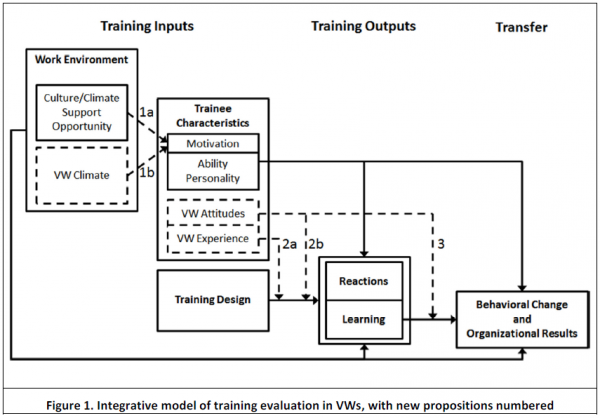
Though framed in terms of organizational outcomes, their model of evaluation could be equally valuable in educational settings. From their integration, the authors make five practical recommendations to those attempting such evaluation (from p. 15, with citations removed):
- All four outcomes of interest should be assessed if feasible: reactions, learning, behavioral change, and organizational results. This will provide a complete picture of the effect of any training program.
- Attitudes towards VWs, experience with VWs, and VW climate should be measured before training begins, and preferably before training is designed. This will give the training designer or researcher perspective on what might influence the effectiveness of their training program before even beginning. If learners have negative attitudes towards VWs, training targeted at improving those attitudes should be implemented before VW-based training begins. Without doing so, the designer risks the presence of an unmeasured moderation effect that could undermine their success. Even if attitudes are neutral or somewhat positive, attitude training may improve outcomes further.
- If comparing VW-based and traditional training across multiple groups, take care to measure and compare personality, ability, and motivation to learn between groups. Independent-samples t-tests or one-way ANOVA can be used for this purpose.
- Consider the organizational context to ensure that no macro-organizational antecedents (like VW climate) are impacting observed effectiveness. Measure these well ahead of training, if feasible.
- Provide sufficient VW navigational training such that trainees report they are comfortable navigating and communicating in VWs before training begins. A VW experience measure or a focus group can be used for this purpose.
For more detail on how to go about such evaluation, this article is freely available (“open access”) to the public at the Journal of Virtual Worlds Research website.
- Landers, R.N., & Callan, R.C. (2012). Training evaluation in virtual worlds: Development of a model Journal of Virtual Worlds Research, 5 (3) Other: http://journals.tdl.org/jvwr/index.php/jvwr/article/view/6335 [↩]