SIOP 2013 Coverage: Schedule Planning | Day 1 | Day 2 | Day 3
SIOP 2013 has begun, and Day 1 was a fascinating set of presentations. The day starting with the opening plenary by SIOP President Doug Reynolds, talking about Big Data and I/O Psychology’s role in it. For some reason, we are not leading the way, despite our expertise being in synthesizing, analyzing and interpreting massive datasets about behavior and personal characteristics. Sounds like it would be a happy marriage to me!
The biggest difference I noticed today in comparison to last year was the massive number of presentations on social media and mobile assessment. Mobile assessment presentations seem to focus on the apparent equivalence of computer-based and mobile-based assessment, but I’ve been seeing some results contradictory to that… so more research is clearly needed. Social media research is progressing, but I heard “we don’t have data” way more times than I can even count. If you don’t have data, why are you presenting at SIOP? This is a data-hungry crowd! Perhaps the most disappointing was the session on “Empirical Evidence” for social media, but where only one presentation had any real data to speak of. I was hopeful though.
Day 1 was actually my lightest day, and I had a couple of time slots that were not scheduled. No worries – just walk 10 feet at SIOP and you’ll run into someone you know. The disadvantage is that it takes an hour to get from one side of the conference hotel to the other!
I also sat in a presentation where “Millenials” were predicted to be dramatically different from everyone else. Surprise! I hate such conclusions – Millenials are a diverse bunch, like every other generation. And I don’t say that just because I’m a Millenial.
Evening activities went pretty late into the night… but it’s SIOP… so that’s just what happens. Totally worth it. Day 2 summary tomorrow!
Archive of Day 1 Twitter posts follows:
| 13:38 | I wonder if this is the first #siop with a 2-minute silence for award winners… #siop13 |
| 13:48 | So many #siop13 awards… where is the award for “best tweet”? |
| 13:56 | Production values have gone up a bit for #siop13 fellow announcements. The muzak is an… interesting touch. |
| 14:07 | RT @fanseel: Very proud of my #ugent colleague Filip Lievens being awarded fellowship by Society for Ind&Org Psychology #SIOP13 http … |
| 14:10 | Who has made the biggest impact on your professional development? Donate to #siop in their honor #siop13 http://t.co/1qyjQJeRes |
| 14:21 | Quite the risqué exposé on SIOP President Doug Reynolds from Tammy Allen #siop13 |
| 14:33 | Will this address on #siop branding effect change differently than the last several years of addresses on branding? #SIOP13 |
| 14:38 | @sioptweets #SIOP13 is the official SIOP hashtag, right? Or did we switch back to #siop2013 this year? |
| 14:39 | @ChrisWieseIO I prefer #siop = “scientist-practitioners who care about both” #siop13 |
| 14:43 | Doug Reynolds saying we are behind on Big Data… But we’ve been doing a lot of this for years, just didn’t call it “Big Data” #siop13 |
| 14:57 | @jsnread Thought so! Saw folks using #siop2013 instead of #siop13 and wanted to be sure. Last year was #siop12, didn’t think it would change |
| 14:58 | With the closing of the opening plenary, #SIOP13 has officially begun! First stop coffee and scones? |
| 16:20 | @neilmorelli Which presentation is this from? We have contradictory results. |
| 16:21 | At community of interest on virtual work #SIOP13 |
| 16:45 | RT @ftcniek: JAP editor Kozlowski in panel session on causality: “I do not send out cross-sectional self-report studies to reviewers” #s … |
| 18:01 | Andalocua tapas bar near the conference hotel highly recommended! #siop13 |
| 19:45 | It’s always 3 simultaneous sessions I want to attend or zero #siop13 |
| 20:35 | In state of social media symposium #siop13 |
| 20:52 | #siop13 symposium on social media so far: lots of ideas, not much data, not many specifics |
| 21:01 | Most common statement about social media in Schmit’s talk: “we don’t have much research” #siop13 |
| 21:05 | 43% of orgs ban social network sites on their networks according to SHRM survey; guess no one thought about smartphones #siop13 |
| 21:22 | Most states prohibit using lawful off-work activity to make hiring decisions; probably includes Facebook photos of drinking, smoking #siop13 |
| 21:29 | @ChrisWieseIO Agreed. Perhaps a new Journal of Social Media in Organizations? #siop13 |
| 21:44 | Getting the impression that the speakers in this social media session don’t know what time it is set to end #siop13 |
| 21:52 | Third speaker just started, 2 mins after end of session… Uh oh #siop13 |
| 22:01 | Now at Empirical Evidence for social media, so hopefully more hard evidence in this one! #siop13 |
| 22:03 | Not going to be “a lot of numbers”, uh oh again #siop13 |
| 22:04 | I do support a new hashtag for common use at #siop13 suggested by speaker: #thispresentationisawesome |
| 22:11 | @fanseel So it seems. He has a theory though. Just didn’t test it in his study. Not sure why. |
| 22:14 | @fanseel Ha, yes exactly! |
| 22:23 | Millennial job applicants usually use combination of social media and websites to investigate orgs, but some use social media alone #siop13 |
| 22:28 | 21% of youths felt it inappropriate that the military use social media for recruiting #siop13 |
| 22:30 | @DrDavidBallard I know of precisely 2 studies… I’m not sure if she found anything else in her SHRM-funded review! #siop13 |
| 22:53 | Day 1 of sessions wrapped up! Now hours and hours of socializing and networking until passing out and doing it again tomorrow #siop13 |
SIOP 2013 Coverage: Schedule Planning | Day 1 | Day 2 | Day 3
As in 2010 and 2011 and 2012, I’ll be live-blogging the SIOP conference, which begins Thursday, April 11 and runs through Saturday, April 13. This post contains a list of all the sessions that I interested in attending, which are generally focused on technology, training, and assessment. Barring any unexpected battery problems, my live blogging will be on Twitter, with a permanent record stored here.
In the graphic below, the symposium that I presenting in is colored red. As you can see, it’s a bit packed, so I won’t be attending all of these, but this is everything I’m interested in. If you’d like to meet up at any of these events, or if you think I missed something that I should definitely attend, please let me know!
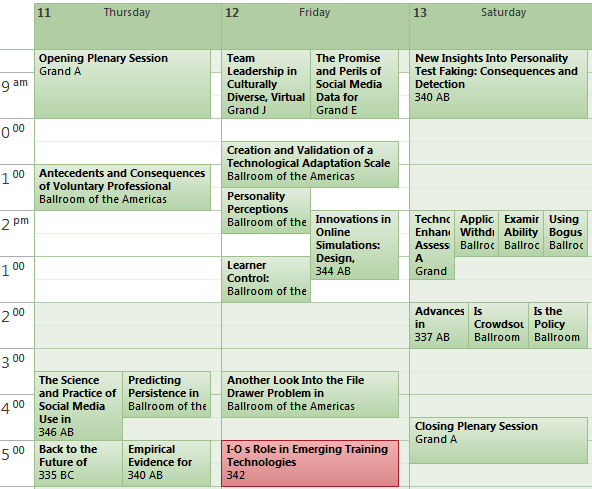
| No. | Day | Start | End | Session Title | Room | Session Type |
|---|---|---|---|---|---|---|
| 1 | 4/11 | 8:30 | 10:00 | Opening Plenary Session | Grand A | Special Events |
| 16-16 | 4/11 | 11:00 | 12:00 | Antecedents and Consequences of Voluntary Professional Developmentong STEM Majors | Ballroom | Poster |
| 75 | 4/11 | 3:30 | 5:00 | The Science and Practice of Social Media Use in Organizations | 346 AB | Master Tutorial |
| 76-9 | 4/11 | 3:30 | 4:30 | Predicting Persistence in Science, Technology, Engineering, and Math Fields | Ballroom | Poster |
| 89 | 4/11 | 5:00 | 6:00 | Back to the Future of Technology-Enhanced I-O Practice | 335 BC | Panel Discussion |
| 91 | 4/11 | 5:00 | 6:00 | Empirical Evidence for Successfully Using Social Media in Organizations | 340 AB | Symposium |
| 110 | 4/12 | 8:30 | 10:00 | The Promise and Perils of Social Media Data for Selection | Grand E | Symposium |
| 114 | 4/12 | 8:30 | 10:00 | Team Leadership in Culturally Diverse, Virtual Environments | Grand J | Symposium |
| 127-18 | 4/12 | 10:30 | 11:30 | Creation and Validation of a Technological Adaptation Scale | Ballroom | Poster |
| 138-32 | 4/12 | 11:30 | 12:30 | Personality Perceptions Based on Social Networking Sites | Ballroom | Poster |
| 148 | 4/12 | 12:00 | 1:30 | Innovations in Online Simulations: Design, Assessment, and Scoring Issues | 344 AB | Symposium |
| 159-22 | 4/12 | 1:00 | 2:00 | Learner Control: Individual Differences, Control Perceptions, and Control Usage | Ballroom | Poster |
| 188-22 | 4/12 | 3:30 | 4:30 | Another Look Into the File Drawer Problem in Meta-Analysis | Ballroom | Poster |
| 206 | 4/12 | 5:00 | 6:00 | I-O’s Role in Emerging Training Technologies | 342 | Symposium |
| 225 | 4/13 | 8:30 | 10:00 | New Insights Into Personality Test Faking: Consequences and Detection | 340 AB | Symposium |
| 274-27 | 4/13 | 12:00 | 1:00 | Using Bogus Items to Detect Faking in Service Jobs | Ballroom | Poster |
| 274-1 | 4/13 | 12:00 | 1:00 | Examining Ability to Fake and Test-Taker Goals in Personality Assessments | Ballroom | Poster |
| 274-13 | 4/13 | 12:00 | 1:00 | Applicant Withdrawal for Online Testing: Investigating Personality Differences | Ballroom | Poster |
| 280 | 4/13 | 12:00 | 1:30 | Technology Enhanced Assessments, A Measurement Odyssey | Grand F | Symposium |
| 305 | 4/13 | 2:00 | 3:00 | Advances in Technology-Based Innovative Item Types: Practical Considerations for Implementation | 337 AB | Symposium |
| 306-12 | 4/13 | 2:00 | 3:00 | Is Crowdsourcing Worthwhile? Measurement Equivalence Across Data Collection Techniques | Ballroom | Poster |
| 306-21 | 4/13 | 2:00 | 3:00 | Is the Policy Capturing Technique Resistant to Response Distortion? | Ballroom | Poster |
| 316 | 4/13 | 4:30 | 5:30 | Closing Plenary Session | Grand A | Special Events |
 Most academic research on video games studies them as single player experiences – a single individual, alone in a room with a game console. Study on massively multiplayer online games (MMOGs) is also growing. However, much (and perhaps most) video game play in the modern day is multiplayer in a smaller setting: or at home in front of a Kinect or a Wii with two or three friends. Surprisingly little research has examined this context.
In a recent issue of Cyberpsychology, Behavior and Social Newtorking, Peng and Crouse1 compared enjoyment, future play motivation and physical intensity on XBOX 360 game Kinect Adventures between single player, cooperative multiplayer and competitive multiplayer modes, finding that competitive multiplayer provided the greatest enjoyment, motivation to play in the future, and physical activity.
The highly physical core game mechanic is best described by the authors:
This game utilized the Kinect motion camera, and the players used their own bodies as the controller to pop soap bubbles that floated between holes on the walls, floors, and ceilings of a virtual zero-gravity room by moving forward, backward, left, and right and waving their arms.
These three conditions were more complex than they appear:
- In the single player condition, participants played alone, twice. In this way, they were competing with their pre-test score.
- In the cooperative mutliplayer condition, participants brought a friend. After individual pre-tests, the two participants next played the game with each other (they were physically active in the same space simultaneously and their scores were combined).
- In the competitive multiplayer condition, participants brought a friend. After individual pre-tests, the two participants then played the game separately (in different rooms) and were told what their friend’s previous high score was on the pre-test.
After the game, participants completed the focal measures. Enjoyment was assessed with a 7-item scale asking them to rate the game on seven adjectives (including “boring,” “entertaining,” and “interesting”). Future play intention was rated on a 3-item scale asking questions like, “Given the chance, I would play this game in my free time.” Physical activity was captured with an accelerometer attached to each player.
162 students participated in the study; however, this seems to include the friend counts. Sample sizes were 26 for single player, 74 for cooperative play and 52 for competitive play. Given that their analytic strategy was a simple ANOVA, it does not seem that the researchers appropriately controlled for covariance between friend pairs – a better strategy would have been to have not included the “friend” in analysis, however this would have dropped their apparent (although misleading) reported sample size.
Based upon the reported ANOVA, several were statistically significant. Single player enjoyment was lower than cooperative and competitive multiplayer modes. Future play motivation after playing alone was lower than both cooperative and competitive mutliplayer modes. For physical activity, the relationship was more complicated. In this case, the single player and cooperative mutliplayer modes resulted in greater physical activity than the competitive multiplayer.
The authors did not depict these relationship graphically (always graph your results!), so I did:
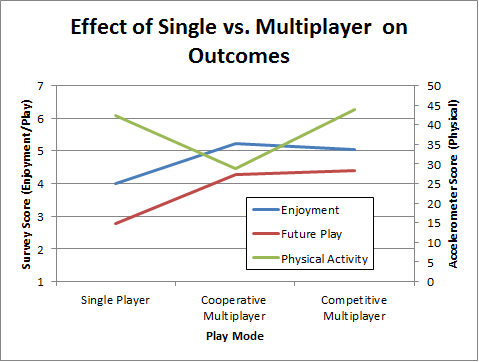
Created from Table 1 of Peng & Crouse (2013)
Although the affects appear pretty substantial in terms of effect size (for example, from 3.99 to 5.22 for enjoyment, about 0.8 standard deviations), it’s hard to say how much the double-sample for the two multiplayer modes inflated the F-statistics (and thus statistical significance) of the results. So I am not 100% confident in the researchers’ interpretation of these data, but I am cautiously optimistic that these results would hold up with appropriate consideration of dependence.
In the context of education and training, this has some critical implications: play with others seems preferable to play alone. While this might seem intuitive, we too often build serious games and gamification efforts where people compete against themselves (e.g. high scores, or some instructor-set target goal level). Adding some coworkers or fellow students to the mix might just improve those efforts.
- Peng, W., & Crouse, J. (2013). Playing in parallel: The effects of multiplayer modes in active video game on motivation and physical exertion Cyberpsychology, Behavior, and Social Networking DOI: 10.1089/cyber.2012.0384 [↩]