Grad School: Where Should I Apply for a Master’s/Ph.D. in I/O Psychology?
Grad School Series: Applying to Graduate School in Industrial/Organizational Psychology
Starting Sophomore Year: Should I get a Ph.D. or Master’s? | How to Get Research Experience
Starting Junior Year: Preparing for the GRE | Getting Recommendations
Starting Senior Year: Where to Apply | Traditional vs. Online Degrees | Personal Statements
Alternative Path: Managing a Career Change to I/O | Pursuing a PhD Post-Master’s
Interviews/Visits: Preparing for Interviews | Going to Interviews
In Graduate School: What to Expect First Year
Rankings/Listings: PhD Program Rankings | Online Programs Listing
So you want to go to graduate school in industrial/organizational (I/O) psychology? Lots of decisions, not much direction. I bet I can help!
While my undergraduate students are lucky to be at a school with I/O psychologists, many students interested in I/O psychology aren’t at schools with people they can talk to. I/O psychology is still fairly uncommon in the grand scheme of psychologists; there are around 7,000 members of SIOP, the dominant professional organization of I/O, compared to the 150,000 in the American Psychological Association. As a result, many schools simply don’t have faculty with expertise in this area, leading many promising graduate students to apply elsewhere. That’s great from the perspective of I/O psychologists – lots of jobs – but not so great for grad-students-to-be or the field as a whole.
As a faculty member at ODU with a small army of undergraduate research assistants, I often find myself answering the same questions over and over again about graduate school. So why not share this advice with everyone?
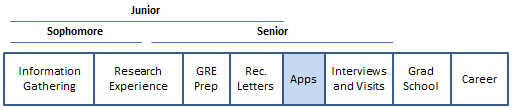
This week, I’d like to talk about an important step in preparation to enter grad school: choosing where to apply.
The variety of schools makes choosing where precisely to apply a daunting (and often expensive) task. You want to balance several factors:
- Don’t overload your letter writers with too many letters.
- Apply only to programs you would actually attend if accepted.
- Apply only to programs for which you are qualified.
In practice, this means you should apply to no more than a dozen schools, typically a balance of 6 to 10 primary targets and 2 to 4 backups.
You should start the selection process by getting a list of graduate schools with either Master’s or Ph.D. programs (depending on which degree you are going for) and then try to narrow it down based on any other major limitations. You can find an excellent search tool to do this on the SIOP website. If you are absolutely tied to a particular region of the country, you can limit your search to one region, but this is a little risky, because program quality is not even across the country.
Create a spreadsheet (use OpenOffice.org, if you don’t already have another spreadsheet program). Put the name of each school in the first column, its location in the second, and program type in the third.
| Program Name | Location | Type |
|---|---|---|
| Old Dominion University | Norfolk, Virginia | Ph.D. |
| Radford University | Radford, Virginia | M.A./M.S. |
When deciding where to apply, you should start by considering the quality of school that you can get into. If you have exceptionally high GRE scores, that means you can get into a highly selective program. If your GRE scores aren’t so strong, then you should not even apply to those schools. Many graduate programs post the average GRE scores of applicants to their programs, so this is something you can find on their websites or using the search tool linked above. Add these values to your chart.
| Program Name | Location | Type | GRE Avg |
|---|---|---|---|
| Old Dominion University | Norfolk, Virginia | Ph.D. | 585/715 |
| Radford University | Radford, Virginia | M.A./M.S. | 458/562 |
You should also not aim too low; if your GRE scores are 700/700, you should probably not be considering programs with averages at 400/400. As you eliminate programs, remove them from your chart.
As you go through the SIOP listings, add other columns that would influence your decision: region of the country, program size, number of faculty, etc. If these things are important to you, they should be in your chart.
Once you are down to a list of 30 or so programs that you are qualified for, open their websites and check out the faculty. Who has interests most similar to yours? As an undergraduate, you may or may not have specific research interests, but even if you don’t, some topics will sound more interesting than others. Job satisfaction, organizational justice, online social media? Again, add this information to your chart.
| Program Name | Location | Type | GRE Avg | Faculty Studying Social Media? |
|---|---|---|---|---|
| Old Dominion University | Norfolk, Virginia | Ph.D. | 585/715 | YES |
| Radford University | Radford, Virginia | M.A./M.S. | 458/562 | No |
With your completed chart, consider your list of programs and trim them down to your final list. Really think about which features are most important to you, and which programs you are most qualified for.
One of the most surprising and scary aspects of applying to graduate school for most undergraduates is that just because you meet the minimum qualifications does not mean you will be accepted. This is true for undergraduate applications as well, but it is even worse for graduate school because competition is much fiercer. Many competitive programs have between 40 and 300 applicants and 5 or fewer spots to fill. This means that faculty sometimes make decisions based upon criteria that you can’t predict – perhaps Candidate Q had a cover letter that really resonated with one of the faculty and Candidate P’s undergraduate adviser is a close personal friend of another faculty member. Now your chances have gone from 5/300 to 3/300. This is why you should apply broadly.
Remember that earlier I mentioned having “backup” schools – these are schools where your GRE scores are right around (or slightly higher than) their current average. This is to increase your chances that even if you are quite unlucky, you’ll still be able to go somewhere. Don’t choose just one backup school – the same strange selectivity can occur at those locations as well. When I applied to graduate school nearly a decade ago, I got into 80% of my primary choices and none of my backups. It happens.
Finally, if you are at a school with I/O faculty, don’t underestimate the value of simply scheduling a meeting and chatting with them about where they think you should apply. When a student comes to me individually, I can consider a lot more about their particular situation and give them more targeted advice.
| Previous Post: | Grad School: How Do I Get Recommendations for Master’s/Ph.D. Programs in I/O Psychology? |
| Next Post: | Grad School: How Do I Prepare for Inteviews at I/O Psychology Master’s/Ph.D. Programs? |


Richard,
As a student currently in the process of applying to graduate schools for I-O, I would like to express my appreciation for you efforts on this site. Having done as much online research on the process of applying that I have, I can say that your insights and suggestions have been some of the best I have found. Specifically, your site has helped me more than others because it is specifically aimed at prospective I-O students.
I have one thing to ask, if you don’t mind… I have been active as an URA for nearly two years now (I-O focused research). I proctor sessions, recruit participants, and enter data on a consistent basis. However, I have not officially conducted any research of my own. Do you think that selection committees, Ph.D. programs in particular, tend to distinguish between the two? Would this be something of a blemish on my application?
Thanks again for all of your help!
Spencer
I’m glad it’s helping! I’ve still got a few more features to go, but we’re definitely getting toward the end.
As for your question, I definitely wouldn’t say that’s a “blemish,” but your application would certainly be that much stronger if you did have that experience.
The issue is that working as a URA and doing an independent research project demonstrate different competencies and are differentially difficult.
By being an URA, you’ve demonstrated initiative (by seeking out such opportunities) and if your letters are strong, work ethic (by being on time, meeting your responsibilities, etc.).
By doing your own research project, you demonstrate independent thought and just that much more initiative. Faculty know that an undergraduate running his own research project is uncommon because it is very difficult. Publishing something as an undergraduate is even more so. It is a real sign of commitment and long-term planning. So that makes those actions all the more impressive.
Having said that, I’d say that the top quarter to third of undergraduates applying to I/O have some URA experience (fewer have glowing letters of recommendation about their performance during such experiences), while the top 5ish% have independent research experience. Only a handful will have published anything. So you are already toward the top.
Richard,
Your website has been a great help in parsing out the many details and considerations involved in applying to graduate school.
One item you may have already addressed, but which I cannot find is: the difference between a MA and a MS in IO Psych?
I would imagine that the MS programs are more quantitative oriented than the MA programs. But how do the different degrees effect career paths? Which is more likely to end up in consulting position? Which programs are more respected in the practitioner world?
Thanks,
Dan
@Dan – It doesn’t matter much. What determines if a program is an MS or MA is usually what college they are located in within their university – Sciences (for MS), Arts & Letters (for MA), or Liberal Arts (could be either). The specific requirements differ by program such that you could get more quant training in an MA program than in an MS program; there’s no way to know from the degree initials alone. So that by itself will not affect your career path; the reputation of the program itself is far more important. As for which programs are more respected in the practitioner world, it is the same list as for the academic world. Program rigor is program rigor. There are certainly established relationships between particular programs and particular large consulting firms, but this varies by program.
Would you say that a PhD in Organizational Studies is similar to a Phd in I/O? I would like to get into management consulting but want to make sure they could both lead me down the same path. Thanks a lot
If it doesn’t say “I/O”, it’s not I/O. A PhD in Organizational Studies could mean virtually anything. If it’s in a business school, it’s probably closer to a degree in human resources and/or organizational behavior. If it’s not, it is probably some sort of interdisciplinary program (perhaps combining elements of psychology, but perhaps not). The only way to really know is to look at the curriculum and see what kinds of classes you would be taking (and also to check the credentials of the faculty – if you don’t see at least two or three folks that calls themselves I/O, it’s definitely not an I/O program).
I am in my first semester of senior year and application deadlines are due this semester. Can I put on my applications that I will be research assisting in the next semester? It sounds silly but I have to turn them in and I would like them to know that I have obtained a position as a research assistant as it is my only research experience.
You can and should; however, it will only help a little bit. I’d recommend approaching the faculty member you’ll be working with and asking if you can start early. Any experience before applications are due (and any experience that the faculty member can reference in her/his recommendation letter) will make your application much stronger.
Is the school you attend as important as people tend to think? I am just wondering if the debt in the end will be worth it for a school like NYU versus a smaller school that costs multiple times less.
Yes, program quality is important in I/O. It varies dramatically when considering the full range of programs available; but even more importantly, better programs will tend to have more or longer-term relationships with places for you to get jobs after school. Online programs generally have few or zero such connections, which is why I don’t recommend them. Rankings sort-of-kind-of reflect this quality, but not perfectly.
Rankings don’t really matter at all between the relatively similar programs – for example, any school in the top 30 or so give you basically the same opportunities. The #1 and #2 school, or the #10 and #11 schools – basically the same, as far as your education is concerned. In fact, I’d say there are relatively few differences between the #4 and #20. Such schools will certainly have minor, noticeable differences (for example, one may emphasize statistical training more strongly), but these vary by program and don’t match up with rankings (and thus require more in-depth research).
I’ll also mention that all decent PhD programs will provide assistantships and tuition waivers, so the cost of PhD programs are all essentially the same, i.e. zero (aside from slightly varying salaries for the assistantships). Cost should only be a factor when comparing Master’s programs.
I am supposed to be starting NYU’S I/O psych masters program in September and have already moved there but I have heard negative things about the school– mainly it is for those that are well off and couldn’t get into ivy leagues. I don’t come from money and didn’t apply to any Ivy Leagues…I was ecstatic to get into NYU but now, 2 weeks before the semester starts, I am having doubts–is getting my masters at NYU worth the debt? I would love to actually hear from someone in the field–please!!!!
The Ivies are not very good for applied psychology – their reputations are not very good for preparing those wanting to go into practice, and I would not recommend them. I think what you are hearing is the (pretty common) elitism about ivy undergrad programs versus non-ivy undergrad programs. It is also probably a side effect of being in New York, where people generally care a lot more about that kind of thing. Let me assure you that graduate school is an altogether different thing from undergrad – that sort of posturing isn’t really relevant to your education. If you look at the US News and World Report rankings for I/O Psychology, you’ll see what I mean – no Ivy even in the top 10. I am not familiar with NYU’s program specifically, but it is probably fine – if you’ve talked to current students and they seem to be getting the sorts of job that you eventually want, that’s all you really need to worry about.
Hi Richard.
First off, thank you for posting all this information, it’s been very useful so far.
I’m concerned because I’m a senior and I’ve recently applied to 3 I/O psychology graduate programs (2 Phd, one MS) and I’m wondering about my chances and whether it’d be better to take an extra year and try to raise my GPA and GRE scores.
My undergraduate GPA is not strong, 3.3, and my GRE scores are 151 Q, 159 V, and 4.5 writing. My psych GPA is a little better at 3.65. On the plus side, I do have 2 years of research experience in an I/O lab and I’ve been working on my own independent research project under an I/O faculty member for about a year, I’m nearly done and am in the final stages of writing up the report and looking for places to submit it to that accept undergraduate research early next year. I was also tickled to receive a research grant last year for said project. I have a bit of conference experience (3, two local, one national). Finally, I have a little bit of consulting experience through a program in my university that does employee assessments of organizations, but I only joined a few months ago.
Does my research experience make up for my lackluster GPA and GRE scores or should I try for an extra year to raise them? I don’t have good excuses for the numbers except that I was working full-time throughout my undergrad career and it kind of sounds like a lame excuse to me. The fact of the matter is that I should have tried harder in some of the classes I disliked, and I’m paying for it now.
Any advice you can provide would be appreciated. Thank You!
A GPA below 3.5 does mean you may be automatically ignored in some selection processes, and your GREs are mixed (45th percentile for quant will be a problem for some programs). But it sounds like you’ve done the right sort of work to try to make up for those weaknesses. If you can publish your project, that will make your application pretty strong. Some universities have policies that allow you to drop low grades (sometimes these are called “grade forgiveness”) which you might consider looking into before your transcripts are sent out.
I don’t think you need to make an explicit decision to “take an extra year.” This is more of a practical question; if you don’t get into a grad school this time, you’ll take an extra year. If you do get in, you won’t. 🙂
Regardless, you need to expand your application spread dramatically. In the current graduate market, it doesn’t make any sense to only apply to 3 programs. You should be applying to at least 10, up to 20, and nationwide. When I applied to grad school many years ago, there were several programs where the faculty members I had been targeting decided at the last minute – after applications were in – not to take any students. Thus it was impossible for me to get into those programs due to no fault of my own. You have no way to predict what individual programs will do, so only applying to 3 is very risky.
I don’t know your career plans, but given your GPA and GRE scores, I would also consider expanding your search to include competitive Master’s programs (e.g. Minnesota State Mankato, Tulsa, George Mason). It’s better to apply broadly now, see where you get in (and don’t), and then make a decision on where to go after you have that information.
Thank you for the advice. I took a look at Minnesota State and George Mason’s websites. The deadlines to apply for the master’s programs aren’t until February, so I think I will start prepping to apply for those schools as well. My school does not have grade forgiveness unfortunately.
My quantitative score needs a lot of work. Unfortunately, math has always been a bit of a weak spot for me (I barely passed college algebra, and swore it would be the last math class I ever took), but I was able to get an A in my undergrad statistics class and an A+ in my undergrad methods class. I’ve also learned a lot about statistics from the project I’ve done, especially regression and a little factor analysis, and I’m really familiar now with SPSS. If I focused on the stats I’ve learned in my personal statement, do you think it would help alleviate fears that I am incapable of keeping up in graduate level math? I guess there is the possibility that I am, but I honestly feel like the stats experiences I’ve had so far have been really positive and the stats part of my project was the part I enjoyed the most, hands down. I would have tried for a minor in stats if my university offered it.
One other thing, I promise this is the last question! I have two minors (philosophy and speech communication) that I got early in my undergrad career before I knew that there were branches of psych other than clinical. Does this strengthen my applications at all?
You should definitely address the relatively low GPA in your statement head-on, and I would definitely emphasize the specific skills you’ve gained relevant to conducting research. Discussing specific statistical competencies you’ve developed is a great idea. There is a general belief that “undergrad stats” is different than “graduate stats” – which is certainly true, as undergrad stats doesn’t usually get too deeply into things like assumption checking, theoretical derivations, etc – so if your understanding is more advanced than typical of an undergrad, that is definitely something important to talk about.
Neither of those minors will probably do anything for you, I’m afraid. Maybe if you can weave them into the narrative of how you got to psychology (e.g. if philosophy got you interested in philosophy of science?) in your personal statement. But that’s a stretch and probably better to use that space to talk about your research experience.
Dr. Landers
I would like to know what your opinion is regarding the notion that the GRE is a weak indicator on graduate school success. Specifically in IO Psych, have you noticed an indicator in which the GRE is a poor indicator? I found the following article interesting.
Sternberg, R. J.; Williams, W. M. (1997). “Does the Graduate Record Examinations predict meaningful success in the graduate training of psychology? A case study”. American Psychologist 52: 630–641.
I am noticing a trend now where graduate schools are waiving the GRE requirements , including top ivy league schools.
http://ainsleydiduca.com/grad-schools-dont-require-gre/
Do you think that grade inflation exists in graduate schools? and how much does grade inflation impact GRE score requirements in terms of selection?
Thanks for your time?
Hi Juan – the GRE predicts graduate performance just fine. Instead of a case study in American Psychologist, I’d recommend this meta-analysis of research published in Science:
Kuncel, NR. & Hezlett, S. (2007). Standardized tests predict graduate student success. Science.
Some schools are dropping the requirement. There are a lot of reasons for that – part of it, especially at the Ivy League level, is that the applicants they get are already exceptionally highly qualified, so the GRE doesn’t tell you as much – this is something called range restriction. There is also the matter of racial differences in GRE scores, so dropping the GRE gets rid of those differences (although it does not solve the underlying problem).
Grade inflation has existed in graduate school for a very long time, because a C is considered a failing grade. So everyone gets an A or B, for the most part. But grades also don’t really matter in graduate school – after you have a PhD, virtually no one is going to look at your transcript again.
Mr. Richard,
I am currently a junior at a very small liberal arts college in the middle of no where. I have a decent gpa of 3.55 and plan on taking the gre during the summer. I’m also a student athlete (captain of football team) and I have also presented on such topics dealing with gender limitations and mental health at a conference held yearly at our school. The only problem I’m having is obtaining research experience. Being at a very small institution, research is very limited. Other than the work I have presented at the conferences, I have no research experience. Also, none of our faculty have a degree in IO Psychology so I have little guidance. My question to you is will coming from a situation like this one hinder my chances at getting into an IO Psych grad program? What do I need to do in order to increase my chances? I honestly would have attended a different undergraduate program if I would have known that I wanted to go into the IO field and if I wouldn’t of received the athletic and academic scholarship.
Coming from a SLAC alone won’t hurt you – in fact, it usually helps, since SLACs tend to be (but are not always) more academically rigorous than big state schools – but the lack of research experience will be a problem. Any psych research experience is what you need (not necessarily I/O). So I would identify any faculty that you could potentially work on research projects with, and ask to work with them.
Having said all that, if the presentation(s) at your local conference are based on empirical research, you can talk about that experience in your letters, and you worked with faculty (even if not in a formal lab setting) who can write you letters based upon your performance on those projects, this problem is mitigated somewhat. So if that’s what you did, the key to a successful application would be to emphasize that experience.
Afternoon, Dr. Landers –
First, thanks for creating such a well-organized guide to pursuing I/O psych! I am someone who likes to do a bit of research before making big life decisions (weird, right?), but I had been having some difficulty finding much information from people with experience in I/O before stumbling upon your blog.
Understandably, your guide is geared towards undergrads. Certainly, a lot of this information still applies to people who have already graduated! It is my guess, though, that suggestions for some things that you’ve covered, such as gathering letters of recommendation, may shift a bit for recent grads. My question for you is: What advice would you give to someone who’s already graduated about pursuing graduate school in I/O psych?
Here’s some background info: I graduated with my bachelor’s in psychology, and have experience in a research lab (no published research, just a published book review), a solid GPA, and loosely related internship experience (including a current HR internship). Family health issues made continuing directly into grad school not ideal. Some post-grad experience in the mental health field made me reevaluate my grad school interests, and now I am primarily interested in I/O master’s programs. I am unsure of how to present this during the application process. Thoughts?
Thank you!!
My advice does not actually shift much. You still need recommendation letters from faculty that you’ve worked with on research, if possible. If you are applying to a Master’s program, you can also get away with replacing one of these with a current supervisor or mentor, but I would suggest doing that only if that person is in HR or I/O, and preferably I/O – and I would not replace more than one.
Applying after being in industry is actually a lot easier if you’ve been out for a longer while (e.g. 10 years of HR experience). Just a little experience can make you appear indecisive (e.g. how does the selection committee know you won’t just change your mind again in a year?). The challenge will be, in your personal statement, explaining why this is the career for you and how you know that definitively now. If your mental health experience helped you make that decision, you should talk about it (but briefly). My post on writing personal statements will go a long way there. I would not mention the “family health issues.”
Hello Richard,
Great website and fantastic commentary.
I was wondering if you could give me some general advice?
About me:
BA (Economics) – Traditional brick and mortar public university, GPA 2.7
MSc (Information Systems) – Online, University of Phoenix, GPA 3.7 (I did this 10 years later)
MA (I/O Psych) – Online, The Chicago School of Prof. Psychology, GPA 4.0 (I did this 5 years after the last degree)
I’m a little old now perhaps (45), but I’ve always had this dream that psychology was for me. It’s just taken me a long time to figure that out plus I place a great deal of value on financial security so I never really wanted to leave any full time job to study full time (hence the online degrees).
I’m interested in going after my PhD but I am worried about my lack of relationships with any former professor so I would not be able to produce any valuable letter of reference. I really didn’t get to know them that well (though I easily could have). I was just focused on the topics and the learning at hand – not in my relationships with the professors. In hindsight, this was probably a mistake.
So, without those letters, I would probably have to aim for a professional school and probably online again but they are more expensive. I would not have the luxury of leaving work in any event as I am the sole breadwinner for my family. In a few years I may have saved enough money to change that but the clock is ticking for me.
Also, my undergrad GPA was horrible and I do have every excuse in the book (Father died, I had to run the family business, got sued (twice), army obligations, etc…). Later on, when I was older I did much better but I am worried that it may not be taken that favorably since the education was online.
I have this dream that I would make a pretty good coach and/or consultant in the areas of organizational restructuring or leadership. My thesis for my MA was on Outsourcing in Information Technology. I may even make a good professor.
So, with that background, for me to go after my dream (PhD or PsyD), should I even bother with any “traditional” school or just accept reality and go for another online school? Personally, I really believe that all the schooling is the same and you get what you put into it but I do not believe the world sees it that way.
Will my age, educational background, GPA, lack of reference letters, etc… be too much for any school to accept other than for profit professional schools?
Age won’t be a problem; many people “discover” I/O after a substantial career in HR. So that doesn’t really matter.
Your GPA could be a problem, but your relatively late-to-I/O career path means that GPA is a long time ago. That will matter more to some programs than to others, but it should not preclude traditional non-profit educational institutions. You are right that a brick-and-mortar Master’s would be much more convincing that you were really capable of doctorate-level work, but I don’t think it’s catastrophic.
The reference letters are more of a problem, unless your GRE scores are quite high. You did not mention if you managed to publish your Master’s thesis, but that would be the most important thing to try if you are aiming at a PhD program. For PsyD, that is less critical.
You mentioned being a coach and doing consulting… that does not sound like a PhD to me. In fact, you should have been trained, at least in part, to do both of those things with a Master’s degree. So I am not sure what your specific motivation is to seek a more advanced degree.
If you do pursue a PhD or PsyD, I’d recommend a brick-and-mortar professional school. You can usually do nights and weekends for such programs. The differences between in-person and online are myriad, and I’ve written about them elsewhere. But the basic idea is that although online programs can be as high quality as (or higher than) brick-and-mortar programs, they usually aren’t. If you want more detail on why, I’ll direct you to those two articles I just linked.
As a result of that, your job opportunities are generally going to be much more limited with an online program unless you have a specific job already lined up for yourself that will require this PhD or PsyD. That is why figuring out your career goals first is so important; that will direct further decisions. If all you want to do is go into consulting, you can do that with your Master’s – I’d recommend reaching out to your professors and alumni network (you hopefully are already connected to these) and see what opportunities are already available with your Master’s.
Dr. Landers,
I am so glad I discovered this website and all the wonderful information provided. Thank you so much.
I will begin my senior year this fall and will be applying to M.A/M.S programs with no intention of pursuing a Phd (of course things may change). I’m a business administration major with a concentration in HR with no time to add psychology as a minor. However, I took a general psychology course some time ago at another institution and I completed a social psychology course this past semester. In addition, I completed a statistics course this past year along with selection and compensation, organizational behavior, and HR management. This coming semester I will take I/O psychology, training and development, and a senior honors research project/thesis, which will be I/O or HR related.
I have noticed that research methods is a common required/recommended course for most masters programs. I will not be able to take research methods since the lecture conflicts with the I/O course (both only offered in the fall). Will this hurt my chances of getting into a strong program, especially being a business major? I have a 4.0 GPA in the Honors College and I am fortunate enough to have a well respected I/O Psychologist as my senior honors project/thesis advisor who will hopefully write me letters of recommendations.
Also, it seems a bit more difficult to distinguish the strong masters programs from the weaker ones compared to Phd programs. I have learned that faculty research is of a greater importance in deciding on Phd programs and not so much in deciding on masters programs. What should I look for?
Thank you!
I/O psychology, whether at the Master’s or PhD level, involves a lot of statistics, and better programs (i.e., the ones that will get you a job) tend to emphasize stats more than weaker programs. Having some background in stats and research methods is the best way to get into one of those better programs.
For Master’s programs, your priorities are really GREs and GPA – if you have a 4.0 and are in the top 10% GRE scores, you can probably go just about wherever you want.
The best indicator of the strength of a Master’s program is going to be the satisfaction and employability of its graduates. You’ll want to contact some current grad students and ask for a brief rundown of how much they like the program and how they see their job prospects – that will give you the best information. If the program doesn’t list their Master’s students on their website, I would take that as a bad sign.
Well I am in my first class in the Philosophy in Leadership & Development in Social Media & Technology at University of the Rockies. I avoid all of the GRE bs and interviews. I wanted to get started and not waste money on testing. I hope to complete my program in 2018. In the meantime, I am seeking a teaching position part-time that will pay the bills. Let’s be honest. While I love going to school, I want to teach as an adjunct professor in organizational management. Someone told me the difference between a Masters Degree vs Phd is you no longer need to knock on doors to a job. They should be knocking on your doors!!
Hello,
Thank you so much for all of the information and lengthy replies! I’ve read through the replies that you gave other people who had questions and learned a lot.
However, I noticed for those who did not have stellar GPA’s or GRE scores, you recommended applying to some masters programs. My end goal is to have a PhD, and I’ve heard that getting a masters at a different school, then getting your PhD will extend the time that you are in school. I haven’t taken the GRE yet (I am an incoming Sophomore) and can’t predict my GPA (although I know I will be working very hard to make sure that both are as good as they can be). Is it useless for me to look up Grad Schools right now? I have an idea of what I want to specialize in, but it might change. Currently I am building a chart of schools I’m interested in, that considers geographic location, offering of a PhD program, and whether or not they placed on SIOP’s grad school ranking list, and in which section. Should I just stick to your timeline and wait until senior year to do this?
Thank you for your help!
Getting a Master’s at a different school from your PhD is a more difficult path to PhD. However, post-college, in case you don’t get into any PhD programs, it’s better to have the option between “Master’s or nothing” than to have only “nothing.”
Incoming sophomore is a bit early, for a lot of reasons. Besides your interests likely changing at least a little, programs change too – for example, faculty may get different jobs and move away from the schools you’re looking at, new centers may be created that change the focus of a program, programs can lose funding and stop taking new students, the faculty you want to work with may end up being on sabbatical and not take students the year you’re out, etc. I would not start worrying about specific targets until the summer before senior year and spend your time broadly preparing instead (research experience, GRE practice, etc.).
Hello Dr.Landers
May I ask you what is the key learnimg difference component between IO psyc and Organizational psychology program at the ph.d level?
I have read over relevant answers to this question, and my understanding is they are similar but OBHR will prepare students for only academic positions in terms of career whereas IO psyc will open doors for both industry and academia due to the science-practioner model.
Specifically, I want to ask you what this science-practioner model is and how this component is not present in OBHR programs.
I have looked up some solid IO programs and I dont see any practicum courses offered in the department. Instead, students seem to only take courses in various IO field and statistics in addition to participating or conducting research.
In this sense, how is such program differ from OBHR? They both make students to take similar courses and conduct research.
Yet I contacted some of the current students at some IO programs, and they informed me that half of their graduates go to industry right after graduation although there are no practicums offered during the program.
This somewhat confuses me. If this is the case, how come career in industries are not easily available to graduates of OBHR program?
What is the exact science-practioner model that every solid IO psyc program endorse, which differentiates the program from OBHR and prepares students for jobs in industry?
It a bit of an oversimplification to say “prepare students for only academic positions”. Instead, I would say that OBHR programs are intended to prepare you for an academic position. In terms of career preparation, that has a number of subtle effects. For example, it’s common for I/O grad programs to encourage students to take summer internships. That’s usually discouraged in OBHR program because that is time spent away from research. As another example, most I/Os more or less accept that a mix of their students will go into practice vs. academia. But if you were to admit to an OBHR advisor that you wanted to go into industry, 1) you’d be unlikely to be admitted as a grad student there and 2) if you were already enrolled, you’d probably be more or less ignored until (if) you graduated – or sometimes, asked to leave the program early. You also need to remember that knowledge at this level is quite deep. Although courses may have the same label, their content can vary dramatically. For example, in my “I/O Research Methods” course, part of the course focuses on how to investigate test bias, which is both a research topic and an on-the-job skill for I/O. Business methods courses are unlikely to have that sort of content.
To understand these differences, you also need to think about why graduate programs take students when students get full tuition waivers and are paid. PhD programs get no money from taking grad students. At all. It is a cost to universities to have a graduate program. The reason most OBHR faculty take students is essentially to train an “apprentice” – someone to conduct the research they’re interested in at another university. Once you admit you’re not going to do that, they have little interest to care about you. In an I/O program, some faculty still have this viewpoint, but it is less common. The scientist-practitioner model values the scholar “in the field” – the idea is that you’ll continue to conduct publishable research once you have a job, to “give back” to the community that developed you. So training academics or practitioners is equally good. (But do remember that this viewpoint varies by program.)
You must remember that inter-program variation is very important here. I’m speaking generally to mean differences, which means, in general this will be true. But for any comparison of two particular programs, this may not be true – you might have an IO program that is very academic-focused or an OBHR program that is practitioner-focused – both are simply very uncommon.
You can also get whatever job you can convince someone to give you, with either degree. There are people running their own consultancies with I/O Master’s degrees and MBAs, and people working for minimum wage with both OBHR and IO PhDs. There is no single path to career success. You just want to give yourself the best odds, and mismatching your career goals with your program choice harms those odds.
Dr. Landers,
I’m applying to masters programs in IO for next fall. I graduated from a good state school with a 3.53, but struggled early on in my college career before I transferred. At community college, before attending the state school, I got a C in my only statistics class. Despite good grades in relevant coursework (labor and employment relations major) later on, I feel like the C grade might really hurt me. Do you think its worth it to retake a statistics class this fall, in order to show I understand the material? How important are specific undergrad grades, compared to the overall GPA?
That’s going to vary a lot program-to-program. My suspicion is that Master’s programs are in general going to care less about individual grades than PhD programs, but I don’t know for sure. 3.5 is a middling GPA for Master’s applications these days, so that in addition to a C is not going to position you terribly favorably unless you have a high GRE.
Hey Richard! Sorry if this info is already posted somewhere. I am new to the site and on my phone, so I can’t navigate very well. I am interested in both MA and PhD programs. From my research it seems like most programs are geared toward preparing students for a career in academia, but I am thinking that I would prefer to go into industry after grad school. Can you give me an idea of the programs that are more suited for industry bound students? Or do you know of any resources that might hint at such information?
I wouldn’t say that. The highest ranked programs, which tend to produce the most academicians, also place their students in the most lucrative industry jobs. So I would say that programs are either suited for academia and industry (more difficult but better preparation) or industry only (easier but weaker preparation). No Master’s programs prepare you for academia – PhD only, if that’s what you want.
Ok, that makes sense. Do you know of any phd programs that are known for focusing heavily on very applied research that would be a good fit for industry bound grads? If you would prefer not to list specific schools, do you think the best approach to find out such information on my own would be searching through program websites and reaching out to current grad students of labs I am interested in joining, or do you have any other suggestions? Much appreciated.
Pretty much any ranked PhD program is going to be reasonable preparation for industry. But higher ranked programs are going to still prep you better and likely to get you better-paying jobs. You might consider this list: http://rlnd.us/1pw
Dr. Landers,
Thank you for creating this valuable blog for those considering I/O Psych study…I’ve learned a lot reading your articles/responses to questions and I appreciate your insights. I’m exploring graduate study after 12 years of work experience, mostly in nonprofit management (development). My interest in I/O Psych has been piqued by a recent organizational “transformation”/restructuring and my involvement with that as a change agent, as well as my broader interested in organizational behavior, leadership, and change. I did not major in psychology in undergrad – I double majored in Mass Comm-PR and Organizational Comm. As part of this training I took a few psych courses including I/O psych, a stats course, and org. behavior and HR management courses.
I’m interested in either master’s or PhD I/O Psych programs and since I live in Boston you would think there would be several I/O programs of both varieties to choose from, but the options are limited. In fact, I don’t think there’s a PhD program available in my area – the only thing that comes close is a PsyD program in Leadership Psychology from the Massachusetts School of Professional Psychology. This program requires that you’ve earned a master’s for admission to the PsyD program and it’s not actually I/O focused. I don’t think an online program is for me, so I am looking at the only bricks and mortar program near me, which is an MS in I/O Psych at Salem State University. I don’t seem Salem State’s program ranked anywhere…it’s a relatively new program, but the curriculum is Scientist/Practitioner based and the curriculum looks fairly strong. The other master’s option is at MSPP – an MA in Org Psych.
I’m not able to relocate for a program, so I’ve been weighing whether I should even pursue the I/O Psych route with such limited options, especially considering that much of the research I’ve done shows that even in I/O consulting, a PhD is required for longer term advancement. I’m weighing whether a Master’s will really equip me with the credentials needed to land a job in I/O Psych, especially in this land of higher ed where PhDs abound. I am going to take your advice and reach out to some former Salem State I/O Psych grads and see what kinds of career opportunities they’ve had. Any thoughts on this MS program from a school without a PhD program? Thank you for your help!
Erik
I/O is so small a field that it is extremely difficult to stay within a particular geographic area. Myself, I went to college in Tennessee, ended up in Minnesota, and got a job in Virginia. The closest place I could have attended graduate school, if that had been a goal for me, was Illinois. So as you are trying to stay in Boston, your chances of being accepted somewhere in Boston are not great. Easier for Master’s than PhD. Difficult but possible.
If Salem is a new program, that implies they are unlikely to have many connections to the local job market – yet. Programs most often rely on their alumni network to get the word out, and if there aren’t any alumni, there is no network. However, they may have established the program with specific links in place to avoid that problem. That is a great question for the grads when you contact them.
I would not recommend a PsyD if you want a career in a traditional I/O path. That is a very unusual degree.
A PhD is not necessarily required for advancement – there are a number of (highly entrepreneurial) I/O Master’s who have started their own consultancies and been extraordinarily successful without the doctorate. So a Master’s is still potentially a reasonable terminal degree. It just depends on what you want to do with it.
Hi Erik,
I was just reading your comment and was wondering if you had gotten in contact with any graduates of Salem State? I am interested in Salem’s program but it is relatively new so I am hesitant to go there.
Thanks
Rachael
Hi Rachael, I haven’t yet – I plan on reaching out to some grads via LinkedIn to get their thoughts. Let me know if you have any insights on the Salem State program – thanks!
Erik
Thank you for this site!
I am a junior at Cal State Northridge and am preparing to decide which masters programs to apply to. How important do you think college prestige is in the IO community? I could easily go to Cal State Long Beach and probably pay nothing with Cal Grants, but USC has an applied psychology degree with a focus on IO to the tune of $54,000. is the debt worth it? Also, is this degree from USC the same thing as a masters in IO like I would receive from Long Beach?
There is currently no ranking system for Master’s institutions in I/O, so prestige is a very fuzzy thing. It is more about the particular organizations that your school is connected to (i.e., where they typically place graduates).
As for those particular schools, how should I know? 🙂 You should talk to some current USC and Long Beach students and see how comfortable they are with their job prospects and earning potential.
Hi Richard,
I’ve read an incredible amount of your comments and I just want to preface this by saying that I greatly appreciate the way you dedicate your time to answering all of these questions. It has cleared up a lot of things for me and confirmed my interest in the field.
A bit about me: I was originally a Psychology major, but then switched to Interdisciplinary International Studies and Spanish after living abroad. However, I do have 5 psychology courses on my transcript, 2 from 8 years ago (both Ds unfortunately, before I withdrew from Yale during the height of a family crisis in the economic downturn), and 3 As, including statistics, from my second round of college at a state school in California.
After graduation I spent the better part of the last 4 years working in developing countries at various NGOs and language schools as a teacher. Over the last year I completed an International Business MBA program in France and worked in market research and digital marketing. Now, I’m 27 and headed home to my native San Francisco. I realized during my work experience that the same questions were constantly present in my mind: Who are the leaders, what makes a great leader, how can the company create a funnel for new leaders as the current ones are nearing retirement? Why is there such high turnover? What is it about the HR culture/policy that causes low motivation and a tendency to do the bare minimum? Who would help them understand they need to do that and show them how? So after a hunt around the internet I discovered I/O and have been obsessively consuming as much knowledge as I can, I didn’t know this existed!
My question:
As I was working in Germany and France, I’m interested in the effects of European work cultures on productivity, motivation and work-life balance as compared to traditional American ones, and the new startup work cultures I’ve observed in SF/Silicon Valley. Specifically, I’d love to examine the claim that European workers exhibit a higher ratio of productivity given hours worked than American workers do, and the long-term affect of little vacation time, (work-life balance, work stress and leisure time). (This is just a dream, I’m happy to research other things!)
Are there any applications of I/O on an international/cross-cultural scale that I could target my career toward? I speak 3 foreign languages fluently and I think this is an asset, especially given the international workforce of multinational corporations, but I’d like to have your advice on that. Are there any schools that focus on this type of research, or certain countries where one can find jobs abroad/that emphasize I/O applications of this sort? I imagine if a corporation’s workforce spans 3 continents there must be some I/Os addressing those intercultural challenges.
I’ve realized that my shot at a PhD is very, very long and not something I want to try for at my age (I’d finish around 33 at best). My plan is to go back to school for a semester and demonstrate that I can get straight As in stats and research courses, volunteer at a lab, and apply in a year’s time for an MS. My undergrad GPA is 3.2, but most of what is bringing me down are the first 2 years (2 bad semesters at Yale) which are now 9-10 years ago. If we take my junior/senior GPA it’s 3.6, add in the MBA it’s 3.76. But unfortunatley I’m not sure if there is anything I can do to salvage that.
A related question is, do you think that is even a feasible plan at this point?
Thank you very much in advance for your time and attention.
Well… there’s a lot in what you’re saying to address.
There are several different major research areas that you’ve just covered that are quite a bit different. Who are leaders and how can they be made is indeed an I/O question. Funneling, however, is part of succession planning, which is part of HR. Turnover goes back to I/O again, but HR policy is HR. Training and development is both HR and I/O. Productivity rates is an HR or maybe a Macro-OB question, and the effects of benefits are back in HR again. So you might want to focus in a bit.
Applications of I/O internationally are certainly something we do, although I feel I should point out that I/O legitimately exists in Europe independently, usually under the label of “work psychology” or “occupational psychology.” So it’s not quite a matter of learning how to apply American I/O to the world – we’re all in this together, so to speak. If you’re interested in specialized international applications, like the application of I/O principles to the developing world, that certainly exists as well, but I don’t know if that’s of interest to you specifically.
You should also remember that departments rarely focus on anything in particular – you’re really asking about individual faculty. And there are certainly faculty in I/O, HR, and OB departments that have that focus – I’d recommend looking for papers on Google Scholar that sound interesting and see who wrote them.
To get into a PhD program, I’d say your chances as is are probably not great, except possibly in executive-oriented programs (non-IO). If you did want to get into an IO PhD program, which I think actually still would be an option if you wanted it (and finishing at 33 is not that late), your plan is probably the best way to pursue that without more information about where you’re applying. However, I think I’d recommend before doing that to identify which faculty you might want to work with, to email them explaining your situation, and ask what they think you should do. You’re taking a very non-traditional path, which means that the normal rules for how these decisions get made are basically out the window. If you decide you do want to get into a Master’s program, you may actually be ok with what you have now. In that case, you should contact graduate program directors and explain your situation to them instead.
Dr.Landers,
No offense to you but I find I/O psychology extremely boring.
I came to the graduate school only because of all the hypes about bright employment opportunities for I/O graduates.
Unfortunately, it is so boring that I can’t stand it anymore. I feel really miserable most of the times I am reading the assigned I/O journals
I don’t mind doing statistics and I have been doing well in statistics courses so far.
I have been doing well in I/O course as well, but I just HATE it so much I don’t think I want to spend more time taking I/O related courses.
As a result, I am thinking of getting a master’s degree in measurement and statistics in graduate school of educations instead.
Few things I want to ask you before making the actual switch
1. Would you say a masters degree in measurement ans statistics be sufficient for many job opportunities after graduation in general? Or would you say Ph.D is essential?
Again, I am asking for measurement and statistics programs in graduate school of education, not statistics courses in statistics or mathematics department (they tend to be more mathematics heavy, requiring calculus related materials to be learned)
I have no interest in working in the academia by the way.
2. Would you say there are lots of journal articles to read in this field too?
Or would you say the courses to be more lecture typed courses due to the content nature?
I realized I don’t really like reading journal articles, especially when they are related to
the field of I/O psychology which makes me feel miserable most of the times.
Thank you
Money is an absolutely terrible reason to go to graduate school. It’s a perk of some grad school career paths, but it is not a reason. Grad school is far too soul-crushing to do it for any reason other than “I love learning about this subject.” This is why nerds run the world.
As to your questions:
1) I have no idea, since I’m not an educational statistician. I know that I/Os tend to know more stats than most ed. stats folks do, although that varies a lot by school.
2) Still journal articles. Getting a graduate degree is about getting to the edge of current knowledge in a field. Journal articles is where that knowledge is found. See if you enjoy reading the following – if not, perhaps you should just drop out: http://www.tandfonline.com/doi/pdf/10.1080/0969594X.2010.513678
Thank you for your advice..and I will try reading the journal article you provided after I finish my I/O coursework within the few weeks.
I guess I had no choice but to choose I/O in the first place, because it was the only one of the few areas in psychology that enable graduates to find jobs after obtaining their degree.
Degrees in other research psychologies such as social psychology and educational psychology seem to be useless unless one is highly intelligent enough to secure a job in academia against all the odds. This is why I chose I/O over these fields although I found them to be quite more interesting.
And.. when I read IO textbook in undergraduate course, it didn’t seem to be this bad…It wasn’t still somewhat boring..but not up to the point that would make me constantly miserable.
I find the I/O journals are much worse than the textbooks..
I’m not quite sure what you mean by “no choice.” If your goal was money, I would think you would’ve gone into something associated with high salaries, e.g., electrical engineering. People generally go into psychology because they either 1) like trying to help people or 2) like trying to understand people. The first of these usually leads to careers in counseling or human services. The second leads to grad school.
Educational psychologists actually go into industry as well, usually as school administrators. Most areas of psych have some sort of industry equivalent, although not all, and they vary widely in pay. But I would say intelligence is critical in all of them, academia or not.
Before switching fields, you might consider if the reason you don’t like I/O so far is because you’re still catching up. Remember that the field of I/O is very large and complex. You need to catch up on “foundational knowledge” before you start to get to the state-of-the-art more exciting stuff. And unfortunately, journal articles containing foundational knowledge are pretty boring, most of the time, even for me. Although you’re years behind being competent in I/O at the kind of level you need to be to make contributions at the frontiers of knowledge (the goal of any PhD grad program), you might also try hunting down articles within your personal interest area to keep your interest. This is a great application of goal-setting theory, by the way. 🙂
So, for example, I found articles on job analysis, which was a good chunk of my first year reading in grad school, to be insanely mind-numbing. However, when I started reading about technology-driven assessment, I found the articles to be much more interesting, because they aligned with my personal passions. I could actually sit down and read those articles just because I was curious and wanted to understand what we know right and what we don’t know in those areas – finding the edge of current knowledge. Unfortunately, the articles covered in the first three years of grad school, most of the time, are not going to be the sorts of articles that trigger those sorts of passions, unless you are a big time traditionalist (and most people are not). So it requires some initiative!
Hello Dr. Landers,
If you don’t mind, I have few more questions to ask.. after doing some research.
I want to ask you the following questions:
1. Is it possible to work in Psychometrics related job with IO degree, purely doing work related to measurement instead of dealing with IO topics? (e.g. performance, leadership, etc.).
This is the qualification that Educational Testing Service(ETS) is requiring for entry level psychometric jobs
“A Ph.D. degree in Educational Measurement, Quantitative Psychology; Statistics: Research and Evaluation Methods: Psychometrics or closely related field with one year of experience in the utilization of psychometric methods, statistical procedures and their applications: application of classical test theory and item response theory. Experience may be gained through doctoral studies. Facility with advanced statistical software, such as SAS, SPSS, R, or similar packages. Excellent verbal and written communication skills are also required”
I don’t see any word related to IO up there, but do you think background with IO can be sufficient for such job?
Although they do actually have separate positions specifically named after IO psychologist, I am not interested in those kind of jobs
2. I am afraid that I might have come to not-so-good IO program. I thought this program would be ok, because it was listed in one of those rankings you often cite as the “decent programs”, and they fund their students. However, after coming here I have realized that they might have some problems..
a) They only have two statistic courses, one in univariate and one in multivariate that are required for all MA and Ph.D students. They also offer one research methods course occasionally. However, they do not have any other more advanced statistics courses. I was recently shocked to find out that they do not actually have a course in hierarchical modeling or structural equation modeling or item response theory in the entire psychology department. Would you say this is a red sign considering that IO psychologists should have strong background in statistics? On the other hand, most programs in measurement and research in the faculty of education at other schools all seem to have these courses. If I am interested in this field, do you think I should really consider switching to those programs instead of staying in IO?
b) They do not have any formal internship programs, so students have to go out and somehow their own internship work. Although they offer some applied projects within few seminar courses, I am not sure if 2 or 3 applied project experience is enough to be competent in the job market.
Based on these factors, do you think this program may not offer good enough training in IO?
Do you think I may be better off quitting this program whether I apply to other programs in measurement or look for other jobs?
Thank you
1) You would certainly be able to apply to such positions and might be qualified depending upon your stats experience, but the appropriateness varies quite a bit by business. In this particular case, ETS employs many IO psychologists, so if they are advertising separately for quants and IOs, that’s who they want. No matter how many stats classes and IO has, they won’t have as many as (or the dissertation of) a quant specialist.
2a) That’s not necessarily a sign of a “not-so-good” program, but it is indicative of departmental priorities. They don’t prioritize stats, so they must prioritize something else. But that focus does mean getting positions intended for quant psychologists, or even highly quant-oriented IOs, is going to be much more difficult. If you find educational measurement much more compelling in terms of your day-to-day work activities, you’re talking about a change in career path – so that’s fine, if that’s what you want. But if the programs in measurement that you like already exist at your school, you might just consider taking grad classes offered in those programs. If you want to switch into their program, they’ll want to see you’re capable of the work first anyway. Just in terms of career earning power, I wouldn’t recommend reapplying to other PhD programs while you’re already in one – there is a lot of potential to create bad blood unintentionally that could lock you out of both options.
2b) That’s actually pretty common, especially in PhD programs without a paired MS. Schools in more remote locations, in particular, tend to have this problem. So for example, my university is in Norfolk VA. There are basically no IO firms here. So that means students are left to find their own internships, because there’s no one we can send them to in the area. However, most of our students do end up finding internships that want them, usually in the DC area, because that is where we tend to send our students to work. In fact, the problem we face more often is that students get internships that turn into jobs that end up delaying their dissertations. So we still have a 100% employment rate, even without a formal internship program. I can’t guess if this is the case wherever you are, of course, but if you’re worried, I’d ask some current dissertation-level students how they feel about their job prospects and what the success rate of recent graduates has been.
Dr. Landers, thank you for your advice.
The problem is, that they don’t have education measurement program at my current school.
So…I guess there’s not much choice other than applying to other schools.
May I ask you why and how this would cause unintentional bad-blood? Do you think the faculty members here will get angry even if I am applying to complete different program, not another program in IO?
I haven’t done any research work so far, and just took few courses since this is my first term. As a result, I have rarely met my supervisor so far. In such case, do you think they will still get angry even if I haven’t really committed anything in terms of research? (And this was expected from them too in the first term).
Do you think it’s not good idea to tell my supervisor upfront that unfortunately, I find IO not very interesting and therefore I would like to apply to different program?
Do you think there may be less possibility that I will invoke the faculty member’s anger if I apply to masters program in education measurement instead of Ph.D? (I may consider doing this for my own interest too.. to try out if I would really like it and only continue to Ph.D once I feel I am ready for it)
The other option is to switch to masters program, as they do have terminal masters degree here. Then, I would apply to Ph.D programs in education measurement in Fall 2015. In fact, I wouldn’t be able to apply to other schools at the present anyway since the deadline passed for most school. I think this may be the best thing to do in terms of not causing anger among faculty members..but there are several downsides as well.
a) I already have a masters degree in other field
b) I wouldn’t want to spend additional three terms and write a thesis in IO, a topic that I find very uninteresting.
The problem with the current program is that the faculty members are not really interested in applied work..and ironically, this school is located in one of the big cities..The program has separate masters program, and they don’t have formal internship program for them either.
In fact, the faculty members want their students to go to academia. But I don’t know why they don’t have not much stats-focused program in such case…Also I am not too sure what their focus is on.
In terms of employment, some of the alumni found employment in applied setting, but most of them already had several years of work experience in prior to completing their degree.
I guess the problem with me is that I don’t want to work in academia, and the only reason I came to start my studies in IO was due to its high possibility of opening doors for applied work.
I somewhat feel that I was misled by my supervisor before coming here, because I got an impression that such applied work would be quite possible when I talked to him before accepting the admission offer. However, once I came here, I am feeling that that seems not to be really the case here..
I don’t know what to do..and I find this situation quite to be difficult.
I would really appreciate your feedback and help.
Thank you
Having an absent supervisor makes this a tricky situation. Normally, new students are quite an investment on the part of faculty – e.g., I can only take up to 1 student in a given year, so I am very selective about it. If a student came in after one semester and said “I don’t like IO”, I would be pretty annoyed, because that’s someone a student should work out before applying. However, if that student has a very compelling argument for why that happened, I try to be supportive in facilitating a career change. Where things would go awry is if that student didn’t tell me, and instead applied to another program blind. If that program identified that you were a current student of mine in the program, and noticed you didn’t have any rec letters from your current program (a red flag already), they might call/email me and ask. If I learned my student was planning to leave in such a way, I would honestly feel quite betrayed. And then you end up with a poor recommendation at the school you want to apply to, plus mistrust from the school you are already at.
If you really do hate IO, I would recommend Mastering out and switching fields then. It’s very unlikely that you’ll be able to switch to another Master’s program at another school at this point anyway – even with support from your own faculty, it looks very, very bad to the selecting school (i.e., not only did you not know what you liked when applying to grad school but then you couldn’t even finish what you started). That is why switching within a school, by taking classes first, is a better option if possible. But if you’re confident that you want to leave IO no matter what, I would also recommend you tell your supervisor ASAP that you are considering leaving IO and ask for his/her recommendation. If you indicate that you want applied experience ASAP, he may be able to facilitate that after your first or second year, and you might find IO more interesting. Just be aware that as soon as you admit this, your advisor may write you off entirely. So there is certainly risk involved.
Dr.Landers, Thank you for your advice. I really appreciate it.
Dr Landers,
Thank you for all your postings and comments. I find them very helpful. I wonder if you are also familiar with Ph.D/Ed.D programs in HRD. Do you think graduates with these degrees can work in applied setting just as I/O Psychologists? Of course, the nature of work will have to be focused specifically on training and development, but I am more interested whether these degrees will be versatile as I/O degrees in terms of finding applied jobs.
As for the admissions, would you say these programs are far easier compared to I/O Psychology? I have just checked the program website at University of Minnesota and I was shocked to find out that their preferred score is extremely low: Verbal 450(45%) and Quant 450(10%).
Here’s the actual link for the admission critertia: http://www.cehd.umn.edu/OLPD/future-students/graduate/admissiongridGS.html#HRDPhD.
Aren’t these scores terriblly low for any Ph.D programs? I heard top IO psychology programs such as Minnesota usually prefers scores over 80%.
You can certainly work in an applied setting, but not as an I/O psychologist. I don’t know anything about the job market for that field.
Dr. Landers,
I am currently attending a graduate program in IO Psychology at a school that is included in your ranking list on the website.
I decided to attend a big job fair that was taking place at our school, and I feel somewhat discouraged returning from the job fair.
There were many employers visiting the school, and I talked to almost every single one of them, yet all of them had NO IDEA what IO was.
Again, this school is included in the rankings you posted, so I assume it has a pretty good reputation in this field. But how will I be hired when no employers are familiar with IO Psychology? Now I am starting to get worried about employment after graduate from the program.
When I gave them brief explanation of the field, they all thought it’s Human Resources work. Would you say IO jobs are a lot similar to HR jobs?
If not, what are the main differences?
Also, would you say IO in general is a difficult major compared to other majors in social science/humanities/education, etc? This is my second graduate degree, and I happen to find the coursework much more challenging, both in content and workload. It’s not because I am unfamiliar with psychology, as my major was in psychology in undergraduate studies. Moreover, I completed my first graduate degree at a school which has much better reputation than the school I am currently at. In fact, the first graduate school is known to be one of the best school in the world.
Back then, I used to take four courses with no problems, I often had spare time to play games for hours yet managed to get all A’s. But within the IO program, I find myself much more busy even though I am taking only two courses. There’s just so much readings and work to do, and the content seems quite more difficult as well. I find myself reading and studying all the times; I barely enjoy leisure time I sometimes feel miserable.
And I am only talking about courses, I am not even involved in research at the moment because it’s just my first year.
Thankks
I have never been to a job fair in my life, and none of my students have either. If they said they wanted to, I’d tell them that it was a waste of time. Remember that job fairs are generally for “entry-level” positions, people with basic qualifications to enter the workforce. A Master’s or PhD in I/O is a highly specialized degree. If you were getting a degree in nuclear physics, you wouldn’t go to a walk-in job fair, would you? For I/O, you will find jobs through faculty networks and through SIOP’s JobNet.
I/Os are certainly qualified to do most HR work, but it is easier and generally less-well-paying than “real” I/O work. An I/O is going to be conducting research (i.e., looking up research literature, determining an appropriate science-driven solution to a personnel problem, designing a research study to determine the impact of that solution, trying it out, putting in monitoring systems, etc). An HR person is more often just going to “do” something, based upon their opinions, case studies they’ve read, etc. So in practice, I/Os are often called in to solve problems HR can’t.
I/O is one of the more difficult areas of psychology, and psychology is traditionally considered one of the more difficult social sciences, so yes, that’s probably accurate. Undergraduate psych is a cakewalk compared to graduate psych, across areas.
In my graduate program, I was reading maybe 10-15 articles per week in any given semester? 400-500 pages? For each class I teach now, I usually assign 5-7 or so. I don’t know if that’s a heavy load or not compared to other areas, but that is pretty common for I/O. I am a little concerned that you aren’t doing research in your first year though – to be competitive, you really want to be involved in research as early as possible – it is more important to be successful in research than in coursework. My first-year student already has a poster at SIOP this coming April.
Dr. Landers,
Thank you for your reply.
May I ask you what some of the job titles are for “real” I/O work?
I am asking this because the list below is the job titles that alumni of our program has got over the last 20 years or so, and they seem more like general HR positions to me.
Would you agree with me?
Ph.D
Organizational Effectiveness Advisor
Program Manager, Employee Engagement
Manager Talent Management & Diversity
Senior Consultant Leadership Solutions
Senior Consultant, Knowledge Management
Head of Leadership and Talent
MA
Senior Advisor, Organizational Development
Human Factors Lead
Area Personnel Selection Officer
Manager for Leadership Development
Also I heard this from some of the current students who had a chance to talk to alumni of the program. Basically, they were told that some (or most) of the alumni felt that obtaining Ph.D didn’t really seem necessary after all, considering the type of work they have been performing over the past years. In fact, some people said that Masters might be better because employers tend to see PhD as being overqualified for many positions.
Would you say there’s not much of difference between I/O jobs for PhD and Master’s other than salary difference? If so, would you recommend students to just get a Master’s degree if they are not interested in academia?
Thanks
Job titles are difficult to pin down, since two jobs with the same title can involve radically different responsibilities. I will give you an exemplar from JobNet though of what I’d think from the job description to be a more “core” I/O type job: http://www.siop.org/jobnet/job.aspx?job=2358&bSearch=1
Note the emphasis on statistical analysis and that the first responsibility listed involves “research.” I’d say that if you don’t have both of those, it’s not really an I/O job, although an I/O might still be qualified to do it (or more accurately, overqualified).
As far as a PhD not really being necessary, there are a few things going on. One, you will have learned most of the “facts” that are critical to I/O work within the first two to three years of a PhD program. So in that sense, if those facts are all you need, then you don’t really need a PhD. But the process of completing a dissertation is in part a creative task and a demonstration of independent thinking. So two, part of what employers are paying for is evidence that you are capable of those things. In practice, that often means PhDs and Master’s have the same general jobs, but the person with the PhD is called “Senior” and the person without the PhD is not. But it varies quite a bit. Three, it’s easy to look backwards in your career and say, “I knew everything I needed to know at x point” while you were still growing. For example, most Americans don’t think they learned anything in high school, but the difference in their knowledge of the world pre-high school and their knowledge post-high school are radically different. The same is true of each year of graduate school – the whole experience sort of smushes together after-the-fact into a vaguely painful hazy memory, and with skills gained post-Master’s being a bit more amorphous than the ones gained pre-Master’s, the specific timeline of how you changed over time becomes very difficult to recollect. But I will tell you that from the faculty perspective, that kind of growth (or lack of it) is generally pretty obvious.
At this point, if you are capable of it, I would still recommend the PhD because Master’s I/Os are becoming much more common than they were even a few years ago. We’re seeing increasing market penetration, i.e., the “supply” of Master’s I/Os is going up, whereas the supply of I/O PhDs is fairly constant. In past years, a Master’s in I/O from anywhere (including for example U Phoenix) because there simply weren’t enough Master’s I/Os to fill all of the open positions. That’s less true now, as evidenced by the increasing number of angry Phoenix et al. I/Os that I’ve been encountering lately, and I would anticipate it to become even less true in the future. So I’d rather have extra training now to stand out in the job market later than to skip two years of school to be part of the crowd. Think of it as an exercise in risk management.
Having said all of that, if you are an extreme networker, people-person, right-place-right-time, always-going-above-and-beyond sort of person, you may not really need the PhD because you’ll shoot right to the top of the organization as soon as you get there anyway. I would just view that as the riskier choice (much like deciding to open a software company in your garage – sometimes you hit it big but usually you don’t). Some I/Os also get into the workforce and discover they are perfectly happy cruising along at a low level – of productivity, salary, and stress – indefinitely.
Dr.Landers,
1) At the moment I am very concerned between IO Psychology program vs. MBA programs. Can I take MBA programs and get a same job as taking IO program, or the vice versa? My dream career is to work at a corporation and provide the best work environment and make people more productive.
2) So, I live in NYC and the school I attend now is only strong for neuroscience psychology, and I have nobody to ask about IO programs. I have looked up programs around this area and few programs popped up are…
Social organizational program at Columbia – this was on the ranking list you posted, but I don’t quite see what is the difference between this program and IO program.
NYU I/O program – I am very interested in going to NYU because their MBA program is good.
CUNY Baruch – I am not so interested in going there…but I know they have many IO psych research labs and their business program is also good.
Are these listed up good enough for me to get a good job? IO psych field is comparably new and looking for a grad school is so much different from undergrad and I have no clue.
Plus, I am also planning to live abroad in the future so want to get my degree where the school’s name is well-known.
3) Do normally grad programs offer grants, stipends, or scholarships? As we all know, grad school tuition fee is extremely expensive and this is one of the most thing I am worried about…
4) Is post-grad working experience important for IO program? I know MBA programs (except for very few) requires at least 2-3 years of work experience. I want to know if that also applies to IO programs (because I am still considering to take MBA as well).
Thank you very much!
1) You can, in the sense that both a person with a BA in Literature and a BS in Chemistry can both be baristas. There are jobs in common between both the MBA path and IO path. However, there are jobs down both paths that you can’t get down the other. For example, an I/O probably will not be as well-prepared to be an entrepreneur, whereas an MBA will probably not be as well-prepared to conduct business research. Pay rates vary across both.
2) I don’t know the difference between Columbia’s social-org and a more focused org. I would contact their graduate program director and ask. Having said that, all of the PhD programs I listed will get you a job if you do well in it. IO psych isn’t all that new – the first people I’d consider I/O researchers started in the 1920s for example – we are just small. You might want to learn more about I/O before dedicating your life to it.
The chance that you will be able to stay in NY and get into a decent I/O program is extremely low. Most people end of moving across the country chasing both grad school and jobs. If you only apply to NY schools, you will probably not get into any of them, unless you are a star applicant. You need to diversify your applications pretty broadly to have a decent chance. The total number of new IO PhD students each year across those three schools is probably less than 10, and those are chosen from hundreds of applicants. Pursuing a Master’s gives you slightly better odds, but you still want to apply broadly.
Also, an I/O degree will not easily allow you to move out of the country, if that’s a major goal. If you want to do that, you should attend a program in the country you want to live in. There is essentially zero name recognition for I/O degrees across international borders – Europe doesn’t even call our field “I/O” (more often IWO, WO, or even just work psychology).
3) I/O PhDs are free at decent PhD programs. You will also earn a stipend usually in exchange for working as a teaching assistant or research assistant. They don’t pay well, but enough to get out debt-free, if that’s a goal.
4) For PhDs, no, not even a little bit. For Master’s, it varies by school.
Thank you so much! I didn’t expect to get a reply so soon. It really helps me to ask somebody who knows well about the field.
I want to ask few more questions, and I hope you don’ t mind.
1) You have said that IO psych is rather small than new. Does that mean that getting into decent IO program (ones that you have listed on the other post) would be more competitive than getting into good MBA programs?
2) I want to know how strong a candidate I am. I have visited several IO program websites and looked up their admission considerations. They listed the range and average of GRE, GRE psychology, and GPA scores, but I think the range they gave is too broad.
For example, one program listed average GPA accepted is 3.5 but the range varied from 3.0 to 4.0. GPA of 3.0 is very different from 4.0 and I want to know how an important factor GPA (and possibly the undergrad school name) is in terms of getting into IO programs.
I am junior in one of the CUNY (city colleges in New York), and my GPA is, 3.884. I am aiming to get 3.9 by the time of graduation. I am also in Honors Program and am planning to do research internship at IO psych lab in the city (it is mandatory to do so as a honors program student). I haven’t taken GRE yet, but surely I have to do my best. My majors are Psychology and the Honors program itself, and minors are Math and Statistics.
Could you please give me an idea how much competitive I am? Are the scores one of the major components of admission (unlike MBA)? I am quite worried of competing against candidates from more prestigious undergrad schools (Ivies) and backgrounds.
3) Many program websites say, “it is not required, but you are welcomed to do ____”. Does that mean I get a better chance by submitting, let’s say, honors thesis or resume of work experience?
4) I know I have to do more research on this, but do IO masters programs generally give out scholarships as much as PhD programs? Plus, what I can get out of Masters vs. PhD would depend by the programs the schools offer, right?
Again, thank you very much. I am very glad that I have found this website and your posts really help me!
1) The top PhD schools on that list are more difficult to get into than the top MBA programs, yes. However, that’s apples and oranges to a degree – the type of preparation required is quite different for each.
2) GPA is nigh-uninterpretable because GPAs at different schools mean different things, so that is why the ranges are broad. GRE is going to be a clearer indicator. Practically speaking in GPA, there is little difference anywhere between a 3.7 and 4.0 in terms of predicting grad student success. A high GPA in an honors program will help you though.
I can’t really tell you how competitive you are, because there are many other factors involved. I will say that with the background you’ve described, if you had a couple of years of research experience, 90th percentile or higher GRE scores, three strong letters, and focused personal statement, you’d have a great shot. To the extent that any of those are weaker, your chances go down. There are no sure things in graduate admissions. All you can do is build a portfolio that is strong as you can make it.
3) If they invite it specifically, that generally means they are looking for it when reviewing applications. I would not focus on particular school requirements though; a strong general application will be fine anywhere.
4) There are no scholarships for either Master’s or PhD programs. An assistantship is employment. You work for the university, and in exchange, you get a salary plus a tuition waiver. These are only for PhD students though. There are virtually no assistantships for Master’s students (some schools have 1 or 2 for an entire incoming class, but these are rare).
Dr. Landers,
I have a few questions about preparing for a future degree/career in I/O Psych but before that some background. I am currently a sophomore in college at a state university that I just transferred to from a private christian college. My GPA is about 2.9 and am majoring in psychology. Here’s the questions:
1) Should I take a minor in business administration?
2) Should I get into the honors college and do a indepenent honors project on a I/O related topic (there is no established honors program in I/O psych so I would have to pick out the honors classes I am interested in, pick out my advisors and pick a topic to research)
3) Should I go for a masters in human resources, organizational development or any other field or just go straight to a masters in I/O psych?
4) What opportunities do I/O psychologists have other than consulting, teaching and researching?
5) Can I get a masters in a related field like HR and then once I am established go for a I/O doctorate?
6) Are I/O psychologist able to become licensed as a psychologist or are you able to just call yourself a I/O psychologist after getting a doctorate?
Thanks so much for this blog and for responding!
Jeffrey Swinarsky
1) Wouldn’t hurt. I had one.
2) Honors classes certainly help. A 2.9 GPA wouldn’t qualify you for an honors program in most places though, so you might want to look into that.
3) If you want a Master’s in I/O, you should get a Master’s in I/O. The others involve different career paths.
4) That is what I/O psychologists are trained to do. There are plenty of I/Os that translate those skillsets into other roles – entrepreneurship, executive level positions, etc. But that varies a lot by person.
5) You can, but you’d probably need to complete a second Master’s, in I/O. Your past HR career also would not have much if any impact on your I/O salary, so I don’t think that would be a particularly good use of time.
6) Only clinical psychologists generally become licensed. You can become licensed as an I/O, but you’d need to complete a residency with a practicing psychologist (i.e., conducting therapy) in an accredited program, and you’d need to attend a school that offers that. Of the schools that do offer that, they generally provide less training in I/O, since you need to replace that training with clinical psych training (usually PsyD training). Since most I/Os don’t want to conduct therapy, most I/Os don’t do that. SIOP has discussed putting together a licensing program before (within SIOP), but the decision has always been that it doesn’t really gain us anything (as a field).
Hi Dr. Landers,
Thanks for all the great advice so far. I’m currently based in Dubai, and looking at doing a masters in I/O in the west.
1. Could you please shed light on the difference, in terms of content value, between doing I/O in North America vs.UK/EU?
2. I currently have 2 years work exp. in HR with MNCs in the oil gas and FMCG industries. Does not having research experience put me at a disadvantage?
1. I would pursue a Master’s in whichever place you want to work. In addition to the interpersonal network that will get you hired somewhere, you will also be learning about local laws that influence the practice of I/O psychology. For example, in the US, you’d learn a lot about affirmative action and the Civil Rights Acts, but you’d probably get none of that in the UK. Master’s training in the US and UK/EU is also quite different – there are several different potential lengths of programs in the UK for Master’s degrees that change the type of Master’s you get, whereas in the US, there are generally only 2: a professional or research oriented Master’s. I don’t know much about the UK/EU system beyond that; you’d need to find someone there to ask (or some clever Googling).
2. I can only really speak to US programs. For a research-oriented Master’s, yes. For a professionally-oriented Master’s, still yes, but not as much.
Thanks for your response!
However, considering I/O is a relatively unknown field in Dubai, how could I make up for the lack of research experience?
Also, I was under the impression that research experience was primarily a requirement for PhD programs as opposed to terminal masters.
Dr. Landers,
I am grateful that you have written such informative posts. Even your replies to other’s have helped me tremendously.
That being said, I have a very specific question that I haven’t been able to find the answer to. Currently, I am pursuing my second B.A., this time in psychology. After working in Moscow, I realized the indispensable skills that an I/O psychologist has for creating a better working environment and a more productive business/organization. I am planning and preparing to apply to Master’s programs in I/O, but I have learned that I can get a Master’s in International Management and Psychology at HWR Berlin.
I was wondering if I study in Germany and receive my M.A. in something equivalent to an American M.A. in I/OP, will my qualifications for an I/OP job in America be less competitive? I’m worried that I will limit myself by receiving a degree abroad, but I also believe it will be valuable to gain experience in a foreign country.
I thank you in advance for your consideration and time,
Kathryn
The question you’re wondering about – is an MA from Germany the same as an MA or MS in the States – is exactly the question that employers will wonder about. And not being sure what your degree means is what will hurt you the most on the job market. If your goal is to get a job in the States, I would recommend an IO program in the States (or Canada). If your goal is to get a job in Germany, I would recommend an IWO program in Germany. If you wanted to get a job in Great Britain, I would recommend an occupational psych program (not the same as US occupational psych, which is typically a counseling degree). They are all slightly different in focus and scope. Also remember that IO has a legal component to it, and you won’t get any training on US law if you are in a program outside the US.
Dr Landers,
Firstly, I really want to thank you for taking the time and effort to guide us aspiring I/O psychologists with your posts. I am a final year (equivalent to senior year I believe) student, majoring in psychology from India. In India, psychology, (let alone I/O psychology), is at a very nascent stage, hence I am looking to pursue graduate studies in I/O in the US. I really want to go through a rigorous grad program so that after gaining some experience I can work to push the field ahead in my country as well.
That being said, I have am a little unsure about my competitive standing against applicants applying from US undergrad courses. I believe the number of students selected in good I/O programs are few and I want to know where I stand. Here is a little bit about me:
– I have completed my BA (Psych) from Mumbai University (India) with a CGPA of 6/7 and a Psychology GPA of 7/7.
– My GRE score is 325/340. I will be attempting it again in Sept in order to touch a 330/340 score.
– I have co authored 3 papers (One related to I/O, one related to Counselling and another on Yoga and Cognition) and presented them at psychology conferences held in Mumbai, Delhi and Bangalore. One of the papers was published in a small online journal (not peer reviewed). That being said, I do not think undergrad level research in India is carried out with same rigour as in the US, so I don’t know how much weight this would hold.
– I have worked part time for 6 months in a mid size Talent Assessment company (handling assessment centre design and job analysis) during my 3rd year of college to gain some practical experience.
1) Do you think I have a chance of being selected for a good PhD program?
(What parts of my background are strong and what needs improvement or explaining?)
2) If not, what do you think I can do to enhance my chances of getting in?
3) Also, what are your thoughts on my standing as an applicant for a Masters program?
Your advice would mean a lot to me. There aren’t too many good people to guide us in psychology here.
Thank you (:
You are going to want to make your scores as understandable to an American audience as possible. I don’t know what a 6/7 means, for example – US schools use a 4.0 scale – so you’ll want to make sure you put “US equivalent”s in your application materials anywhere it is relevant. Any publishing efforts are good – I wouldn’t worry about outlet too much. In fact, the ambiguity in quality will actually help you, in this case, since publishing as an undergraduate is seen as an exceptional sort of thing. So for your questions…
1) I don’t know. I don’t know what your GPA numbers mean, and I can’t interpret your GRE scores as a combined value. If you are implying your quant/verbal were both about 163, which is to say 80th percentile or higher, that makes your scores “competitive.” You are likely to rank middle-to-upper-middle among realistic PhD applicants at tier 2 schools (i.e., #5-#40 or so, on the list I posted) or low-to-middle in tier 1 schools (top 5). If one of your scores is much higher than the other, that could change this. Most IO programs will favor quant scores.
2) You will definitely want to “translate” your credentials for a US audience. A GPA like that on your vita would probably be interpreted by our secretary as “uninterpretable”, which would automatically get you placed on the secondary list of people with “incomplete materials,” so faculty might not ever even see your application. You really don’t want that. You also want to make sure your personal statement has a very clear explanation for why you want to go to another country – but it sounds like you’ve already got some good thinking on that front. If you’re interested in a PhD, I assume you have some idea of specific sorts of research you might want to do for a thesis/dissertation – if so, it would be in your best interest to contact some faculty doing that sort of research at schools you want to apply to, and explain your situation, asking for their advice directly. That will dispel any doubt about whether or not you are a “serious” applicant and put you in their minds when looking through applications.
3) You sound very strong for a Master’s applicant. You’ll want to highlight both your research experience and the specifics of your part time work. The international angle is probably a selling point, too.
You will also want to go ahead and look at the technical details of participating in a doctoral program internationally. There are some weird visa issues that crop up sometimes; e.g., sometimes students are not allowed to have research/teaching assistantships, which means they end up paying for their PhD program, and sometimes the reverse – if they don’t have an assistantship the entire time they’re in grad school, they could be deported. It depends on the country of origin and US foreign policy related to that country. Just be careful.
Dr Landers,
I am so grateful that you have posted such informative advises. I am a prospective student from Asia and looking at studying I/O psychology in a masters level in U.S.
Here is my background:
– My bachelor degree was not in psychology, but in Business Administration (with 3.1 GPA).
– I have obtained MBA degree (with 3.6 GPA) in my home country in 2013 and this master’s program is accredited by ACBSP . My master’s thesis research was in a human resource area-retention strategy.
– I have 5 years of working experiences and half of it have spent working in Human Resource field (in private and public entities).
– I have overall score 6.5 in IELTS.
– I am considering to apply for universities which can accept my professional degree as a substitution for the GRE.
Could you please advise me on the following aspects:
1) Do you think I have a chance of being selected for a Masters program?
2) If not, what do you think I can do to enhance my chances of getting in?
3) I would like to conduct a research on measuring the overall effectiveness of training and develop practical assessment method and techniques for measuring training ROI. But, I am not sure this topic belongs to I/O field.
Do you think this is acceptable research topic?
Your advice would mean a lot to me.
Thank you very much. I am very grateful that I have found this website and your posts really help me!
1) Yes, although you’ll need to explain clearly how things are different/similar between your home country program and where you are applying.
2) I would apply to places requiring the GRE if you want good job opportunities in the future. That’s not universally true, but a GRE req is a quality sign. In which case, I’d recommend taking the GRE.
3) That loosely fits in IO but sounds more like an HR PhD dissertation. Training evaluation in general falls within IO but practicality is pretty low down the priority list and ROI is not something we usually worry much about, since the ROI trade offs for training evaluation at this point are pretty well understood.
Dear Dr. Landers,
I’m a recent Psychology graduate of a small private university in southern California. I’m not sure of its actual ranking as this is different on different sites. I transferred there after two years at community college. I’m currently waiting to hear back from school about M.S. in I/O.
I recently found this site, or I would have posted pre-applying, but I was wondering what you think my chances might be for admittance. My overall (both schools) GPA is a 3.52, my university GPA from last two years is a 3.87 and my cumulative psychology GPA is a 3.896 which includes A’s in I/O, stats, research methods and my final senior project.
My GRE scores were verbal 160, quantitative 152 and writing 4. Which are not that great and have me quite worried.
I had three letters, one from I/O professor, one from life span psychology and another from my long time supervisor.
I’m currently working part time but trying to find either an intership for during the next 8 months until school begins as I graduated last month or full time work in case I dont get in anywhere.
I’m going a little nuts checking sites to see if status has changed and deciding if I should apply to some of the online programs I had avoided before as they seemed sketchy to me for graduate school. These almost all have rolling admission so I could start looking at those now before all my professors forget who I am, which I’m worried about if I don’t get in a reapply or apply to more schools next fall.
I would actually characterize your verbal GRE as pretty good, although the quant is a bit low. In terms of your chances, it’s important to remember that graduate admissions are quite idiosyncratic. So you may or may not be accepted at a school you are qualified for, simply because your interests/personal statement didn’t resonate with the professors in charge of it, or any number of random factors. For example, at a lot of schools, faculty just get a spreadsheet with basic info on all the applicants and use that as an initial weed-out. At some schools, you may show up in that spreadsheet as a 3.5 and others as a 3.9 – and that 3.5 might mean that you don’t get past the first stage at some schools but get interviews at others. That is why I suggest (and hope) you applied to 10+ schools. With those qualifications, I’d expect you to get into at least one or two Master’s programs in a group of 10 fairly competitive schools.
I would not recommend applying to any online program with rolling admissions, assuming you want decent changes at a job after you graduate. There are really only a few programs I would recommend at this time; if you haven’t seen it yet, my recommendations on that front are here.
Undergraduate ranking doesn’t really matter much, if at all, so I wouldn’t worry about that.
Hello Dr. Landers,
I’m in my last semester as an undergrad and currently in the process of applying to graduate programs around the country for this upcoming fall semester (specifically MA programs in IO). I was wondering if you could shed some light via your personal opinions, experiences, etc. on my situation at hand. I will graduate in May with a B.S. of Psychology and a Minor is Sociology. I’ve already applied to a few programs (Minnesota State, George Mason, Columbia – Teachers College, Hofstra, Xavier, Western Florida) and will continue to apply to a few more before their deadlines at the end of this month (Middle Tennessee, East Carolina, UNC Charlotte, Brooklyn College). Do you think I should even bother or should I just save my money and hope for the best with the first few schools? The reason I ask is because although I have great research experience and field experience (research lab for 2 years – specifically focusing on IO practices, 3 accepted poster presentation to National and regional conference “APA, WPA, SIOP” – none are first author, summer paid internship position at a private consulting IO firm, etc.) but I have extremely low GRE scores. I panicked and didn’t do well at all. I received a 148 Verbal, 142 Q, 3.5 Writing. These scores do not indicate how intelligent, driven, ambitious, and dedicated I am to being a successful academic student. My professors can vouch for that and I believe one did in my letter of recommendation. Speaking of, I have 3 strong letters of recommendation as well. My cumulative is only about average at a 3.51 but my Major (Psych) GPA is around a 3.8 or so. Basically what I’m getting at is, do you think I stand a chance? I’ve already had one rejection letter but also had one offer to attend an online open house and meet the faculty, as well as ask questions about the program. Do you think my research experience and other noteworthy accomplishments (as exhibited in my personal statement and CV) will outweigh my poor GRE scores? Or do you think it will weed out my application before they even get a chance to look at it? I feel like a standardized test doesn’t truly exhibit some student’s potential, academic capabilities, strengths, and the desire for knowledge and success. I’m just waiting to hear back from all of the schools and of course, I’m overthinking everything and extremely stressed out. Your professional opinion and expertise on the matter would be greatly appreciate — even if it’s bad news, in your humble opinion.
Thank you,
Dakota
It is probably not worthwhile to apply with that GRE score. Moderately low GREs can often be overlooked, but that quant score in particular looks like around the 12th percentile. You really want at least 35th percentile or so (149) to be in consideration for a Master’s, and probably 50th or higher for people not to worry about it. A 12th percentile score is going to be a massive red flag to anyone making these decisions, especially since that number is in comparison to people applying to non-technical fields (e.g., Master’s in English), and both Master’s and PhD level training in IO are traditionally heavy on statistics (much heavier than most areas of psych). You need to retake it. Immediately. An alternative approach would be to take and earn an A in a graduate-level statistics courses as an undergrad, but it sounds like you are too late for that.
I will tell that you have a near-zero chance of Mason or Mankato with that GRE quant score without some exceptional circumstance. I don’t know about the others. If you don’t retake the GRE, I’d suggest applying as widely as you can to any reasonable program.
I feel I should also mention that a large part of what I/O psychologists do is develop, validate, and deploy standardized tests, which is why the quant score tends to be important.
Hello Sir,
I am a prospective student for a Masters in I/O Psychology. I have a very low GPA, around 2.8. Our country has only three years bachelors and i have a Bachelors in Arts ( BA ) majors in psychology. I have my next bachelors in Business Administration. Will my Dual bachelors make up for the US equivalent problem ?
I have my GRE exams in March 3.
Since the Deadlines for the intake for the FALL session have already crossed. What universities are still available ?
I wish to pursue PHD hence i would work hard in terminal masters but most programs are very toughly competitive. what should I work more to increase my Chances ?
The universities are very expensive and that very few have assistanships. I wish to hear from you the postive aspects that can come my way .
would you also suggest some Universities with low fee and decent programs ?
Thank you Very Much.
Equivalency is really dealt with on a case-by-case basis and policies differ by university. So that’s hard to predict. Your only way to find out is to contact the graduate program director at the program you’re applying to.
Many programs are still accepting students for Fall 2016 right now (February), although the number available is decreasing as we get further along. You will really need to do your own research to figure out which ones are – this changes year to year. Costs are usually on university websites, so you’ll want to look that up too.
With that GPA, you won’t qualify for many high quality programs, at any level. If there’s any way to increase it, e.g. by retaking classes, I would recommend you do that, in addition to all the standard advice: getting research experience, getting publications, creating relationships with faculty, contacting current students in those programs, etc.
Dr. Landers – Thank you again for creating this blog; it has become one of my go-to resources. I first reached out to you about a year ago for advice on pursuing a Ph.D. vs. Master’s, and am happy to report that I was recently accepted to two ranked I/O Ph.D. programs. With a difficult decision before me, I’m wondering what your thoughts are based on my interpretation of the two options (institution names withheld for objectivity):
Institution #1 – Program is more highly ranked overall and the institution has broad name recognition. Medium fit for my research interests. Program does not offer guaranteed funding, so most students work part-time to support themselves throughout, often in I/O-related internships/consulting. Very strong alumni network (national/international) and job prospects, but it seems that students fairly commonly take full-time jobs before graduating (probably due to funding situation) which impacts program length and completion rates.
Institution #2 – Program is less highly ranked but appears to be on a positive trajectory in recent years. Strong fit for my research interests. Program faculty and culture also seem like an excellent fit for me. Program offers guaranteed funding/stipend for 5 years, with typical limitations on other work experience (package includes expectation to be a course instructor for 6 semesters). Institution is less well-known and alumni base is more regionally concentrated, so I have some concerns about job prospects.
Both programs are ranked in the top 30. At this point, my goal is to pursue a blended career in academia and industry, but I could anticipate getting pulled either direction. I already have six years of industry experience (corporate HR). With these consideration in mind, are there any thoughts you would be willing to share?
That trade-off depends on your values, so it’s hard to give a specific recommendation. But I will say that if in the same situation, I would probably go for #2, personally. I tend to think of graduate school as another life stage – if you spend 5 (or 6, or 7…) years doing something you hate, worrying about money, etc., I tend to think of that as wasting an awful lot of your prime years, although I suppose it would depend on how “safe” you feel about those part-time internships. For #2, research fit, faculty fit, culture fit – that sounds like a lot of fit. But if your goal is to have more location flexibility right out of school, then that sounds important too. One thing to remember there is that although your first job might be regionally locked, your second job (which is often within a short distance) may have greater flexibility. Impress the right people at SIOP during grad school, and you might not even need to worry about the first job.
Having said all that, also keep in mind that research interests tend to shift around quite a bit during the first few years of a PhD program. You will find you hate things you thought you liked and love things you didn’t know existed. All part of the process. Your preferences for people change less often though. 🙂
Hi Dr. Landers,
Thank you so much for these articles and for the incredibly helpful comments! None of my professors can give me any advice in this field, so I was hoping that you could give me some guidance.
I am a junior in my undergrad majoring in psychology and minoring in management. I was originally attracted to the field of I/O psych because I loved the way that it incorporated my passion for making things better for people and organizations as a whole. I have come across the field of Organizational Development in many of my management classes, which seemed to be strikingly similar to I/O. Could you clarify what the differences are between these OD and I/O psych careers if you are aware of any? I got the impression that I/O was more science based, whereas OD seemed to be a little softer or theoretical, but I would love an opinion from someone who actually knows the job.
I love the field of I/O, but I sometimes worry that there is a slightly better fit for me out there because I am not an enormous fan of research or statistics. If you could shed some light on this or give me some direction, I would be immensely grateful!
OD is a business area focused on on managing change in organizations related to people. There is a significant degree of overlap but they are not quite the same. OD is based on a combination of research literatures – it takes some of the material from org psych (especially related to climate/culture, job attitudes), some from organizational communication, some from strategy, and then some from various other areas. In most direct contrast to I/O, you would get very little if any I-psych content, and you would only get a portion of O-side content. Some OD folks also have more of a counseling or therapy sort of perspective, and might even be licensed as counselors, but I don’t think that’s terribly common. (You would not get any of that, at all, in an I/O program.)
There is still usually an emphasis on statistics and research in OD, though, since that is how you evaluate if your change strategies work. The era where consultants could just walk into organizations with big ideas, change some things, and walk out the door assuming everything worked out, is fading away a bit. Which is probably good, since a lot of damage has been caused that way.
Hello Dr. Landers,
Thank you so much for taking the time to respond to all of these comments in such detail. I was wondering if I could add my own situation to the mix:
I did three years at a big state school, earning a terrible GPA of 2.8. However, during this time, I worked in two research labs, won a few awards (including a year-long research grant from the school), and did some interning. A good chunk of this bad GPA was due to the fact that I started out pre-med and simply couldn’t cut it– I am now a psych/econ double major.
I then transferred to a small liberal arts school, because they offered I/O courses and a lab, while my previous university did not. There, I have maintained about a 3.7, worked in the I/O lab (which should result in at least two publications), become a TA, did independent research in the economics department, and won another university-funded research grant.
Although I have not taken the GRE yet, I have reason to believe that I will score around the 90th percentile, as I have historically done well on standardized testing. In an ideal world, I would be accepted to a top-ten doctoral program (research-oriented). I am not opposed to doing a Masters first to get there.
I have three questions: 1) do conference presentations count as publications? (If this is the case then, I have 3 so far, and may have as many as 6 by the time I apply). and 2) I know my starting GPA would preclude my acceptance to many schools, however, many of my fellow lab members said that when they applied, the schools only requested their GPA from the last two years. If this is the case, the school would still see my transcripts. How much damage do you think this will do to my application? 3) Do you think it’s a fool’s errand for me to apply to top-ten doctoral program come this December, or do I at least have a shot?
Sorry this was so long! I really appreciate your time and expertise.
1) They don’t, but presentations are still impressive if they are high-caliber outlets. If you have presented at APA, APS, SIOP, or AOM, those are best. Other national or international conferences are second. Regional conferences are third. Undergraduate conferences are fourth/last. Any presentations are useful though as they signifies you are doing research and trying to share it with others.
2) That will vary widely from school to school. You will be required to send _all_ transcripts at some point but possibly not until after acceptance (for degree verification). I would probably not send in the low one unless you are asked to send all of them, but having said that, it will be obvious you haven’t taken enough classe from your later transcript alone. So you will want to address that in your personal statement, directly, whichever you do.
3) If your GREs are really in the 90th percentile, you have a decent chance at a top-10 school in combination with a 3.7 and work experience on a funded project with a personal funding history. They often reject people with perfect or near-perfect GREs, so that is not the sole criterion here. So you have a shot, and I wouldn’t say it’s a waste of time. Having said that, remember that program rankings are not particularly useful in terms of either employment (pretty much 100% employment for IO PhDs, throughout all the top 40 schools) or your personal enjoyment/stress. You really want to identify programs with mentors you are likely to get along with, either because you literally get along with them or because you have research interests you think they could spark. The only situation where coming from a top-10 school is particularly useful is if you want to become an academic in a top-10 school. The top-10 programs also have very different sorts of philosophies to IO psychology (in terms of what is emphasized, what aspects of the field are valued, where they come down in various debates in our field), so if you have strong opinions about IO (e.g., if you value quant highly, if you think occ-health is the future of the field, something else) then that should guide your decision too.
Dr. Landers,
Wow, you are such a good resource! Thank you so much for providing this information as getting straight answers about I/O Psychology is very rare due to it being a relatively young study in psychology. I have some questions about a few programs for I/O Psychology and what to do in my situation. I graduated with a bachelor’s degree in Psychology from the University of Wyoming in 2013. I decided to not go to graduate school for school counseling and take a job working for a large oil company doing GIS work. I have worked here for a little over two years now and have decided that I would like to pursue a master’s degree in I/O Psychology. I thought that my years of real work experience for a big company would beef up my resume a little bit while applying for schools and also aid me in a program. Now, I have applied to four schools so far. I live in Fort Collins Colorado so of course I applied for CSU, their program is all online. I was not accepted to this program due to the large number of applicants (my GPA is not the strongest, 3.1). I have also applied to the University of the Rockies, Capella University, and Adler University, all online programs. I have been accepted to all three of these schools but notice that the schools are all accredited but the I/O psychology program itself is not accredited. All advisers have told me that accreditation in this program does not work like accreditation for other psychology grad programs as I/O psychologists are not “licensed psychologists” necessarily. Can you give me some input on this? If I enter a program that offers the degree but is not accredited, will it be hell to try to find a respectable job in the field after?
I apologize for such a long post! Thank you so much for your time.
Adam Morse
Accreditation is multi-tiered.
First, you definitely want your school to have regional accreditation by an accreditor recognized by the DOE (http://ope.ed.gov/accreditation/agencies.aspx). I believe all three of those do. If a school is not accredited by a DOE-approved accreditor, get away quickly. This is a fairly low bar to meet, so if a school doesn’t meet it, there is probably something seriously wrong.
Second, APA (American Psychological Association) accredits PhD programs in clinical, school, and counseling psychology in schools that are already regionally accredited. They do not accredit Master’s programs. They do not accredit anything that isn’t one of those there. That said, if a department has an APA-accredited program, that is probably a pretty good sign that the other non-clinical programs are likely pretty solid too. It’s not a guarantee, but it’s worth noticing. If a program doesn’t have a clinical, school, or counseling program, then there’s nothing to accredit, so lack of APA doesn’t mean anything one way or the other. I would personally recommend you only worry if the school does have a PhD in clinical but is NOT accredited. That is the combination to look out for.
Third, other areas of psychology may or may not accredit programs. IO does not. So as long as you have the two bits above (uni is regionally accredited, plus any PhD in clinical/counseling/school is accredited if one exists in that program), you are clear of accreditation hurdles. I would not worry about it further.
Having said all that, what I’d recommend you do is:
1) Check to be sure that the IO websites of those universities list all I/O faculty with PhDs in I/O psychology. If they don’t list their faculty, or if their faculty don’t have I/O degrees, you don’t want to go there.
2) Contact current students at those universities and ask them how confident they currently are about getting a job. Do they know former students that have graduated recently and gotten jobs? Do they make as much money as their colleagues? Where do they typically get jobs?
I will say that it is important to realize that if you want to work in I/O psychology, unless you’re planning to become an entrepreneur, you are pretty much required to move to a major metro area. That’s just where I/O jobs are. If you want to start your own consultancy, you can do that anywhere, but it takes a lot of work. If you just want to learn about I/O so you can take it to a job you’re already in, or use it to leverage a promotion out of your employer, that is generally the best use of an online Master’s.
Hi Dr. Landers:
I’m an international student with a degree in psychology, I’ll be applying to to grad school in the states and Canada next year. I have 8 years of exprience in HR but I want to shift my direction towards Academia and Research. My issue is that while a have a decent undergrad GPA (3.5) and good letters of recomendations from my previous bosses I don’t have exprience in research and I’ve out of school for 10 years. I have excutive experience wich makes me a better candidate for an MBA. What kind of prgrams should I be looking for?
I think you’d be an excellent candidate for a professional I/O Master’s degree, although you sound like you’re also in a good place for an MBA. Very different career paths though.
PhD entry would be difficult. If you want to do that, you might want to contact some local psychology labs and see if you can volunteer a few hours a week. My concern from seeing an application like what you describe would be that I don’t know if you have any real understanding of what kind of work undertaking a PhD involves. Lab experience is the primary way to gain that.
Dear Dr. Landers,
I appreciate the mammoth task that was putting together this website. I have come back to it time and time again, and it has answered questions I didn’t even know I had! However, there are some concerns I have that I wanted to get your opinion on.
But first, a little background for some perspective…
I am a 4th-year undergrad this year and would like to apply to PhD programs. I have secured 3 letters of rec from various areas of psychology (I also have one lined up that’s a PhD student of business administration in case I apply for one or two MS/MA programs as well.) My GPA is weak (3.38 cumulative, 3.44 upper division, 3.75 psych); however, I expect it to rise before I graduate. I already plan on addressing my GPA head-on in the my personal statement. As for the GRE, I am taking it this upcoming Monday (9/12). I have taken multiple GRE practice tests and have been studying for a few months, with my Verbal score hovering around the high 150s and my Quant score hovering around the low 150s. As for research experience, I have been involved in research since my sophomore year. I am involved with 4 labs currently – all various areas of psychology. There is not a lot of IO-related labs where I attend, so I am doing the best I can. I am extremely familiar with the entire research process (lit review, proposal, IRB submission, data collection, analysis with SPSS, write-up and poster presentation). I am authored on two poster presentations (one presented at APS 2016 in Chicago). I think the strongest part of my application is that I secured a $4,000 REU grant that combines engineering and psychology.
Questions:
1) As more and more people are applying to IO programs, should I apply to masters programs, try to do better, and then apply to top PhD programs to be more competitive? I eventually want to get my PhD in IO, so I just thought I shouldn’t waste any time (and I also don’t want to take out more loans for a master program).
2) What is the minimum cut-offs (GRE, GPA) for PhD programs?
3) I plan to apply to a range of schools (15 to 20 schools) based on research interests and potential chances of getting in. Would my professors have to write different letters of rec for each?
4) I’m not sure how much you have on this, but how important is writing a senior thesis? teaching experience? campus involvement?
I appreciate your time and consideration. Please reply at your earliest convenience!
Yeah, your GRE quant score and GPA in combination are a bit of a problem. That would rank you pretty low in most PhD applicant lists. A poster (especially APS) plus lab experience does counter that somewhat, but it means you’ll be one of the “case by case” candidates – some PhD programs would consider your app and others wouldn’t at all. So that’s tricky. You’ll want to diversify your applications, which it sounds like you’re planning.
1) Master’s is a non-preferable path if you plan on an eventual PhD because you often need to complete a second Master’s degree on the way. If you do take that path, you’d want to be sure you complete a Master’s degree with an empirical thesis at the end. If there is no empirical thesis, it is likely a Master’s program intended to train practitioners, which won’t really count at all for PhD applications. Having said that, you’ll also want to balance risk – if you applied for Master’s and PhD programs and got into no PhD programs, do you think you’d take the Master’s program, even paying for loans? Are you “PhD or bust” – would you try to work for a year while volunteering in a lab to boost your PhD apps, and having a Master’s degree would not matter to you? Your answer to that question should drive whether you apply for Master’s programs or not. If you think you _could_ be happy with a Master’s, you might as well apply to both and see what hits.
2) Hard cut-offs for GPA are usually 3 or 3.25. There usually are not any hard cut-offs in GRE. But most schools rarely accept people near the cutoffs. I haven’t looked at the data recently, but I’d say in practice we (for example) usually take people at the 75th percentile or higher in GRE on both scales, and 3.5 or higher in GPA. But having said that, Within the last few years, we’ve been accepting folks much higher than that – the applicant pool has become more qualified, at least for us. The specifics of every school are going to be different. So unless you see a minimum on their website, I would not worry about it.
3) Sort of. Your professors will customize each slightly, e.g., program/university name, Master’s vs PhD. If they know someone at that school personally, they may write a custom letter for that school. You can just trust your professors know to do this – just be sure to give them a detailed list of everywhere you’re applying and what sort of program it is.
4) Undergraduate teaching assistant experience is a potential signifier that you’ve been seriously thinking about grad school for some time. A senior thesis isn’t going to be complete by the time you apply, so it does not really matter – unless it is necessary to get an “honors” designation on your transcript that you can put on your vita, in which case it does matter. But this varies by school. Campus involvement/extracurriculars are generally irrelevant.
Hi Dr. Landers,
What is your opinion on the following master’s programs: George Mason, San Diego State, University of Tulsa, and IUPUI. The first three are the biggest contenders for me at the moment but it’s hard to get a sense of what the “best” program is (I know there are many factors to consider). I know GMU is well regarded but it’s quite expensive at the master’s level. Would I be getting anything from that program that I wouldn’t get, or couldn’t cultivate myself, from another one of those programs?
Is George Mason worth the money compared to the others, which are funded, from what you know about the program? What should I be weighing most when deciding which to attend (quant training is the top of my needs in a program). I’d love to hear your opinions, if any, though I know you may be more familiar with PhD programs. Thanks for your time.
As a general rule, I do not provide opinions about specific programs, just facts. Of the four you’ve listed, George Mason is 1) attached to a highly ranked PhD program and 2) well-connected in the DC area. If your goal is to get a high-paying job, particularly in but not limited to the DC area, Mason is the way to go for those two reasons. Reputation-wise, the others are likely to be more regionally connected, i.e., if you want a job in the San Diego, Tulsa, or Indianapolis areas, and their emphases will likely be a bit different. I am not sure if the PhD faculty teach in the Master’s programs in those locations, but that is a factor to consider and can dramatically change the sort of content those classes contain.
I will say that school reputation with good grades alone will get you a very long way for your first job with a MS. As to whether that difference is “worth the money,” that’s up to you. In the case of Master’s programs, you do tend to “get what you pay for,” BUT, what you pay for and get may not be what you personally value. So that is the decision you must make.
Hi there,
Thank you so much for this great resource! My dream job would also be to become a consultant/coach for personal development/leadership training. I graduated in Psychology and Marketing with a 3.7 GPA, took a year off, and now work as an HR Specialist (for almost a year).
I would like to get my Master’s in IO, however I hate what I currently do as an HR Specialist… I feel that I have learned all the skills and business acumen, and there is not much opportunity for personal growth and I am just a desk monkey. If I apply to grad schools in the fall, is it okay to quit my HR job and become a ski patroller for a season? The way I am thinking I could spin it is that I could learn the business from a different perspective, I can grow more personally (I fit in better with that team, and learn soft skills such as teamwork, working under high pressure situations, interacting with people on the team and guests alike, etc.) and working in an environment that personally makes me a lot happier and more fulfilled when I come home from work.
What is the best thing to do between the year where you apply and go to school?
Thank you so much for some advice.
You can quit your HR job and do whatever want as long as it doesn’t interfere with your degree AND the program you’re entering has a stellar (100%) placement rate. I generally suggest, if you can afford it or don’t mind student loans, to quit all jobs and just focus on your studies. There is so much to learn, you will find it drains you every day. If you do that in addition to a job, it can be a quick road to burnout if you aren’t careful.
That said, if you go to a middling master’s program, there’s no guarantee of a job on the other side. In that case, you might want to keep your HR job as a way to have a consistent job history on your resume so that once you have your degree, you don’t need to explain the gap. Unfortunately, resume gaps can still keep people from even getting an interview – it’s an easy (but unfair) way to say “this person has something weird going on; no need to take the risk on them.” So be careful with that.
Also be careful assuming that you’ll get into a master’s program. There’s a lot of randomness to admissions, and there are many combinations of factors outside of your control that might end up with you not getting into a master’s program and working a career as a ski patroller. If you wouldn’t be happy in a long-term career as a ski patroller… I wouldn’t risk it, if it were me.
Hello,
I have really enjoyed reading through the replies in this thread. It has provided me with a lot of information, so thank you all. I am a senior in my undergrad degree and I am currently looking at PhD programs for IO Psych. I plan to apply next fall, and gain some more research experience in the meantime. I currently have a 3.85 GPA, with a 4.0 in both of my majors (Psych & Communications). I started doing research my second semester of my junior year (January of 2018) in a research lab at my university. I will continue working in that lab until I go into another program. I now also work in a research lab as a research assistant, and will have this position until I go into a program. I wanted to take a gap year to capitalize on this research experience and make me more competitive when I apply to PhD programs. Is there anything else you would suggest doing during this gap year?
Thanks,
Kayley
Gap years generally do not make you more competitive unless you have a very specific plan to boost your vita through them, and doing that is rather difficult. And if you can get into a program without a gap year, you should do that instead. I’m not clear on why if you are a senior now and could apply this fall, why you would wait until next fall. You should still try this year. If you don’t get in anywhere, at that point you can tackle the “how do I make my app more competitive” question. But don’t preemptively shut yourself out; you can just apply both years if needed. If you do end up taking a gap year, I would suggest sinking as many hours as possible into your lab work and have conversations with your lab supervisors about your potential to get something either presented at SIOP or published. If you take a gap year but have nothing on your vita but some extra RA experience to show for it, it’s not going to do you much good (certainly not enough good to justify losing a year). I would also strongly suggest creating a backup plan; at least next year but maybe this year too, also apply to Master’s programs. Your career earning potential is hurt by waiting a year; if you don’t get into PhD programs but do get into Master’s programs, you can decide at that point whether you really want to say “no” or not to a Master’s program offer-in-hand. Think of it this way: next December, would you rather be 25% finished with a Master’s program or in the middle of a gap year and submitting PhD applications? (Different people will answer this question differently, and that’s the point!)
Hello Dr. Landers,
I also very much appreciate you taking the time to give such personalized answers. They have been very helpful to read through.
I graduated in the spring from a private university with a BA in Psychology and minors in Spanish and International Business. Both my major and psych GPAs were 3.82. I took I/O courses, as well as Applied Diversity and relevant business courses. I also took two stats courses, including an intensive research capstone in which I conducted a full project over a year (including IRB, participant data testing, SPSS, and presenting a poster with significant results at my university’s capstone symposium). I received As in all. My senior year I was the Vice President of Psi Chi.
I also have four years of research experience–
RA in a cognitive psychology (1.5 years) and an I/O / Social Psychology lab (2 years).
Recipient of funding for graduate/undergraduate research collaboration on the Job Demands-Resources model, Inclusion, and Burnout. Currently collecting data.
Currently working as a Workforce Insights Analyst for an architecture and design firm. The firm is midsized and does not have an HR department. Have had a lot of room to apply knowledge and self-initiate efforts to apply research, as well as play a leading D&I role, conduct OHP research to inform their workspace design, recruitment and onboarding, culture efforts, and diversity and inclusion.
My main issue is that my quant GRE is low–150. My verbal is 161 and my essay score is 5. I am interested in OHP topics and would like to work in a research and consulting firm specializing in topics such as work-life balance, burnout, and stress. I have spoken with some faculty about my identified programs and have had to highly edit them based on competitiveness (some of the more competitive programs would cut me immediately from the low quant GRE). I am from a very poor and rural area and did not receive a math education pre-college–I tanked the geometry section on the GRE but got 10/12 data interpretation questions right.
My main concerns right now are completing applications in time and applying to the right programs/the correct number. I was in great shape with starting early, but the last few months have involved a number of major unforeseen life events, and I am working a 9-5. I have a draft of my personal statement, but it needs a lot of work, as does my resume. I am still finalizing my list of programs after reworking them. I have to write drafts of two of my three letters of recommendation. This does not even count filling out the actual applications online…
I am worried that my applications may seem rushed, and will not be as considered. With that on top of my low quant scores, I am worried about my chances. Have you seen people have luck with cutting the process so close to the wire??
Thank you so much for reading this long post, and for helping others like me! -Kenzie
That’s a tricky situation. I don’t know that doing things last-minute necessarily hurts you, as long as the quality is still good. Whether you can quickly put together a strong application or not is on you, but I will say that doing things last-minute is not all that uncommon among academics and grad students. The low quant is definitely a problem though; I suggest you explain what you explained to me in your personal statement, and also highlight that despite coming from a low socioeconomic status area, you have worked hard to overcome early educational disadvantages and will continue to do so as evidenced by your data interp score (which by the way they will not see in the materials that ETS sends). I’m not sure if you’re aiming PhD or Master’s, but I think you’ve got a mixed-strength application at the PhD level but are fair at the Master’s level. If you’re targeting PhDs, I would suggest applying to both and just seeing what happens. Any time you have a mixed-strength application, some people making selection decisions will care about your weaknesses and others will care about your strengths. So it is in your best interests to play the odds by applying as broadly as you can.
Hi Dr. Landers,
I am currently a senior psychology major who is in the process of applying to I-O doctorate programs. I’ve been following your blog since I was a freshman, which has driven my pursuit of research experience in multiple labs. I am planning on applying to programs at Michigan State, DePaul, University of Georgia, Penn State, University of South Florida, University of Maryland, and Clemson. I was also considering Virginia Tech due to strong research for with an advisor there, although I’m still unsure. I just wanted to verify, would you know if Maryland’s program is still active? It appears that there is a program called Social Decisional and Organizational Sciences (SDOS) under the Psychology department, but this title seems atypical compared to other programs. There are I-O professors in there, and I couldn’t find anything else at Maryland that indicates a different program.
Currently, I have the following credentials:
– 3.9 GPA in an honors program at my state university
– 163 V (93rd percentile) 161 Q (76th percentile) 5.5 AW (98th percentile)
– 3.5 years of research experience across two labs (one neuroscience, one social/personality).
– through the neuroscience lab, I have an authorship on a replication paper based on my contributions as a project manager. However, this paper has 10+ authors and is about replication, which suggests this won’t be weighted strongly.
– through the social/personality lab, I have presented a poster at the Society for Personality and Social Psychology conference, and also am 3rd author on an upcoming registered report that is currently under revisions based on reviews.
– I am currently working on my independent thesis involving interpersonal perceptions of status components. I designed the study, created the task materials, and developed the research protocol. I also developed a set of research questions and hypotheses paired with statistical analyses, which are currently embargoed in a preregistration on OSF.
– My letter writers are the PIs from my two lab experiences. My third letter writers is an assistant professor specializing in human factors who I took 3 courses with. I selected this faculty because one of those courses was a small 7-person seminar on expertise and decision-making, and I met frequently with the professor to develop a research proposal for my final project on the type of research I hope to pursue in grad school. As I did not work in a 3rd lab, and my school does not have I-O professors, so I believe that this is my best option.
– In terms of coursework, the significant classes are one graduate level research methods class in the Psychology department (taught by the professor of my social/personality lab), and one upper-division data analysis class introducing the general linear model. I have taken other research methods and statistical classes as well, but those two are the most significant ones. For content courses, I’ve also taken classes on group dynamics, human performance, personality, social psychology, applied psychology (seminar), and expert decision making (seminar).
I’ve emailed faculty at my programs of interest, and have received some positive responses. However, my primary concern is my quantitative experience, as my GRE quant score is relatively low (comparable the listed averages of my programs of interest) and I have not acquired expertise of R or Python. My thesis project will be analyzed using structural equation modeling techniques through R, but that is in the future stage of this project, and I will be receiving too much help to claim that as a skill. If I do not manage to get in this year, I will pursue a lab manager position and attempt to push for publishing my thesis and/or submitting for a conference poster session at SIOP.
Another point I was curious about is that many of the programs I’m interested in use an open mentorship model, which is fairly different from the apprenticeship model I’m familiar with. I’m certainly interested in developing expertise across a breadth of I-O topics, and know that this model is likely an effective model for doing so. My personal research interests lean O-side, towards topics like team adaptation and composition. I’m unsure about how to approach communicating my interests in the open mentorship model (to show good fit for the program) while still maintaining my core research interests. I’d appreciate any advice you would have towards this.
Sorry for the long post!
I think you are in pretty good shape for applications. The quant score is a hair low to be competitive with the best-of-the-best, but the effect of that is more that you’ll be less competitive for fellowships. You can never really predict it, but I’d say your chances at acceptance for at least one of those programs is pretty good. You have prepared in a solid way, and a lack of prior experience in R or Python should not hurt you (although I would not mention this explicitly in your statement!). Any decent program will train you in those skills anyway.
Open or cohort mentoring models tend to be more common in programs with more high profile faculty and generally stronger programs. There is a bit more of an assumption that students will be intellectually curious and will want to work with multiple faculty. That may or may not mesh with your personal desired advising style, so that’s something to pay attention to. However, you will probably find a lot of variation even within programs. For example, my current university uses an open mentoring model, but I still personally take more of an apprenticeship approach with my own advisees. The advantage to the open approach is that they are pretty free to work with others, if they discover they’d prefer that. So I’d recommend feeling this out with individual faculty, versus judging whole programs on it. You may also find you prefer the open approach, once you’re benefiting from it. In terms of writing your statement, just speak honestly – whose research do you resonate with, do you see yourself identifying more closely with particular faculty (or not), etc.
Re: Maryland, you’re seeing the impact of a weird situation about a decade ago where almost all (or perhaps all? can’t remember) of the Maryland faculty left Maryland at the same time. The program essentially disintegrated. However, they relatively quickly re-formed it, with the present identity change. This is a bit of a guess, but I believe the shift was due to the opportunity a lot of faculty leaving created; some of the IO faculty lines might have been reallocated to social psych or other areas, so the core IO faculty shrunk from what it was previously (which was quite large, if I recall correctly), and the name of the program was changed to reflect the new composition. That is still a bit of a guess though. And having said all of that, I would not evaluate it on different standards than any other program, and if you’re accepted there, you will want to ask about it during their welcome weekend event.
Hi Dr. Landers,
I am currently a senior majoring in Psycholgoy and minoring in CS.
Here’s a little bit of my background:
I currently have a cGPA of 3.9/4.0 at a major research university in Canada. And my GREs are at V:156 (73 percentile); Q: 167 (90 percentile); AWA: 5 (92 percentile). I didn’t take the GRE Psychology exam.
I have about 2.5 years of research experience. I completed my first honors project at a neurocience lab, and I am currently doing my second project at a psychometrics lab. I also volunteered at a social psychology research lab, where I received a research award for $7000 to work full-time at the lab in the past summer. Through coursework, I learned how to code in R and how to do data analysis in SPSS.
I don’t really have any major pubs but I presented my project at a school conference and a national conference last year, and I am currently in the process of submitting another abstract for poster presentation.
How competitive do you think I will be for progams in the states? I am pretty confident about my research experience and quant background. My biggest fear is my mediocre GRE verbal and lack of GRE Psych. Is there anything you would recommend me to do to make myself stand out when writing my personal statements?
Thanks a lot!
You are competitive for PhD programs in general and reasonably competitive for top programs. The GRE Psych is generally more important for people who don’t have a Psych background, so I wouldn’t worry about that so much. Your Verbal score is not bad – it will neither make nor break your application. Generally anything in the 70th-90th percentile range is “competitive,” and scores above the 90th are strengths. So your have a borderline strong quant and a competitive verbal. Your chances for any particular program will generally depend much more on fit than on qualifications, but I suspect if you apply broadly across a range of institutions, you’ll have a mixture of successes.
Thank you!
Hi Dr. Landers!
As all have stated, much appreciation goes to you for the long standing thread of years of dilgently replying. That really means a lot and has been beneficial to read. Aside from some basic question which have already been answered. I have a BA sociology, 3.2 and a Masters in social work form Florida State, 3.8 GPA. I took different quant, research methods, and psych classes for those degrees.
I have been a licensed clinical social worker for the past 5 years for the Dept of Veteran Affairs. I have always had a policy tracked/analytical mind thus working for the government, I have divulged into active roles on many policy and quality improvement project charters and employee engagement committees, not apart of my daily tasks as a LCSW. This passion grew and for awhile I wanted to obtain an MBA, however what I now know as my interests will go further to apply for IO programs. I want to obtain the more scientific methods to pair with my clinical background in consulting with management/leadership on how to build better orgs and retain employees, especially with the larger diversity now in the workforce.
At this point, I am stuck to decide on applying to Masters or PhD level programs? any pointers given the tidbit of my background. I’d love to bounce ideas off of you, if needed in email.
Thank you for any advice you may have or if needed, more information.
Unfortunately, your circumstances put you outside the “normal” applicant pool, which means it’s very difficult to predict how people would react to your application. Because you don’t have a master’s in psych, you’d definitely be expected in the PhD route to complete a full 4-5-year-in-residence PhD program, including master’s level coursework. It would depend on your specific coursework and how long ago you did it, but you might also be expected to re-take those psych classes in the leading summer before your program started. That could be an issue at at either master’s or PhD levels.
I think a lot will depend on your specific research experience; if you’ve only got coursework and no research experience, your chances of getting into a PhD program (at least unless you’re 99th percentile on your GREs) are not great. A PhD is fundamentally a research degree, and you didn’t describe any research roles. So if you wanted to go into a PhD program, you’d like need to either 1) go into a research-oriented master’s program first anyway or 2) volunteer in local research labs on top of your current job for at least 6 months and preferably at least a year.
If you’re thinking about applying this cycle, the deadlines for most PhD programs have already passed or are very soon (early Jan), so you don’t really have time to apply to most of those programs anyway. So I would suggest either identifying local labs that you want to volunteer with for the next year or go ahead and apply to master’s programs (which tend to be due Feb-Apr).
Hello,
I am looking into applying to the University of Hartford which has a 100% online option, as well as a in person option. I have read your thoughts about various online programs, and was wondering if you have heard anything on Hartford’s program specifically? It is accredited (non profit), as I stated above has an in person option as well. If you have any thoughts on this program I would love to hear them.
Thanks!
That is the right formula! I don’t know anything about that program specifically though.
Hi Richard,
I am a potential aspirant for MS in I/O psychology in US and it would be really helpful to gather some of your insights in this area. I have already done my MBA in Human Resources in 2015.
I am currently working in HR & OC Consulting at Accenture Strategy, India. My goal is to work for Consulting/Industry in I/O psychology since I am keen to work in this area. India does not have much scope in this area currently.
I would be grateful if you could help me to understand the current job scenario of I/O psychology in the US. Since the Visa issues for International students are too stringent it is a risky bet.
I was also considering to look at Canada and European countries for the same programs for their relaxed visa norms but have no idea of the I/O psychology scope. Would you recommend that?
Sorry for the long post but I am really struggling to get some expert advice. Thank you in advance.
It is unfortunately a bit complex. There are two different issues: whether you are allowed to work in the US while you are a student, and whether you are allowed to work in the US permanently after your degree.
For the first issue, which only applies during the summer of your first year, as long as your university says your job is closely related to your degree, it is not too difficult to get a position. This is much easier if you work through the university (e.g., sometimes programs have in-house consulting firms that students work in) but external consulting is possible as well.
For the second issue, you unfortunately become part of the big H1B situation going on in the US right now. You can read more about it here (https://www.forbes.com/sites/andyjsemotiuk/2019/01/02/recent-changes-to-the-h1b-visa-program-and-what-is-coming-in-2019). The good news is that H1Bs are absolutely possible still. The bad news is that you will need anywhere you want to work to “sponsor” your H1B application, and a lot of companies are simply not interested in doing so. With a master’s (versus a PhD) it’s also going to be much more difficult, since there are a lot more master’s than PhDs, making it harder for a company to argue that there is a lack of qualified US applicants (a key H1B requirement).
Essentially, the company needs to be willing to say to the government that they need someone with your degree, that your degree is typical for the job they are hiring for, and that there aren’t sufficient qualified US applicants available for the position. That’s a much easier argument to make for PhDs than master’s, and even PhDs have a hard time. But that’s the challenge you are facing. If you can’t get an H1B, you would need to return to India after your student visa expires.
Canada has plenty of IO jobs, but their preferential hiring for Canadians is even stronger than the US’s preferential hiring for Americans. So I’m not sure how much luck you’ll have there.
I know very little about the European IO market or related legal issues, unfortunately, except that every non-EU country has different rules, and there is even some variance within the EU.
Good luck!
Hi Dr. Landers,
I was hoping to get some advice from you. I am currently a freshman at a mid-level private liberal arts college and am wanting to apply to IO Psych Ph.D. programs in my senior year. I am triple majoring in Psychology, Business, and Philosophy and minoring in Computer Science. I am in the honors program at my college which requires that I have a 3.7 GPA so I assume my GPA will be right around there by the time I apply. I am joining a research lab starting in the fall semester of my sophomore year and will be in a lab for every semester including during the summer until graduation. I’ve taken a few official practice tests of the GRE and have gotten raw scores right around 163 Q and 159 V consistently. I haven’t studied for it at all yet beyond the practice tests so I assume my score will increase over time. I have also been trying to build the strongest relationships I can with my Psychology professors to set myself up for strong letters of rec in the future.
My questions are as follows:
1) If I’m wanting to make myself the strongest candidate I can be, am I headed in the right direction?
2) What else can I do to make myself competitive to any program by the time I apply?
3) Is my triple major going to help or hurt my application?
4) Do you recommend extensive studying for the GRE or are my scores unlikely to change substantially?
Thank you so much for your time, your blog has been a great help to me.
1) Yep.
2) You will want to ask the PI in charge of the research lab how you can pursue opportunities that will get you presentations at a “major national or international conference” (preferably SIOP, but also APA, APS, SPSP, etc), or even better, publications in journals. I would call this a “nice to have” versus a “must have” though, designed to move you from (what I’d call currently) competitive to highly competitive.
3) Help if you can keep your GPA high.
4) Depends what you mean by “extensive.” I would recommend studying until you no longer feel excessive anxiety, i.e., you know what to expect, you know all the major “tricks,” and you feel like you can walk into the testing center, sit down, and get to work. You can easily accomplish this with a GRE prep book (you do not need a class). If you can get your GREs both above 90th percentile, this would also be enough to move to “highly competitive.” I would also recommend you work on quant more so than verbal, although both are important – I would just say quant is easier to move upwards, so more rewards for less effort, so to speak.
Having said all that, if you had a conference presentation, journal publication, and 90+ percentile on both GRE subtests by application time, maintaining the same or higher GPA, you’d move from competitive to ultra-competitive (i.e., likely to get into more than one top program).
Hi Dr. Landers,
Thank you so much for putting together this resource. I have a question about contacting professors in advance of submitting PhD program applications. Is there a benefit to emailing potential mentors in advance of applying to introduce myself and share my qualifications/research interests? Are these emails viewed favorably by professors?
Thank you!
I would not generally suggest the email you describe, because everything you’ve suggested saying would be in an application anyway, so you’re just wasting the professor’s time. You should only email mentors ahead of time if you have a legitimate reason to do so. For example, you might have read several papers from their lab and have a specific question that has come up. You might want to know if they are planning to take students next year, but you thoroughly checked their website and cannot find any indication of it. You might just not be completely sure if your research interests match up with theirs and want to ask for some greater clarity. You might have heavily investigated their research interests but are not sure if what they are currently working on is what they’ve researched historically, and this difference matters to you. As a general rule, only email if you have a legitimate question to ask and once you’ve done your “due diligence” to answer/address that question but are unable to find an answer.
To give you a sense of it, here are some common emails that I get that I am mildly annoyed by – not enough to hold a grudge against an applicant, but it definitely did them no favors:
1) Hi, I’m so and so, and here’s my life story.
2) Hi, do you research x topic that is clearly all over your vita?
3) Hi, I saw you wrote –CLEARLY COPY-PASTED TITLE IN ALL CAPS– and I think it’s interesting. Are you taking students next year?
Here is an example of a good email:
*) Hi, I noticed you do both artificial intelligence and games/gamification research, but I’m really interested in just AI. Is that possible in your lab? (Answer: Yes, projects are generally driven by student interests as long as they are within my overall interests, even if we don’t have specific projects right this second)
Hi Professor,
I’m entering my senior year for my B.A. in I/O psychology and I’m a little lost as to my next steps. I know that I ought to go for a MA program because I need the extra prep and I also know that I’m more interested in the organizational side of I/O. I’m going to spend this year gaining research experience and developing rapport with my professors to get letters of rec.
Can you please point me in the right direction? I have a mid-tier GPA (3.3~) so I know that I’m not as competitive as some other students. Where do you think I should apply?
Thanks
At a 3.3 GPA, you are a pretty typical applicant for an MA program, and I agree that seems like the correct “next step” for you given your career goals. You don’t necessarily need much if any research experience for an MA application, but you do need recommendation letters, and research experience is a good way to get it. It sounds like you have a reasonable plan already. In terms of where to apply, you can apply to more or less any MA program, and I’d suggest applying to at least 10. As a “typical” applicant, it’s hard to say what the people deciding admissions will like or not like about your application, so applying widely is a good way to diversify your risk. In terms of specific schools, I suggest taking a look at SIOP resources ranking MA programs and choose some ranks that you think are important for you (e.g., job placement, student culture, etc.) and then apply to your top 10.