Grad School: Should I Get a Ph.D. or Master’s in I/O Psychology?
Grad School Series: Applying to Graduate School in Industrial/Organizational Psychology
Starting Sophomore Year: Should I get a Ph.D. or Master’s? | How to Get Research Experience
Starting Junior Year: Preparing for the GRE | Getting Recommendations
Starting Senior Year: Where to Apply | Traditional vs. Online Degrees | Personal Statements
Alternative Path: Managing a Career Change to I/O | Pursuing a PhD Post-Master’s
Interviews/Visits: Preparing for Interviews | Going to Interviews
In Graduate School: What to Expect First Year
Rankings/Listings: PhD Program Rankings | Online Programs Listing
So you want to go to graduate school in industrial/organizational (I/O) psychology? Lots of decisions, not much direction. I bet I can help!
While my undergraduate students are lucky to be at a school with I/O psychologists, many students interested in I/O psychology aren’t at schools with people they can talk to. I/O psychology is still fairly uncommon in the grand scheme of psychologists; there are around 7,000 members of SIOP, the dominant professional organization of I/O, compared to the 150,000 in the American Psychological Association. As a result, many schools simply don’t have faculty with expertise in this area, leading many promising graduate students to apply elsewhere. That’s great from the perspective of I/O psychologists – lots of jobs – but not so great for grad-students-to-be or the field as a whole.
As a faculty member at ODU with a small army of undergraduate research assistants, I often find myself answering the same questions over and over again about graduate school. So why not share this advice with everyone?
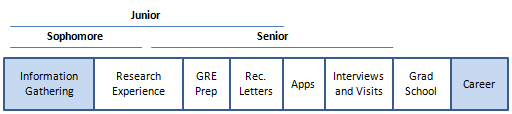
This week, I’d like to talk about a Big Decision: Should I get a Master’s or Ph.D. in I/O Psychology?
This falls under two categories in my grad school timeline above: Information Gathering and Career. This is a decision you should try to make during your sophomore year of college, and the decision should be driven by what kind of career you ultimately want.
Careers in I/O psychology are a little different than in most fields. Because we are so small (in the grand scheme of things), there is less public advertisement of positions than typical in most fields. You probably won’t find a position for an “I/O psychologist” on Monster.com, for example. Many positions that I/O psychologists end up in are also not called “I/O psychologist.” As the “science behind human resources,” I/O psychologists end up in a wide variety of career paths. This is because the skill set developed as a I/O psychologist in training prepares you for virtually any job involving “people at work,” including consultants, professors, assessors, directors, and CEOs. For a few examples, see these resources from SIOP.
So when you think about the difference between Master’s and Ph.D.-level training, you’re not comparing specific careers – rather, you are considering different approaches to training. In a Master’s program, you are training to become an I/O professional. An I/O professional will consider how to apply the principles of I/O psychology to solve specific organizational problems. In a Ph.D. program, you are training to become an I/O scholar. An I/O scholar will do the same tasks as the I/O professional, but will also use those experiences to advance our general understanding of I/O through research.
Thus, I/O professionals (Master’s) are trained to help organizations. I/O scholars (Ph.D.’s) are trained to advance organizational science, helping organizations along the way. Master’s students are trained to practice I/O psychology. Ph.D. students are trained to conduct research in I/O psychology.
In practice, this means that an I/O psychology Ph.D. will generally have more responsibility than an I/O with a Master’s. If you are in an organization with lots of I/O psychologists, the Ph.D.’s will generally be making “the big decisions,” while the I/Os with Master’s will aid with implementation or conduct background research. Since many modern organizational problems are at the frontiers of our current understanding of organizations, a person with Master’s level training will generally not be prepared to conduct research within the organization to help answer these questions. Of course, there are many I/O’s with Master’s that start their own consulting agencies or work as the only I/O psychologist in an organization – but this is a matter of experience and personal drive.
And of course, if you want to be a professor, the only suitable degree is a Ph.D.
All I/O training, regardless of level, centers around (or rather, should center around) the scientist-practitioner model. This is one of the key differences between an MBA in Human Resources and a degree in I/O Psychology. While the MBA will make an informed decision, usually based on reasoning from case studies and their own experience as managers (often anecdotal evidence or recommendations from more experienced businesspeople), an I/O will reference the current scholarly research literature to make this same judgment from scientific evidence. While an MBA simply wants to solve a problem, an I/O wants to understand that problem based on our scientific understanding of human behavior and then solve it.
If you are having a hard time making a decision, assume you’ll go for a Ph.D. The preparation you’ll do over the next three years for a Ph.D. will be sufficient for a Master’s too, but the preparation needed for a Master’s won’t be enough for a Ph.D. Better safe than sorry!
Please also note that the guidelines given here are based on “typical” programs – there are certainly scholarship-focused Master’s programs and practitioner-focused Ph.D. programs, but the majority of them follow the model here.
Once you have a degree in mind, you should tailor your efforts to prepare to apply to programs accordingly. Check out the links at the top of this post for more resources to help you make more decisions along this path. And if you’re considering a Ph.D. program, please think about applying to my school, Old Dominion University.

Richard,
Great post. I just finished grad school for my masters degree focused in Organizational Leadership and was looking to pursue my doctorates in I/O Psych. I am currently doing coaching for different focuses (http://www.shaunmayfield.com/coaching.html), and beginning to get into business and church consulting. My goals as a consultant is to help organizations with conflict resolution/management, team development and help coach executives as well as the traditional business development consulting.
What are some of your thoughts regarding different schools offering I/O Psych degrees?
Thanks again.
I’ll be writing a full post on this at some point, but here is some advice based on your question.
First, frame your decision as “which faculty” rather than “which program” or “which school.” Even if you’re in the strongest program around, if you have a poor advisor, you’ll have a poor experience. Generally, “better programs” tend to have better faculty, but the correlation isn’t all that high, IMHO.
Second, along those lines, since doctoral studies also center more around the idea of scholarship and research, the match between your interests and those of your advisor are going to be most critical. Even if you have a poor advisor, if you’re doing work you’re passionate about, you’ll still have a good experience.
Third, make sure they have a rigorous statistics training, and take as many of those classes as you can. If you have an interest in leadership, HLM is critical. Stats and research methods are the most critical skill sets that distinguish high quality I/O PhDs.
Great post, Richard! Students interested in a rigorous I/O Master’s program should check out our program at Radford University (http://www.radford.edu/content/chbs/home/psychology/programs/industrial-organizational.html).
Interested students can contact me directly if they have any questions about our program (cgorman6@radford.edu).
ag
I am and undergraduate student interested in the field and found this article very helpful. I am currently a business student and was wondering if there would be an advantage to obtaining a minor in business before i move on to a graduate program.
@Andrew – Do you mean you’re a business student considering a psychology minor? If you’re thinking a Master’s, it probably doesn’t matter much, but that will differ by program. If you’re thinking PhD, then it will be critical to have psych background to get into a Psych-department I/O program. Less so if you’re applying to business school I/O programs.
But keep in mind that many programs require you take the Psych GRE Subject Test. If you don’t have broad Psych undergrad experience, that will probably be rather difficult.
I am currently majoring in I/O psychology. I am wondering if it would be beneficial for me to obtain a minor in business administration before applying for a Ph.D program. It will add an extra semester to my undergraduate studies but I am willing to do it if it will make a difference in getting accepted.
If you’re applying into programs in psychology departments, I doubt it. If you’re thinking about business schools, then it might. You should note though that doctoral applications are typically due at the end of Fall semester, with invites to interview or visit around February. If taking an extra semester throws you off a full-academic-year schedule, I don’t think it would be worth it (at least, unless you aren’t also trying to raise your GPA).
Richard,
As an undergraduate junior at an institution that does not offer much information on I/O Psychology, I am extremely pleased with this article. It gave me way more insight than I ever intended on receiving. I now feel more confident in applying to Clemson’s I/O Psychology program. To clarify, when you stated “If you are having a hard time making a decision, assume you’ll go for a Ph.D. ” were you meaning one may skip receiving their MBA and go straightforward to Ph.D in I/O?
Keep up the amazing work!
Tatiana, I’m glad you found it valuable. By that statement, I mean that preparing yourself to apply to a PhD program (getting research experience, taking difficult classes, etc) will qualify you to apply to a Master’s program too, but the reverse is not necessarily true – or in other words, it’s easier to get into a Master’s program, so if you don’t know which you want, prepping as if you’re applying for a PhD gives you the option to pursue either later. The reverse is not necessarily true.
As an undergraduate with an extreme interest in I/O psychology but in a college setting without the appropriate faculty to help me with my interest, I found this article really helpful. Since the field is small, I’ve found it difficult to find supplements to aid my curiosity about it. Richard, could you suggest any books that may be of interest in helping my understand the field a bit more? The only things I have found have been textbooks. Thanks!
Honestly, textbooks are probably the best you’ll get – they give you a broad survey of the specialty areas in the field, which will help you narrow down your specific interest areas (if you have one). I recommend the Landy & Conte text.
I have become really interested in the field of industrial and organization psychology. If I were to get a master’s degree in this field, how difficult is to to get a job and what kind of salary can I expect to make? Are online degrees in this field a good way to get a masters degree, or would it be better to go the normal route and attend a university?
@Jeff – Employment is good for I/Os right now (you can find some outlook data here). There is projected 29% growth in the next decade, which is quite strong. You can find up-to-date salary information in these surveys conducted by SIOP. You can also find a comparison of online vs. traditional institutional outcomes in this article, which was just published this month.
Dear Professor,
Thank you for your insightful article about I/O Psychology. I am a graduate from a top college, and I’m looking to continue my studies in an I/O Ph.D. program. Despite having a reasonable major GPA, my overall GPA is just barely 3.0. I do have years of research experience in undergraduate years in great labs and now am working as a research assistant with a couple of co-authorships in peer-reviewed publications. Do you think my low GPA will affect my chances at graduate school admissions enough to warrant going for a masters first? This has been worrying me for quite some time, and I appreciate any advice.
@Jane – It really depends upon the specific programs to which you’re applying. If they have specific GPA cut-offs (pretty common), your application may not even be considered by a live person. So I think, given your background, it would certainly be wise to apply to Master’s programs simultaneously to PhD programs. With both, you definitely want to address the low overall GPA head-on in your personal statement – a number that low needs an explanation.
Can you still become a licensed Psychologist if you get a PhD in I/O Psychology??
@Gabby – Assuming you’re talking about APA (USA) licensing, yes you can, if you go to a program that is a hybrid clinical/I-O program. There are not many though. Most I/O psychologists are not licensed because there is no advantage to being licensed – it is typically more hassle than it is worth. The only reason you really need a license is to legally practical clinical psychology in whatever state you want to practice in, which is not needed to do anything I/O psychologists are typically trained to do (i.e. it is not needed or particularly valuable for organizational consulting).
Hi there – thank you for the informative article! I am currently considering making a career change, and would like some input from you if you have the time. I have a background in behavior analysis, with an undergraduate psychology degree from Western Michigan University. Most of my research and practical experience as an undergraduate involved work on studies involving children and schools. After receiving my undergraduate degree, I decided to pursue School Psychology (University of Oregon). I finished my masters degree in this area a couple of years ago, and have been working in a school system since then. I am finding that I love certain aspects of my job: working in a system and finding ways to improve it (through staff training, creating systems/procedures to increase efficiency) and the use of data to make decisions about the type of instruction students need and ways to improve that instruction if a student is not making progress. Other aspects have been trying. I do not enjoy working in an environment that is so “democratic” in nature. The principals technically are the head of the organization, but a lot of power is given to teachers/staff to make decisions based on their own values. This is not always in the best interest of the children or the organization. I can make suggestions to a teacher based on evidence-based procedures (e.g., how to change environment to help improve a child’s behavior), but there is no reason that he/she needs to listen to me. Also, in general, data isn’t valued (gut instincts and experience are valued), and there is not adequate funding for training/professional development around building these skills, even when the district states that they value making data-based decisions. I also do not enjoy the mountain of paperwork and special education procedure that goes along with my job. I am providing this level of detail, because in the research I have done thus far, it appears that the field of I/O psychology might be a good option for me to pursue, given my strengths and the things I do enjoy about working in a system or organization. I realize there would be major differences between the business world and schools, but they are effectively both organizations and some overarching concepts apply to both.
What advice would you have for me in testing the water in the field of I/O (how to find job shadowing opportunities, books or articles to read on I/O psychology, etc.)? Do you think that I would need to go the route of getting another masters degree, or given that there is some overlap (stats, research methods) between my school psychology masters coursework and an I/O masters, would I want to see about going straight into a Ph.D. program? I am fairly sure I would want to pursue a Ph.D., given the greater range of opportunities I would have with that degree. I am a perfectionist and I am very driven once I decide to pursue a course of action, but I do not want to make the same mistake I did with School Psychology, and decide to make a career change without adequate justification or information. I have spent some time looking at siop.org.
Thank you so much for any input or advice you can provide!
@Rachel – I’m not sure the reasons you want to pursue a degree in I/O are necessarily based on a realistic picture of I/O practice. Many of the things you describe (low budgets, people trusting guts over data, excessive paperwork, etc) are still present in a consulting environment. We fight the “no really, data will help” battle all the time. Paperwork just shifts to recording billable hours – recording all of your activities in great detail to accurately charge clients for your time. So I am not sure you’d really be avoiding the things you seem to dislike about it.
The best resources for “what is I/O really like” that I can send you to are all on siop.org, so you’ve probably already seen them. Jobs in I/O vary a lot in both titles and responsibilities (from data analyst to CEO) so it’s hard to pin down exactly what an I/O job is or involves. The common element is a focus on using psychology to improve human resources and human resources processes. If you’re interested in improving general organizational functioning (e.g. strategy, customer relations), we don’t deal with these areas at all.
Ph.D. programs in I/O generally bring in people straight from undergraduate, and stats/methods tend to be different at every school. In a sense, schools wants to remold you in their own stats image, and stats varies a great deal. At ODU, for example, if you didn’t get a little SEM, HLM and IRT before getting here, you’d probably need to retake the whole stats sequence.
So you might have some luck with applying some of your previous stats/methods credits, but you might not – it will be on a school-by-school basis. The bigger issue will be that you have adequate research experience – if you didn’t get at least a pub or two through your previous Master’s program, it will be difficult to apply that experience to a PhD training environment.
Process-wise, I will tell you that most post-Master’s students that apply to ODU just go ahead and apply – after acceptance, we work out what needs to be retaken. FWIW, in the past, the students that we thought had sufficient stats have told us later that they wish they’d retaken the stats courses anyway, just so that they could have a similar frame of reference to their cohorts.
Hello- I am a sophomore majoring in Human Resource Management, and I just recently read about I/O Psychology and am somewhat interested in it. I am however having problems finding out what would be the best courses to take before going on to graduate school. Would a bachelors in HR while minoring in psychology be sufficient to get into most grad programs? (That’s going for a masters, not a PhD.)
@Heather – That degree combination would be fine as long as you had sufficient experience in a research lab (Psychology, HRM, or OB).
Dear Mr Landers,
Thank you for the great post! It sheds inside some light on how things are going.
I am a master’s student in Organizational Psychology and HRM in my second and last year, with a BA in Psychology. I would like to further pursue a Phd in I/O Psychology, but am currently not sure where my odds stand. I have a good GPA (or so I think, based on my country’s grade classification ..). I haven’t taken any of the abilities tests yes, GRE, but I’m sure I will do just fine. The problem is with the research and work experience. I’ve conducted research projects on my own but did not assist any professor or haven’t been assistant in a laboratory. Also, I haven’t been employed in the field until now, so real I don’t have organizational experience ( as an employee, the projects which I conducted involved organizational applications). I really enjoy conducting research and I would like to develop my career path in this direction.
My thought is – how strong an application do I hold or can I be accepted by a good program only based on what I have done so far? Or should I better seek to gain laboratory or work experience before applying? Basically, I’m thinking that I would get admitted but analyzing some of the CV’s of current Phd students at various universities lead me to conclude that they have done more than this. The second reason for which I am asking is that I see most programs offer few places and are very competitive. Also, not affording to attend a program self-funded, I’m hoping to get an assistantship or a similar funding opportunity. How far off do you think my expectations are?
Thank you!
@Anne – The lack of formal research experience is going to be a negative for you unless you have published something from your own research. The only PhD programs that will provide funding are going to be research-intensive and highly selective (selecting between 1 and 5 people out of 75 to 300 applicants, depending upon the program). Organizational experience will generally not make your application more competitive in these programs, because working in an organization doesn’t generally teach you anything about research, which is the focus of these programs. I would not recommend applying to or attending a PhD program that does not provide funding to most of its students.
If you won’t be producing a publishable, empirical thesis from your Master’s program, such programs will also likely disregard your Master’s (except as far as your GPA anyway), requiring you to complete a second Master’s or at a minimum repeating all Master’s-level work. Also, in many of these programs, doing “just fine” on the GRE often isn’t enough – you’ll need to be in the top 5% or better (sometimes much better).
In any case, what all this means is that for a realistic chance at the kind of program you’re targeting, you need, at a minimum:
1) Some practical research experience with a faculty member and a letter of recommendation from that faculty member
-or-
2) Your own published first-author work
Dear Mr. Landers
I am currently pursuing my Bachelors in Psychology from India and I’ve been very interested in pursuing a graduate degree in this field from the US. Due to the very limited exposure to this field here, I had the basic idea however.
Thank You very much for this article. It has not only helped me understand the difference in the PhD and Masters programs, but also the difference between MBA and Masters, something that I had been trying to understand for quite some time now.
I am preparing for GRE and I have a decent score in college as well. My only concern is that I do not have any research background. Will I still be able to get admission in a top college??
Thank You.
@Trisha – It depends on your goals. If you are seeking a PhD, yes, that will prevent you for getting into top programs. But if you are seeking a terminal Masters degree, you can get into highly rated Masters programs without research experience.
Dear Mr. Landers,
I am looking for some good advise. I am considering a PhD degree in IO Psychology and I’d like to know if you recommend the program at Grand Canyon University. They offer a PhD in General Psychology with emphasis in IO Psychology. Sounds like a PhD in IO Psychology but I am not sure if in fact these two are the same.
I have a bachelors in Psychology and a MS in Organizational Leadership. I currently work as an assistant professor for a city university in NY.
I would appreciate if you could provide any type of recommendation
Thank you
Jorge
Hi Mr. Landers,
I am stuck between applying for a Masters in I/O psychology and a Ph.D. The school I am applying to has both options (Wayne State University) and I would like to get a masters, but I feel inclined that I must go for a PhD because of today’s competitive market. Am I right in this thinking? I would like to make around 90,000 a year and be a I/O psychologist or whatever you want to call it in the job field. I realize that the I/O psychology PhD program is a 6 year program at my school, while the masters is 2 years. I want to know if the extra 4 years will be worth the time lost in the workforce. This is a very stressful decision that will impact me the rest of my life, and I would like to know what is the best decision. I wouldn’t mind teaching or going into research, but since I am in my last year of undergrad majoring in Psychology and minoring in Management and Organizational Behavior taking classes such as research methods and senior thesis, I feel as if I will get a better idea of research throughout my last year. I do not have much experience with research, so I do not want to jump into something that I am not sure about, but I want to help people in the human resources aspect, but also not lose my job to someone with a PhD. Let me know if this is something I should be concerned about, and if not, I can apply for a masters walking out confidently thinking that I can get a job, because there is a bright outlook for this job position. Thank YOU!!!!
Maan
@Jorge – I am not familiar with Grand Canyon University, so I can’t really comment on that. However, a “PhD in General Psychology with emphasis in IO Psychology” implies a couple of things to me. One, you are most likely going to be completing more “general psychology” electives (sometimes called distribution requirements) than those in more “pure” I-O programs. Two, they probably don’t have a large number of dedicated I-O faculty. But those are guesses; you should check out their website to verify both of these. If you can’t find information on the website to answer these questions, contact the doctoral programs director. If you can’t get a straight answer from the website or the director, it is not likely a good program.
@Maan – Honestly, a Master’s vs PhD give you very different career prospects. The types of jobs that those with Master’s go into are not going to be the same as those with PhDs. But I’m confident you’d walk out the doors with a job with either degree from Wayne State. Given what I know about Wayne State, your chances of getting into their PhD program without research experience are probably near-zero. I don’t know about their Master’s program. It is very unlikely you would start at $90K or higher, regardless of degree. Based on the 2009 SIOP salary survey (most recent available), median starting salary with a Master’s is $55K, and the median with a PhD is $75K.
Hi Richard,
Thank you for the useful information. However, I am taking a Research Methods class this semester which leads into a Senior Thesis class for next semester. If you are unsure of these class titles, this semester we choose our topic of research and prepare a research proposal. Then next semester is where we collect all the data. This will give me research experience, but I am not sure if PhD is the way to go. Thank you.
Maan
@Maan – For comparison, one of the students in my lab hoping for admission into a PhD program next year is currently completing an independent research project while volunteering 30+ hours per week across 2 I/O research labs and 1 outside I/O. He will have 3 letters of recommendations from faculty with whom he has worked as a researcher. He has attended weekly lab meetings with my for nearly 2 years. For a high-tier research PhD program, that is just one student with whom you are competing among a hundred or more applicants for 3-4 total spots at each school. Given his history, I suspect he will be admitted to about half of the programs to which he applies. I think you are underestimating your competition.
As for whether or not a PhD is appropriate for you, I can’t tell you much more than what I’ve written here. Working in a research lab with a faculty advisor and graduate student supervising you is precisely the experience that would help you answer that question (which is why many faculty, myself included, don’t generally take students without such experience).
Dear Mr. Landers,
Thank you so much for the valuable comment. I think you were right on the money. I spoke to the doctored admissions officer and she mentioned that the degree is indeed in general psychology and it has 5 distinctive electives related to I/O Psychology (I/O Psych, Human resources, Systems, Leadership, Program Review etc.) The other 15 classes are from the general psych format.
If I may, I came across with Keiser University program. This school seems to have a true I/O Psychology program but I am not familiar with the reputation of the university and if it will be a good institution to obtain such a high degree.
Considering my background, in your experience, would it matter where do I get my PhD from. As I mentioned earlier, I have a bachelors in Psychology and a MS in Organizational Leadership ending with an empirical base research thesis dissertation. I currently work as an assistant professor tenure track for a city university in NY.
Thank you again
Jorge
Thank you for your time Mr. Landers.
@Jorge – I’m honestly a little confused by your situation. Typically, the PhD is considered the entry-level degree for a tenure-track professorships, so if you’ve already got that, and that position is your end-goal, I’m not sure why you need a PhD. If this is about a salary increase and your goal is teaching where you are forever, then it probably does not matter much where you go. If this is about future career prospects and your goal is research, consulting, or upward/lateral movement within academia, then you want the best program you can get into.
Dear Mr. Landers, thank you for your reply.
The reason I am looking for a PhD is to further my career as an educator. I have been working as a surgical assistant for 17 years and I became an educator about six years ago. My position as an assisting professor tenure-track is at the associates level where the highest education required is a masters degree as well as publications, which I am still working on.
My goal indeed, is to teach at a graduate level in a field related to my graduate degree and eventually move out of the associates level. My problem so far is identify the right school that offer the programs I need under the conditions I can afford at this present time. I am 52 and have a family to support, therefore the program must be online with no GRE requirements. I know I am asking too much. Keiser University asks for a Masters degree in lieu of the GREs. However, I am not sure if obtaining a degree at this school will be worth enough to accomplish my goal.
Thank you for your time again and again,
Jorge
@Jorge – You still seem to be in an atypical position in comparison to the T-T positions I’m familiar with. In I/O, you generally need a PhD to be on the T-T at all (progression from Assistant Professor to Associate Professor to full Professor, which generally takes at least 12 years post-PhD). Assuming you want to stay where you are, I think you should speak to another I/O (or at least another psychologist) in your department; I can’t speak to the culture and technical requirements of your institution. If you want to go somewhere else, you will almost certainly need a PhD – at least 5 years to get the degree (sometimes longer) and generally 7 more years to earn tenure.
Hello Rich,
First of all, thank you for your highly informative and factually rich article. Your candid and honest advice has clearly been valued by those who have read this article, and has personally provided for me an adequate amount of information in addition to what I have seen on the SIOP website to formulate my own opinions on the field.
Now, I would like some candid and honest advice of my own. I am a fresh graduate from a major Big Ten university (Indiana – go hoosiers!). I demonstrated academic poise and discipline by finishing my undergrad in just three years, with a BA in Spanish, a Certificate in Business Operations, and minors in Linguistics and Latino Studies. Since graduation, I have launched a career in Account Management, but have noticed a keen affinity for structural and organizational affairs. I have assisted execs in developing initiatives in a newly-public company to add structure to a program that is meant to cover intraoffice diversity issues. I have long-term interests in the area of Corporate Social Responsibility, and am looking at MS programs in I/O psychology to get a formalized credential on my resume before I consider applying for MBA programs.
Essentially, I am curious about a few things. 1) Will I be set back by not having an undergrad background in Psychology? 2) Will my current position (Account Management) be of hinderance in the application process as it is not the most comprehensive, analytical position? (Even though I have proven myself to work outside of the job description in a much more I/O psych flavored way?)
I would appreciate your prompt response, although it appears that you have many questions to answer — consider that a compliment! You’re the pro! 🙂
1) For an MS, I’m honestly not sure. If you were applying to PhD programs, zero background in psychology would definitely be a problem. I’d normally recommend taking a few undergraduate classes in Psychology at the nearest university, volunteering in a research lab, and completing the Psych GRE. In your case, I’d recommend contacting the I/O area director (or MS program director) at the schools you are considering and ask their opinion.
2) Generally, no one cares about outside work experience as far as admissions are concerned.
As a side note, it’s very unusual to think about an MS in I/O as credentialing along the way to an MBA; an I/O MS is a more rigorous degree than an MBA (I’d think of it as a step backwards, or at best, sideways).
Hello again Sir,
I came across a course on the SIOP website – MA in Human Resource and Industrial Relations, that is being offered by some universities.
I just wanted to know if there is any difference between this course and I/O Psychology, in terms of course as well as future prospects.
Thank You
I think by “course”, you mean “program.” And no – they’re not the same. HRIR is going to be in a business school, and it is somewhere between an MS/MA in I/O and an MBA in HR. The job opportunities may be similar, but it depends on the school.
Thanks a lot for your help Mr. Landers.
I was wondering what your take on psy D approach. I’m currently looking at a IO masters and a psy D after wards in Org psych.
I’ve been told that a psy d. is more applying info like a masters.
Could could please shed some light on the difference?
Thanks and great article
PsyD in I/O is very uncommon. Most likely, it focuses on clinical with an I/O and counseling emphasis. You are correct that it will be more applied; however, you won’t get the same sort of training (or honestly, respect) as an I/O PhD will.
Hi Dr. Landers,
I am currently in a PsyD I/O program at Touro and had previously left there to complete a Clinical psych licensure program. I plan to return to Touro. The PsyD I/O curriculum is completely research based but without the PhD label. Coming back to Touro for an MA or PsyD in I/O are options. I am 54 with an MA in Multicultural Ed and teaching background, and tons of units that cant all transfer. Since Im 54 and a high school teacher/administrator I am not sure if the PsyD or perhaps a PhD somewhere else would be smart. I would like to teach but can I do so with a PsyD in I/O? How realistic is this? Is an MA from Touro just as good since the PsyD will cost more time and $$..and may not carry enough credibility to make it worthwhile?
Thanks in advance .
I did not know Touro had an I/O program at all. You can teach with a Master’s degree in Psychology, so a PsyD is plenty. If all you’re trying to do is teach at the college level, a Master’s is all you really need. I don’t know how much you’ve looked into it, but I will warn you that teaching at the college level does not pay particularly well. At most teaching-oriented schools, you can expect an earnings cap around $55K with a PhD, closer to $35-40K with a Master’s, although sometimes much lower. Adjunct work pays around $12K full time, although many people work more than full time (e.g., 80 hours across multiple institutions) to make a living wage.
The only exception here would be if you want to teach graduate students, which pays better but would require a PhD.
Thanks for the advice! The program is only a few years old and just had first grads in late 2015. I did wish to teach at the university level but wonder if PhD holders would edge me out as the preferred and normal degree. I already hold an MA so to finish another one in I/O will mean about 4 more courses vs 4 more to finsh PsyD..plus 27 addtl units for dissertation activities. So the $$ paid out for the PsyD might not be worth it.
I also consider finishing MA in Psych at Pepperdine as the brand may be beneficial but it would cost the same as the PsyD and finish faster. Cost per unit is doubled.. Issue is I am stuck right now and make 80K as a high school teacher. I have so many courses but did the bad choice of trying to combine I/O with a licensure in Clinical as so.eone here had considered. O agree..bad idea! Wish I had read/found this blog beforehand.
FYI Touro does not have a residency as it is online which they explain as to why no PhD.; however, the curriculum includes a scholar practitioner model, core has not one but 2 quant courses. All papers for each class in the program require developing evidence – based research designs using scientific model.
In teaching institutions, you actually often have people with Master’s winning out positions over those with PhDs because people with Master’s will generally work cheaper (as I mentioned). It is doubtful in a teaching career that you would ever even approach 80K again, so you should be really sure of this career path before committing. Even PhDs in tenure-track positions at top-tier research universities often start at or lower than 80, these days.
Dr. Landers,
Thank you for a very informative and wonderful post.
I am recently gaining a lot of interest in the Psych I/O field. I come from a very diverse background. I have a Bachelor’s degree in Health Sciences and most credits in a Masters in Social Policy Admin/ Social Work degree (have not finished final internship and don’t intend to finish it either)..I have taken some psych classes during my graduate social work coursework.
I want to apply to PhD programs in I/O Psych. Do you think that would be a realistic option given my background? I have a strong undergrad GPA 3.7 and a not-so-good graduate GPA 3.0.
But I do have 2 published papers in the field of mental health.
Would you give me some insight on whether I should even apply? Also, are you in a position to recommend schools I would be able to apply to given my background.
Thanks in advance for your time.
The graduate GPA will hurt you pretty badly. An axiom in I/O psych is “the best predictor of future performance is past performance,” so that will translate into poor predicted PhD performance for you. The two papers do make your case a little unusual though, so it’s hard to predict. I’d say if you have a really good reason for why your GPA is low and explain that well in admissions essays, you might still have a reasonable shot at decent PhD programs. So I’d recommend applying. But your chances may not be good (unless those are both top-tier pubs with you as first author). I’d recommend you apply to a school that shares your interests – I wrote an article on this topic: https://neoacademic.com/2011/08/03/grad-school-where-should-i-apply/
Thanks so much for the information and the link to the other article. Does a decent GRE score have the potential to cover up for the bad grad school grades? (315 on the revised GRE)
It’ll really depend department-to-department – it could, but it’s hard to say. But I will say that if you don’t address the cause of the low GPA in your written materials, it will be a strong mark against you anywhere.
Dr. Landers,
My MA is in Psychology with a 3.44 GPA. However, for my graduate program I changed disciplines and have completed classes for my MA in Anthropolgy/Archaeology with a 3.56 GPA. I am currently working on my archaeological thesis, and have been working in the field of archaeology for the past year. During that time I have reevaluated my future career goals and have decided to return to my initial interest in I/O Psychology. I am an Air Force veteran and my GRE scores were 746 Q and a perfect 800 V. However, I was not involved in any research projects during my undergraduate, and the only research I have been involved in grad school is my own thesis. I am applying to five I/O Ph.D programs for next fall, all ranked highly on SIOP. What are my chances of being accepted to one of these programs, and what could I do to increase those chances? Should I accept that my less-than 4.0 GPA and my lack of research experience will keep me from being accepted and simply apply to MA programs, and try again for a Ph.D program when I have an I/O MA? Or are admissions likely to take into account my ability to complete graduate studies even though it is in a different field, and my better-than-average GRE scores? Any advice on the correct course of action for my situation would be appreciated!
Thank you,
Heather
First of all, there’s no ambiguous “admissions” group in small high-quality programs – the ones that make the decisions are the current I/O faculty at those institutions. Remember, you’re not applying to the school – you’re applying for a 5+ year mentoring relationship with a specific person or group of people.
The lack of research experience in psychology will definitely be a negative for your application, unless you have published a few things in your current field, but it sounds like you haven’t. Most PhD programs at the highest tiers of institution don’t consider previous Master’s work unless it is VERY similar to what they want you to have completed at the Master’s level, so my suspicion is that completing a distinct I/O Master’s is probably a waste of time if you’re definitely on the PhD track. However, I think your situation is sufficiently unique that you should probably contact the faculty you’re thinking of working with at those institutions and ask their opinion.
I’m also not sure what you mean by “ranked highly”. If you’re interested in top 10, for comparison, I went to a top-10 program , coming out of undergrad with a 3.9 GPA, 99th percentile GRE scores, and an in press publication. I was still in the middle of the pack of those admitted. You might want to set your sights slightly lower, where your high GRE scores are more likely to lead faculty to overlook the lack of psych research experience (but this will vary from professor to professor). I would personally be very apprehensive unless you had an extremely convincing personal statement that explained the switch very clearly.
Dr. Landers,
I am considering getting an undergraduate in Psychology, and I would like to go on to receive a PhD in I-O Psychology in the future. However, I am worried about the difficulties of getting a steady job in the field. I realize that earlier you informed Jeff that the employment for I-O Psychologists is supposed to increase 29% in the next decade, but since I-O Psychology is a small specialty, won’t this dramatic growth only amount to about 800 new jobs? Those numbers worry me a bit. I was also recently told that I-O Psychologists were among the careers with the highest current unemployment (around 10.4%). Is this true?
-Thanks for the help,
Pat
More technically, employment for “I/O Psychologist” as a job title is expected to increase 29%, but this is 1500 new jobs (see http://www.onetonline.org/link/summary/19-3032.00). But I/O Psychologists work with many other job titles as well (e.g. VP of Human Resources, Director of Training, etc), so that is not exhaustive. I expect the number to be higher.
Where did you see 10.4%? Can you cite a source? The unemployment rate for people with PhDs hovers around 1-2% (even during this last recession), so that seems very high to me. We’ve never failed to place a PhD student in a job, and the same was true for the graduate school I attended. Although I suspect that is less true for online institutions.
The 10.4% number makes more sense if you’re talking about an undergrad “I/O psychology” degree. I wouldn’t recommend an undergrad psych degree alone (or any liberal arts degree) in terms of career prospects without a graduate degree to follow.
Oh. Quite. I had not considered that.
As far as the unemployment rate goes, I double checked my sources and I believe you are correct. In the articles I read, I-O Psychologist was being placed among other undergraduate degrees, they just never explicitly stated that they were not counting PhD graduates. My apologies. I believe my entire question was one small misunderstanding.
Dear Dr. Landers.
I have been looking into numerous programs as they relate to Human resources, organizational leadership, behaviors in the workplace and on productivity, etc. I have come across a few programs-the ED.d in Organizational Leadership. I am drawn to these programs and the I/O doctoral programsPhD.
Can you tell me the difference in these two types of programs, for example the training received and would you they both prepare you for the same type of practical work. I would assume that with the PhD there is the option to be in academia, and that option would not be with the ED.d.
The organizational leadership on some I/o programs is also a concentration within those studies and the EDd in many programs has most of the core couse work from the pyschology department.
I am really confused as to the difference between these programs other than the fact that one is a Phd and one is an EdD.
Can you p lease provide some clarification..
Thanks.
They are very different programs. An EdD is going to be more practice-oriented, but focused more narrowly than an I/O degree. An EdD will prepare you for leadership positions generally in higher education – VP of a community college, head of distance education, etc. There may be some focus on applied analytics, but less dedicated statistics and research methods training than you are likely to get in an I/O program. I don’t think many EdDs get jobs in industry, but I imagine some do. My suspicion would actually be that it’s more common for an EdD to become a faculty member than work in industry, but that’s a guess. An I/O degree, regardless of MS or PhD level, is much broader – you’ll get training across all areas of human resources and organizational behavior. If you take I/O courses within an EdD program, I’m guessing they are primarily focused on leadership/teams/org behavior, which is only a portion of an I/O degree. But again, this will differ from program to program – comparing any particular pair of programs, PhD vs EdD, either could be more rigorous/respected/likely to get you a job.
Hi Dr. Landers,
I am currently enrolled in an M.A. I/O Psychology program. In the future, I have interests in becoming involved with developing start-up companies. I am curious about the role/need for an I/O Psychologist in the entrepreneurial world. Will there be value for I/O Psychologists in assisting business development for newborn companies? What would be the biggest challenges and how would these types of positions differ in comparison to those with established corporations?
Thank you.
That’s a pretty broad question. I/O provides a toolset for managing human resources, which I think is valuable in virtually any organization. However, many of our statistical analyses rely on large sample sizes (i.e. large organizations), so I think the biggest challenge would be adapting those analyses for use in small organizations. For example, if you’re hiring 30 people from a pool of 100, I have many tools to help you do that – but if you’re hiring 1 person from 5, I have some advice for you, but much less.
To be honest, I don’t think that most small organizations (less than 50 employees) need a dedicated in-house I/O psychologist – they would be much better off outsourcing to an I/O consultancy. If you want to work with startups, I’d suggest joining (or creating) a company dedicated to working with startups. But I don’t think I/Os in such contexts are very common, at least right now.
Hi Dr. Landers,
I appreciate your comments and information they are very helpful! I am a junior pursuing a degree in psychology with a minor in business. I am looking into receiving my MA in I/O-hopefully in Europe. Are you familiar with any I/O masters programs there? I plan to come back to the states to work, but would it be difficult to find a job here because I have been studying abroad? Any general challenges I should be aware of if I decide to do this?
I/O is not precisely I/O in Europe – most European schools fall under the label “work psychology” and tend to focus more on the “O” side of I/O. That’s not universally true through. If you’re interested in more of the “I” side (which I’d say is where most of the jobs are), you’re probably best off staying stateside.
Also, one of the biggest advantages to going to a respected program is that they will have connections to local (or at least regional) consulting firms where their graduate students tend to go. If you go to a European school, all of your connections will be European, and you’ll be best off getting a job in Europe (in fact, probably in the country of your school).
Finally, Master’s and Doctorate degrees in Europe are generally not “American-style degrees” – Master’s degrees for example typically are paired with undergrad degrees and often only involve 1 year of study. Even PhD study is typically quite different – more of an apprenticeship to a professor than a formal program of study. That’s not going to be universally true for all schools in Europe, but it does mean you’d need to do a LOT more research on individual programs to see how similar to US programs they are, if you want to eventually come back. If you want to stay in Europe, the differences matter less.
IO psychology is a generally horrendous field to go into. I’m finishing my masters and virtually no fellow students over the two years in my program or others I’ve met at the masters level find jobs that are even mildly related to the field. Expect exceedingly low pay near 30K with a ceiling below 50 after ten years. The only successful consultants went to highly competitive schools for PhDs. Let me reiterate this as clear as possible, DO NOT GET A MASTERS DEGREE IN IO PSYCHOLOGY. You will most likely regret the decision unless your goal is low pay working in HR doing mind numbing tasks. You will not hear this from professors but unless you score very highly on the gre, your odds of gaining acceptance to a good phd program are very low. Here is the remedy: get a degree in engineering and go into the oil and gas industry. There you will find respect, great compensation and a great job outlook. Do not fall pray to anyone who tells you that you are a “professional” at the masters level in io, you are not and will not be treated as such. I wish someone told me this two years ago before taking on the debt of a masters in IO because its almost as worthless as a masters in clinical. Do not do it, you will thank yourself later.
While I appreciate that you’ve had a bad experience, I don’t think it’s the norm. What you’re saying doesn’t match up at all with the salary surveys conducted by SIOP or what I hear from students with Master’s themselves. What you describe actually sounds like the result of going to a Master’s program with a poor reputation (e.g. online or not specifically I/O focused). Like most business-related fields, I/Os is a people-business, and if the program you go to doesn’t have connections with industry or a good reputation, you’re not likely to get a good job. I/O also fights for respect in general – if you go somewhere without an I/O PhD that will supervise you, you will have to fight that battle. Most people don’t even know what I/O is – why would they respect it? But if there are already I/Os there, they will have already fought that fight.
To also continually spew this misinformation that most accepted phd students score in the top 5% is completely incorrect. The students accepted to almost any phd program average just under 1300 on the old gre scale. It is public information on their program pages, you can’t make numbers up. They are psychology students, not engineers, the scores are simply not that high, and you need to actually look up the info before you tell a woman who scored in the 99th percentile that she won’t get in because any psych program would roll out a red carpet for her.
I was referring to quality programs. Usually departmental websites will give you a mean GRE score for their entire psychology program – that doesn’t take into account inter-program differences. I am getting my numbers from our own applicant and acceptance pool. We fairly rarely accept anyone with much below 1300 – but that is not necessarily true in other areas. I/O tends to have higher expectations for math skills than other areas. Also, if you think that “top 5%” is more stringent than “99th percentile”, I think that serves as pretty strong evidence that your quant training was not great. 🙂
I didn’t imply that the top 5 percent is more stringent than the 99th percentile. I was stating that most phd programs outside the top 5 accept students who score around 1300 on the old scale. There are also no a plethora of “respected” masters level programs that receive any of that respect outside of the realm of IO. Check the top google keyword searches for masters IO psychology jobs and you’ll see that it isn’t easily accomplished. Big IO firms don’t hire at the masters level primarily and if you actually want to do IO work on a salaried basis that’s about your only option. You “fairly rarely” accept anyone under a 1300? Got it. You’re out of touch with reality and giving people unrealistic expectations about the job outlook for IO masters and their odds of gained acceptance to a phd program. Inter-program differences are greatest between Neuro and everything else. Clinically generally has even greater applicant numbers than IO and higher gre scores.
Why would you Google I/O jobs? I’ll reiterate – if the place you went didn’t direct you toward several potential employers, then it was not a good place to go. If you made a bad decision about where to go, just own it and move on. And I’ll agree in that case – if you can’t get into one of the better-reputed Master’s programs, you probably shouldn’t go at all. But that is true for any field, including engineering. And if you want a little career advice – the kind of bizarre arrogance you’re displaying here is a big turnoff for employers. Respect is not automatic, for those with Master’s degrees or PhDs. It must be earned no matter what, and it appears you expected it to be automatic.
Dr. Landers,
I’m considering pursuing a career in I/O Psychology. However, my undergraduate degree was in accounting and international business. I have no academic experience in psychology other than an Intro to Psychology class my sophomore year.
Assuming I am accepted to a master’s program in I/O Psychology and complete a master’s thesis, would that provide enough groundwork to apply to a doctoral program?
You’ve responded to other posts mentioning the importance of going to a university with a good reputation. Would all of the Top 20 MA/MS programs listed on the SIOP website be considered quality schools? I know that might be a dumb question, but if there are only 40 schools to choose from, the top 20 doesn’t mean much. Also, some of the schools listed in the top 20 MA/MS don’t offer a doctoral program. Would it be a disadvantage coming from one of these schools when applying for a doctoral program at a different school after graduating?
That’s a complicated question. If you know 100% that you want to pursue a PhD, you should try for a PhD immediately. It is generally more difficult to get into a PhD program if you already have a Master’s degree. And even with a Master’s degree, you may still need a full program (5-7 years) at the PhD level afterward, which means the Master’s just delays you career-wise. Most programs that have both the Master’s and PhD level don’t expect Master’s students to progress into their PhD program – if you wanted a PhD, it is assumed you would have applied there in the first place. There are exceptions; for example, at ODU, we occasionally accept people into our Master’s program if they are reasonably strong candidates but not strong enough to get into the PhD program (or we’ve run out of money for assistantships), and we want to give them a sort of “trial run”. But as a result, our I/O Master’s program is very small – maybe 1 student every 4 or 5 years, but they take classes alongside the doctoral students and most ultimately end up in the PhD program formally later. But that’s something that must be arranged beforehand with a particular faculty member.
Rankings are tricky, because they are not always based on something you would personally find meaningful. If you’re looking at rankings based upon reputation from industry, then that sort of list would be helpful. If you’re looking at rankings based upon how happy the grad students are, that will be less helpful, given your goals. There is also some variance in how current those lists are, so I’d recommend checking publication date too.
An extra problem for you is the empirical thesis dimension. The training in most Master’s programs, high quality or otherwise, is explicitly directed at getting you prepared to work in a Master’s type role. Programs vary in the degree to which they would prepare you to enter a PhD program – statistics training is generally weaker, as is research methods. Even if you do a thesis, it may not be empirical (e.g. case study research, or some types of program evaluation). This is something you’d need to investigate about each program.
To be honest, you are not in a good position given your goals. I have heard of people going back to get a second Bachelor’s in Psychology in that situation, although that’s probably a bit extreme. If I were in your shoes, I would probably identify a particular faculty member that I was interested in working with and then contact them via phone to explain my situation and ask if they’d be interested in my volunteering to work in their lab for a year, 20+ hours per week, with the intention of applying to their PhD program if everything went well. If they were open to it, I’d then work my butt off to be an absolutely amazing research assistant over the next year. Even that strategy is not surefire – but at worst, you’d have some research experience to talk about in your applications elsewhere.
Dr. Landers
While filling out my applications, I realized there are some universities offering Masters in HR. These universities have also been listed on the official siop website.
http://www.siop.org/gtp/GtpLookup.asp
I would like to know how exactly the programs in HR are different from I/O, especially in terms of career prospects.
Thank you
To be honest, this is really a case-by-case sort of question. Some HR Master’s programs will be more like an MBA with an HR emphasis, others will be a blend of traditional MBA/HRM courses with I/O, and others will be mostly I/O. I’d say it is probably easier to get a job with an I/O background than an MBA, but it depends a lot on the school you attend either way. I’d recommend checking the programs to see what their curriculum looks like (mostly MBA courses or mostly I/O-type courses). If you see a lot of overlap with the traditional MBA program, it is probably more like an MBA.
Thank you Sir.
Also, is there any reliable source to know about which schools are good, especially in terms of placements. Being an international student, most of what I know is through the internet. So a reliable source about universities would be really helpful.
There’s really no single source, since it depends on what you are looking for in a program. Graduate education is much more complex than undergraduate. If you are interested in job placement, some programs self-report on their websites where their graduates tend to work. Here is an example from ODU: http://sci.odu.edu/psychology/io/alumni.shtml
Dr. Landers,
You’ve stated that you do not recommend attending programs that do not fund their students, and that “getting into the best program you can” is important for careers that involve research or consulting. What about applied work in organizational development or human resources management? Does it matter much then?
What about a school like Louisiana Tech…they do not provide tuition waivers, but they provide a 15k/year stipend for their PhD students to work 1/2 time as research assistants, and the TOTAL cost of the program comes out to be between 15k-17k (about $2,300 + fees per 12 credit semester). This seems like a pretty good deal to me, and with an acceptance rate of around 50% (only 12 applicants on average according to SIOP), and fairly low GRE and GPA cutoffs, it seems like a good choice for applicants who are lacking in some piece(s) of their applications.
However, having so few applicants and the inability to provide tuition waivers leads me to believe that this school is less “prestigious” than others…will this hurt a Louisiana Tech grad’s job prospects?
That is a tough question. RAs are generally considered better than TAs because you are paid for the research work that you are likely to be doing anyway. A lack of tuition waiver is unusual; tuition waivers are usually part of an RA/TA package, and that’s actually the first school I’ve heard of that doesn’t include one. But that doesn’t necessarily speak to the quality of the program.
I suppose the trade-off is that you can only get a PhD in a certain field once. Once you are “branded”, so to speak, that is your PhD granting institution forever. In academia, it could work against you to have a degree from a relatively unknown place. However, in industry, that will be less true. Once you have a few years of work experience post-PhD, it honestly doesn’t matter a whole lot which school you went to except in terms of training quality (higher quality programs tend to have better training especially in statistics) and alumni network (which, to be honest, is very convenient at times). I suppose I’d recommend asking their graduate/PhD programs director what their placement rates look like – I suspect most students end up going applied, but you want to get more information on where and approximate salaries. You might also consider emailing some of their graduate students and asking how they feel about their chances on the job market.
Again, it’s important to remember that while I can give general recommendations, nothing will be better than getting first-hand accounts from current students from the particular programs you are interested in.
Thanks!
Dr.Landers,
I am a US Army Soldier, currently on deployment to Afghanistan. I recently completed my BA in Psychology through a regionally accredited online university. I am debating whether a Master’s in I/O Psychology would be the right choice for me. Due to my current line of work, I am unable to relocate in order to take advantage of a graduate school program at a physical university facility, so I am limited to those schools which have the program available online. One of the more reputable online programs available appears to be Colorado State University – it is, at least, a recognizable State run institution rather than a no-name, for-profit, or private university. Another option might be Southern New Hampshire University (private, non-profit, regionally accredited).
I have read the information available here and on the SIOP website regarding the dim light that online degree holders are often cast in by employers compared to our traditionally educated counterparts. My question to you is as follows: do you believe that the circumstances of my education (i.e. obtaining it while in the service) would mitigate to some degree the negative impression that often follows online educations?
Also, by the time my contract is up, I will have completed eight years of honorable service in the Army with three of those years as a Sergeant or better. Would a company interested in hiring IO degree holders view me as having had management experience based on this? I can assure you that an Army SGT is expected to deal with a variety of challenges that would probably cause even the most stalwart of corporate team leaders to pause for composure, but I do not know if this type of management/leadership experience is something that the IO / HR world recognizes as being transferable to a corporate setting.
Any insights you may have to offer on these issues will be greatly appreciated.
Lucas
That is a very tricky question. One set of the primary advantages to an applied graduate program are the connections you gain by being a part of one. You just don’t generally get those in online I/O programs – at least right now. That may not be true for SNHU (I didn’t even know they had an I/O program), but I don’t know for sure.
Your question also isn’t really the right one to ask – that being in the service would mitigate the negative impression. Even students in low quality brick-and-mortar I/O master’s programs have a hard time finding jobs – the issue there is that the training often isn’t as high quality, or as focused, or as intense. For comparison, our master’s degree training requires a full-time commitment. Many of our students at the master’s level spend 60-80 hours per week going to class, working on research, etc. More during crunch time. We also only have 5-10 students at the master’s level (PhD track or otherwise) at any given time. You just don’t get that kind of intensive training and one-on-one attention in any online program that I know of (the same is true in diploma-mill master’s programs, of which there is a growing number). As a result, you come out with poorer harder-to-employ training.
I will add that Colorado State may be the lone exception to all of this. They have top-notch faculty (e.g. Kurt Kraiger, Jan Cleveland), so I would expect the training and alumni network to be top-notch too. But I don’t know anyone personally that has completed that program, so that’s a bit of a guess.
As for your military experience, it is very transportable to I/O, but I think the value placed on it varies a lot by employer. While I’ve personally seen the discipline, level-headedness, and problem solving that veterans often bring with them to I/O, not all see that value. More of concern to me in your response, however, is that you are comparing team leadership with what you might be doing with an I/O master’s. I don’t think that is typically what I/O training would prepare you for – that sounds more like an MBA. I/O is going to have you doing things like creating surveys to assess employee engagement, meeting with HR to discuss current retention strategies, etc. – not quite the same.
Hi Dr. Landers,
My post may not be as specific because I am just learning about this field (I/O P).
Your article was highly informative. I graduated with a B.S. in Physiology and Neurobiology. (In high school, I began to take some college courses in Psychology.) I ended up taking a few years off post college. During this time, I worked in Human Resources. HR sparked my interest and now I am considering to get a degree to become a coach, consultant, or some type of person who admonishes in the corporate world. I have been doing some research, and I found a program that is a DBA specializing in I/O Psychology. Now, I read through some of the aforementioned questions and replies, but I did notice any question about DBAs. Could you explain if a DBA is well respected and/or accepted in the business world or would it be preferable to get a MS or Ph.D in I/O if I were interested in HR Coaching/Consultant or to be part of the organizational development team for a corp?
Thanks,
J
I have never even heard of a DBA. Having said that, I am not in a business school, so it might be perfectly fine. However, in most business schools, a doctorate is a research-focused degree, and you generally only want one if you plan to be an academic researcher. If you want to do executive coaching – or anything applied, for that matter – you are probably more interested in an I/O PhD, I/O MS, or MBA.
Thank you for this information as it was very helpful. I am wondering if you have any advice on someone trying to re-enter the field of I/O Psychology. I have an MBA in Strategic Management and would love to get back into the field after being absent for over 17 years (I used to be an HR consultant) I have been working in management (project and operations) and recently I miss the Field both academically as well as practically. Any advice/guidance you can offer?
It would be very challenging to move into a PhD program, if that’s your goal. But if you wanted to try anyway, I’d recommend volunteering 10-20 hours per week at a local I/O psychology lab to get some recent research experience. With a year or two doing that, plus good GRE scores (start prepping now), you probably have a good chance. If you’re interested in a MS/MA, I’d recommend just applying – your extensive applied experience will be seen very positively, as long as your GREs are also strong.
Dr. Landers,
Thank for the article with the much needed clarity in the differences between Masters in Business studies and I/O psychology. This triggered to share a concern.
I have done my bachelors in Engineering and I am a corporate trainer in the behavioral domain with experience in designing and delivering training programs for the employees of a firm in India. I have developed an interest for observing workplace behavior and how it can affect productivity. Given my experience and inclination for better understanding training effectiveness among employees and to contribute for better understanding of workplace attitude, I have considered pursuing MS in I/O and organizational behavior.
I have worked with a social organization which has given me the exposure to understand what the measure of effectiveness of training programs would be in an open organization. Also, i am exploring the dimension of personnel selection too.
I would want to know what the potential of areas of research in the field of I/O?
I also would want to if my interests are aligned with what the programs have to offer?
I am planning to apply for next fall for some of the top universities in the US. I have not majored in Psychology in my academics, would this affect my admission? One thing i have noticed is that universities ask for knowledge in Statistics.
Can you guide me in filling this void in my qualificatiion.
Thank you.
Training effectiveness is certainly within the boundaries of I/O. I have created a model of training effectiveness myself as part of my research program. So I think you will find overlap there, although certainly not all I/O jobs involve training evaluation. If you want to pursue training evaluation specifically, I’d recommend identifying programs that specialize in training.
For MS degrees, your lack of psych background may not hurt you, but I honestly don’t know. It would be almost impossible to get into PhD programs – I would never accept anyone without a psych degree or (instead) at least 3-4 years of lab experience in a psychology lab. I imagine MS programs care less, but I don’t bring on MS students, so I don’t have an answer for you. Many programs do expect a basic grasp of psychometric measurement (reliability, validity, constructs, etc) and basic statistics (from means up through at least analysis of variance/ANOVA). If you don’t have any background in statistics at all, I suspect you’d find most I/O graduate programs very difficult.
Dr. Landers,
Thank you for addressing my conerns. I did get a chance to read and get insights about your research on training evaluation.
In continuation with what i had asked earlier about the lack of introduction to Statistics, i wanted to know if it would help if i took up introductory course in Statistics online? Then, would a mere mention about my knowledge do or would i be required to produce transcripts about an institution certifying me in Basic Statistics.?
And, Sir, You had suggested identifying progrmas that specialize in training, What would be some of he best sources to help me explore that field?
On the other hand,my interests lie both in training effectiveness and in personnel selection, I wanted to increase my knowledge base with a Masters in I/O psychology as I believe it would introduce me to the different aspects of I/O and i would eventually choose courses that i want to specialize in. Would you say this train of thought is advisable?
Thank you
Informal statistical training probably won’t help you – you would need to take a course somewhere.
To determine the specialization, you should look at the list of faculty for each institution you are interested in and read up on their recent publications and stated interests. If they are interested in training, they’ll say it there. And I would not trust a program that does not list its faculty online.
As to your thinking with the Master’s, it sounds like you might be thinking about a PhD after the Master’s. I will say that it generally a bit easier to get into a PhD program without getting a Master’s first. So if you already know you will want to take classes past the Master’s, you should be aiming for PhD programs.
Dr. Landers,
Thank you for your very helpful information regarding I/O psychology as a career field.
I’m currently a junior at a small, well-respected liberal arts school pursuing an undergraduate degree in pyschology. Up until this past summer I was interested in speech pathology but after doing an internship with SLP I switched my interest to I/O. Since then I have secured an HR internship which I am currently participating in and have tried to grab a couple of relevant courses such as Research Methods. My biggest concern is that because of the liberal arts emphasis of the school, the opportunities to conduct research are extremely limited and generally reserved for students in the natural sciences. I could try and find a research-based internship for next semester but by that point I will all ready be a senior and won’t be far into an internship by the time I have to submit my master’s applications; meaning I won’t have recommendations from research supervisors, etc. Do some master’s programs weigh research experience more heavily than others? How can I find information about this? Lastly, I’m curious whether you think my HR internship is a waste of time considering that the internship is very business-centric. T
Thank You.
If you only want a Master’s degree, research experience is not as vital. In fact, your HR internship is probably ideal for getting into a Master’s program, because it will give you plenty of opportunity in your various personal statements to explain what you see as attractive about HR, but why you specifically want to go into I/O.
It’s only if you want to go into a PhD program that research experience becomes absolutely vital. To that end, students in SLACs (small liberal arts colleges) seeking research experience do a few things to get around this problem: 1) drive to a nearby university to participate, 2) work in a research lab remotely, i.e. online, 3) participate in a summer REU program in psychology. I’d strongly recommend REU, although most of their deadlines are probably around now or already due. You can get more info through this portal: http://www.nsf.gov/crssprgm/reu/list_result.cfm?unitid=5054
Other schools sometimes have REU programs outside of NSF, but it would require some googling to find them.
Dear Mr Landers,
I’m so thankful I find your articles and advice here. I’m an undergrad student majoring in Business in Vietnam and therefore I’m not familiar with the system and get quite confused. Please help me make clear a few things first:
1) The PhD program in this context is a 2-3 year or a full 5-8 year? Do 5-8 year program require much research experience?
2) Why a master degree will hurt my prospect of getting into a PhD program? A second balchelor in Psy is more desirable than a M.A in General Psy (or anything psy, even I.O if that’s available) to get in a full 5-8 yr program?
My plan is to go to a MA prog (in Psy or in something business with extra courses in general Psy) then apply to PhD with or without some work experience in the middle.
I get a faint notion from all the advice above that in this case, it’s best to get a second Balchelor in Psy then apply straight to PhD program. But I’m interested in getting a MA (or MS), just to be on the professional/applied side of things for a while before going for PhD. This may sound time consuming but as I’m not a Psy major, it’s either I study for another BA or MA before a PhD program.
Also, truth be told, my GPA so far is poor (7.6 out of 10, about 3.0/4.0 correspondingly) while I only have 2 semester left so I’m hoping to start again. what would be the best course of action for me?
Eventually my goal is to work in consultancies and do research but I also want a career that entails travelling. Do you have to be physically limited to a lab/country doing research?
I hope to receive your advice and enlightenment and thank you so much.
1) All PhD programs in I/O in the US are designed as either 5-year or 6-year programs. People that come in with a Master’s degree usually want to skip the first few years. This is not always possible and may be undesirable to the university.
2) It is only potentially harmful if you want to use your Master’s hours to count toward your Ph.D. This is what most Master’s students want. Otherwise, you often need to earn a second Master’s degree in the new program. If you are willing to complete a second Master’s if the institution wants you to do so, this will help you and is something you should mention in your personal statement.
Without a Bachelor’s in Psychology, you may be disadvantaged. Especially with a low GPA and/or low GRE scores. Given your relatively low GPA, and given your goal of a Ph.D., I’d probably recommend enrolling in a Psychology Master’s program, ensuring you get a 4.0 and a publication or two, and then applying to Ph.D. programs with a statement that you’re willing to get a second Master’s. If you can get a Bachelor’s in Psychology without going through a complete program (i.e. if you can do it within a year or two), a second Bachelor’s in Psychology would also be sufficient and possibly preferable. Also, you can sometimes apply your previous credits towards a new degree or second major in ways that aren’t immediately obvious; I’d recommend you talk to advising. A business major and psychology minor would also be a reasonable path for many schools, and you may have time to complete a psych minor right now, depending on your institution’s requirements.
There are certainly jobs in I/O consulting that involve travel, if that’s something you want. International travel is uncommon, though.
Dr. Landers,
I graduated with a bachelors in music and am interested in eventually getting a PhD in I/O psychology. I am now in my early 30s and want to go back to school for psychology. Do you think that going back to school to get a bachelors degree in psychology would be a crazy idea at my age? Would that raise a red flag to graduate schools?
I don’t think it’s “crazy” exactly. It is fairly uncommon. But as long as you get a 4.0 GPA, have high GRE scores, great recommendation letters, and lab experience (see the other pages in my grad school series here), it doesn’t really matter when you go.
Since you are more advanced, though, you might consider taking a practice GRE test now to get an estimate of your what your score will be – practice/prep will increase it a bit, but not by a whole lot. So you might want to get a sense of which schools you would be qualified to get into and think about if that will meet your career goals before investing that many years.
What are your thoughts or opinions on PsyD in I/O psychology?
If your sole goal is to be a practicing therapist, PsyD programs are generally sufficient for that. If you might ever change your mind and want to conduct research (e.g. to identify better treatments for your patients than are currently permitted/supported, and to contribute to your field professionally at a larger scale), then most are not. You simply don’t get the right kind of training in most of them.
I say most because there are more research-oriented PsyDs and less research-oriented PsyDs. The more research-oriented ones are generally better in terms of broad preparation (although you could not be an academic, you would more prepared to contribute to the field), but there are not as many research-oriented programs as practice-focused programs. ODU (where I am) actually used to have a research-oriented PsyD, in a consortium with neighboring universities (including William and Mary and UVA, I believe). But that entire degree program is being replaced with a PhD (this year, in fact).
Non-research-oriented PsyDs are purely practical degrees – like an MBA. It doesn’t prepare you for anything other than the precise career path it is designed to prepare you for, and this specific path varies school to school.
Hi Dr.Landers,
I just happened to read and research about schools offerign programs in I/O and OB and I didnt quite understand if there really is a difference between the two? Or is it true that OB is essentially a subset of I/O? I also happen to come across via thw web that I/O is a dying field ans that all focus has shifted to Ob which was quite a shocker to me. What would be your take on this?
Also, what are the subtle differences between OB and OD (Organizational development), if any?
Thank you,
Abhinaya
I/O and OB are quite different, in terms of training. OB PhD training will be so that you can become an academic – there is not much purpose to an OB PhD otherwise. I/O has career paths with both the Master’s and PhD. OB is not a subset of I/O – it’s the other way around, if anything. OB corresponds roughly to the “O” side of I/O, while HR corresponds roughly to the “I” side. However, both OB and HR cover some topics that I/O does not (like benefits and succession planning, in HR). I don’t think I/O is dying – otherwise, I don’t think we’d have a 100% placement rate for jobs here. However, I/O Master’s programs are popping up that don’t offer very rigorous training – you might be seeing some disgruntled I/Os that were in such programs unable to find a job (which is not surprising to me at all). As for OB vs OD, I am not very familiar with OD as a field – I was always under the impression it was one part of OB (the active change management aspect). But I have not looked into it very deeply.
I’m currently considering a masters in I/O. I’m very concerned about the cost of attendance and I’m more so concerned with the career prospects. I don’t want to go through the trouble of getting the degree only to obtain a job in HR making less than $40,000. I’m very concerned about what the starting salary would be. I’m also concerned that many of the I/O related jobs would require a PhD. I definitely don’t want to do a doctorate.
I’m also concerned about getting into a good master’s program from a high ranking program. I graduated in a B.S in Psychology in December 2012. I graduated Cum Laude, completed special honors courses and completed an honors thesis, and I co-authored a research study with a professor in the psychology department. I don’t know if this is a good enough profile to gain admission into a top school.
I would only recommend attending a Master’s-granting institution that has strong connections to industry and a track record of sending their students into I/O jobs. Such jobs generally pay over $60K. Honors, a thesis, and involvement on a study should be plenty for entry into a high quality Master’s program as long as your GREs are strong. Although I suspect there will probably be questions about why you finished off schedule (i.e. not in May) and what you’ve been doing in the interim and why.
How much of a risk do you feel it is to pursue a masters in I/O?
It depends what you mean by “risk.” Having a Master’s (and not a PhD) means that you will always have the non-terminal degree of your field. As a result, as long as you’re working within another organization (i.e. not as an independent consultant), others will always be more qualified than you. If you’re happy following orders (and making less money as a consequence), and don’t care that you’ll never be in charge, a Master’s is fine – it’s really a matter of career choice and what you imagine yourself doing on a day-to-day basis for your career.
Mr. Landers,
How competitive is I/O psychology vs Clinical?
By competitive, I assume you mean entry into PhD programs? I/O is less competitive than clinical. But then again, everything is less competitive than clinical. I remember in my graduate program, there was a lot of discussion about how our clinical PhD program rejected people with perfect GRE scores. I often find myself suggesting choosing a field other than clinical (and sometimes other than psychology) to undergrads that want clinical – usually they just want to “help people” in a clinical setting, That can be accomplished with a Master’s degree in Human Services, Counseling, Social Work, etc – a clinical PhD is generally not the best path to that sort of career.
Sorry Dr. Landers…also, why do the I/O programs only admit a few students each year? If the profession is so small, why not increase the amount of students?
Thanks!
Undergrad and graduate work are very different, especially at the PhD level. In graduate work, you have a one-on-one relationship with your advisor, and the depth of that relationship varies by program, from “pretty intense” to “constant attention”. I probably personally spend 2-3 hours per week supervising each advisee individually when they are NOT working on their thesis or dissertation – so I top out around 5-ish students (which ends up being 8-15 hours per week dedicated supervision). During thesis and dissertation time, the time commitment increases dramatically. The only way to get more I/O PhD students while keeping student-faculty ratios about the same is to increase the size of I/O faculty programs, and there are many outside constraints to that problem (state-provided funding for tenure-track lines, for example).
Dr. Landers,
As an I/O psychologist, do you work more for the company’s well being or the employee’s well being? For example, are they expected to be involved in helping a company increase profits or maybe helping a displaced worker find a position in a company that fits his/her abilities. 50/50 maybe? Also, do I/O psychologists work in the medical field? Where do you see the field 10 years from now?
Thanks!
I/O psychologists do not really deal with employee well-being as its own end. “Helping a displaced worker find a position” is not I/O – it is work counseling. If you want to do that, you should get a degree in counseling. We are focused on helping the organization reach its goals; however, that often (perhaps even usually) means helping employees along the way. For example, in working with an organization, we might discover that their team structure is dysfunctional and causing a lot of stress/strain for employes which limits the productivity of those teams, so we engage in work redesign to fix the problem – this helps the organization by helping the employees.
I/O does do work in medical contexts (e.g. I saw a piece on figuring out the best way to keep doctors up-to-date in terms of training), but it is not a focal area.
In 10 years, I think I/O will be much bigger – we are in the midst of a growth period, and I see no signs of stopping. One of the big challenges that we’re seeing now is that the “I/O” term is beginning to be used more broadly, and it is being used to sell products that don’t really represent what I/O is, or don’t represent it well. For example, training in I/O is no longer limited to PhD programs (which is fine), but a lot of Master’s programs have sprung up without the support structure such programs really need to ensure a high work placement rate (e.g. connections to local industry). So I anticipate some growing pains along with that growth.
Dr. Landers,
I assume work-life balance is probably studied a lot in I/O psychology, but what is the work-life balance like as a practicing I/O psychologist? Is it a 9-5 job or are I/O psychologists often conducting business calls during vacations or expected to work during vacations?
It varies quite widely. Internal consultants (e.g. if you worked within a single organization’s HR function) and government-sponsored workers (e.g. Army Research Institute) are more likely to have a 9-5. External consultant schedules tend to be a little more chaotic, but vary from firm to firm – I know people who work 40 hour weeks and others who work 100. As with most jobs requiring an advanced degree, it depends more on the position than the job itself.
Dr. Landers,
There are very little jobs seen in this fields; estimates in 1200s. How translatable is this degree? Can you find occupations not related or is finding an I/O titled occupation somewhat feasible? I’m asking does a masters in the application of the field give leeway for possibly doing HRM or only I/O jobs. I see good outlook for the career but very little positions in general.
Where did you see an estimate in the 1200s? That seems low to me, but at the Master’s level, could be accurate. But there aren’t very many I/O Master’s students, either.
I don’t think there are many jobs with the title “I/O” other than professor. Most I/Os go into either specialist positions within HR (e.g. assessment specialist, training designer, executive positions) or into a consultancy.
A Master’s degree as a terminal degree in I/O has not been around very long, and a lot of I/O Master’s programs are springing up. I honestly don’t know if there are jobs to support these students. The traditional degree is the Ph.D. But like I’ve mentioned before, most jobs in I/O, Master’s or PhD, come about through the connections your degree-granting institution has with industry – for example, most (but not all) ODU grads going into practice go to one of a relatively small group of consultancies, but given that, our placement rate for graduates is 100%.
Just about the worst thing you could do would be to attend a relatively unknown I/O Master’s program – especially an online program – without a job lined up already. It would be exceptionally difficult to land a position with that sort of education and without industry connections.
Sir,
Thank you for your very insightful posts, I have long had questions specific to IO psychology and appreciate your time.
My situation feels similar to Lucas’s, who is in the armed services and seeking higher education that will, hopefully, somehow dovetail academic achievement with practical real life experience to afford some level of market sustainability.
I am a full time commercial fisherman in Alaska currently getting my BS with a focus on Psychology from an accredited online university, GPA 4.0, and I plan on pursuing my Masters in Liberal Arts with a major in General (possibly Clinical) Psychology with the Harvard Extension School (my attempt to move closer to brick and mortar; as I will stop fishing for my educational interests the close of this year).
I would like to apply my professional maritime credentials (I am licensed by the US Coast Guard as a captain as well as an engineer), combine them with psychology, and work privately as a consultant while researching psychology as it pertains to the maritime industry, working with companies with a focus on employee and career management. This has led to an interest in I/O psychology which I hope is not misplaced or unfounded.
I feel this is a bit of a gray area to be asking advice about. On one hand I have professional contacts already, which is good, and I am not seeking an academic career, which might afford some flexibility. On the other hand, I do not know of much precedent of psychology specifically within the maritime industry and would appreciate your advice and insights as to how I might proceed, as I feel this would be an exciting applied field in which I am currently versed, though if it does lack a certain precedent this might place greater emphasis on holding a terminal research oriented degree.
Best,
William
First of all, you will find little to no value in getting a clinical Master’s degree. The entry-level for clinical work in psychology is the Ph.D. or Psy.D. – the Master’s will usually not even get you licensed. I don’t see any compelling career-oriented reason to get this degree. If you want to enter I/O, I’d get a Master’s in I/O straight from undergrad, although it will be more difficult to get into such a program with an online degree. I would not recommend attending an online Master’s program.
Second, your goals are extremely specific. Often, this means that you will be more difficult to employ, or that you will need to have extremely strong ability to explain how your developed skills will apply in the context you are seeking. I doubt there many jobs for “I/O Psychologist” in maritime management. However, there are likely to be many jobs that an I/O could fill within that field – e.g. training supervisor – but it would be up to you to figure out which jobs those were through your pre-existing network.
Third, “a focus on employee and career management” is a little vague. Employee management – i.e. making managerial and supervisory processes more effective – is a part of I/O. But career management is not at all. That more often falls under either Human Resources or Counseling with a workplace emphasis (not part of Psychology). I’d suggest thinking about what you see yourself doing on a day-to-day basis and let that drive your career choice (“I want to use psychology” is not enough by itself).
In terms of general recommendations, I’d suggest researching I/O Master’s and Ph.D. programs to identify some with connections to the industry that you are already in – then contact I/O area directors to explain your situation and ask for advice. If such programs don’t exist, then it will be all the more difficult later to find employment – but this would be a reality you should face head-on. If you want to be a private consultant, leveraging your industry network as clients, I’d also suggest pursuing a Ph.D.
Dr. Landers,
Why aren’t I/O psychologists refered to as psychologists when in the work environment? Do you think that may be a reason for the lack of knowledge among professionals about the profession? Also, is business psychology and I/O psychology the same thing? As an I/O psychologists, do you find the work you do rewarding?
We sometimes are. But I think the reason most people don’t call themselves I/O psychologists in the work environment is because of the most common response one would get: “What is that?” or “Why do we need a psychologist?” The most common response I get now when saying I’m an I/O Psychologist is, “Oh I know someone you’d love to analyze!” The public misconception about what most psychologists do means that when you’re trying to sell your services to a client, it’s more profitable and easier to say “I’m a consultant” versus “I’m a psychologist.”
Business psychology is mostly the same thing – there isn’t a field called “business psychology” per se, but I/O might be considered under that heading, along with Career Counseling and a couple of related fields. So I would say “business psychology” is a label that includes several distinct fields, including I/O Psychology, but does not represent a distinct field itself. The exception to this is “work psychology” or “work and organizational psychology” which are common European terms for I/O.
And I absolutely find the work I do rewarding – few social sciences have such broad practical impact on people’s lives. Time spent at work makes up about half of most people’s waking lives before retirement. What better place is there to help massive numbers of people? Better training helps people do their jobs better (more satisfying to them, more value to the organization), better selection creates a more pleasant workplace (better coworker relations, less process loss within the organization), better leadership is more inspiring, better teamwork, etc., etc. These are all processes that I/O psychologists can influence for the better through both research and practice.
Hello Dr. Landers.
I am really appreciate such an insightful thread and responses to questions in the field.
There are some doctoral programs out there particularly, Louisiana Tech that are more focused on applied rather than research. From what I gather on the website, the program is a fairly new program about 4-5 years old. But the school has a well established Master’s program, I think the only one in the state. Although it is a small department it appears to be a program run by all I/O psychologist.
It is a school that I am considering but I have my concerns because the program is new, and the school does not offer a tuition waver. Do you have any information on a program such as this one, and in your opinion would it be a good choice to submit an application to? I am considering their Masters program as well, I really don’t understand the difference in a Master’s program and a Phd program that is geared toward applied.
Your comments would be appreciated.
Thanks.
No matter what, a Ph.D. is a research degree. The difference is going to be the focus. In a more academically-inclined program (although there are not many of these these days, if any) is going to focus more on research as a means to answer unique and interesting questions about I/O. An applied program is going to focus on research as a means to solve practical organizational problems. Most “traditional” PhD programs in I/O these days are somewhere in the middle – for example, we have dedicated research methods classes and students complete 1st-year research projects, but I also train my students in techniques to evaluate fairness and bias of selection systems (and the theory behind these processes), evaluate tests actually used in the field, etc. In contrast, a Master’s program is going to be more nuts-and-bolts – while you might learn to evaluate bias in a selection system there as well, you are likely to get less of the theory behind WHY you would do this, which will also leave you less prepared to adapt as standards change until someone else trains you how to use the new techniques. With the PhD, you would be better prepared to understand why that change was necessary and be the teacher rather than the learner when such changes occurred.
As long as the department is APA-accredited (I/O is not accredited specifically), the program is probably fine. I don’t think there’s any harm applying to such a place in addition to anywhere else you apply – once you know everywhere you are accepted, you can choose the best option among that set.
And again, the absolute best thing you can do is track down some recent graduates of the program and see what kinds of jobs they have. First-hand information is better than anything else.
Dr. Landers,
I appreciate your candor regarding I/O psychology. This thread has been active for many years now. I/O psychology doesn’t have to be APA accredited, correct? Most states do not issue a licensure because one is consulting business and not necessarily individuals. Have you ever had to be licensed or take exams such as the eppp?
Thank you!
That’s correct, but more technically, IO psychology cannot be APA accredited. APA only accredits clinical, counseling, and school psychology PhD programs. No Master’s programs at all, and no PhD programs in any other area. Any other accreditation must be done by professional organizations – for example, HFES accredits human factors programs. SIOP occasionally convenes a committee to discuss whether or not implementing accreditation (or pushing for licensure) is a “good idea” for IO psychology, but it is generally decided that it is not.
The only accreditation that you really need is “regional accreditation.” That is accreditation at the university level by one of a dozen agencies at the top of this page: http://ope.ed.gov/accreditation/agencies.aspx. But that is a very general level accreditation and doesn’t reflect individual program quality. Or more simply: it’s a low bar to pass. If a university doesn’t have regional accreditation, there’s probably a very good reason, and you shouldn’t go there.
The only reason you might ever want to be licensed is if you want to call yourself a “psychologist” in states where the state psychology licensing board requires it. That’s not all states, and in practice, most IO psychologists don’t called themselves “psychologists” anyway. The most common title I see is “research scientist” or now (more trendy) “data scientist.” If you do want to pursue the ability to call yourself a psychologist in a state that requires it, then people sometimes take dual IO-clinical PsyD degrees. But unless you plan to conduct therapy as part of a private practice, it is a significant waste of time and a dilution of training.
You can find more discussion of the issue here (http://www.apa.org/science/about/psa/2006/06/tippins.aspx). Although it’s from 2006, very little has changed since then. The current formal policy on licensure from SIOP – which was written in 1996 – also provides some perspective (http://www.siop.org/licensure/licensure.aspx).
Dr. Landers,
The more research I do, the more it seems to me that the profession is business focused (profit focused). Where does the psychology come into play? Are there positions held by I/O psychologists that may be more employee focused? I see a lot of graduate students that have interests in subjects such as diversity or work-life balance, but I do not see any relationships between those subjects with the actual I/O job descriptions I have been reading in regards to employment. I can’t see myself working for a company like Walmart as a psychologist seeing as their employees are not treated or paid well. I don’t know if I explained myself well enough for you. There are just things I’ve been thinking about.
Thanks!
The profit-focused side is still psychology – for example, understanding what human characteristics best predict job performance – but you seem to want more of the warm fuzzy side. We’d call that “more of an interest in the O-side than the I-side of I/O.” That’s a matter of job title. If you want the more “employee focused” jobs, you want jobs with titles involving things like “organizational development.” However, there do tend to be more jobs on the I side.
I will add though that the only way to improve the lives of those tens of thousands of employees at Walmart would be to work at Walmart and try to change things from the inside. There are many I/O’s trying to do just that – but it is a battle to convince upper management that such moves would ultimately be in the best interests of the company without obvious ROI. If you work in a company where employees are already happy and productive, what’s the point of your job? 🙂
Dear Dr. Landers,
Thank you for this very informative article! I’m an engineering undergrad from CalPoly in San Luis Obispo interested in a career in I-O Psychology. I recently came across this job posting at a software firm, and was wondering if you could provide some feedback regarding whether this job post describe some typical job-functions a practicing I-O psychologist would do.
Thank you very much.
Responsibilities:
The role reports into the Senior Manager, Nuance University. The primary responsibilities are:
Developing a career development framework, including supported programs, processes, and tools.
Creating and managing a company-wide mentoring program to help employees tap into the vast reservoir of expertise that
exists in the company, as well as contribute as a mentor.
Career coaching to help employees explore new career directions.
Job rotation program to improve internal mobility.
Create a definitive, scalable, year-round career development framework encompassing programs, processes and tools so
that all employees can easily navigate Nuance career opportunities.
Support knowledge management company wide, create a mentoring program and integrate into a career exploration
program that matches employees interested in exploring new career paths; implement program improvements as best
practices evolve.
Manage the Individual Development Planning Program and ensure it is integrated into the career exploration process.
Provide 1:1 career coaching to employees interested in exploring new career directions.
Maintain the complete library of job family profiles for use by all employees for career exploration.
Partner with Engineering Excellence to implement a job rotation process for technical employees.
Develop and deliver “train the trainer” workshops for HR managers to help them support career development programs
globally.
Create and manage a robust career development presence on the company intranet.
Support various Nuance University programs as needed through facilitation, content development and program
management.
Qualifications:
8+ years building employee development programs for mid to large global companies. Experience in technology industry
strongly preferred.
Knowledge of corporate career development best practices to provide well thought out plans for programs and
improvements; able to assess organizational needs.
Strong project management, communication, and influencing skills; strong collaborator with the ability to quickly build
mutually beneficial relationships based on trust; able to work with all levels of employees and managers.
A confident demeanor; ability to work in a fast-paced work environment covering both a “start-up” entrepreneurial
atmosphere and large, established businesses.
Exceptional influencing skills with the ability to drive change.
Coaching skills and relevant, demonstrated coaching experience.
Strong business acumen, creativity, and tolerance for ambiguity.
Yes, that looks like something an I/O psychologist would be mostly trained to do. Development of theoretical frameworks, creation of company-wide developmental programs, development of mentoring programs, and management of train-the-trainer programs are well within the I/O wheelhouse. The only thing that might be on the outside would be coaching – which is in fact a part of I/O but is relatively uncommon. You’d really need to go to a school with a coaching emphasis to get much of that – or, for this ad, more likely you’d target it during your 8 years of experience!
Dear Dr Landers,
Thank you for your prompt response! Would I be excluded from such a position if I only peruse a masters degree instead of going for the PhD? It seems like with appropriate experience having the PhD would not be as important, but then again a PhD would probably help to prepare for the authority that this position demands.
I will be applying to both masters and PhD programs, but my ultimate goal would be to have a high degree of authority in my career.
Regarding masters program, I could not find much information of the quality of the masters program at the San Jose State University, but it seems that the location of the University in the Silicon Valley alone could be of much help to form professional connections. Any suggestions on the quality of this program or the best way to go about finding this out if it is not directly available (statistics of placement etc) from the University would be greatly appreciated!
Best,
Lukas
You would not be excluded if it is not in the job description, but I can guarantee you that the Ph.D. would better prepare you for that position than a Master’s would. If you went up against someone with a Ph.D. in the same field, you would not have good chances.
As for the specific program, the best approach is to contact their current grad students. They should have them listed somewhere on their website if they are a decent program.
I am currently a graduate from University of Phoenix with a BS in Psychology. I am going to start their PhD program in IO psychology. It includes a masters that rolls right into a PhD. What are your thoughts on this? Is this set up better then traditional masters then going into a PhD program?
I would actually say that “straight to Ph.D.” is more traditional in I/O than getting a Master’s degree first. In fact, you do not even need a Master’s to get a Ph.D., and there is no value to a Master’s once you have a Ph.D., except for the networking connections that you might gain from exposure to an additional institution (which is one of the most important things to get out of these programs – but a high quality Ph.D. program will give you plenty). I don’t have a Master’s, myself – only the Ph.D. The quality of the program is much more important – there’s Master’s training at some institutions that is superior to Ph.D. training at others.
Dr. Landers,
I am considering Capella University for a PhD in I/O Psychology. I plan to complete the degree by 2018; the same year I can retire from the Army at 39 years old.
I believe Capella is one of the more reputable online schools (http://www.chea.org/pdf/Chea-Chronicle_Feb2010.pdf) . I read SIOPs article on online schools which was inconclusive in my opinion i.e. more research is required (http://www.siop.org/reportsandminutes/CommitteeReports/Jan10/online_industrial.pdf).
Do you think there is a stigma in the way the field or the clients would view a degree from an online university, specifically, Capella?
Would you recommend obtaining this degree from Capella?
Regards,
Russell
I’m not going to comment on the quality of any particular program in a public forum. But I will say that any online program CAN be a good program, given proper design and adequate resources. The keys are that the traditional one-on-one close mentoring relationship between advisor and student, intense focus on research, and traditional 60-100 hour per week workload is maintained, which is much more difficult to do online than it is in person, for both the student and faculty. It takes a LOT of time to learn all there is to know to earn a Ph.D., and programs that act as if you can gain that experience in 5 hours a week on weekends is either lying to you or not going to give you a worthwhile education. If Capella or any other online program maintains those high Ph.D.-level expectations and resources, I would support it fully. But right now, I think I am probably in the minority – many folks in the field simply don’t trust any online degrees, for better or for worse. That will probably change, but I couldn’t hazard a guess as to when.
Richard,
Do you have an email address? I am torn between 2 Master IO programs with 2 different approaches and I would love some advice on which is the best option.
I certainly do, which you can find on my main webpage (http://rlanders.net).
Dr. Landers,
I would love to know your opinion on University of Phoenix’s Ph.D I/O program. If a graduate from this program applied for a professor position at OD would he be looked down upon because his degree came from phoenix?
Do you have any opinions on The Chicago School of Professional Psychology? They offer a Master’s in I/O both on campus and online.
What are some courses that a master’s program should at least include? According to SIOP the master’s guidelines should include:
I. Core Psychological Domains (may be acquired at the undergraduate level)
A. History and Systems of Psychology
B. Fields of Psychology
II. Data Collection and Analysis Skills
A. Research Methods
B. Statistical Methods/Data Analysis
III. Core Industrial-Organizational Domains
A. Ethical, Legal, and Professional Contexts
B. Measurement of Individual Differences
C. Criterion Theory and Development
D. Job and Task Analysis
E. Employee Selection, Placement, and Classification
F. Performance Appraisal and Feedback
G. Training: Theory, Program Design, and Evaluation
H. Work Motivation
I. Attitude Theory
J. Small Group Theory and Process
K. Organization Theory
L. Organizational Development
IV. Additional Industrial-Organizational Domains (educational experiences in these domains are considered desirable but not essential)
A. Career Development Theory
B. Human Performance/Human Factors
C. Consumer Behavior
D. Compensation and Benefits
E. Industrial and Labor Relations
Southern New Hampshire for example says it was designed to align with I-O competencies and standards defined by the Society for Industrial & Organizational Psychology but it seems strangely narrowed.
Should a master’s in I/O include courses such as social, personality, and cognitive.
Thanks for your help.
It is difficult to give advice on a particular program because the standards within programs are constantly changing. So I’m not going to speak to the quality of either program. I will say that if your goal is to be a professor, you should not get an online degree at this time – the stigma is too great among hiring committees. This may change in a decade or two, but you probably don’t want to wait that long.
For Master’s programs, I’ve also noticed that SNHU seems narrow. It’s hard to know exactly what content you get in those courses, though. It’s also important to realize that SNHU’s Master’s is not an I/O degree – it is a Master’s in General Psychology with a concentration in I/O (which seems to mean 4 I/O classes). That is less I/O content than you would get in a dedicated I/O Master’s program (which would more typically contain, e.g., 2 courses in statistics and research methods and 8 to 10 courses in I/O).
Dr. Landers,
Thank you for answering my emails the other day. I do appreciate it.
I graduated in 2007 with a BA in Psychology. My goal at the time was to test the job market and see what developed. I have been underemployed the last 5 years, and my goal now is to go back to school and pursue a career in I/O psychology.
My overall GPA was a 3.20, my GPA in the last 60 hours was a 3.36. I have never taken the GRE.
I don’t have any research experience, though I did have an internship in HR primarily in employee selection.
I keep reading that getting a Ph.D is better in the long run, but you need research experience to have good chance.
I want to position myself the best way possible. If I can get accepted to a Ph.D program great, if not i do want to pursue a master’s.
I am currently employed, working 40 hours a week. I don’t know what my options are if I were to get accepted.
Do you have any advice on which routes I can take?
Dr. Landers,
I have several questions. Do you think a masters program in i/o should follow a scientist-practitioner approach, or an applied approach?
What about faculty? Do you think learning from academic professors or researchers with Ph.D is better than learning from practitioners who don’t even hold I/O degrees but rather hold Psy.D or come from other disciplines. Should a student be comfortable knowing that he is learning from someone who has experience in the field but very limited research.?
Considering that I/O is an applied field which method is best or ideal?
I think all programs should follow the scientist-practitioner model, regardless of focus. I/O is, at either Master’s or Ph.D. level, a very research-oriented and analytic field. It is about problem solving in an organization through research to solve what is typically an ambiguous problem. So if a program pretends to be able to do that without giving you any of the “scientist” side, I would say it is not really an I/O program – it is probably closer to an MBA in HR. I would not trust a Psy.D. with I/O training for that reason – Psy.D. tends to be very light on research focus, which is core to the I/O education. The people you are learning from don’t necessarily need an extensive publication history (pubs aren’t everything) but they should be well-versed in I/O research, which means an I/O Ph.D. Publication history is a shortcut to saying “this person stays current on the I/O literature” but a person without a publication history doesn’t necessarily lack that. But that is a great question for current graduate students taking classes from that person.
Hello. Thank you for your wise advice. I have been trying to make a decision on an online university IO PHD program and I cannot seem to find any rankings anywhere. I would like to go to one of the top rated online schools for this program but I am having a very hard time finding which one would be most well recognized. Can you please assist me with this??
Thank you.
As far as I am aware, there are no well-regarded online I/O Ph.D. programs. If you want a good Ph.D. program, your options are all brick-and-mortar.
Hi Dr. Landers,
I wanted to get your advice.
Currently I’m a professional in the electrical engineering field.
While working in my position I have gained an interest to learn more about organizational leadership, management, and behavior.
Upon further research, I have come to find that this is the area that best fits the path I want to pursue in my career. Though it is a change from one profession to another, that is fine.
Now, questions on advisement from you would be:
1. How would I transition from one profession to the next? Where do I begin?
2. What would it take (steps) to accomplish this effort?
3. Should I pursue a masters 1st, then determine after the masters whether or not I want to pursue my Doctorate?
4. What programs or schools would be the best fit for me since I have a professional background?
5. What type jobs/careers are available upon completion of masters and/or Ph.D?
Thanks for the advisement, very much appreciated.
-T.V.C.M-
Before thinking about those questions in that order, I’d instead recommend starting from the other direction – figuring out which type of job/career are you thinking you want, and figure out which degree will get you there. OB and Management PhDs are for the explicit purpose of becoming a professor in a business school. If you just want to practice (e.g. to effectively manage electrical engineers), you might actually want an MBA with a focus in OBHRM. It depends on what you see yourself doing day-to-day.
What are your thoughts on professional schools in Psychology? Would you recommend a program with practitioners instead of researchers?
For a Master’s degree, some of them are fine. It depends on the program’s rigor. I would not recommend a professional school for a Ph.D, because the training is not focused the same way. A Psy.D. in I/O is extremely unusual (and not as employable as a Ph.D.).
Do you think IO psychology has a future in the sports industry? If we look at Teams as an organization with ambiguous problems, and if we look at the players as employees is it possible for them to hire consultants?
Most of the work in I/O psych as it applies to sports has been in player selection (what is now being called “Big Data” but has actually been used for decades). I don’t know of any Organization Development (OD) work in sports, but there is no reason it wouldn’t apply. Especially at the professional level, players are just highly specialized employees.
Hi I am currecntly an undergradute. I won’t be graduating until December 2014. I am majoring in psychology with a minor in cross-cultural analysis. Since I have to stick around until December to take one last class I was considering taking up a second minor in Statistics. Do you think this will give me an advantage when applying for a Ph.D program in I/O psychology? Are there anyother courses that you woould suggest taking up to help prepare me or give me an advantage? And I have work experience but none relating to this field. Is it difficult getting a job in the field with not real world experience? Lastly, I was looking up progams and I notices Columbia overs a Social-Organizational program oppose to and I/O is this program seen as much different or is it less appealing in the job market? I’d really appreciate your feedback!
A minor in Statistics or Business would likely help you in Ph.D. applications to I/O programs. It would also be advantageous to take any graduate-level I/O or statistics courses currently offered within the Psychology department. You can often get instructor permission to join these classes. Work experience is not useful in applying to a Ph.D. program; you need research experience. If you are admitted to a Ph.D. program, you will have plenty of opportunity to get an internship during your Ph.D. work. Social-Org is not precisely an I/O program but will give you many of the same classes; as I’ve mentioned elsewhere, what is more important is that the university has a good history of placing graduates in good positions. This is something to talk to the graduate program director of the programs you are interested in about or by scouring program websites for data.
Hi,
Thank you for the blog and helpful answers. I’m in a unique situation and wondered if you might be able to help me out with a little advice.
I’m a first year phd student in management and organizational business studies. The program is usually ranked around fiftieth. I earned a masters in IO psych and consulted for 3 years at an IO firm previously to entering the program. As you’re probably aware OB track management profs and students study nearly identical phenomenon aside from a management twist in research and takin course like strategy and org theory. In management 90% or more of the students go into academia and I’m still interested in consulting after. This wouldn’t be viewed favorably in my department so I can’t really bring it up, however it’s a thought expressed by many students away from faculty. Have you known any management phd’s who specialized in OB that went into consulting? As I’m interested in going applied after, should I think about applying to an IO phd program or would currently being a mang phd student drastically decrease my chances of acceptance? I was accepted to IO programs but chose the phd mang program due to location being close to my partner’s job and the funding in management is nice/research similarity. Sorry if this situation is a little too unique to comment on but I would really appreciate any help. Overall I’m although the workload is very high (typical of a phd program, around 80 hours a week) I am enjoying the program but am worried about whether I’ll be able to get into consulting after.
The topics we study are certainly similar on the surface – I’m on the executive committee of the OB division of AOM myself – but the preparation of an OB Ph.D. program is very specifically targeted at theory development and research literature creation within OB specifically. And as you might have noticed, the topics studied in AMJ/AMR are on average a bit more esoteric (and less practically useful) than is typical of the core I/O literature. OB Ph.D.s also aren’t generally well-trained (if at all) on the HR side, which is where a lot of I/O consulting work tends to fall – there’s an expectation that I/O-type consultants will be well-versed in all people-management sorts of problems (the OB-HR distinction is not perceived as a real one to most managers). I don’t personally know any OB Ph.D.s that have gone into consulting, except as a side-job to academia, and usually in a very limited capacity. In my mind, and I think for most people, choosing to go to an OB Ph.D. program is choosing to pursue an academic career. There are probably exceptions, but they are just that – exceptions.
Thanks for your response. I agree with your thoughts on reasons why most people choose management being a desire for career in academia. The literature, especially strategy seems extremely theoretical to your point. My thought process was that my experience consulting and masters in IO would be complemented by further training in OB, writing, research and statitics, thus getting back into consulting after being possible. However now I’m very concerned that this is a very risky proposition. Would applying to IO Phd. programs from a current phd program be something that other programs would look at very unfavorably? Any other advice you might have for my situation would be very appreciated..Thank you again for your time.
Ahh… well, you’d get all that in an I/O program, but with the consulting career prep. 🙂 Let me be clear that it’s certainly still _possible_ to go into consulting with an OB Ph.D. – there just isn’t a pre-established pipeline to do so. In I/O PhD programs, you’re more likely to be connected to a larger network of practitioners where you’re likely to get a job. From an OB program, you’d need to join or build such a network on your own (assuming your adviser was not happy about the switch).
I don’t think it would hurt to apply to I/O PhD programs, although I wouldn’t tell your current adviser/faculty just in case you don’t find something. Switching, you’d lose a year of academic progress, but it sounds like the prep would be better given your intended career path.
A somewhat more common approach would be to try to switch to an I/O Psych program in your current institution if your current institution has one. This is contingent on identifying a faculty member willing to take you though. It is sometimes also possible to transfer coursework in this context.
Regardless of where/if you apply, I would not switch to a low-ranked I/O program from a middle-rank business school. Lateral or upward only. I think you would still have better consulting chances with the “name recognition” from your b-school than a low-rank (e.g. online) I/O program.
Dr. Landers,
What is the stress level being an I/O psychologist?
I suppose that depends on what type of job you end up with. It varies pretty widely. A traditional within-organization 9-5 job (e.g. working for Target) isn’t terribly stressful in the grand scheme of things; independent consultancy and academic are probably at the high end. Lots of middle grounds though.
Except for grad school. Grad school is stressful no matter where you go. 🙂
I suppose if you would feel overstressed at having hundreds or thousands of people’s work lives, chances at getting hired and fired, etc., dependent upon you, I/O is probably not a good choice, since that’s most of what we do.
Hi Dr. Landers,
I have spent a significant amount of time reviewing your I/O psychology advice and it is all extremely insightful and greatly appreciated; however, I still maintain some concerns that are tailored more specifically to my [wishful] personal endeavors within this field. I am an undergraduate student at a SLAC in the Chicago area, slated to graduate with a BA in psychology come May of 2014 (3.9 GPA). I have been largely confused with choosing the exact career path that I wish to pursue, yet I am certain that graduate level study is necessary for a successful career in the field of psychology. Recently, I have garnered an interest in I/O psychology and am pondering options for I/O study at the graduate level. However, I am not entirely convinced that I wish to pursue a doctoral degree, therefore I am ultimately concerned with the potential limitations that a master’s degree in I/O psychology may offer. I have come to understand that you may suggest a master’s degree in this field as long as the program is well-regarded and presents ample connections within the industry. Do you know of any I/O master’s programs that may meet such criteria? In addition, is it realistic that one with a master’s degree in I/O psychology [from a program with such criteria] can receive an annual salary upwards of 50k?
Furthermore, I am considering taking a year off of school after undergrad to be certain that I have fully prepared myself to take the GRE and perhaps to work in a HR setting to gain more business experience (If I have not taken numerous [undergrad] business courses, am I disqualified for pursuit of a graduate level I/O degree?). Based on your knowledge, are graduate level programs reluctant to accept students who have taken such a break in his/her education?
I realize that you may not have exact answers for any of my questions or concerns, but any insightful feedback would be tremendously appreciated. Thank you greatly for your time!
Best,
Alex
There are a few (but not many) Master’s programs that will give you that sort of prep while also adequately prepping you to apply to a doctoral program later without having to complete a second Master’s degree. At the top of that list is probably Minnesota State Mankato, but I’m hesitant to give any recommendations beyond that. Starting salaries for people with Master’s in I/O from a good program will probably be above US$50K – but that’s going to vary by the specific job you’re talking about a bit. The mean starting salary for people with Master’s degrees is around $50K currently. Doctoral starting salaries are generally around $80K, at least right now. See http://www.siop.org/2012SIOPIncomeSurvey.pdf for more detail. In terms of long-term earning potential, starting $30K higher for an extra 2 to 3 years of education will result in a better long term financial profile (likely more money over your lifetime).
A break is not itself the problem but what you do doing that break. Taking off a year in general is not recommended unless you are getting lab experience during that year. You need direct experience with I/O one way or another, most critically. Experience at an I/O lab in the Chicago area would be my first suggestion. You need, in your personal statements and in the reference letters written for you, to convince the selection committee why you have sufficient experience/knowledge to know that I/O is the right career for you. HR experience helps a little, but not much. More though if you have I/Os at your organization that you make friends with. If not, you are much better off with I/O lab experience. If you don’t have any I/O experience (either academic or practical) from which to pull, you are unlikely to be accepted.
It also wouldn’t hurt to sit in on some graduate-level stats courses locally if you have the option, e.g. psychometrics, regression, multivariate.
Dr. Landers,
Are there some undergraduate degrees to get in conjunction with psychology that might help with getting into I/O Psychology? I was thinking of behavioral science with psychology or economics with psychology? Do you have any ideas?
Thanks
It depends what you mean by “help.” If you mean getting into grad school, a second major or undergraduate degree won’t generally help your application. In terms of getting you ready to do the type of work you’d do in grad school, I’d suggest statistics or business. Behavioral science” is a broader term for social sciences that focus on human behavior (which includes psychology), so I don’t think that would help you much. Economics definitely won’t.
Hi Dr. Landers
I am an undergrad (senior) at University of North Texas, I will be applying to Master’s programs in I/O for the fall 2014. I currently have some research experience, a 3.5 GPA, 2 recommendation letters (I am working on the 3rd one) I have a minor in Business Management and Spanish and I am currently involved in a couple of organizations. I recently took the GRE and made a really bad grade, I don’t know how much this can affect me while applying to other schools. Do you think I still have a chance of getting accepted to a descent Master’s program.
I eventually want to become an executive coach, but I have no idea what path I should take. I am the first in my family to go to college & just found out last semester about the GRE, also my school doesn’t have an I/O program so I’ve had very little advising .
Ps. I will be retaking the GRE in a couple of months and my recommendation letters will be from faculty.
It really depends on how bad you mean by “really bad” and what kinds of programs you’re applying to. If you have below a 300, it will definitely hurt you for any reputable competitive program. Better preparing and re-taking the GRE will be, by a long shot, the best thing you can do right now. Normally you want several months of prep at a minimum (see https://neoacademic.com/2011/07/19/grad-school-prepping-for-the-gre/), so you should be studying daily at this point. A Master’s can potentially get you toward being an executive coach, although a Ph.D. is probably more common for coaching coming at it from an I/O direction. Have you taken a look all of the other grad school articles I’ve written (linked at the top)? There is a lot of advice in there.
Dr. Landers,
Would concentrations in human factors or behavioral analysis undergraduate degrees help with getting into a PhD I/O program? Also, how saturated do you think the job market is for I/O?
Thanks!
If it’s anything other than “I/O”, it’s going to be more about the classes you take than the specific concentration. So whatever gets you more statistics. 🙂
The traditional Ph.D. market is quite good right now. I could probably walk out the door of ODU and get a practitioner job within two weeks any time I wanted, and we have a 100% placement rate at ODU (Ph.D. only). That is probably not as true for Psy.D.’s or online Ph.D.s though. The Master’s market is also a bit more iffy, primarily because the quality of I/O Master’s degrees is getting a bit diffuse. If you attend a respected program, I doubt you’d have any trouble getting a job.
What jobs may be available to somebody with a MS in I/O Psych and no work experience?
It depends what you mean by “work experience.” If that includes internships, not many, unless the particular MS program you’re looking at has a pre-existing relationship with specific employers (e.g. all graduates of x university end up working for y employer). For broad options post-graduate training, you really need to go into an MS program where students complete internships, at a minimum, between 1st and 2nd year.
It’s not as important to have work experience pre-graduate school, especially since it won’t be I/O work anyway. Doesn’t hurt though.
Hello Dr. Landers,
I am currently a sophomore pursuing a BS in Psychology with a minor in Human Resource Management. My current GPA is 3.88.
If I obtain MA in I/O Psych with a good GPA from a not-so-reputed University, and no real-life work experience (except for internships), will I be able to get a decent job?
Please respond to this question. My university doesn’t have professors with a sold background in I/O like you do.
Thank you very much.
I’m afraid the best answer I can give you is “maybe.” It will depend entirely on the particular program. I would ask their graduate program director for stats on their placement rate in the first year after completion of graduate study. If it’s below 95%, or if they don’t have that information, I’d be worried.
Hi Dr. Landers
I appreciate the quick response. Yes, I would definitely do that. Thank you. 🙂
I was looking up jobs available for people with a MA in I/O Psych, and every employer requires applicants to have at least 4 to 5 years of experience.
Would that mean that people with a recent Master’s degree and no experience are going to be unemployed?
Also, what is the employment outlook for someone with a MA in I/O Psych?
I would not want to regret my decision of grad school.
Thank you so much for taking the time to answer this.
If “every employer” required that, then yes, that’s what that would mean. However, the job market for I/Os – like many fields requiring advanced degrees – is not generally advertised. Most job opportunities spread by word of mouth, via online social networks, via various private I/O job market websites, by the job market at the annual SIOP conference, on government contractor sites, etc. So you are probably not finding most of what is available.
However, that is why the quality of your graduate program is so important. They are the ones that will make these connections for you. Don’t go to a school without investigating their job placement rate.
Hello Dr. Landers,
I have a BA in psychology and I am wondering if it is possible to get into I/O psychology PhD program without getting a master degree first. If yes, what are some good PhD programs (prefer to be around California)? Also what are the chances of getting into the a PhD program? Thank you !
It is preferable to apply directly to a PhD program post-BA/BS without a Master’s. Completing a Master’s first actually will generally lead to problems and/or make it more difficult to get into a PhD program. That is only a path you want to take if you are unable to get into a PhD program.
That chances of getting into a competitive PhD program vary based upon your qualifications. But in terms of pure numbers, most decent programs have an acceptance rate in the 3%-8% area. That is why it is recommended you apply nationwide. I would not stick to California; there are fewer high quality I/O PhD programs the further west you go – schools are concentrated in the midwest and east coast.
Hi, Dr. Landers. I’m taking a serious look at psychology, particularly I/O. I graduated a few years ago with a bachelor’s in business administration. My final GPA was 3.5, though 50-something of my college credits, including most of the business classes, were through an online university (albeit accredited), and I have a few withdrawals. My work history is pretty thin. About how much work and time would I likely need to invest to qualify for a Master’s program (with good job connections) or Doctorate program, if I could even get accepted into the latter at this point?
Also, are you able to verify the veracity of the following statement that I think is about counseling psychology, which I’m also considering: “I have a PhD but if I had to do it over again and if I stayed in the field, I would go for the LCSW instead. It is a more flexible degree, cheaper to get, almost as well respected, and pays similarly.”? Thanks in advance!
You would not qualify for most PhD programs now, and it would be a long uphill climb to get there. I’d suggest you affiliate yourself with a local university for a couple of years and work as a volunteer research assistant for an I/O lab. Maybe audit a few graduate I/O and statistics courses (pay to sit in on the class, but don’t earn course credit). But that’ll be just enough to give you a chance.
For a Master’s, it’s a bit easier, but it depends where you go. You need either research experience in I/O – so the plan I mentioned above wouldn’t hurt – or work experience in human resources. You really need one or the other though. If your goal is practice, I would find an entry-level HR job and work in it for 3-4 years, and then reevaluate I/O.
That kind of sentiment is common for both clinical and counseling. But it depends on what you want to do with the degree. If your idea of counseling is to work with troubled populations, conduct research on new treatment techniques as you apply them, teach in a university setting, get grant funding, etc., then you need a PhD in Counseling. However, if your interest in counseling is some vague “I just want to talk to people and help them”, LCSW (i.e. Licensed Clinical Social Worker for anyone else reading this) is a much better path for the reasons you describe. It will qualify you for a much wider range of slightly poorer paying jobs. The tradeoff is that you eliminate the research component and thus the possibility for advancement is similarly limited – the high end of pay for a PhD Counseling is higher than the high end of LCSW (with some exceptions).
Late followup here. Based on our exchange:
* If I understand you correctly, a PhD is almost out of the question but I should qualify for a good master’s program if I do what you say?
* Is there particular use to going for both research experience and HR work as to qualify for a good I/O pysch. master’s program?
* If I work HR for a little while, is there anything that might be useful to know about the work/jobs to seek, particularly after I’ve been entry level for a little while?
* If I go the master’s and not PhD route, how difficult will it be to get into work where I have a lot of autonomy?
Thanks so far 🙂
You could probably still do either with sufficient preparation, depending on your GRE scores. But yes, a Master’s program is probably more realistic. As to whether research or HR or both will help you more, this depends a lot on the program. The very best Master’s programs will prefer both, but it varies everywhere below that. If you want to get the most relevant HR experience, you want experience in the areas of I/O psych that correspond to HR, which is not all of HR: employee selection and recruitment, performance appraisal, measure development, training and development, teamwork and leadership management, etc. Time spent in benefits, conflict resolution, strategy, compliance, etc. (any area of HR that is not part of I-O) won’t help you much (although it is better than nothing). As for getting a job… you can certainly eventually get into a job with a great deal of autonomy with a Master’s – you’re just less likely to get that job right out of graduate school. But this depends a lot, again, on which school you go to. No easy answers on that front.
Thank you. More questions: according to the Bureau of Labor Statistics, Minnesota and Massachusetts have by far the best ratio of IOPs to the general population; do you know why that is and how concerned should I be about locale with finding work in this area? It seems like the type of work that many businesses could benefit from. Would you say that I/O psychology generally shakes out to be a big business job?
Minnesota is pretty IO saturated because the University of Minnesota (where I went, in fact) is a powerhouse of IO psychology. 🙂 There are many jobs for IOs there, and they are mostly (but not exclusively) Minnesota graduates. Massachusetts I don’t know as much about – I’m not sure what schools or businesses might be driving that.
Location is an important issue if you want to work as an “IO psychologist.” Most IO jobs are in Minneapolis, New York, Washington DC, and Atlanta. Then there are smaller pockets in a variety of other cities. But if you are willing to work in any human capital oriented position (e.g., VP of HR), then your options open up dramatically.
IO is almost entirely a big (or at least large-ish) business oriented field. Most statistical approaches to talent management (which is what IO relies upon) require large samples. As a result, we can do less good in a 10-person company than one with hundreds. Plus, it is usually only companies with hundreds or more employees that can afford us. 🙂
How much less value can IOPs bring to small and medium businesses?
How hard would it be to negotiate such work with small or medium businesses as a consultant?
How much control do they have over their work environment?
How much schedule flexibility do they tend to have?
How much, if any, of what an IOP learns is similar to counseling psychology?
How different are mid-upper tier HR jobs that I/O psychology qualifies one for?
Do you have information or insight about IOP job satisfaction/enjoyment? I couldn’t find any data on this anywhere, other than informal data on MyPlan.com, even with help.
How structured does I/O psychology tend to be?
You’ve been my most valuable resource on the subject so far, sorry for so many questions, thank you.
That’s quite a few questions – here you go.
1) It is a matter of “you must have money to make money.” I/O brings most of its immediate value through refinement of existing systems. So the bigger those systems are, the more value we can create. There is still good to be done in smaller organizations, though.
2) Running a private practice is not something most I/Os do until mid to late career, if ever – sometimes 20, 30+ years in. And even then, it is entirely a matter of how well you can market yourself.
3) Depends on the specific position – usually a lot, but it varies.
4) Depends on the specific position – usually a lot, but it varies.
5) There is very little, if any, overlap.
6) Working in HR is not something you are directly trained for in I/O; it is generally easier to work HR than to be an I/O psychologist. There are skills you need in HR that you don’t get in I/O though. So it is entirely based on how well you can adapt to different work requirements and sell your skills to someone who could benefit from them.
7) There are so many different jobs we go into, it’s hard to know that. Generally if you don’t like the level of intensity/challenge of your current job, there are others.
8) Depends on the specific position – usually unstructured, but it varies. More structured at the MA/MS level than the PhD level.
Thank you, am I able to donate money to you? Do you have PayPal?
If I recall correctly, there’s a decent minority of IOPs who work independently, and I’m presuming the good majority stick to the handful of major metro areas you mentioned; do you see being an IOP consultant for small-to-medium businesses as feasible, or you think it would be too hard to make a decent living doing?
Do you know how hard it would be to sell services as an IOP to big businesses outside of the metro areas you mentioned, or you couldn’t really say (i.e. is there good reason this job hasn’t blown up elsewhere)?
Lastly, how come you’re willing to answer so many questions in such detail from everyone on the subject? 🙂
If you want to make a donation, feel free to donate to the university where I work (https://secure.acceptiva.com/?cst=1c0e01). But you don’t really need to give (me or them) anything.
Yes, there are a number of private consultants. The issue is simply that being a private consultant is a combination of both I/O skills and business skills/entrepreneurship. And IO programs don’t train you in entrepreneurship. 🙂 So trying to be independent carries with it all the risks of starting a business, as in any field. If you were popular, you could make a killing. But it’s all a matter of how well you can run your business.
I wouldn’t go too far out of metros completely, just because you have access to more potential clients in a metro area. But again, it all depends on how able you are to run your own business. Or maybe you can manage it all virtually – that is becoming more realistic, although there is still a lot of cachet in face to face meetings.
Why I answer questions… is a complicated question. 🙂 I suppose the basic reason is that I/O has been good to me, I had stellar advising in grad school, and I feel a responsibility to “give back.” Plus a lot of people obviously need help with this!
Dr. Landers,
What types of statistics do your graduate students study? Is it calculus based?
Thank you!
Calculus lies underneath many of the statistics used in I/O graduate programs, but most problems do not peek quite that far under the hood. I wouldn’t even say that an understanding of calculus helps all that much in understanding statistics or how to use them – they are very different skill sets. The stats in I/O start with basic z-tests and t-tests, up through ANOVA and regression, and all the way up to multilevel and structural equations modeling. But the most complex math you need, even at the high end, is probably matrix algebra. And a lot of students get away without even learning that.
Dr. Landers,
I get the notion that Industrial Organizational Psychology prepares students for work as HR professionals. Looking at the Master’s level specifically is there much difference in a Masters in Human Resource Management or a Masters in Human Resource Development, even a Masters in Organizational Leadership compared to a Masters in I/O Psychology?
I keep finding similar courses across all degree types. like organizational behavior, organizational development, organizational leadership. human behavior in organizations, org theory, design, and org change.
Also how is a graduate level statistics course different from the undergraduate level?
There is a lot of overlap, but there are some important differences.
1) An I/O degree doesn’t provide the HR generalist skills needed for professional HR work. For example, after an I/O program (most I/O programs, anyway), you will know absolutely nothing about the administrative side, e.g. benefits and compensation, employee rights, organizational procedures, etc. which is what most HR generalists actually do on a day-to-day basis.
2) In an HR program, you will come out knowing very little about statistics or interpreting scientific research, and you generally won’t be exposed to much organizational development work, although this varies a bit by program.
Stats and methods courses vary a lot by program, but I can tell you what we do. Have you taken an undergraduate statistics course in psychology or business? That is about the amount of content we cover in the first 2-3 weeks of class. It moves forward from there. At the Master’s level, our students then complete an additional 2 statistics courses. After completion of the Master’s thesis, they then complete at least 2 more (sometimes 3). So most of our graduate students complete 5 statistics courses, and some do as many as 7. This does vary by program though. Less rigorous programs tend to have less statistics instruction.
Yes, I have taken an undergraduate level statistics course. So a graduate student at the Master’s level takes up to 3 stats courses and the PhD students take up to 7. The following courses are for an online PhD. Each course is 7 weeks long. Very pricey too! It is a Post-Master’s program. What are your thoughts on post-master PhD programs?
The Curriculum
Total Program Credits: 61
Core Courses (58 credits)
IO 519 – Statistics and Lab (4 credits)
PB 400 – Professional Development Seminar (3 credits)
PB 451 – Social Psychology/Behavioral Economics (3 credits)
PB 455 – Research Methods (3 credits)
PB 528 – Advanced Statistics (3 credits)
PB 530 – Individual Interviewing and Assessment (3 credits)
PB 534 – Business Development for Consulting Psychologists (3 credits)
PB 535 – Business and Financial Literacy (3 credits)
PB 536 – Strategic and Organizational Planning (3 credits)
PB 537 – Change Management (3 credits)
PB 538 – Advanced Consulting Skills (3 credits)
PB 552 – Professional Coaching (3 credits)
PB 565 – Group Facilitation (3 credits)
PB 566 – Intergroup Conflict Resolution (3 credits)
OL 621 – Qualitative Research Methods (3 credits)
PB 620 – Competency Examination (3 credits)
PB 610 – Dissertation Development I (3 credits)
PB 611 – Dissertation Development II (3 credits)
PB 612 – Dissertation Development III (3 credits)
Electives (3 credits)
PB 568 – Large Group Methods (3 credits)
PB 574 – Talent Management and Succession Planning (3 credits)
PB 575 – Psychometrics for I/O Psychologists (3 credits)
OL 634 – Virtual and Global Leadership (3 credits)
OL 637 – Team Interventions (3 credits)
OL 640 – Governance in Non-profit (3 credits)
OL 641 – Supervising and Coaching Employees (3 credits)
OL 642 – Strategic Human Resources Effectiveness (3 credits)
OL 643 – Social Entrepreneurship (3 credits)
OL 644 – Leadership Ethics (3 credits)
OL 645 – Diversity (3 credits)
OL 646 – The Role of Technology in Organizations (3 credits)
I don’t know that “up to 3” is a good rule. It differs by program. I would look for at least 3 though.
There are fewer PhD programs that will take people with Master’s degrees, and they are generally not very strong. There are exceptions though.
I also would not pursue most online programs, for the reasons I describe here: https://neoacademic.com/2012/05/09/grad-school-online-or-brick-and-mortar-io/
Mr.Landers,
Thank you for your information.
I’m an IT master student with a minor in management. Do you think I can apply for a master in I/O psychology?
I’ve always been fascinated by psychology and all its branches and thought I/O would be the closest one to what I’ve studied so far.
I couldn’t go through all the comments you received in here, so forgive me if you got this type of question already.
You can certainly always apply. A lack of psychology experience will certainly harm your application, but the requirements for entry into Master’s programs are not as rigorous – if you have stellar GREs, a high GPA, and strong letters, it won’t tank your application. But it would be much better if you could at least get some psych experience – for example working in a psych lab. The problem is that a person evaluating your application – like me – is going to question, “How do I know this people even knows what I/O Psych is well enough to start a career in it?” The degree to which needing to ask that question hurts your application differs by program.
Hi, thank you for the information. It was very useful. I am however still confused about a few things. I am only in high school and I have been researching the field of industrial organizational psychology for the past couple months because it sounds very interesting to me. There are two universities near me that have programs geared towards this career but I don’t want to earn a masters degree in this field if I can’t get a job. The schools that I am looking at are: Oregon institute of technology and Portland state university. I understand that Portland state has a good Ph.d program but I haven’t found anything that says much about it’s masters program. As for Oregon institute of technology they have a bachelors program that specializes in I/O psychology but I don’t know if I should do this because I can’t find much information on it. Do you think this would be a promising path? Getting a bachelors at Oregon institute of technology and then transferring to Portland State University to earn my masters?
I’m not going to comment on particular programs, because the specific strengths and weaknesses between programs are myriad – but I think you may not realize that you don’t really “transfer” from a Bachelor’s to a Master’s program. There is a fully distinct application process. If you want to pursue a career path in I/O, and you wanted to start down this path immediately after high school, I would recommend attending a university with an I/O program for both your Bachelor’s and Master’s. Both are important, although your Master’s institution is more important.
For now, I would start by emailing a few graduate students in each department and asking how they like it, and if they’d recommend it.
I’ll also say that targeting a particular school for a Master’s – or even a particular region of the country – is a terrible idea. You really want to cast a wide net and apply to a range of schools of different quality levels across the country. For college, I would apply to at least 6 or 7 colleges with strong undergrad I/O programs. Once you see where you get in, make the decision then – if you have the option between local and not-local, you can make that decision then. But if you don’t get in anywhere local, you don’t want to be forced to not attend college because you only applied to 2 places.
Is grade inflation present at the graduate level?
Probably? But even if so, it does not really matter. Students who can’t hack it are usually filtered out through means other than grades (e.g. by failing candidacy exams, by being unable to finish a thesis on time, etc). After graduation, no one looks at a Ph.D.’s graduate school grades anyway.
Hi, my names Mckenzie and I am very interested in the field of I/O psychology. I live in Oregon and I am planning to study at Oregon institute of Technology and receive a bachelors in this field. Then I’m going to transfer to Portland State University and earn a masters degree. I was wondering if this sounds like a good plan and how difficult it is to get a job in this field of study with a masters. How much to people typically make. I know the average salary is around 90,000 but is that for master degree graduates as well? Should I even bother getting a masters degree in this field?
Although you can aspire to attending a Master’s program at Portland, it is not a good idea to pin your hopes on attending a specific school. It rarely works out that way. You will need to obtain high GRE scores, a high GPA, and research experience during your time in college. And even if you have all those things, you won’t necessarily get into the programs you want to get into (for the reasons I detail here: https://neoacademic.com/2011/08/03/grad-school-where-should-i-apply). The median first-year salary for I/O’s with Master’s degrees is around $52K; the median first-year salary for I/O’s with doctoral degrees is $80K. This varies by position type though. I don’t know where you got $90K – that is around the 70th percentile (see http://www.siop.org/2012SIOPIncomeSurvey.pdf).
I’m not sure what you mean by “bother”. You need at least a Master’s to pursue a career in I/O. A Bachelor’s alone will not enable that.
Dr. Landers.
Are scholarships available for master students? I have heard that some graduate schools offer their students tuition waivers if they decide to complete a doctorate after completing a masters. Have you heard of this?
They are, at some schools, but they are uncommon. When they are offered, it’s usually only for the top 1 or 2 students applying.
For your other comment, I think what you probably heard is that if you progress into a PhD program after a Master’s program, you won’t qualify for a tuition waiver/assistantship while working on the Master’s, but you’ll still be able to get it if you get into the PhD program. That is common, among schools that have both terminal Master’s and PhD programs.
You should also keep in mind that a tuition waiver is usually not offered independently of an assistantship; you are generally expected to work 20 hours per week (teaching, for example) to earn a tuition waiver as a fringe benefit of your assistantship (akin to health or dental). You usually can’t get a tuition waiver without working an assistantship.
You will not be able to get into a Ph.D. program with a 3.2 GPA and no research experience. You will also have trouble getting into a Master’s program, at least one that will get you a decent job. If you want to pursue a career in I/O at this point, I’d recommend first completing a practice GRE to get a sense of what your scores would be – then check that against what the schools you’re thinking about consider competitive. If your score is high, you might be able to get into a decent Master’s programs with just that – maybe – as long as you get letters of recommendation from HR/psych folks wherever you work now. It would be preferable, however, to volunteer at a local university conducting Psychology research for a year or two before applying, and to get rec letters from the people running the lab.
If your score is average or low, you will 100% need to get that kind of research experience and the strong rec letters with it, no matter what.
If you do get accepted, any decent program would strongly recommend that you quit your job. Master’s programs will tell you to get loans. PhD programs will employ you as a teaching or research assistant (usually somewhere in the $12K-$25K range, currently). It is not a good idea to work a 40 hour job concurrently with graduate study in a decent program. You will be spending at least 30 hours on classwork, another 10-20 hours on research, and 20 hours on an assistantship if you get one (which will also get you a tuition waiver). If you’re thinking 70-hour weeks every week take a toll, you are right. If you try to make that a 110-hour week, you may not survive it.
I graduated in 2007 with a BA in Psychology. My goal at the time was to test the job market and see what developed. I have been underemployed the last 5 years, and my goal now is to go back to school and pursue a career in I/O psychology.
My overall GPA was a 3.20, my GPA in the last 60 hours was a 3.36. I have never taken the GRE. I am considering professional schools that don’t require the GRE.
I don’t have any research experience, though I did have an internship in HR primarily in employee selection.
I know that getting a Ph.D is better in the long run, but you need research experience to have good chance.
I want to position myself the best way possible. If I can get accepted to a Ph.D program great, if not i do want to pursue a master’s.
I am currently employed, working 40 hours a week. I don’t know what my options are if I were to get accepted.
I graduated in 12/2011 with a BS in Psychology with a 3.0 overall GPA and 3.7 in Psychology. I’ve been interested in I/O the entire time, but haven’t been accepted into a Master’s program yet. My GRE scores are 50-60th percentile, and haven’t done any formal research but I did have an internship in 2011 for 8 months in the HR dept, and have had an internship since September doing a huge job analysis project and working on creating an effective structured interview process. Other than improving my GRE scores, what else could I do to improve my chances?
Alternatively, I was thinking of applying to an MBA program with a specialization in HRM. Do you think taking this route and then getting a PhD in I/O would is beneficial? My end goal is to have a PhD in I/O, but would I seem more valuable if I have an MBA instead of an MA in I/O?
With both a low GPA and GRE scores, you’re not going to have any luck in either Master’s or PhD apps without research experience. So without research experience, I can see why you didn’t get any offers. Starting an I/O career given those credentials is going to be very difficult. You might be able to get into a practice-oriented Master’s program, but that will likely not get you into a PhD program (except perhaps at somewhere like Phoenix, but I wouldn’t recommend that). In similar cases, I’ve heard of people completing second bachelor’s degrees (with straight As). Another option would be getting extensive research experience – preferably in several labs simultaneously.
You can certainly get an MBA – that won’t hurt, and might give you more career options – but it also won’t help you get an I/O PhD. If you did ultimately pursue an I/O PhD with an MBA, you would almost certainly need to get a second Master’s degree in I/O.
Thanks for the response.
Do you think it would be more beneficial for me to try and get extensive research experience, or go back and get a 2nd degree? I live in Nashville and MTSU has a very good undergrad I/O program that I could apply for.
Also, what kind of research or what type of job would look most appealing to graduate schools?
If you want to maximize your chances, both. Straight A’s across an I/O focused degree and starting to work in psychology research laboratories (preferably at least one I/O lab, plus at least one other) in your first year of that program would improve your standing dramatically.
Having said that, it might also be a worthwhile exercise to stop and think seriously about if an I/O career is really right for you. At this point, if you won’t be able to get straight A’s in difficult I/O related courses (e.g. a double major in psychology and statistics with a business minor), it’s not worthwhile to attempt a second degree. You already have a low GPA degree, and you can’t escape that. So if you can’t get your GRE any higher, you’re already penalized in two ways; you need to be that much more impressive with your other qualifications, and that may not be realistic.
When you have a long-term goal, and you’re highly committed to that goal, it’s easy to get trapped into thinking that it’s the only way forward. But if you sit down and think seriously about your career goals, you might find that there are other options. I don’t know if this will be true for you, of course – but it’s something you should really carefully consider before committing the next 3 or 4 years of your life.
Ben,
I just want to try to help you out real quick as I’ve been down a similar road. I got an undergrad in psych with 2.5 years working in research labs and had similar grads. My GRE score at the time was 1150. I ended up gaining admission to all the masters I/O programs I applied for, some with scholarships or assistantships. I think it was mostly due to having research experience and working in a distinguished professor’s laboratory. Here’s the deal though, I accumulated about 60K of debt over the course of my masters as it’s not funded..like a phd program. However, phd programs in I/O from students I’ve met, still only pay around 1250-1350. I’m sure if varies but trust me, unless you want to live on rice, you don’t have a significant other to take out to eat, and you generally don’t want to leave the house, you will have to take out more loans. So now you’re looking at probably 80K of debt with a phd in I/O and probably 8-10 years of your life gone. IT IS NOT WORTH IT. Go be an engineer, please. Get a degree in petroleum engineering with all A’s and you’ll get job offers over 100K in 3 years versus waiting 8-10, accumulating huge amounts of debt and your job offers in the private sector will probably be 70-100k, while in academia, 50-65K starting. Of course if your parents are paying for everything and you don’t mind watching all your friends earn money for the next 10 years while you scrape by, then it’s your funeral.
I/O programs are incredibly difficult to get into as I’m sure you understand after reading Dr. Lander’s blog and unless your find out about that career path option when you’re 18-20, I would never recommend someone take that route in life. There are better options.
Also, if your ultimate goal is academia and the most money you can make, think about management programs. What you study if you go the organizational behavior route is exactly the same. You will have fewer classes dedicated to ‘micro’ level issues if you go to a program that exposes students to strategy and OT as well, which is a downside in my opinion. 116K was the average last year for new management doctorates. In my opinion, management programs are much easier to get into, you will be paid much more, close to 2K usually, and job options are essentially the same after. Full disclosure, I did make about a 1400 on the GRE and worked at an I/O firm for 2.5 years while being in the master’s I/O program. People will tell you that you can only go into academia because you have a management phd, but that’s just because they want you to publish with them and their program. You have close to the same consulting skills depending on the electives, statistics and comprehensive examine route you choose to take. I/O programs are dying off in some places as they just simply don’t get the funding they need. Professors are just as intelligent and hard working as the highest paid business prof’s but the business profs are paid TWICE as much. Just think about your options and don’t fall prey to an escalation of commitment sort of life choice.
That’s a tad bitter/cynical, but still contains some good advice. 🙂 I would actually rephrase it to say that a PhD is never worthwhile from an earning power perspective, in management, I/O or anything else. You should only pursue a PhD if you are passionate and self-motivated in your chosen area of study. There is not really any other good reason; there are majors where you can earn more than a PhD with a BS or MS, even within field (e.g., the salary of someone with a Bachelor’s of Computer Science is in many cases higher than the salary of someone with a Ph.D. of Computer Science). There are some important differences between business schools and I/O programs, but in terms of earning potential, they are not generally very important as far as prepping you for consulting practice goes.
I’m not quite sure what you mean by “I/O programs are dying off in some places” due to lack of funding… here, we more often feel pressure to expand larger than we are comfortable doing given the resources we have (e.g., by being asked to add a large I/O Master’s program). The problem is not so much that programs are dying off, but that faculty as being asked to do more with less. But that is pretty common across academia, these days.
That makes sense. To put things into perspective, I realized I wanted to do I/O AFTER my freshman year at an out-of-country uni of a different major where I performed very poorly. After transferring, my final 90 hours and major coursework were both above 3.5, but my overall is still 3.0. I’m involved in SHRM and am networking with local I/O consultants in the area.
I’m confident that I can get my GRE scores up though.
There’s no statistics major offered, but I was looking at an I/O major with a minor in Industrial Relations, and/or Statistics or Management.
Any advice on the best outlets to get research experience? I know it can be difficult if you’re not a student at that particular university.
AHh… well, when you say “3.0 GPA”, I think most faculty (myself included) would interpret that as “mostly Bs, with a mixture of As and Cs”. The Cs are going to be the red flag to selection committees.
If you think you can explain that sufficiently in your application, it’s probably not worthwhile to get another degree – I would only recommend that if you have a fair number of Cs on your transcript. Getting research experience without being somewhere is tricky – the typical approach is to send emails asking about opportunities to local faculty that you think might have spots open explaining your situation. If you have connections through SHRM and current I/Os, you probably have distal connections to either I/O or Management labs already, but that you don’t know about. I’d recommend talking to some of your contacts and try to work your way back to some local faculty through those connections.
Hello Dr. Landers,
I do have several questions. What is a practitioner based Masters program? I am currently a Masters student. I just finished my second term and have accumulated a Gpa of 4.0 so far.
I am at a professional school, so your comments regarding professional schools got me worried so I did some digging. I found that majority of faculty are adjunct, with PSY D and PHD. Most got their education from for profit institutions. Also found that these faculty members are also teaching at for profit institutions. However they are “practicing I/O psychologists” A lot of the students who graduate from the professional school, come back and teach classes. I don’t know if that is a good thing or not.
From what I have seen, I think its a good program. I like to think it’s heavy on research since we are to write an research proposal over the course of the program. It is an applied research project that can be used in the workplace.
My last point. If I were to transfer to another graduate school, will admission school committees look more heavily at the Graduate GPA than Undergraduate? Thanks.
“Practitioner” is typically code for “easier to get into, less difficult, and less research-oriented.” However, as long as they have a pipeline into industry, that doesn’t matter much. When you say “a lot of the students” go back to teach, do you have a sense as to whether that is by choice? Some people find they enjoy teaching more than they think they would. But it may mean that the school artificially inflates its job placement numbers by hiring everyone that can’t get a job. I would dig further. 🙂
So… for comparison in terms of “researchy-ness”, I would consider the first two years of our doctoral program (pre-Master’s) to be pretty “research heavy.” My goal with new students is to have them running a research project from Day 1 (called a first-year project) which they will complete by the end of the first year. Over the first summer, they develop a thesis proposal, which they defend in August, then run their project over their second year. The goal is for them to defend their thesis by May of their second year (or August at latest). I also try to involve them in 1 or 2 other projects during this time, and if they’re ambitious, they might start one or two of their own. My current first year student has already helped write a book chapter, is about to wrap up his first-year project, is starting up two additional projects, is part of the team for a fourth project, and is beginning to put together ideas for his thesis proposal. I’m also potentially pulling him in on a research grant or practitioner project (depending on how things work out) next academic year. So that is the kind of experience you are potentially competing with on the job market, and writing one proposal that you never actually conduct is not going to look very good, in comparison.
Now of course, programs vary a lot, even within “research heavy” programs, and our program is in preparation for later doctoral work. But if you ever potentially want to join a doctoral program, you’ll need this kind of experience pre-Master’s. So if pushing on to the PhD is on your eventual career radar, I’d be careful now. Changing programs by itself also doesn’t guarantee you that kind of experience, unless you’re getting into a good program. If you are already in a job where people are saying “if you get a Master’s, you can move up the HR career ladder”, and that’s your only goal, it doesn’t matter so much where you go or how rigorous your experience is. But if you’re trying to gain a useful skillset, that is where you need to be more careful.
If you change schools, you’ll need to include all transcripts, and they will probably pay more attention to graduate than undergraduate – but this will vary by faculty member reviewing your application. Note that it is impossible to “transfer” in the undergraduate sense – you will need to retake all classes. No graduate classes transfer across universities, unless you are post-Master’s and applying for PhD. Even then, you may need to retake some Master’s-level courses.
Hello Ben,
First of all I must say your article is so insightful that it already enlightened me about some of my queries. Apart from it, I’m preparing for GRE these days and aiming to apply to a Ph.D program for fall 2015. As far as my stats are concerned, I feel a bit skeptical about making it to the Ph.D. Anyway I have a Bachelor in App. Psychology (Hons.) from India with aggregate percentage of 68.50% which accounts for 3.87 GPA according to WES organization. I have also 2 research publication under my name as a main author but I don’t have real lab experience which makes me feel a bit low. I have still to appear for the GRE and have a TOEFL score of 87. So looking at my stats what makes you think ?? Do I have a clear shot to Ph.D or I should focus on terminal Master’s.
Please let me know your thoughts. Any kind of advice would work which can help me to make myself a better candidate for Ph.D
Thanks in advance..:)
I don’t know who Ben is… but… I will say that your statement that you have two publications but no lab experience is a confusing one. If you mean you have two publications in low-tier or theory-oriented journals, that’s still great for an undergraduate. If you mean you have publications in for-profit journals or as conference presentations, that’s less good. No lab experience at all is going to be a problem; I would get that immediately. Master’s will certainly be easier than Ph.D.; if I were you, I’d probably apply to both simultaneously.
Hi Richard,
Sorry for the name confusion, I was reading the whole discussion and couldn’t remember your name and got confused when putting comment.
Anyway, let me brief you about my experience a bit. I have 2 publications in which one has been published in profit making journal as it was not solid research work (it was rejected by the reputed journals so I had to submit it anyhow) but the last one has been accepted in one of the top psychology journal of India.
The reason of not having lab experience for me is that there are not enough labs available in India which asks for Undergrads. Even you will find very few professors who are conducting research studies or writing their own papers apart from teaching. So it’s so hard to find such work in here. Though I have enough experience with statistical softwares i.e. SPSS, STATA & R program but not particular lab experience. I have worked on some small independent research project which constitute a cumulative of 2-3 months.
So in nutshell does this experience is good so far considering the admission in Ph.D or I should just give up.
P.S. what would you do to become more competitive for Ph.D if you are at my place. Any advice would be helpful.
Thank you for your fast responce.
If you have any publication experience, that is better than no publication experience. I’m not understanding how you have published anything without doing what we would normally consider lab work. Do you mean it is a theory development paper? As long as you can explain what this is in your personal statement, and can make an argument as to why it prepares you for grad school, this will be good. The experience you need is not precisely “working in a lab” but “getting experience with research.” Running participants, conducting analyses, writing up papers, etc. So if that’s what you did, you are positioned well (at least in this way). You still need a strong GPA, GRE scores, letters of recommendation, etc.
Yes Richard, I have done one of the kind of research work you mentioned. My last study was about examining the relationship between Interpersonal trust and team performance using correlation methodology (It was a quantitative study).
I might be confused with the lab work as it is kind of work which I think you are assigned in a lab officially i.e. literature review and research paper editing and so on. But in my case I have done it by myself without any help from professors or any class teacher. Whatever help I needed was from library journals and online resources and some friends. As I told you earlier as well that I have worked on some research projects where I needed to submit a report at the end of every project but there were only two such projects which constitutes around 2 months. So far, this is what I have as a research experience. Now do you think I stand a chance ??
Thanks for your earlier remarks Richard.
That is more research experience than most students have. As long as you can explain all of that adequately in your personal statement, a lack of supervised lab experience won’t hurt you. You will still need everything else though, including strong letters that speak of your quality and potential as a researcher. If you can’t get those from a direct supervisor, you will need to get it from someone else familiar with your academic work.
Yes I do have strong LOR’s from 3 Ph.D’s in which one of them is my OB teacher. I was just skeptical about the research experience considering Ph.D but now I think you have made it all crystal clear.
Thank you Richard for your insight and help again. I hope you will keep resolving our dilemmas like this in future too.
Best of luck with your future blogs.
Dear Professor Landers ,
Thank you for all the posts. I have found them very informative and helpful.
I have some questions about the I/O Psychology program as well as the job outlook.
I understand that I/O psychology has high job outlook in the States.
I would like to ask you if this is the same case in Canada.
All the positive statistics and sources seem to pertain to job market in the States.
I am from Canada and I haven’t been able to really find much information about the job outlook in Canada.
I have been recently admitted to a Ph.D program in I/O from a university in Canada.
According to your previous comments, it seems like the program quality is somewhat reflected by the number of statistics courses offered in the program.
The program that gave me admission require two statistics courses, and four seminar courses in i/o psychology.
Would you think that such course requirement will provide me with sufficient training as a doctoral student in i/o psychology, at least in terms of coursework?
Also, I would like to ask you if I/O psychology has significantly better job outlook compared to other pure research psychology fields such as educational psychology or social psychology.
At last, it seems like that some I/O psychologists end up working at elementary and middle schools. I wonder how these i/o psychologists could end up working in schools and I am curious what they would do in such work settings.
Thank you
I honestly don’t know much about the Canadian job market. That would be a good question for the graduate students at the program you’ve been admitted into (e.g., How worried are you about finding a job?).
Two stats courses is ok, but on the low end. Sometimes they have more stats courses available, but not required. If they only have two, and you can only take two, that’s not a good sign. Four seminar courses in I/O is also a little low if that’s literally all the I/O content. Sometimes schools have I/O elective courses that aren’t listed with seminar courses though, so there may be more than that – a good question for the programs director.
I/O psychology has a substantially better job outlook than ed psych. My understanding is that ed psych is mostly for people who want to go into academic work. Some I/O psychologists do end up in education, but it’s usually as some sort of data analyst, since I/O stats training tends to be a bit stronger than Ed stats training. Still varies a lot though. But any I/O that goes into a school as a counselor didn’t really get trained as an I/O, as least in the US – the certifications required to be a school psychologist are not included in I/O programs.
Thanks for the info! Was wondering if you had any recommendations for what to minor in other than business management?
Within business, but not Management, I’d suggest Human Resources. Business Statistics would be fine too. The only minor outside of business that I can think might help with your application would probably be Statistics.
Do you think acquiring a second Masters in Data Analytics would be a good idea with someone with only a MA in I/O psychology?
Doesn’t hurt? I don’t know if it would advance a traditional I/O career trajectory very much, but I can certainly envision jobs where both sets of expertise would be valuable. But I will say that if you had a good statistics foundation at the Master’s level (let’s say 3 stats courses), data analytics will cover a lot of the same ground that you already covered. The main difference will be the addition of data mining. But otherwise, it’s fairly similar (descriptives, ANOVA, regression, etc.).
Hi,
I applied for 6 MS programs in IO psychology for the fall 2014, and as much as I don’t want to think about the possibility of not getting accepted into any I still think I need to have a backup plan. I am graduating this May 2014 but if I don’t get accepted I was thinking if it is a good idea for me to postpone my graduation? at least one more semester until
December when I can apply again. Or if I do decide to graduate, what is something I could do (IO psychology related) during that semester that could help me make my applications for IO programs stronger.
I also wanted to know what is the difference between an IO psychology program and a program in applied psychology with a concentration in IO and if they offer the same job opportunities?
Thank you
If you don’t get in anywhere, I’d recommend taking an internship or job in HR while volunteering in an I/O research lab in your spare time. I would not postpone graduation unless you can take a variety of difficult I/O-related classes during that time (e.g. Statistics, graduate level Psych or Business courses).
It’s difficult to know differences between programs based on the name alone. You really need to research the specific programs you’re considering. But an I/O program is generally going to have more I/O specific coursework than a general “applied” program. Job opportunities will vary by program also; for that, I’d ask some current graduate students and/or recent graduates in both.
Hello Dr. Landers,
I wanted to get your opinion on what I believe is a key factor in selecting a graduate program: The Graduate training approach. As you may know, there are 2 different approaches to graduate training. The is the Boulder model (scientist-practitioner model) and the Vail model (scholar-practitioner). I read an article that was published on SIOP stating that the Vail model has already been adopted in several Clinical Psychology areas (It was approved by the APA in 1973). The Vail model has flourished in Clinical Psychology as now over 50 clinical psychology programs use it.
The article states that I/O psychology would benefit from a Vail model approach just as Clinical Psychology. Furthermore, most professional psychology degrees use the Vail model (that’s why most offer the PsyD vs the PhD)
What are your thoughts? Do you think I/O psychology is moving in a direction where more programs will adopt the Scholar Practitioner approach? Is this a good approach to follow?
I currently attend a school that uses the Vail model. I have noticed the program only offers 1 stat course, and 2 applied research method courses that .5 credit each totaling 1 credit hour. I wish I would have researched the differences in graduate training before I decided to enroll. I am still early in the program where I can leave and attend a school that follows the boulder approach (assuming this approach is the best graduate training method)
Here is my concern. After reading most of the comments, I think the consensus is that a Masters program needs to have more than 1 stat course and heavy on research methods. However, if one wants to be a practitioner rather than a researcher, do you think taking less statistics is not necessarily a bad thing? I have spoken to a lot of people in the field of I/O and the majority mention that statistics being used in the real world is really going to depend on the type of job you get. For example an executive coach or a OD consultant probably won’t require a lot of stat courses.
I know your not a fan of online degrees. But let me ask this question to you. What if the program is based out of a traditional brick and mortar school, and the curriculum is the same in the classroom and online. Essentially everything is the same (assignments, lectures) Does the method of delivery still matter at this point?
Thanks for your time in answering my questions.
There are many more than “two” approaches. You’re actually describing models that have historically been much more relevant to clinical psych and its exploration of the Psy.D. model than I/O. As you may know, Psy.D.s are generally not as respected within the scholarly community as Ph.D.s because Psy.D. programs are not generally as rigorous. Although they purport to be a “scholar-practitioner model”, in my exposure to Psy.D. programs, there’s usually relatively little scholarship going on (with a few notable exceptions). They are the vocational schools of doctoral education. While a person with a Psy.D. is perfectly qualified to conduct therapy, they generally aren’t well versed in conducting research (at least in comparison to Ph.D. programs).
I/O, even at the Master’s level, has historically been treated as a research degree. If your goal is to be an executive coach or consultant, I suspect you get just as much value out of a “Vail model” I/O degree as you would get out of an MBA, so that’s not really an I/O specific problem. But if you want to work in the most common I/O jobs – job analysis, selection system design, training and development, performance management – you need stats. If you don’t really want an I/O job, and just like the idea of “consulting,” you don’t really need an I/O degree in the first place.
Frankly, a lot of I/Os are upset at people not trained as researchers giving organizations advice as if they are I/Os. Many of these consultants borrow a “theory” or two from psychology and apply it in completely inappropriate and nonsensical ways without rigorous research-based evaluation (core to all I/O methods). When that approach fails to produce any results, it discredits our entire field and devalues the degrees we grant. That is partly why it is so hard for people with online Master’s to get jobs – the people willing to call themselves a “consultant” with a couple years training are a dime a dozen. It is the research orientation that distinguishes I/Os in the market.
As for online vs brick-and-mortar, it is really less to do with just “being online”, and more because most current online programs are terrible. If your in-person and online courses truly are equivalent, or if you take advantage of the capabilities of online specifically, it doesn’t really matter.
For example, I probably have about 25-50 contact hours each year with my Master’s level students outside of any classroom – casual discussions in the hall, meetings to discuss research and practice, lab meetings critiquing articles related to lab interests, occasional happy hours to socialize. Those out-of-classroom experiences are important socialization into the profession. While you CAN get similar experiences online, most online programs don’t bother. Which is, honestly, a shame.
Hi Dr. Landers,
I’ve read through your advice here and the blog itslelf and I find it very informative.
My goal is to go for a PhD in I/O after my bachelors.
I got a bit of a late start in my academic career for personal reasons, but I turn 28 in July and will be transferring Spring 2015 in to an online BA Psych program (the reason I am having to go online is because I work full-time and can’t find a traditional campus degree that accomodates my traditional M-F 9-5 work schedule). I am just now finishing up my lower-division undergrad work at a local community college and finally have enough credits to transfer.
Not working isn’t an option for me, unfortuantely – so I need to figure out out if my goal is unrealistic. I reside in California but I’m most likely going to transfer to Arizona State’s online program (either ASU or Colorado State), so I have no idea if research opportunities will be available.
Given my age (28), inability to obtain a degree by standard campus-based learning, and having to work a full-time job right now, what can I possible do to ensure my next two years of undergrad are fruitful to put me in a good position to go for that PhD?
It also looks like there aren’t any I/O PhD programs in California. Is a Masters more realistic in my case?
Thanks for any advice you can offer.
There are a number of things I’m concerned about in your response. Restraining your academic career to a particular state or region is the most common way people tank their careers before they begin. Every Master’s program that could land you a decent job is difficult to get into – many take 10 to 15 applicants per year out of hundreds applying. There are no I/O PhD programs that I am aware of in CA, which makes sense, since there aren’t very many I/O jobs there either.
So given that, keep in mind that there are many undergraduates who focus solely on learning and training during their time in college – in a week, spending 12-18 hours in classes, another 12-18 hours studying, and another 10-20 hours working in research labs and getting to know faculty so that they can provide recommendation letters. If you prioritize your work over education and try to do this in your spare time, you are already at a disadvantage.
Completing your first two years at a CC also puts you at a slight disadvantage because you won’t have had access to the research environments of the university you are transferring to. Completing your second two years online does the same – you probably won’t ever get to know any faculty, you probably won’t get much lab experience, and in the end, you won’t be qualified for decent Master’s and PhD programs.
If I were you, and if earning a PhD were really my priority, I would take student loans in order to stop working, transfer to a major research university with an I/O program (ASU and Colorado are both reasonable options) and try to find two research labs (at least one I/O) to volunteer in 20-30 hours per week during your first semester. You’re already starting late – Sophomore year is better – so you need to play catch-up at this point.
If you don’t want to take out loans and quit working, remember that this means you are prioritizing work over education, and this will be pretty obvious to graduate school selection committees. That may not seem fair, but it is a choice you’re making that others don’t make – and you’ll be competing with those people for spots in a graduate program. When faculty are trying to identify 15 applicants to join a program, and 30 applicants have 1000+ hours lab experience, whereas 100 applicants have none, who do you think gets to join the program?
If you insist on an online program for your final two years, it is 100% critical that you identify a major research university in driving distance and volunteer in a psychology research lab or two, at least 10-15 hours per week. Non-I/O is better than nothing. If you have neither research experience nor executive HR experience, your chances of getting into a decent Master’s program drop to near-zero. Being an online research assistant is extremely uncommon, and in many contexts, it is impossible (e.g., there is no way to run research participants through an experiment if you aren’t on campus to run it).
Note that despite of this, that you could still probably join a for-profit online Master’s or PhD program, but the difference is that those programs are much less likely to get you a job. As Conan O’Brien said on his show recently, a phrase never before uttered is, “I’ve been rejected from the University of Phoenix.”
Hello Dr. Landers.
I applied to a Masters program in I/O psychology. The deadline for the application is August 1st for Fall. I have not taken the GRE yet. I spoke to an admissions counselor and told me I need to take the test as soon as possibly. The latest would be memorial day weekend. I have already registered for the GRE for July 7th. Do you think this is enough time for the schools to receive the scores?
The admission counselor told me that taking the GRE with few test takers in the testing center is to my advantage since the percentiles get curved, therefore your score will be higher. I have never heard of this strategy before. Do you have any knowledge on this?
I was planning to take the test on July since that will give me more time to study. I was also planning on taking a GRE review course leading up to the end of June.
One last question. Does the committee look at the years in which particular psychology courses were taken? Since Psychology is always advancing is there a disadvantage with having taken Statistics, Research Methods, Intro, Social, Abnormal, etc. nearly 7 years ago vs recently?
You’ve received some very strange advice. Here are a few things that come to mind:
1) An August deadline is not a great sign for the quality of the program you are applying to. Generally (although not always), program quality roughly corresponds to application deadline. The best schools will take the best students in early rounds. Lower quality programs will wait to scoop up applicants that were rejected in earlier months, so their deadlines will be much later. August, for Fall entry, is extremely late. Most Master’s deadlines are between December and May.
2) The timeline between completion of the GRE and when your scores get sent to schools is usually within 2 weeks. However, there are also usually a number of administrative hurdles your application needs to go through before it actually gets to the people making the decision. As long as you have a month or so, I’d say you’re probably fine, although that doesn’t give you any time to retake if you need to retake.
3) Your admission counselor is wrong. Items on the GRE are norm-referenced (i.e., curved) to the entire applicant pool. It does not matter who you complete it with. Taking the test with few test takers in the center is to your advantage only if having other people in the testing center would make you nervous (affects some people more than others).
4) In terms of timeline, I’d recommend going through GRE practice books/computer or online programs on your own time, up to 6 months before completing the test. Statistical evidence on the in-person courses shows that it doesn’t do much – about a 30 point gain on the old 1600 point scale (roughly equivalent to 1 to 2 points on the new scale). You get nearly the same benefit with the books and simulation software, and they cost much less. Some more detail about GRE prep here: https://neoacademic.com/2011/07/19/grad-school-prepping-for-the-gre/
5) Every committee is different. Some people will care and some won’t. Stats and methods at the undergraduate level have not changed much in the last 7 years, but anything with research content probably has. Whether or not your particular selection committee will care is a different question, and one only they can answer.
Dr. Landers,
Thank you for the feedback. The program I am applying to recently changed their admission requirements. The GRE was officially required as part of the spring 2014 semester. Beginning in 205, they will only admit for the Fall semester with the deadline being February 15th. Perhaps the school is improving the quality. You mentioned that the GRE scores are norm referenced (curved) to the entire applicant pool. Are you saying the GRE scores are curved to the entire applicants for a particular program? How does the curve work?
Pushing back a deadline back from August to February is an even weirder move. Sounds like some major changes in that program recently.
Not to a program’s applicant pool – to the overall applicant pool, i.e., every person completing the test anywhere. The percentages reported with GRE scores (i.e. percentile ranks) are normed each year, whereas the main scale scores (130-170) are normed less frequently. That provides some consistency within multi-year blocks, but scores become less comparable over longer periods of time (e.g. scores from 10 years ago don’t mean exactly what new scores mean). Both scale scores and yearly percentile ranks are reported to admissions personnel (i.e., they see a report that says “This applicant scored better than 75% of all GRE test takers”). Most admissions personnel use the percentile ranks rather than the scale scores, but it varies.
Dr. Landers,
Do you know anything about the quality of the program in Applied psychology (IO concentration) from The University of Wisconsin-Stout? I know this program does not get many applicants and I’m wondering if that is due to the quality of the program? I’ve been looking through their website and the information I’ve seen so far is positive, so I am a little confused on why they have such low applicant rate. Also, in the SIOP website this school has a good ranking for MS program.
I can’t really comment on specific programs, mostly because program quality is subject to change over time – a good program this year may not be as good 3 or 4 years from now. However, I will say that a big barrier to UW-Stout applications is that few people want to live in Menomonie, Wisconsin. 🙂
I was thinking about that same reason too, although I did see they have a job placement rate of 97% which I think it’s really high.
I wanted to ask you if you work along with the faculty of Radford university? Or what is the relationship between the IO programs at ODU and RU ,if there is any? i read something about it somewhere in here (maybe I’m wrong). By the way, today I read and article about your study on how Facebook is a stronger predictor of success at work than a self reported personality test and it was very interesting 🙂
That is roughly the placement rate of all high quality programs – for example, our Ph.D. program at ODU has never failed to place a graduate immediately after graduation (i.e., 100% placement). I would be worried about any placement rate below 95%, at the Master’s and Ph.D. level.
I have previously worked a little bit with Radford faculty, but nothing currently – the person I worked with left for another school a few years ago.
Hello Dr. Landers.
When it comes to graduate school, how are I/O graduate statistic courses designed? Are courses now focused more on learning how to use SPSS rather than learning all the math calculations and formulas for each statistical test?
Is it a combination of both? How often as a researcher do you sit and do the calculations by hand to do the data analysis. Do you find yourself using SPSS more at the graduate level?
It is typically a combination, but the right balance is a matter of opinion. If you have dedicated quantitative psych faculty, which is common at the best programs, you’ll probably have very in depth statistical training. Most programs don’t require you learn calculus (i.e., to understand why the normal curve has the shape it does, and where p-values come from), but that varies too. If you want to have any hope of understanding structural equations modeling, which is becoming the de facto analytical approach for much of I/O these days, you need that much depth – the interface is not really point-and-click except for AMOS, and it’s really easy to run completely the wrong test in AMOS if you don’t know what you’re doing.
As a researcher, it’s not that you necessarily that you need to do many calculations by hand. Instead, it’s important that you understand what’s happening “under the hood”, so to speak, so that you can better identify which statistical tests are actually appropriate, and when. I review papers all the time where it’s very clear that the people who wrote the paper don’t even vaguely understand the tests they used, or what those tests actually imply. Trying to fix those papers through the review process, i.e., teaching the researchers why their choice of test was the wrong one and what they should have done, is not very common – more typically, your work is simply rejected. So it is in your best interests to get as rigorous a stats education at the grad level as possible (and this is regardless of career path – bad stats that give bad advice on an organization’s HR processes are just as problematic).
Also, not all programs use SPSS – Stata is becoming more popular, and many use R, which requires learning a little computer programming.
Dr. Landers
What is your opinion on I/O programs housed in business schools rather than psychology departments. The I/O program at the University of Tennessee Knoxville struck my interest because it is in the college of business instead of being run by the psychology department. I have done a little research and it appears to be a solid program. What do you think the benefits of a program like that would be, and would there be any negatives?
Business schools have different values than psychology departments. You’ll typically see much less emphasis on practical application to real organizations, and business school Ph.D. training is virtually always intended to train academic researchers only (little to no attention paid to consulting). So if academia is your intended career path, they’re probably just fine. The primary advantage to a PhD from a business school is money – funding is easier to come by, generally because they cash in on MBA programs, so you generally get paid a little better. For your academic career, it’s also a bit easier to get a job in a business school if you come from one, but that varies a bit too – a lot of business schools try to attract away top psych faculty to teach (because of the much higher pay). So attending a business school for PhD is not a guarantee of academic employment, any more than in a psych program.
Business schools also tend to take fewer graduate students in their PhD programs (in a per faculty sense) relative to psych programs, so you will usually have fewer other grad students at your level. That doesn’t matter to some people though.
Training quality itself (in terms of both coursework and research mentoring) varies just as much as in psych departments – it really depends on each particular program. I’d recommend talking to some current students about what they think.
I recently got into Pathway Program In George Mason University – Industrial and Organizational psychology Fall 2014. I have done my Bachelors and Masters in psychology from India. My GRE scores is 289.
Is George Mason university a Good University for INDUSTRIAL AND ORGANIZATIONAL Psych?
Are there any other Universities i could apply too, that would accept me based on my GRE scores (289)?
Also what score in GRE is needed??
I don’t know what Pathway is exactly, but Mason is generally ranked among the top 10 I/O PhD programs. Their Master’s program is generally pretty strong too, I think. For specific GRE score cutoffs, you’ll need to check each program’s website or contact graduate program directors directly.
Hi Divya,
I think we belong to the same part of the world and I am too preparing for Fall 2015 intake in I/O psych doctoral program. As far as I know, your GRE scores are very low considering what graduate program asks for. So I would suggest you take it again and score at least in 160’s in each section if your goal is to get in Ph.D. I have yet to appear for GRE though so if you want to catch up, don’t hesitate to leave me a message.
Regards
Hi
Virendra , when will u applying n wen are u planing to give ur GRE?
give me ur email id so that i could get in touch.
You can reach me at vnirwan@gmail.com
Hi,
I read you mention in your post to no go into an I/O Master’s program that is unknown.
I am considering starting a terminal masters program at the University of Georgia. They have a very competitive PhD program and one of the tenured PhD Professors started the Masters program for working professionals.
I have attached a link to the curriculum for you to see if it seems substantial. The program started in Jan. 2014 so it has not been around long enough to gain a reputation. The classes are taught by UGA professors or UGA PhD graduates who work in the Atlanta area.
Thanks for your feedback.
http://iomp.uga.edu/Curriculum.html
HI Richard,
Here is another link that details more of the courses if you scroll towards the bottom. I most certainly want an applied degree so I figured a Masters would suffice. I majored in Communication Studies with a minor in statistics. All A’s/A- in my stat course work. 3.5. undergrad gpa. I also have about 18 hours of additional psychology course work from undergrad.I have been working in training & development so far. I want to consult after getting a Masters at one one of the HR consultancies and prob go back in house mid career in a managerial role in training and development, talent management, change management, or organizational development. I was wondering would the new UGA masters be sufficient for career mobility?
Also, for salary prospects with a person with a Masters vs. PhD who work in applied HR settings I heard after a few years the salary levels out and it is based on how well in perform in your job. Is this true?
I have been told by graduate students that the PhD does not increase job prospects tremendously and that you should only go that route if you really want to do research or work academia. What are you thoughts?
I see a lot of PhDs in managerial roles (manager,VP etc) in training, or HR, org. development or talent development and there are many educational routes to get those top job.
I look forward to your feedback. Sorry for the three different post. I forgot to add questions and/or thought of new ones.
http://gradschool.uga.edu/faculty/agenda/Attachments/April2011/AttachH.pdf
Both PhD and Master’s can be used for applied careers, so I wouldn’t decide based upon that alone. Salary does not even out for Master’s vs. PhD long term – the SIOP salary surveys are the best source of information on this – the median salary for someone with a Master’s is about $30K/year lower, which would be quite a large lifetime difference.
In I/O, the specific degree matters less right now than the specific program you attend and the connection it has to industry. And after you have your first job, that will matter less.
I don’t understand what you mean by “you should only go that route if you really want to do research”. I/O is research. That’s what we do. If you aren’t conducting research to solve organizational problems, you aren’t practicing I/O, and you are probably practicing HR (which requires much less expertise). You might as well get an MBA, if that’s what you want to do.
As for UGA, I don’t know anything about it. There is always a risk joining a new program, but if you feel confident in the faculty, then it’s probably fine.
I meant salary in regards to jobs because there are people who people in consulting jobs and senior management HR jobs with masters and PhDs. I was meaning not go that route as in only get the PhD if you want to be an academic. Are you just really critical of those who get masters? That are more and more popular and it seems like you don’t like anyone unless they got a PhD from a top ten program.
There are plenty of great I/O Master’s programs. There are also plenty of programs labeled I/O Master’s that are in fact HR programs or Psych generalist programs that barely teach you anything about I/O. I just recommend you know which you’re getting into.
If you’ve read much here, you should also recognize that I don’t pay much attention to rankings. Fit and networked job prospects are most critical. I think you are applying your own biases to what I’m saying, and I’d urge caution in your interpretations.
While there certainly “are people in consulting jobs…with Master’s and PhDs”, I hope you’d recognize, as a potential I/O, that you are citing anecdotal evidence, which is not a reliable source of information. I suggest you read through the SIOP salary survey – it is freely available on the SIOP website. Individuals in I/O have all sorts of bizarre career paths that lead them to the jobs they end up with; that doesn’t mean you will. All you can do is maximize your chances to end up where you want to end up. And for that, you should stick with the numbers.
If anything I say sounds harsh, it’s only because we’re starting to see a small surge of I/Os from cash-cow programs who don’t get decent training and don’t make any decent network connections to others in the field, and as a direct result of that, can’t get I/O jobs. It does you no good to take a 2-year I/O Master’s program only to end up as a HR generalist, which you can do with a Bachelor’s degree.
I also have seen several people go the Master’s route only to discover that it did not provide the job opportunities they thought it did and then returned to the PhD – however, because many Master’s programs are not rigorous, those students must sometimes complete a _second_ Master’s degree before being able to complete the PhD. That’s at least 2 years, and sometimes more, completely wasted. You just want to be sure you go for Master’s vs. PhD for the right reason, or you can seriously harm your career path.
My apologies for the assumptions. What do you consider I/O jobs? What type of I/O jobs do you feel a masters graduate should be able to get if they went to a credible I/ O masters program in which you describe?
Thanks for your insights.
There are quite a lot of them. You can get a good cross section from SIOP’s JobNet: http://www.siop.org/jobnet/default.aspx – just check “industry” and search. “Behavioral analyst”, “research consultant”, “research analyst”, “selection consultant,” “R&D scientist”, “development consultant”, etc. Most of the jobs up there now are PhD level, but the listings are a little sparse right now because it varies over the year (the SIOP conference is the big hiring season, which was last month, so less available at the moment).
My son became interested in pursuing an I/O Master’s degree. He has high GRE scores (97th, 93th percentiles). He has applied to a limited number of schools and has been accepted at a school that has a 98% acceptance rate. What is the best method for evaluating these Programs and the schools themselves?
I would recommend that your son email current students in those programs and ask their opinions about their job prospects and experiences in the program.
I currently have a my BA in Psychology and my MA in Mental Health Counseling. I have been working in HR for the past 6 years with an emphasis in Finance. After doing a lot of research I feel as though I/O would be a great fit for me considering my strengths and my experience. I was looking into different graduate programs and I’m having a difficult time trying to decipher if I should get a another Masters in I/O or go for a Ph.D. I’ve narrowed the schools down to either getting my Masters from UGA or the PhD from Capella University. I feel as though since this is a change of career that the Masters would be a better decision considering it would provide me with a good structure, not to mention its cheaper and takes less time, but my ultimate goal is to be in an executive role which I would have a better chance of acquiring with a PhD. I’ve had my fair share of schooling so I want this degree to be my last but I’m not sure what direction to go. What are your thoughts?
If your choice is really between a PhD at Capella and a Master’s at UGA, I’d get a Master’s at UGA (see, for example, http://www.onlinedegreereviews.org/college/capella-university-reviews/psychology-1874/). But I would recommend applying much more broadly than two schools, regardless. If you want this to be your final degree, you want it to be a worthwhile one.
Thanks for the link, that was really helpful. I have looked into a lot of schools and those two were the best fit for my lifestyle, I am a married, mother of two, that works full time, so I need something that’s catered to my schedule. In reference to my career change, what is your opinion about the decision between a Masters and PhD.
That’s a false choice. I said what I did because I suspect, career-wise, you will have more opportunities with a UGA Master’s than a Capella PhD. It is easier to get into the Capella PhD program than the UGA online Master’s program, and that should tell you something.
You are unlikely to have many “executive” opportunities with a Capella PhD unless you’re already part of an organization now that is telling you to get a PhD in order to be promoted, in which case they don’t really care what you learn, only that you get credentialed. If your goal is to learn, you need a good program.
Capella also means you’re going to be in school for several extra years for relatively little additional benefit. The online UGA program is new (2012, I believe), but I still trust it more than Capella, and I believe that’s a common attitude.
I will also mention that UGA only accepts up to 30 students per year out of many hundred applicants. If you don’t already have an acceptance, I don’t recommend assuming you’ll get one. You should apply broadly. Really. It is the number one mistake people make.
The kind of low faculty-student ratio you get from selective admissions (around 5:1) is what you get in the better programs, and it’s generally even lower in better PhD programs. Our rate (at ODU, where I work) is about 3:1, which allows for a lot of individual attention and developmental focus from faculty. At Capella, it’s a very high ratio. I’ve even heard stories from graduates that they didn’t ever even talk to their advisors until dissertation stage, which is just horrible from a career preparation standpoint – by dissertation stage, students should have at least a publication or two already in the research literature plus some practical research experience to be competitive on the market. Otherwise they are shooting themselves in the foot.
Remember, a quality PhD program means you’ll be devoting 10000+ hours to learning, whether you’re cramming it between other responsibilities or not. Invest your time wisely.
Capella, and other online-only schools, may change to improve their student-faculty ratios and overall quality, but the impression from the hiring community is poor and likely to remain that way for some time, which is why salaries of people with online I/O degrees are so much lower than brick and mortar. That may not be true for online I/Os attached to traditional I/O programs, like Colorado State and UGA, but we just don’t know yet – such programs have only existed for a couple of years.
Thank you so much!!!! That was vey helpful.
Hi Professor Landers,
First and foremost, I hope this message does not bother you, but since you received your Ph.d from a top school,
I would like to ask you if the school prestige or brand name matters when it comes to the field of I/O psychology.
I was informed that prestige indeed plays a significant role in humanities field such as sociology or history.
I received Ph.D admission from a school that is ranked around 30th according to the most recent journal: An Evaluation of Research Productivity Among I-O Psychology Doctoral Programs,
which I found under the I-O program ranking section on SIOP website. (By the way, Old Dominion University is ranked 27th and University of Minnesota is ranked 3rd place for overall ranking on research productivity.) Given that 62 schools were initially included in the study, I guess ranking around 30th place isn’t too bad, but the problem is that the overall name or reputation of the school is not very well-known to general public. In such case, I am somewhat worried if I would have hard time finding jobs after graduation. I have talked to the current students and according to them, they seem to find applied jobs pretty well within their location, perhaps due to the fact that the school is the only one that has i/o program in their region.
Their students, however, mostly consist of masters students: I think there are only 3-4 ph.d students among 10~12 graduate students. This seems to be the case for recent past graduates as well. I kind of feel this may be another factor indicating that not many students enroll in their ph.d program due to not so well known name/reputation of the school. By the way, I heard the schools usually receives around 20 applications (Masters + Doctoral) and they accept around 5 students each year. I am now quite worried about attending their ph.d program and I am not sure if I should consider switching to their masters program and seek admission from more prestigious schools for ph.d later on. I currently do not have a masters degree in I/O psychology. I would appreciate if you could share your opinion on this matter. Would you say that such decision would be ethically problematic?
Well… that’s a very complicated question.
First of all, the study that you’re referring to 1) had entry requirements for which programs it ranked – so you’ll notice that a lot of schools aren’t even on that list, like Phoenix or Capella, and 2) is a ranking of research productivity. That is not at all the same as “employability” or “quality of education,” although productivity is likely correlated with these things. Because of the particular entry requirements to get on that list, pretty much any school on that list is going to give you a well-rounded, research-oriented education, and you’re likely to have plenty of job options. Anything in that list is probably going to be fine because the list is made up almost entirely of good programs. At ODU, for example, we don’t take Master’s students at all, but we have a 100% placement rate for PhDs up and down the east coast. It is a similar situation for almost all of those schools.
I doubt that reputation plays out the way you’re thinking it does. You’re probably thinking “higher up the list means more opportunities,” but it is more subtle than that. For example, because I went to Minnesota (which is ranked #1 by US News and World Report, by the way ;), I randomly find myself being contacted by folks I went to grad school with, and by other people connected to Minnesota, with random opportunities. But that is true of pretty much every school on that list – each has an alumni network that you will be connected to, and each will bring advantages unique to the particular type of training you receive. It does not so much play out in the “oh you went to School A so I will offer you a job instead of the person who went to School B”. That would be very unusual – it still comes down to qualifications, which is typically in the form of internship experience, publications, and conference presentations.
In terms of career earning potential, I would not put off a year of school “just in case” you can get into a higher ranked school later. The loss in earning potential from essentially taking a year off will not be worth it. Even if you can get into a higher ranked school, you’re very unlikely to get THAT many more opportunities as a result to justify losing a year of work experience (and the associated $60K-90K of first-year salary). That leaves the option you describe – switching programs post-Masters.
But switching programs is extremely difficult. Many programs do not take post-Master’s students into PhD programs by default. If they do, such students often need to redo Master’s coursework. For examples, we’ve taken a couple of post-Master’s students into our PhD program over the last decade or so, and each ended up redoing most of the Master’s coursework – one even completed an entire second Master’s degree because the coursework the student had already taken didn’t really match up to our degree requirements. So I would definitely not rely on that. It also takes an EXCEPTIONALLY highly qualified post-Master’s student to get into a PhD program in general. When you’re coming out of undergraduate, it’s expected you haven’t done much career-wise. If you already have a Master’s, you’ve had a few years to show what you’ve got – to demonstrate what kind of grad student you are – so if you don’t have a publication post-Master’s, you look like a MUCH worse candidate than an undergraduate without a publication. Past performance is the best predictor of future performance, after all.
I’ll also mention that switching programs is likely to anger whatever faculty are in the program you’re switching out of – and one of the things about I/O is that we are a VERY small community. That kind of anger can follow you around your entire career. I wouldn’t risk it.
That small-world quality also means that most people hiring IO PhDs know what schools IO PhDs come from. So what you think of as a no-name school may be just the opposite within the IO community. When I look around #30 on the list I think you’re looking at – Waterloo, Calgary, Ohio, Clemson, De Paul – I don’t have firsthand experience with any of them, but by reputation, they all look like solid schools to me.
Hi Dr. Landers,
What are your general thoughts of a PhD I/O vs. PhD Organizational Behavior from a business school in regards to applied and academic careers?
You might have heard of the scientist-practitioner model as being a major aspect of I/O education – that our objective is to both help organizations while developing a strong science. I/O programs vary a bit in their balance in these objectives, but they generally all include both to some degree.
OB PhD programs are going to go very firmly on the scientist side, with little (if any) training in being a practitioner. You are not likely to have many, if any, courses involving solving real organizational problems. The focus instead will be on theory, theory development, statistics, and research methods. That type of background is really focused entirely on getting you a job as faculty in a business school. The MBA degree is the practitioner-oriented business degree; there is no practitioner-oriented PhD in business schools.
So if your goal is to be a practitioner or to work in a psychology department (which are better ;), you are better off with an I/O degree, from an employability standpoint.
Having said all that, the background gained in an OB program is certainly relevant to I/O practice – just differently targeted. If you’re the sort of person who reads a textbook and immediately has all sorts of (good) ideas about how to apply those concepts in the real world, you’ll probably be perfectly capable of consulting for real organization with an OB background, although that’s a non-traditional sort of path to get there. The main downside for that path is that in a dedicated OB program, you may not get much coverage of HR, which is a major aspect of the employability of I/Os – a broad understanding of all aspects of people science in organizations.
Thank you so much. You reiterated a lot of things I’ve heard. I’ve also heard if you want to for sure go the academic route org behavior provides you considerably greater pay outcome as a professor.
What do you think or have heard about the social organizational program at Columbia? I see it on a few of the ranking lists by siop and was wondering how it compared since it’s not an I/O program but similar.
Thank you Dr. Landers
I don’t know about “considerably.” It depends how good you are. The top-tier psych chaired psych faculty make about as much as the top-tier business school faculty. Business school faculty just start higher right out of grad school. But that’s probably necessary – most psych faculty need that incentive to switch to the business school environment, which has a lot of extra downsides (see, for example, http://qz.com/228387/why-i-stopped-teaching/).
I try not to comment about specific programs, in part because they change (sometimes drastically) from year to year. I will say that programs in major cities are advantageous because you are likely to be connected to a larger local alumni network. At least, assuming you want to stay local.
Hi Richard,
Thank you for all your timely and informative advice.
I received my masters in I/O Psychology and have an interview with a consulting firm that employs mostly MBA’s. I applied to the firm because I saw an overlap between what they do and what many I/O consulting firms do, as they focus on measurement of organizations and their programs via survey construction and data analysis. For example, they have surveys that focus on ROI of certain programming, as well as on retention, attrition, and on gathering the views of various stakeholders to gain data-based information to drive organization and board decision making.
They also have surveys that incorporate many aspects of the programming so that the decision makers can anticipate what financial impact a particular decision might have, such as adding employees, or cutting cost in certain areas, which may not be the focus of I/O’s.
My question: They selected me for an interview despite my lack of MBA background. However, are there particular aspects of concern that they might have going into the interview (areas of expertise I may be lacking) due to my background that I should be aware of? Are there areas of value that I could demonstrate to them because of my I/O background? Again, they are very focused on quantitative results and analysis. In addition, they ask for excel expertise, which I do not have, only because we focused on more sophisticated analyses in school which required using SPSS. How could I use that to my advantage, as opposed to being a detriment?
Thanks,
David
This is going to differ a lot by organization, so it’s difficult to know how to answer your question. For any job, you really want to target your skills toward job requirements. I’m not sure what “sophisticated analyses” you’re talking about, but anything you can do in SPSS, you can also do in Excel (although it can be clunky and may require manually entering formulas). I would not admit to not knowing Excel – if you were able to learn SPSS, you can pick up Excel quite easily from a free online course (which, honestly, I’d recommend you do anyway, regardless of this job).
The biggest area that might be of concern is that as an I/O, you don’t really have the background that an MBA generalist would have. That means you aren’t going to be very familiar with accounting, finance, strategy, and other areas that MBAs are familiar with. In comparison to MBA HR specialist, you are more similarly trained, but you probably don’t know much about salary/benefits and a couple of other areas. I would just not mention that. Your expertise in statistics and methods is going to be leagues better than most MBAs – so I’d recommend you play to that strength.
Hi Richard,
I found this site by googling ‘is a Masters in I/O psych worth it?’ I was accepted into a University program and start classes in a few weeks. Lately, however, I’ve been having major second thoughts about if the degree is worth pursuing and taking out extra loans for.
I have a BS in public health, and a Masters in Public Health from a University that is not widely recognized or respected. I have been stuck in unfulfilling and, quite frankly, horrible jobs. Because of my unsuccessful job hunts and lack of career progress, I have been looking to make a career change.
I came across the I/O psych field, did comprehensive research on it, and was ultimately accepted to a Masters program at a good school. I’ve talked to several current students and alumni, but am still not convinced that my job prospects will be better after this degree. I’m also not sure how my resume will read to potential employers, as I’ll now have two Masters degrees and be entering the I/O job market as a 30-year-old.
I live near a major city in the northeast, where I’ve been told are a lot of opportunities, but also heavy competition. I know there is no guarantee of a job no matter what one is in school for, but there are definitely ways to put yourself in a position to get hired.
The questions I have are:
Is this degree worth it, considering I already have another Masters that doesn’t seem to be helpful in getting a job?
Do you think employers will value this degree over more work experience? (As in, should I just keep working while applying to jobs, or go back to school?)
What is your take on the job market for I/O psychologists? I know the Bureau of Labor Statistics marked it as the number one growing field, but I would like a realistic practitioner’s take.
Thank you so much for your time – this is a great post!
I’m not sure what a Public Health degree even teaches you, so I can’t really speak to the relative value of the degrees. Although maybe that’s the problem you’ve been having. I would not condemn all Master’s degrees because you don’t have a useful one. 🙂
I/O Master’s degrees, at least from decent institutions, are highly employable. They are generally highly skills based, mostly in academic literature review, statistics, and research methods, which are also the skills most I/O practitioners use for a living. If the folks at the school you’re attending all have gotten jobs in I/O within the last 5 years or so, you are set and I would stop worrying. The job market for I/Os is very different than what you probably have experience with – it is largely based upon word of mouth and interpersonal networks. So if you already know those networks are in place, you’re golden. You can’t get an I/O job without an I/O degree – the skills are simply too specialized (most people don’t need to use SPSS for their jobs, but that is why I/O pays better!).
Also, 30 is not all that late for a career change. 🙂
Hi Richard,
Thanks for your reply.
I believe that most alumni from the program I got into do have jobs. However, an additional concern is that I may not be living in this area once I graduate. So I’m wondering how transferable this degree will be city to city, state to state. Especially as I might not be in the same geographical job market the school is in.
And public health degrees, especially MPHs, focus on statistics and research methods as well. Many state employees in health departments, for example, have MPHs, and the degree can be both research oriented and have real-world applicability.
Again, I’m just hesitant to pile on another degree + loans. When researching fields, everyone will say having higher education is marketable, but it hasn’t been so in my case. If an I/O degree is unique, I will definitely be considering it more realistically.
Well, geographic restrictions introduce a slightly different problem. Because I/O is a relatively small field, you are expected to follow the jobs. For example, I moved from the midwest (Minnesota) to Virginia for my position, and it was my only option at the time; colleagues who took practitioner positions ended up in North Carolina, Texas, elsewhere in Minnesota, and a few other places. If you get a job, you’re generally expected to move. If you want to end up in a specific city, you’re better off entering a field that every place you might eventually want to move needs. I suggest nursing.
People DO move between cities, but given what you’ve described, you would almost certainly need to stay local (or go to wherever your first job happens to be) to work for a few years, to gain experience and a reputation, before applying in other cities/states. A lot of people that get degrees here, for example, end up working in Washington DC for at least a few years, just because that’s where have existing relationships and a reputation (not because they want to move to Washington).
Did you have job opportunities with your MPH in the city where you got that degree? If so, it might make more sense to move back there, work for a few years, and then apply more broadly.
Dr. Landers,
I have been following this blog for the past year and a half and I must say this has been one of the forums that has turned out be a storehouse of information. Following all the queries that you get from folk before and after graduation, my question stands out in that I’d like your perspective on what is the course of reserach experience at grad school including internships/jobs and lab work that would land you in the field of work that has good job openings?
As much as I understand that different schools have diverse research interests and importantly one just needs to feel passionate about the area of interest, My question is just to get some pointers because I dont think Master’s students want to spend time doing research that does not take them anywhere.
I have heard the Occupational health psychology is a hot topic these days and the kind of work there gets a lot of grant to do research. This is just an example of one area that I learnt about.
What are your opinions about the upcoming/ stable research areas that is getting a lot of attention?
I will be attending grad school starting this Fall and I am open to quite a few areas before I commit to one as I come with applied experience and no research experience as such and I have a non-psych bachelors degree. Your thoughts please.
Regards,
Abhinaya Rangarajan
Research experience during graduate school is generally the key to employment in I/O. I/O is research. When we go in to help an organization, we collect data on the problem they’re having, use research literature to support an approach to solving that problem, and then conduct research to ensure that it worked – and if it doesn’t, what should be done next. If you aren’t doing that, or at least some portion of that, you aren’t really doing I/O work.
At the Master’s level, it doesn’t particularly matter what area you specifically get research experience in, as long you are motivated to learn through your experience. Work hard, learn a lot. So passion for the particular research area is not vital, although it does help you stay motivated. If you’re completing an empirical thesis as part of your Master’s, then it’s a bit more important. This is very, very important at the PhD level, since you’re building toward a dissertation (where motivation is way, way more important).
Any research area you see in an I/O textbook is a “major” area. These things wax and wane constantly, so it’s hard to say what is “upcoming”. If you’re pursuing a Master’s, you don’t really need to worry about grants anyway. Most grants require a multi-year application process, and you will have graduated before the grant you worked on it likely to be awarded.
Dr. Landers,
I have been interested in I/O psychology for some time now, and have come to a crossroads. A counselor pointed out the Organizational Studies two year bachelor program at the university of Michigan, which is relatively new and fairly competitive to get accepted to. I was currently thinking about pursuing my bachelors with a double major in psych and business with a minors in stats at Wayne state university. I would like to go to either Wayne State’s phd program, or Michigan States, and was wondering what you know about the Organizational Studies program at UofM and if you thought it would be wise for me to attempt to take this route. You mentioned you are familiar with Wayne State and was hoping you would be able to give some valuable insight.
Thank you for your time.
-Brandon
I’m assuming from your post that you haven’t gone to college at all yet. If you’re considering a 2-year Bachelor’s versus a 4-year, I would not take a 2-year program. The value you will get out of college is largely in the time you have to grow and think about your career, and to do things in your spare time to gain skills pushing toward that career. A 2-year program won’t give you much off time to do any of that. If you want a PhD, I would take a 4-year program and spend your spare time (although not all of it) working in a research lab or two and expanding that experience.
I will also mention, as I’ve mentioned to a lot of people, that setting your heart on one or two schools – or even a particular state or region of the country – is an extremely bad idea. Grad school admissions are nothing like undergraduate admissions – in many ways, Ivy league apps are easier and more predictable. You will want to apply broadly. I would also plan your college career so that you have a backup career path (e.g., HR) in case you don’t get in any programs at all – most students don’t.
I have already finished my first two years at a community college as I have actually served over seas. The program I was referring to is a program that accepts juniors or students with 60 credits, I would still graduate from UofM with a bachelors degree. I guess I am asking which major is the best way to come out of undergraduate school and seem appealing to graduate schools? Psychology and business or organizational studies?
Thank you so much again.
Ah, I see. That depends a bit. If the org studies program has some I/O psych courses, it probably won’t matter. But if there’s a possibility you’d complete the org studies program without having taken a few psych classes, you’d want to go with psych. Either way, you’ll want more research experience in psych.
Hello Dr. Landers,
I would like to know if it is possible to get into a highly ranked (US News top 30 rankings) IOP PhD programs with low GRE score (below average for all sections)? I am not a good standardized test taker, but I have a 3.8 GPA and one research experience during my undergraduate years. What are your suggestions about having a low GRE score and how I can strengthen my application. I have already retake it once and it wasn’t any better than the first one. Please advice thank you!
I’m not sure which schools exactly are on the US News top 30 these days, but I will hazard a guess that it is not possible. Even middle-ranked schools will have minimum cutoff GRE scores, below which no human being will ever even look at your application. The traditional path for someone with poor GRE scores is to pursue a Master’s first, prove themselves in such a program, and then try for Ph.D. afterward. I will say, however, that most students I’ve known with poor GRE scores that attempted a Master’s program decided from their experience in that Master’s program that it was fortunate that they didn’t go into a Ph.D. program, because they would have probably ended up dropping out anyway.
Side note: I would not trust the US News rankings as a sole indicator of quality. There was actually a program or on the rankings for several years that did not technically exist at the time – almost all of the I/O faculty had left the program and so there were not enough faculty to teach any of their grad students. Several students had no advisor. Despite that, it was still a “US News ranked program”!
Dr. Landers,
I currently received my Bachelors in Psychology and minored in Business. I was advised to take two years off to gain experience before going for my Masters. It has been hard for me to gain experience since I have graduated. Do you think I’ll be able to get experience through my school if I were to go for my Masters now or should I wait until I get the experience?
You probably got that advice if your other qualifications were weak; so you really should be using this time wisely. Each year post-Bachelor’s, there’s an expectation that you will have used that time to get more experience – so if you haven’t, you are probably in a worse position than you would have been if you had applied immediately. I am not sure why you wouldn’t have applied, however; it doesn’t hurt to put applications out there year over year just to see if anything hits.
Dr. Landers,
I have just started my ph.d program in i/o psychology.
As you know better than myself, I heard publication during the graduate studies is the key factor that will lead one to secure a job in academia as a tenured-track assistant professor.
I would like to ask you how important publication is for practioner route such as consulting or in-house i/o psychologist.
Would you say it is not difficult to find a job as a practioner with 0 or 1 publication article during graduate school?
Also, I heard most of the statistics used in i/o psychology is multivariate.
If so, is univariate of following topics not really relevant?
-Testing hypotheses about group means in a one-way design
-Linear Contrasts
-Multiple comparisons
-Factorial designs: main effects & interactions
-Factorial designs: linear contrasts, simple main effects & unbalanced data
-Designs with covariates
-One-way within-subject designs
-Higher-order within-subject designs
-Multivariate Analysis of Variance (last two lectures)
I am asking you this because there is non-required statistics course with the topics written above. I was going to take it but most students advice me against it for it is not relevant to reasearch in i/o and the selected text book is written in such a convoluted way that is alsmot incomprehensible.
If it is not really relevant in the research of i/o field, I am thinking of not taking it(since it’s not required anyway) for the sake of my grade. If it’s still somewhat relevant, I am thinking of auditing it instead of taking it as a graded course.
Thank you
Publication is absolutely required for a tenure-track research-oriented job, and I’d say you want 5 to 10 to have a decent shot at a job. Teaching-oriented jobs will require fewer, as few as none in some cases.
For a practitioner route, it depends a lot on the particular job. If you want a job in an I/O firm (the PDIs, PDRIs, HumRROs and such), you’re probably going to need at least a couple of pubs. But more is always better, and may give you a leg up over other job applicants.
Univariate statistics is the basis for multivariate… I don’t actually see how you could successfully complete a multivariate course without a good handle on univariate statistics. But the course you’re describing looks to be focused on analysis of experimental data. Vital for research, since experimentation is the only way to demonstrate causality, but probably less so for practice.
Dr.Landers, thank you for your reply.
I want to ask you if I should be better off getting a terminal masters degree instead of ph.d if I later realize that I don’t want to work in academia at all.
The school currently I am attending has terminal masters program as well, and they somehow provide almost same amount of funding to masters students compared to ph.d students. For this reason, I don’t think it will be problematic to leave the program early with a masters degree as long as my advisor isn’t against it.
But, I also want to ask you if having a ph.d will give me definite edge over a masters degree even if I decide to go to the practioner route.
I heard there are so many opportuniteis for ph.d graduates that they literally don’t have to worry about finding jobs after graduating. Would you say it is more difficult for graduates with a masters degree?
Overall, I would like to ask you if it is worth it to get a phd in I/O psychology as opposed to a masters degree if I later decide that I will never want to go into academia but work as a practioner.
Thank you
A PhD will usually give you more fresh-out-of-school opportunities for employment than a Master’s would, but this really varies case-by-case. Regardless, entry-level for an I/O with a Master’s is at a much lower pay rate than entry-level with a PhD. If you’re already in a PhD track, I’d recommend you stick with it unless you really hate it.
Dr. Landers,
I know that coming right out of college, a PhD will usually give more opportunities and have higher pay as compared to a masters. With that said, would you go to a masters program that you feel was going to give you the opportunity to network more and give more opportunities to connect with businesses? There is a particular masters school that I am applying for that appears to have more opportunities to work with businesses through projects and consulting services than any of the PhD programs I am applying to. Right now my goal is not to work in academia, but to work in an applied setting.
Thanks
As with a lot of questions recently, this really comes down to the specific programs you’re talking about, and is a decision you’ll need to make for yourself. But if the decision was between something like a Master’s at George Mason University versus and a PhD at University of Phoenix – I’d go for the Master’s at Mason.
Dr. Landers,
As many others have stated (but it deserves restating), thank you very much for the outstanding information and for tolerating everyone’s questions. I have a bit of a quandary here. I attend online school exclusively. I completed my BA in Psychology with Ashford University, receiving a 4.0 in Psychology and a 3.98 overall with my electives included into the mixture. My sub-discipline was in organizational management. I now and attending University of the Rockies in pursuit of my Masters in Organizational Management with an emphasis on innovation and technology. My institution did not have a specific I/O Psychology degree, but stated that this would emulate the same knowledge-flow. I currently have a 4.0 and expect to conclude this pursuit with the same GPA.
Unfortunately I failed to find an online university that offered what I was seeking, so this was my best choice.
My questions are as follows:
Online educations are becoming much more prevalent. Do you know of any institutions that provide good quality I/O Psychology programs for the online environment? There are no local colleges that feature this degree and I have an established career – I cannot readily pursue education elsewhere without sacrificing my income that essentially funds my education.
In the online education atmosphere, building relationships with professors is not easy (in my experience). Do you have any recommendations for sourcing opportunities to participate in research studies that will result in publication, thus enhancing my potential for being accepted into a PhD program with a worthy institution? I am happy to devote any amount of time and resources toward this endeavor, but thus far have not found any professors at my institution that are pursuing research and as a result am struggling to have an impressive history in this area so that I might be worthy of consideration when applying for a PhD program.
Can you please clarify for me what level of work experience might qualify for consideration in a PhD program’s consideration? I realize that this is highly dependent upon the university but hope to get a general idea. Just to put things into perspective, I have worked in management for thirteen years with seven of those being spent in leadership capacities. Of those seven, three have been in executive-level positions.
I apologize if you already answered some of these questions. I scanned through the various topics but after reading through the blather from “Bad Decision” I needed to move on with my life. On behalf of those that are actually seeking to learn from you, I’m sorry that “Bad Decision” decided to hijack your post and throw in so much negativity into such a valuable source of information. Thank you for your professionalism while dealing with that bad egg.
With much appreciation,
Dave
I generally try to avoid commenting on specific programs. But if you are dead set on an online program, what I would recommend you do is check which established brick-and-mortar I/O programs have added online I/O Master’s degrees to their offerings. Avoid for-profit institutions (you can find this out on Wikipedia), since such institutions are highly motivated to accept and graduate as many students as possible regardless of job prospects or skillsets gained. There are no high quality online PhD programs, to my knowledge.
Getting lab experience and potentially on something published or presented is really the best way to prepare. If you don’t have I/O locally, I’d suggest volunteering in any local psychology laboratory. I/O experience specifically is helpful, but not necessary.
Work experience is generally irrelevant to most PhD program applications, at least unless you have work experience in something I/O related (e.g., data scientist, director of HR). There are exceptions – some universities grant credit hours for work experience – but those are generally the universities you want to avoid. It’s important to remember that a PhD is a degree in conducting research. An I/O PhD only contextualizes that – it is a degree in conducting research in the tradition of psychology within organizations. So, work experience, although helpful to understanding the organizational context, doesn’t really speak to your ability to successfully execute a research degree.
I’ll also note that (decent) PhD programs provide funding to grad students, and the expectation is that you’ll be working 60-100 hours per week on your degree program. You seem to be wanting to get an advanced I/O degree with a career path in management – but it’s important to realize that this is really a career change. If you want to hold onto your old job, maybe you should just stay there. If you want a career change, then jump in all the way. Staying on the edge will just frustrate you and likely harm your success in both. If you just want some I/O skills to support your current job, that is an argument to pursue a Master’s.
Hello Dr. Landers,
I would just like to say thanks again having this option available and replying to all questions.
I graduated in May with a psychology major and am currently working at a non-profit fulfilling HR responsibilities as an assistant. I am in the process of studying for the GRE and looking at schools to apply to.
My biggest concern, that I am hoping you can help me with, is I am afraid of getting my master’s or PhD and then being unemployed. I spend 3 months looking for a job after getting my bachelors and I do not want to experience that frustrating time again. Because I/O is such a new field that job prospect and how fast the career is developing is hard to find online. I want to know what you think about the job availability and whether the field is growing or not, as these are my biggest concerns. Also you briefly mentioned a Masters in Human Resources in your blog. I am considering Masters in HR as well as Masters in I/O and perhaps a PhD in I/O ( I really enjoy research in all its aspects) Any guidance and direction will be helpful.
Thank you,
Krina
I/O is not a new field – it’s a small field. I/O can be traced back to at least 1917.
Job prospects are pretty great in I/O as long as you go to a school that is well-respected or has good industry connections. As I’ve mentioned to a bunch of other folks in these comments, my university’s I/O program has a 100% placement rate. Every student we’ve graduated with a PhD has ended up with a great job. That is true of most PhD-granting institutions, but not all (especially the online ones). At the Master’s level, things get a lot trickier. You really need to talk to some current and recently graduated Master’s students from the programs you’re interested in to get a sense of how they feel about the job market.
A Master’s of HR is a very different sort of degree. I/O psychology is the science of human resources – we run research studies to understand how people fit in their jobs, how to train people, how to identify leaders, etc. – the psychology of people at work. HR is just HR. Just look at the other people in your HR office to see what kind of job you could get with a Master’s in HR. An I/O would never have any of those sorts of roles. So you can think of an I/O as a “behind the scenes” sort of person, and HR as the front line. As a result, there are fewer I/O jobs than HR jobs – although most organizations would benefit from I/O, it’s not something most orgs worry about until they’re fairly large. So if you get an I/O degree, you’re likely to need to move more – I know folks that have gone up and down the eastern seaboard following jobs.
I’ll also add that if you aren’t getting research experience while working as an HR assistant, your chance of getting into a decent PhD program is nearly zero. The kinds of places you could get into are not the kinds of places that will give you good job prospects. So I’d recommend if you want to pursue that path, you need to volunteer in a lab somewhere local for at least a year and apply in the 2015/2016 application cycle. If you want to pursue a Master’s, your HR experience will probably be sufficient, and you could apply this year.
Hi Dr. landers,
I know a lot of Masters in the Atlanta area who work in talent management, succession planning, organizational development, talent and change management in leading companies in Atlanta as well as HR consulting firms such as Mercer, towers Watson etc. Are these jobs not considered I/O or I/O enough? I’m trying to understand your logic between HR and I\O jobs since many end up in HR departments.
Thanks.
It’s difficult to answer that without knowing what specifically they are doing in those positions. In general, I would not consider a job to be very “I/O” unless at least 75% of your time is spent reading research literature, writing reports, designing or administering research studies, running or interpreting statistical analyses, and meeting with upper management. If you’re solving problems that individual employees are having (versus company-wide issues), it’s not really an I/O job. If you’re happy with an HR job, that’s fine. They just generally don’t pay as well and don’t really take advantage of I/O-specific training (specifically, the heavy emphasis on the interpretation of scientific research literature and the use of statistics).
Hi Dr. Landers,
I’m about to finish up my sophomore year in undergraduate studies, and will have a 3.72 GPA by the end of this semester. I was pretty uncertain what path I wanted to go down when I first got out of high school, and quit school for a about 4-5 years before returning. I’ve now decided that I am very interested in the field of I/O psychology, and have been doing a lot of research on it. I plan to apply to PHD programs, and only a masters program as a last resort.
I plan to transfer after this semester to a university with an I/O program where I can apply for I/O related psych labs. By the time I graduate, I should have over a 3.8 GPA, and (hopefully) decent GRE scores.
Because I changed majors, I have a lot of credits towards my previous English major, and have the option to do a dual degree (get 2 separate bachelors degrees) in Psychology and English. It would basically mean an extra year of studying. The main reason I’m seriously considering this is I’m concerned that having a year to a year and a half of research experience will not be enough to get into a good PhD program, and that maybe spending an extra year in my bachelors would be beneficial since I can gain extra research experience.
Do you really think its worth it or necessary for me to gain an extra years worth of research experience? Or is 1 – 1 1/2 years of research experience enough to gain entrance (granted that all other criteria such as gpa, gre, and letters of recommendation are met)
Thanks in advance!
It all depends on how well you are able to take advantage of that year-and-a-half. If you’re already set to transfer, I would work ahead to ensure that there is a psych lab (or two) ready to get you involved immediately, and even see if you can work ahead with that lab (e.g., by driving over or via email) before you transfer. If you do that, and if you communicate clearly that your goal is to apply to a PhD program, to get all the experience you can, to devote up to 20 hours per week on lab activities, with a goal of getting involved in a national conference presentation or two by the end of your junior year, and you find a faculty member willing to help you do all that, the extra year won’t really help you.
If I were you, I would probably do that – but then, after applying to graduate schools, see if I got into any PhD programs – if I didn’t, I’d then go back and add the second degree or otherwise find a way to stay local while working in the lab. But simply having a second degree is not going to help you much, if at all. So I would not prioritize that, if you’re set on an I/O PhD. It would be much more helpful to have a second degree, or even a second minor, in something like Statistics or Analytics.
Hello Dr.Landers,
I am a first year ph.d student in IO Psyc. I am just taking courses now as this is my first term.
Thr problem is..I yhink the statistics is ok..and I feel I am learning something useful, but I really don’t like the IO psychology course. I have so much difficulty reading the assigned articles because they are just so unintersting to me. Perhaps, it is brcause I have a masters degree in very different field. Anyway, if I really feel IO psyc is not all that interesting, do you think quitting the program is better than suffer two more years and get a masters in IO psyc? The main reason I chose to even start IO psyc was due to its so called dantastic job outlook. But I just find all thesr journal articles so uninteresting..the course I taking now is a graduate course that gives general overview of the field. In this case, do you think I will also not be happy with Io practioner job at masters level?
Thank you
I suppose it really depends on why you hate it. If you find these particular articles boring, early IO classes tend to be heavier on “classic” articles, which do tend to be a bit more dull. But if you find the reality of applying psychology to work boring, the that is a larger problem. Reading, interpreting and applying literature is pretty much all IO is. If you like the stats part more, you might switch to a stats program – they generally pay as well or better, too.
Thank you so much for your thoughtful reply Dr. Landers!
I contacted my school, and they have a lot of research opportunities I can partake in, which I hope to get started with right away.
Whatever individual research projects I partake in, I want it to be relevant to the field of study I hope to go into. I know I’m a few years away from needing to submit any kind of personal statements to graduate schools, but I feel like I already have a good idea of what interests me in the field. One subject that especially interests me, and that I’ve done some independent research on, is the study and application of gamification. However, I don’t know if this is too “niche” of an interest to conduct my research on, and if it’s a relevant, or remotely popular interest in the i/o world. Should I change my field of interest to something a little more broad? How important is it that I’ve conducted research within the scope of my intended graduate studies? I’d hate to spend the next few years devoting myself to research, onto find my interests don’t match any programs.
In I/O psychology, there are only perhaps 2-3 people that study gamification, and one of them is me. I would not recommend stating that as a research area – it is too narrow as a focus. If you are more broadly interested in motivational interventions, or a sense of play in the workplace, those might be a little better. It would certainly be helpful if you’d done research in the area you want to go into, but this is extremely uncommon among applicants. I would not worry about it – a high level of research experience, with experience using a variety of different research-related skillsets, will be much more valuable. If possible, you want experience conducting literature reviews, designing studies, proctoring research sessions, recruiting participants, preparing ethics committee review materials, running statistical analyses, preparing manuscripts, and discussing research with faculty. The more, the better!
Dr. Landers,
I’m considering pursuing a masters degree in I/O Psychology. However, my undergraduate degree was HR management. I have no academic experience in psychology other than an Intro to Psychology class my sophomore year. would i be accepted for a masters degree in I/O psychology? or i’ll be required to have a minor degree in psychology before applying to the masters degree? thank you
That’s going to depend upon the specific programs you’re applying to. No background in Psych means you probably haven’t had psych stats or methods, which will be a problem in some programs. Less statistically-oriented programs are going to care less. I would contact the graduate program director at the programs you’re considering and ask directly.
Dr. Landers,
I thought I could get some perspective from you with respect to picking course in the first year of the Masters program. I am in my first semester now, and I do not have a formal psych undergrad degree and I intend to go back to an applied setting after graduation. Given my background, I have a couple of optiosn to choose from for the spring semester, like Training and Development, Personality, Cognitive psychology.. I have a T&D work experience for 3 years. Also I wanted to take a content-oriented course to enhance my psych knowledge base. Given all of these and what grad programs usually cover, what are your perspectives about the courses and do you have any recommendations in general?
Are you just asking about those three? If so, cognitive psych probably won’t help you much, but the other two are fine.
By the end of your Master’s, assuming you’re taking 3 courses per semester for two years, you should have had at least 4 dedicated I/O seminars of some sort (intro to I and intro to O are common, plus two more general I/O courses), plus at least 2 stats and methods courses. If you complete an empirical thesis, you’ll probably have 1 or 2 thesis courses worth of thesis credits – if not, those should be additional dedicated I/O courses. If you take non-I/O courses, the most useful are going to be personality and social.
I wouldn’t go further outside I/O, if you can avoid it.
Hello, this has been an incredible resource for my curiosity into grad school programs. I just wanted to thank you for the significant amount of time you put into it. I am currently an undergrad Psychology major in my senior year. I was lost in what I wanted to do until I pretty thoroughly looked into I/O this past month. Unfortunately, I was not gearing up soon enough for this goal. I am doing research in a Social Psychology lab on 2 projects. I will not be coauthering on either. I will definitely work to get into 2 I/O labs over next semesters and probably stay an extra semester next Fall just to knock out some more research and make myself more competitive. My GPA is slacking though, and I’ll have 5-6 withdrawals. I think my cumulative GPA will be around a 3.6 or so. 3.85 from community college coursework (around 100 hours) and about 60 at a 3.5ish from a relatively reputable public university. I will hopefully have 2 coauthorships and 3-4 labs I have experience in. Assuming I do well on the GRE, how well do you think I stand? I am only wanting a PhD program. I can’t afford the debt of a Masters, and I’d much rather be a true expert in the field that I’m passionate about.
If you’re a senior, and that means you’re applying right now, you will certainly have problems. However, if you’re taking an extra year, and you’ll have all of this experience and coauthorships by the time you apply, you’ll be positioned pretty well as long as you have high GREs and good letters from these labs.
Dr. Landers,
first and foremost thank you for your time in answering these questions that we have. Second, I was wondering with regards to getting a job at a major management consulting firm, would a PhD. in I/O psych or an MBA in econ or finance be more appealing to them. What would have the most potential for working your way up to principal or partner in a major firm?
thank you again for all your time and help
-brandon
Promotion to these kinds of positions is much more about the person – especially their political skill – than anything to do with education. I’d say it’s probably more common to take that path with an MBA, but either is possible. However, the greater concern is that you’re going to be working at least 10 years (on the low end) to get to that point, so you’d be much better off choosing something to fill your days that you’ll actually enjoy. The day-to-day tasks of a finance officer, economist, and I/O psychologist are all quite different.
What about FIRST getting hired at a management consulting firm, as opposed to working your way up? Would a PhD. be more appealing or would an MBA be more desirable as a recent grad with little experience?
thanks again
That’s going to vary tremendously by organization and by position. Could be either.
Hi Dr. Landers,
I can’t believe you’re still answering comments on here more than 3 years after writing the article. Shows how limited good resources still are on this subject. Thanks for taking the time. I read many of your responses, but not all, so I apologize if you’ve already answered this question…
I don’t think I am going to pursue a PH.D. because I am more interested in being in the actual business environment rather than in the academic environment at this point– but I am torn between getting a masters in I/O psych, or getting an MBA in organizational behavior. It seems to me that both degrees basically feed into the same jobs, and include the same sort of curriculum.
I’ve run my own business for 6 years and have just decided I am limiting myself by not going to grad school. I have an undergraduate degree in English lit, and a 3.3 GPA, so nothing that will be stunning for any school (and I plan to take my GRE in November (next month), so I don’t know how that will factor in yet). The only thing that sets me apart now is my analysis and writing ability (learned in my undergrad), and my vast work experience in managing my own organization and business– as well as becoming an practiced expert on the cycle of the sale. Do you think I would have a chance at getting into a good I/O psych M.S. program with only this experience? Or should I just focus on my business ability and just apply for Business schools?
I would appreciate any input you could give me very much. Thanks for some great perspective, regardless. You are very generous with your time.
It’s a common misconception that a PhD is more for “academic” positions. In general, the PhD is the entry level degree for most I/O work. People with Master’s often end up assisting those with PhDs, and I know a few folks who obtained Master’s that decided after working in the field for a few years to go back for the higher degree. But with a 3.3 GPA, and I’m assuming no lab experience, you’re unlikely to get into a decent PhD program anyway.
As far as Master’s degrees go, the major difference between a Master’s in I/O and a Master’s in OB will be additional statistical and research methods training in the I/O Master’s program (at least, the decent ones). If you find an I/O Master’s program that doesn’t have you completing at least two stats courses, you are not really looking at an I/O program. OB programs, on the other hand, are going to vary tremendously from school to school, depending upon the particular faculty that happen to be teaching there. Some are going to be stats heavy, some won’t have any stats training at all. So the specific school you end up attending is going to matter a great deal.
I will also say that an I/O degree at any level will generally aim you at more research-oriented job, since that’s what I/O is – conducting research on organizations, driven by current scientific theory, in order to create solutions to organizational problems. An OB degree, in contrast, will put you in the general pool of MBAs. That’s fine, as long as you go to a school with a very strong reputation. There are a LOT of MBAs these days, mostly because a lot of poor-quality business schools have popped up preying on students who can’t get into the good business schools. But those poor-quality business schools also often won’t get you a job. The reason for their growth is that MBA programs are generally considered cash cows – higher tuition than most other degree programs and a large number of students that don’t particular care about education and just see it as a barrier to getting a job. They don’t even need to pretend they have a high quality program, or put all that much effort in, or have decent faculty, because neither they nor the students care about education quality. The students just want a degree, because they don’t understand how education works. Then they come out of school with neither usable skills nor the reputation of their school to lean on to get a job, and they end up with nothing.
That’s beginning to happen in I/O too – and it really started with U of Phoenix – but it’s not quite as common. So you are a little safer if you don’t do sufficient program research. Either way, I’d recommend doing that kind of research though. 🙂
In your particular case, you could really go either way. If I were you, I’d probably apply to both I/O Master’s and MBA programs and just see what hits. No reason to limit yourself, and you should be applying to at least a dozen or two programs across the country anyway. If you’re planning to apply this season (December to March-ish), there’s not much you can change about what you’re doing now to better prepare anyway before apps are due.
Dr. Landers,
After reading your most recent reply, I want to ask you questions related to the comment you made: “In general, the PhD is the entry level degree for most I/O work. People with Master’s often end up assisting those with PhDs…”
Would you say masters in I/O psychology from a solid program is likely to be useless in terms of finding a job if a student has no previous work experience?
Recently, there has been all these hypes about I/O field being “Hot field” that will grow substantially over the next 10 years. Would you say this bright job outlook only limits to Ph.D, not masters, especially for students with no previous work experience?
Also, what would you say the difference between Ph.D in HRD (or Adult learning education) and Ph.D in I/O? I guess the former one specifically focuses on the learning and education side, but would you say they also do similar works as I/O in terms of reading literature, interpreting them, and applying science to work place? Or would you say HRD is less focused on research and more like MBA?
As for MBA, I think you emphasized the importance of prestige several times. Would you say it is similar case for I/O, regardless it’s MA or Ph.D? For example, you got your ph.d from one of the top schools in I/O. However, if I know that I won’t be able to get into one of the top 5 or 10 schools, would you say it’s quite useless or time wasting to do a Masters or Ph.D at other schools that are ranked on the lower side? I am referring to schools that are ranked below 30th place based on the most recent ranking of overall productivity [e.g. Calgary(31) ~ Illinois Institute of Technology(40)].
Would you say it matters more if I have had degrees from prestigious schools so far?
I have a Bachelor’s degree from one of the top schools (top 20) and a masters degree from Harvard University (And no, it’s not from Harvard Extension School)
Thank you
If you attend a decent Master’s program, you should be getting work experience along the way, usually random applied projects each semester plus an internship between Year 1 and Year 2. So that should be taken care of, at least in a decent program.
A PhD in HRD is usually designed to teach you to be business school faculty. You rarely get much, if any, practical experience. The PhD programs that are practitioner-focused are generally not much better than an MBA (these are usually called “executive education”). But these are two very different paths.
As I’ve mentioned in a few other comments, prestige in I/O is not so much the important component as the specific experiences you gain along the way and the employability rate of graduates.
So for PhDs, pretty much all ranked programs are highly employable. Old Dominion, where I work (for example), is generally ranked in the 20-40 range. We have a 100% placement rate. One of my students even had 3 different offers for a summer internship. So if you can get into any PhD program, and you make an honest go at it and come out with a few publications, you probably won’t have a problem finding a job.
For Master’s, things are different. You really need to talk to current students anywhere you are considering, because currently available rankings don’t really tell you much.
For your particular degree path, it really depends on what you did at those schools. Prestige itself doesn’t matter as much what being at those schools enabled you to do. So if you got some lab experience, or practical experience, as a result of attaching to those schools, then you will be better positioned. For example, I was able to run my own research project as an undergraduate which was later published because I went to a big state school and found a faculty member that was happy to support me. In smaller schools, and in schools where faculty are overworked (high student-faculty ratios), that’s less likely to happen.
Hi Dr. Landers,
i just need some help in making my resume or CV, in applying for my first internship. did it, but i’m not sure if it’s perfect. can i send it to you to check it?
I’m afraid I am up to my ears in editing for my own students at my own university! I would recommend talking to someone at your university – most have a “career center” or even a writing center that are happy to work with you to perfect it.
Dr.Landers,
Thank-you for taking the time to answer all of these questions.
I’m sorry if my question is a repeat. I’ve read through quite a few of these comments but not all.
I’m a senior in college and I’m currently undertaking the process of applying to grad school. I have a GPA of 3.6, three different research experiences, some relevant experience pertaining to I/O, and three strong letters of recommendation. However, I have a poor quantitative GRE score. It’s below the 50th percentile. On the other hand, I did well in both the verbal and writing sections. I’m wondering how much this is going to effect my applications to phd programs. I know this tends to be quite a competitive process and my math score may mean that my application isn’t looked at further. It’s a little late for me to retake the GRE to make my December deadlines. Should I instead apply to master’s programs ? I haven’t really looked into them as much as the phd programs so I’m not sure that I could even get into one with my low math score. I’m beginning to think my only option is to take the test again and apply to schools with later January deadlines.
That’s going to vary a great deal from program to program, but quant does tend to be more important in most I/O programs. I would do both – apply to programs as deadlines pass with your old score, but retake and update your score (assuming it gets better) for applications due after that point. I would definitely add Master’s programs though, in case it doesn’t go up.
Hello Dr.Landers.
Greeting from Pakistan.
I’m considering pursuing a masters degree in I/O Psychology. However, i have a degree of MBA HR management (16 years education from pakistan). I have no academic experience in psychology. would i be accepted for a masters degree in I/O psychology? or psychology background is a must.
Let me specify first that I’m talking about “good” Master’s program. Normally, I would say if you don’t have any practical experience in management or HR in addition to your MBA, your chances would not be great. The programs you are applying to have no way to know that you even know what I/O Psychology is, let alone predict that you would do well in their program. Having said that, being an international student can tilt your application in either direction, depending upon who is reviewing it.
Dear Dr Landers ,
I have 5 years relevant experience in HR Department as well, on the designations of Sr. HR Officer and Assistant Director HR. Moreover i have special interest in Training and Development.
Great info and I am glad that I just finished my first year of my PhD in I/O. Been a long hard road and I am glad to be one it. Great info Dr. L.
Hi Dr. Landers,
I have a basic question that probably varies depending on where one is studying. Once you have your research question formulated for a PhD in I/O, how does a student conduct his/her research? Especially if the school’s faculty does not practice in that specific area.
I suppose my question can relate to any PhD student for that matter. How does one actually go about researching their area of interest and coming up with a defensible thesis? (This is of course assuming that the university is not already conducting that research).
Thank you for your time.
So you might be reacting to the difference between American and European PhD programs. In Europe, students are expected to apply to doctoral programs with a thesis proposal, which they pursue over their study. They rarely take many classes, and most of their work is one on one with an advisor. They have a very different model than the American model. At an American university (in a decent program), you will be trained how design, propose, and test research. You’ll take a wide variety of classes before you propose your first project, many of which will be about research study development. You won’t propose your dissertation until at least your fourth year of study, and by that point, you should be well-trained to identify good research questions, design studies to address them, run those studies, analyze the results, and write them up.
If you’re asking about how to develop a research question with the intent of applying to a European I/O program, I honestly have no idea. The process there has never made sense to me. 🙂
Many students aim to get educated in Psychology to help society and make a difference. Typically via counselling or social work. How is I/O making the same (or equivalent) effort to improve lives of people? I understand that I/O professionals are there to help employees and businesses increase productivity and cope with the growing industrialization across the globe. But, with due respect, is there really a need for I/O when you have HR management boards, MBA’s, and other business professionals?
Is there a purpose to get an MA/PhD in I/O other than making more money than others in typical psychology fields? What’s the point of studying the science behind workplace behavior? How is this supposed to make a difference?
Please know that I’m not attacking your field, I am a psych major who’d like to learn a bit about I/O.
Thank You.
Viky
If your goal is counseling or social work, you probably shouldn’t be in psychology. Psychology is concerned with the application of social scientific principles to understand how people think and behave in a wide variety of situations, with the foundations of its knowledge formed in psychological measurement (psychometrics) and research design. It is an odd thing to ask about the “need” for I/O – we seek to understand workplace behavior in the same way that social psychologists seek to understand social interactions, that clinical psychologists try to understand mental disorders, that quantitative psychologists try to understand the measurement of mental processes, etc. If you think that the practice of psychology involves helping people in a hands on sort of way, I’d suggest you don’t really understand psychology very well. And if you criticize I/O for these things, you criticize all of psychology. Which is an understandable perspective, but an odd stance for a psych major.
Having said that, there are certainly specialities within I/O that are more help-others-oriented. As an example of a research speciality within I/O, some people are focused on saving lives and reducing injuries in high-risk environments like mining and construction (i.e., occupational health psychology, which is a cross-cutting area within I/O). Others try to offer their expertise to help those in developing nations (i.e., humanitarian work psychology, in which members have helped people become self-sufficient by starting and managing businesses throughout Africa). I personally find helping people learn more effectively with technology to be compelling – right now, so much time and money are wasted on technologies that do no good to those using them. We waste resources adding useless training programs, and those resources could benefit employees in more direct ways. Understanding why and how people learn is the key to fixing that problem.
It all depends on your personal passions. No one is going to teach you how to save the world, no matter what field you go into. It’s up to you to make the bridge between what you know and what you want to do with it.
Hello Dr. Landers,
I want to ask you how many publications I need realistically if I am going for the practitioner jobs after graduating from ph.d
I honestly don’t think I have the capacity to publish several journal articles which is essential for securing a job in academia.
I am in my first year Ph.D, and I have ZERO publication as my master’s program was non-thesis based in other field of psychology. In fact, I am not even familiar with the publication process since I have never tried it before both in undergrad and graduate school.
I have taken few research courses and conducted a short empirical study though.
I was quite surprised when this Ph.D program admitted me in the first place, and this is one of the “decent programs” you quote time to time.
I think they admitted me because I have very high GPA from one of the top schools with great brand names for both my undergraduate and graduate school. Probably the fact that I worked in HR for four years at one of the biggest companies in the world helped me in receiving the admission.
Nonetheless, I don’t think I have the capacity to become a professor, and I am hoping to find practitioner jobs after graduating.
In such case, how many publications should I have at minimum in order to qualify for the practitioner jobs? Will the Ph.D dissertation alone be sufficient?
And should I keep looking for internships related to I/O jobs for every summer?
Thank you
It depends. The primary advantage of publications as an applicant to a consulting firm is that you can demonstrate to them, “I am capable of academic publications.” That signals intelligence, drive, etc. But if you already have a lot of internship experience in I/O firms, that conveys the same thing. So as long as you are confident you’ll have lots of practical I/O experience, publication isn’t quite so important – except in the firms that like saying “our consultants have x number of pubs, which indicates how qualified they are”, in which case you’d have more of a problem. So I would keep looking for internships and trying to publish, as painful as that may sound right now.
I wanted to address a broader issue here though. If you were accepted to a “decent program,” the faculty saw that you were capable of the type of achievement they want of their students. It doesn’t make sense to accept people who aren’t going to be successful – faculty make too much of an investment in students to waste time like that. So they believe in you – and if you’re not that successful yet, that you will be. So I don’t believe “I don’t think I have the capacity to become a professor.” Maybe you don’t want to, and that’s completely legitimate, but don’t undersell yourself. You got into a good PhD program. Anyone who can do that is capable of whatever career path in I/O they’re willing to fight for. If you have doubts that you can publish, talk to your advisor – tell him/her that you want to start a set of publications by graduation but need a lot of direction. If you have a decent advisor, you’ll get it!
Time-wise, things could be a little rough depending how far from graduation you are, but if you have at least 2 years left, you can definitely get at least a couple of pubs on your vita before you get on the market. I can even see a potential career path leading to a research professor if you really wanted to try for it. I get the sense you don’t, but just keep that in mind. 🙂
Dr.Landers,
Thank you very much for the reply and encouraging words. I appreciate it.
Thank you
Dr. Landers,
Appreciate your prompt responses for all our queries!
I am a MA I/O First year student in the USA and I am currently in my Summer internship hunt. I am also an international student. Let me also make a mention that I wish to go applied after graduation.
My questions for you are:
1. A cursory glance through the internship jobs where I/Os would fit are labelled HR. Also, a lot of generalist HR job is not what an I/O would want to get in.
My question is, in this scenario where I/O jobs are not very clearly seen at a cursory glance, how are these jobs advertised, or how do students like me hunt for one that isn’t a role of a generalist.
2. A lot of places are usually hubs for certain jobs. And a lot of awesome jobs could come up at the oddest of the places. But where does an I/O student start her hunt from?
My rationale for this question is this: I am interested in testing waters in London, and I think a lot of leadership development and related stuff happens there. Please correct me if I am wrong and I wish to earn some experience there.
3. In your tenure, how ambitious have you seen international students get? Do they find summer jobs? Do you think they have applied outside USA?
I am keeping my options open, I can apply in USA, I can go back home (India) or try my luck in London.
4. What are some other things that I/O Masters need to be wary of while hunting for Summer jobs?
5. What is the typical timeline of recruitment for these Summer jobs.
Thank you Dr. Landers for taking my questions!
Best,
Abhinaya
Hi Abhinaya,
I am too gonna be in same boat soon. I was wondering if we can have a word about the same, it would be big help for me. Please let me know your response at vnirwan@gmail.com if possible.
Thanks for your time.
This is a little outside the scope of “PhD vs MA” but I will try to help as much as I can. But to be honest, I don’t know the answers to most of your questions. Here’s a stab though:
1. Few few, if any, of my students (PhD students) have ever applied for an “advertised” job or internship. In most cases, either my program or I are sent job ads directly from organizations that we’ve worked with in the past, often via alumni. I don’t think most IO jobs, including internships, are advertised publicly. The ones that are will be on SIOP.org. Sometimes they pop up on listservs. But I probably wouldn’t look anywhere else.
2. No idea. Our students don’t usually face this problem, so I don’t really have other places to look.
3. I have never had an international student as a PhD student. So I don’t know there either. I don’t think it would really affect much though. There was one student here (not mine) who had some visa issues when trying to get an internship, but that’s all I know about it.
4. I think you’ve actually already hit the only major issue – you really don’t want (or need) experience as an HR generalist at this point. Although that can be useful for grad school applications, it is no longer useful once you’re in a program. It will just put you on a path toward HR, which is away from I/O.
5. Most intern searches are early Spring through early summer that I’ve seen as early as February or March, all the way through June.
Dr. Landers,
I have applied for my masters in i/o psychology!
The program to which I have applied requires the GRE. My GRE scores are VERY low and considered “below average”.
However, my cumulative GPA is 3.92, and my GPA for psychology courses is 4.17. I also completed an undergraduate thesis and presented my research at a conference. I am also a Teaching Assistant at the school to which I am applying. I was told by a professor in the program that GRE scores “are not that important”, but I am still very worried.
Do you think my low scores will gain me a refusal?
That depends on so many factors, I have no idea. It doesn’t help though. 🙂
Dr. Landers,
is it beneficial to have a minor in finance, beside a bachelor degree in human resource management? if no, what do you recommend having, with the bachelor degree in HRM? thank you
Assuming you’re talking about getting into grad school in I/O, no, not really. Finance doesn’t play a significant role in anything I/O-related. I would suggest Psychology or Statistics.
This article was really helpful but I am about to get my bachelors degree in psychology.I was thinking of just getting an MBA instead of an I/O degree.Can that still get me on that career track..i.e an I/O psychologist?
If you’re asking if you can become an I/O psychologist without a degree in I/O psychology, the answer is “no.” But if you just want to work in HR, an MBA is fine. Possibly overkill, in many businesses.
So having a degree in psychology does not count?But HR is not the only field I can go to?Okay I was thinking that doing I/O psychology would be less marketable unlike going for an MBA.
No, because an undergraduate degree in psychology is not a difficult degree to obtain in the grand scheme of things, and you don’t really have many (often, any) marketable I/O skills as a result of obtaining that degree. The primary purpose of an undergraduate degree in psychology is to qualify you to enter graduate school in psychology. If you pursue an MBA, you are preparing to go into management, which includes HR, but it is certainly broader than that. Like I/O, the employment rate of MBAs differs dramatically by school. Although we have a 100% employment rate, a number of I/O programs, mostly the for-profit ones, don’t. Last I heard, the employment rate for MBAs was around 80%, although two-year programs are a bit better. But I imagine the employment rate at Harvard Business is probably 100% too.
Dr. Landers,
Do I have a chance of getting into a Master’s I/O psych program? I’m graduating with just above 3.0 gpa and 3.8 psych gpa. I also have research in I/O psych labs from the past 3 semesters and I might become a statistical psych TA next semester.
Thank You,
Sarah
That 3.0 is going to hurt you, but as long as your GREs are strong, you still have a shot at most programs given your experience. There are a few programs with a 3.25 minimum though; it’s not worth the time to even apply to those.
Hi Dr. Landers,
I had a question regarding personality selection for I/O psychology. Perhaps this is a bit of a broad question, so I apologize if its not something that can be easily answered.
I’m leaving a career in IT because its all wrong for me, and I find very little intrinsic satisfaction in the job. I have the personality type of a dominant Introverted Intuitive (also a feeling perceiver). I know this might seem like a strange question, but in your experience, is a career as an industrial organizational psychologist compatible with my personality type? I’ve read that Introverted Intuitive’s are not normally successful (or happy) in the business world, and I/O psychology is heavily involved in business.
Well, if you do change career paths, the first thing you’ll learn is that the Myers-Briggs and related Jungian approaches to personality, scientifically speaking, are not very good. 🙂
I don’t have much of a technical answer for you, but I will say that my original intended career path – from about age 2 through college – was computer programming. And I am pretty introverted myself. I seem to recall reading somewhere that people who pursue PhDs tend to be more introverted, in general.
As for success in the business world, it depends a bit on what part of the business world you want to interact with. If you want to be more on the behind-the-scenes side, running statistical analyses and writing reports, there is certainly room for that. If you want to be more of the deal-making sort, moving up the corporate ladder, that certainly benefits extraverts a bit more.
Personally, part of my decision to become a professor is because the total required time spent in the presence of other people is generally less than 10 hours per week (except around finals anyway), and as a result, I also usually work from home. Most consulting positions are not nearly so isolated.
Dr. Landers,
Your article was really helpful in distinguishing between Masters and Ph.D.
I am currently doing BS in Psychology, planning to major in I/O. I am interning at the HR department of a hospital, and I needed advice as to how should I continue in order to get the most experience and learn the most about I/O as well as should I opt for MA or MS in I/O?
Thank you.
It’s important to remember that I/O psychology is a science, and that this is the major difference between graduate training in I/O versus an MBA in HR. You really want to have more experience on the science side, if at all possible – research assistantships on the academic side, and research projects on the applied side. So in your HR internship, I’d recommend trying to identify who is solving problems in HR (not just doing front-line sort of work) and telling that person you’d like more experience in that area. Almost any sort of applied research project will give you HR experience that is relevant to I/O (e.g., trying to figure out why the turnover rate is too high, helping figure out how to develop the leadership pipeline, identifying high potentials, etc.).
As I’ve mentioned elsewhere, the MA vs MS distinction is not really terribly meaningful and is generally just a consequence of the college that the psych department happens to be in (i.e., if a College of Arts & Letters, it’ll be a MA; if a College of Sciences, an MS; if a College of Arts & Sciences, could be either). What is much more important is the specific school and its particular reputation. You might find this post helpful:
Happy New Year Dr.Landers.
I would like to ask you if the writing score section is important for admission to I/O psychology ph.d programs. I saw your other posting where the average GRE verbal and quant score for Old Dominion University was V 585 / Q715.
I took the new GRE and after referring to the GRE score conversion table, I found out that my scores are equivalent to V590 (80% percentile) and Q710 (65% percentile). I guess this is similar to the average score, so I am OK with it. What really concerns me is my writing score. I got 3.0 (15% percentile). Do you think this horrible score will hurt me drastically? Will my application be automatically rejected? I know some programs specifically require minimum writing score, but that doesn’t happen to be the case for most I/O programs. I am bit slow, so it takes me longer to write papers and therefore I feel I am greatly handicapped for the GRE writing section. What should I do? My undergrad GPA is little above 3.5 and my graduate GPA is above 3.9.
Thank you
One of the things you’ll discover about IOs is that we tend to be very data-oriented. We pay attention to the V and Q dimensions of the GRE because there’s a sizable body of evidence that those scores predict graduate outcomes (time to completion, number of pubs in grad school, persistence to degree, etc). The writing section has no such evidence that I am aware of. In fact, the only study that I recall demonstrated that it was only moderately correlated with other, more typical assessments of writing ability/skill. So as a result, I don’t think many IOs pay much attention to it, especially accompanying an otherwise high quality application. I’d actually guess that the quant score is more likely to hurt you than the writing score (relatively speaking).
Dr. Landers,
Thank you for your reply. So do you think I wouldn’t waste my application fee by applying to different I/O programs with that terrible writing score? I really hope so, because I heard there are some programs in general that won’t even consider your application if you score below 4.0 on the writing section of GRE.
As for the Quant section, if 710 is low enough to hurt me, then what should I aim for? Do I really need to score above 80 percentile as well? But unlike verbal section, 80 percentile converts to a very high school for Quant section. It’s 770, not very far from the perfect score, 800. I also heard 800 is only equivalent to 92 percentile even though it is a perfect mark.
One thing I want to tell you is that I am not having hopes for the very best I/O programs such as Minnesota, Michigan State and South Florida. I am not going to even apply to these programs as I know I will be just wasting my application fee.
But at the same time, I would want to get into some of the decent schools ranked in between 8~15. Personally, my dream schools are Columbia(8), UIUC(11), Penn Sate(14). For these schools, will I really need higher Quant score to have a chance? If so, by how much?
I will apply to other lower ranked schools as well, but I really don’t want to go to schools that are ranked below 30. Some people on the internet say that it is simply just not worth attending these schools. Would you agree on this?
Thank you very much
I don’t think a 3 would hurt you at any of the schools you’ve mentioned, Minnesota and Michigan included. There just isn’t much evidence that writing scores predict much about future grad school performance.
710-equivalent is low enough to make you middle-of-the-pack for Minnesota/Michigan, but it is in the right range to competitive in (the broad range of) typical schools. I did not saying it was “low” but rather that it was relatively speaking of greater concern than the writing score.
I would really caution you against interpreting rankings as being so meaningful. When I applied to grad school about a decade ago, I was accepted by Minnesota, Michigan and UIUC but was rejected by Rice and a few others. There is just so much going on in admissions decisions that if you have a competitive applications (i.e., no particular weaknesses – high GPA, high verbal and quant GRE, at least 2 years research experience in one or more labs, strong letters from faculty you’ve conducted research with, and a personal statement that hits all the key points), it is really in your best interest to apply very, very broadly, because you never know for what reasons that have nothing to do with your qualifications that you will or will not receive an offer for. Sometimes it comes down to personality match (or mismatch) between the advisor and applicant. You really just never know without applying.
When I was applying to grad school, I was similarly worried about application fees. A wise professor in my department told me, “Remember that you’re applying for training in a career that should ultimately earn you over $5 million in lifetime earnings, and maybe much more. A few extra $60 application fees to make sure you get into a PhD program is worth it.”
I wouldn’t say that it is “not worth attending” such schools if you’re pursuing a PhD. PhD training, as long as you’re talking about a non-profit research university, is just about the same everywhere. That is because most research universities are employed by graduates of those top programs – for example, at ODU, I went to Minnesota, two of my colleagues went to Michigan State, another George Mason and another Colorado State. We all bring our interpretations of the training we received (although some more recently than others) to our own students. This results in a sort of “core” I/O knowledge and perspective that gets passed on generation to generation of I/Os, regardless of PhD program.
The only area where I might suggest avoiding mid or lower tier schools is if you want to ultimately work as a professor at a high-tier school. If you graduate from FIT, it would be difficult to get a job at Michigan State. But of course, it’s difficult to get a job at Michigan State regardless. 🙂
I would also recommend thinking about fit in addition to simple rankings. You’re more likely to love your grad school experience if you go to a school to research something you’re passionate about. You’re spending 5 years of your life learning everything you can about something, after all. So if there’s someone researching something you personally find intensely amazing at a low-tier school, you’ll have a better experience at that low-tier school than anything higher ranked.
For Master’s institutions, reputation gets much trickier. But it sounds like that is not what you’re targeting anyway.
Thank you so much Dr. Landers.
May I ask you one more thing? Would you say that schools ranked below “20” is considered mid or lower tier schools considering there are only 40~60 schools that offer Ph.D in IO psychology in North America? I mean 40~60 after excluding schools like University of Phoenix.
Also, you stated that graduates from mid or lower tier schools are likely to have difficult time securing a job in top-tier universities.
I would like to ask you if this is the same case with the corporations. I heard that the business world cares more about prestige than the academia. In fact, I heard most big corporations don’t even consider hiring MBA graduates unless they are from top-tier programs.
Would you say this is the same case with the IO programs? Moreover, how important is the general/overall reputation of the university for getting I/O jobs in corporations? For example, I would say that University of New York, Albany has somewhat solid overall reputation, despite the fact that is is ranked at the bottom of the list in I/O rankings. On the other hand, Wright State university(26), although it is ranked in the middle of the I/O programs, I suppose it has poor overall reputation. In fact, I don’t think most people would even know such school exists in the nation. In this case, do you think graduates from SUNY Albany would probably have better chance of getting jobs in corporations than the graduates of Wright State, considering all other credentials being equal?
Again, thank you so much for your help
This is going to differ a bit depending upon who you ask, but I’d say the top-tier schools are Minnesota, Michigan State, USF, and Bowling Green. Maybe Penn State, although they had a significant change in I/O faculty recently. Mid-tier is pretty much every other school on the Top 40 list I posted (https://neoacademic.com/2014/09/17/sortable-io-psychology-ph-d-program-rankings/) – almost all of those schools will have 100% employment rates after graduation, if that’s what you’re worried about. Anything not listed I’d say is low-tier, and will be a bit more hit-or-miss.
Also remember that rankings change. People retire and program faculty change. Maryland was clearly top-tier about a decade ago, but then almost every faculty member working there left in the same couple of years. So now, it’s not quite as recognizable (although that doesn’t mean it’s not a strong program). The most recognizable programs are generally recognizable because they have best-of-the-best faculty who also happen to be people that haven’t changed jobs for many years. Minnesota, for example, has had Campbell, Sackett, and Ones for many decades, and they are all instantly recognizable names in the world of I/O. If they left/retired, Minnesota would lose a lot of that status.
Anything for-profit is not worth considering, at least right now. I’ve seen Phoenix students posting on message boards asking how to do a dissertation because they’ve never done a research project before. That’s terrifying to me – my students will have done at least 5 or 6 pre-dissertation, and I would push for more, if there was time.
As I’ve mentioned elsewhere, because I/O psychology is relationship-oriented, reputation of your particular program isn’t going to carry much weight _in general_ unless you’re in the top-tier programs (i.e., instantly recognizable as a top tier program by pretty much all I/Os). Otherwise, it’s all about who your particular school has sent graduates to (that did well).
MBAs are different, because an MBA is a fairly easy degree to get, in the grand scheme of post-graduate degrees. Getting an MBA from a top-tier program at least suggests that the student actually knows at least a little something about business. I wouldn’t assume that to be true with just an MBA from anywhere. All Master’s degrees suffer from this sort of problem to some extent, which is why reputation matters a lot more with a Master’s degree – there are a lot of very easy Master’s degrees. There are not very many easy PhDs.
Wright State actually has a great reputation within the I/O world. You are probably basing your opinion primarily on your exposure to the school in general – which is usually a consequence of having a popular sports program or living in close proximity to it (there’s actually research on this). Remember that I/Os generally hire I/Os – our popularity with business people in general is not very important for our employability. But this does highlight why I wouldn’t recommend you trust rankings quite so literally. 🙂
Hello Dr. Landers!
I’m a sophomore at a small liberal arts school pursuing a double major in business (with an emphasis in management) and psychology. My GPA currently hovers around 3.2; I’m not proud of it, and I hope to raise it by the time I apply for my graduate degree. I’m about to start doing research with a Social Psychologist who focuses on race. I’m a group facilitator for a club where we discuss controversial topics, and I serve on a leadership board. I also volunteer with animals and tutor.
I think I’d like to pursue a master’s degree, but I’m slightly concerned about job security/placement. Do you think I’d be able to get into a decent program with my current credentials? Do you think a phD is possible for me straight out of undergrad?
Also, what do you think would be the most efficient way for me to spend my summers/free time (internships, independent research, etc)?
If you have any other comments/advice for me, I would love to hear it.
Thank you so much for your time; I really appreciate it!!
Sam
If you end up with straight-As (4.0) on all of your future classes, you can raise your GPA to about 3.65 by the time you apply, which probably wouldn’t hurt you at all for either Master’s or PhD, even with lower grades in the first three semesters. So I would really concentrate on earning straight-As. Extra-curriculars don’t affect graduate school applications whatsoever unless they are directly related to your intended career path, so I’d recommend pulling back on that if it is taking away time from studying. The only extra-curriculars you need are working in a research lab (trickier in liberal arts, but usually still possible). Practically speaking, anyway.
For summers, I’d concentrate on more lab experience or finding an HR internship. A supervised semi-independent research project would be fine if you couldn’t do either of those.
Dr. Landers,
Given the new workplace trends for 2015, what are some electives you would reccomend for a Masters in I/O Psyc?
My current program offers 24 core courses and either 6 hours in an internship, thesis, or applied project with the rest (12 hours) being electives (42 hours total) OR 45 with a coursework option with an additional seminar and 2 extra electives.
We have the option to choose electives in the psychology department as well as school of business. Some electives include training and development, advanced social psychology, leadership in organizations, teamwork and group dynamics and seminar in advanced statistics. Business courses include management of technology, negotiation, compensation and benefits, HR law, HR mgt processes, international business, teamwork and leadership skills, six sigma, project management in HRM.
I am still deciding if I find the I or O field more interesting. I know this will depend heavily on what career path I choose, however I find the electives to be difficult to choose since it could define what kind of career I can expect to have.
Any advice with regards to choosing and selecting electives for a I/O program?
I wouldn’t recommend you base a career on trends. 🙂
Long-term, you will be best off with as much statistics training as you can get. Even if the particular stats you learn aren’t ultimately useful, the experience will still increase your overall competence with stats in general, making it easier to learn new stats when you need to. This is the #1 way to differentiate yourself from other “consultants”, even among I/Os.
I would avoid the business courses entirely. None of those will serve you very well in I/O – they just dilute your expertise. Remember that if you have expertise others don’t (for whatever reason), you will end up getting tapped to do those tasks. If you’re an I/O who knows compensation, you are more likely to get pulled into compensation projects. But compensation is BORING. So I would instead double-down on I/O topics (after adding in stats). If you have much wiggle room, I’d recommend you take them all.
Traditionally in I/O, I-topics tend to pay the best (there is always a demand for hiring, training, and performance management) and O-topics tend to be more squishy, which many I/Os do prefer – they enjoy just feeling out situations and conducting surveys and interviews to learn more about a situation and then apply their judgment to solve a problem. The I-side is more technical in nature. But the best way to learn both is to take classes in both!
Personally, if I needed 4 classes, I’d take the advanced stats, T&D, teamwork, and leadership, in that order. Adv social would be interesting but you should get most of the relevant content in teamwork and leadership anyway (teamwork and leadership both are essentially applied social psych, with a sprinkling of other areas).
Hello Dr. Landers!
i am currently pursuing a double major, psychology and Human resources management. i feel as if i need to do something special, to increase my qualifications and to have a successful future, but i do not know how and from where to start. any ideas? and if i want to apply for a scholarship to study abroad, any suggestions for universities? Thank you so much.
Research experience. Lots of it. The best way to differentiate yourself is to 1) work in multiple labs, 2) work on independent projects, and 3) get published.
If you study abroad, I’d recommend you find faculty there in business or I/O (called IWO psychology everywhere except the US) that you contact in advance to work with them as a research assistant.
Hello,
I have a DM (Doctorate of Management and Organizational Development). I have a MS in Criminal Justice and would like to pursue a MS in I/O psychology. During both degree programs I was immersed in research and both involved a great deal of statistics and human behavior although obviously the DM focused on organizational behavior are there any suggestions as I would like to start applying in 2016 if not before then. Thank you for your time and consideration.
Org behavior is essentially the same field as I/O… and in fact, I/Os that get doctorate degrees in business schools often have doctoral degrees in Management… so that’s an unusual path. You would need to be able to explain why you want to pursue a Master’s degree in a field that most people would think you already have a doctoral degree in. Another challenge would be that some programs require undergraduate coursework in psychology to enter a Master’s program in psychology – many students with a Master’s in another non-psych field end up taking non-degree-seeking undergrad courses in psychology before applying to deal with those requirements.
Dear Dr. Landers,
Thank you for the informative article! I am very interested in getting a Ph.D. in I/O psychology, and I was wondering if you could give me some insight regarding my current situation (I appreciate your straight forward style of advice). I graduated in 2013 with a BA is Psychology. My GPA was 3.7. Unfortunately, my undergraduate career lasted 7 years due to illness, and in my last two years I accrued 6 withdrawals on my transcript. Since my graduation, I have been working as a research assistant in two labs (A Cognitive Psychophysiology and Memory lab). My questions are, am I competitive enough for Ph.D. programs, and is there anyway I can make myself more competitive for graduate school at this point (short of time travel to fix my transcripts)? I really appreciate your opinion!
Thank you,
Sam
All else equal, a few withdrawals and a long degree program for a good reason won’t hurt you as long as you address it in your personal statement. You probably shouldn’t need to say something to indicate that it’s unlikely to happen in the future… but I probably would, if I were you.
Great Article! I have two concerns that I would love some help with. I am going to be a sophomore in college this upcoming fall 2015 and my major is of coarse psychology. I have two questions and thank you ahead for the responses.
1) Industrial vs Clinical. Which career demand is higher? What is the better choice for an open-minded psychology major? Which will actually get me to the 90k and above salary? I do love dealing with people and their emotions but I am also comfortable with working in a work environment. I am not a big fan of math courses but I can manage.
2) If I pursue a bachelors and masters degree in general psychology with some leadership and business courses, will that be enough for me to pursue a doctorate in I/O psychology? Or would I have to get a masters in I/O?
1) That is a complicated question, although I’m not sure from your question that you know what either involves. They are not at all similar. If you just want to “deal with people and their emotions,” that is not clinical at all – you are more likely talking about counseling psych or social work (not psych at all). Clinical is focused on mental disorder – bipolar, schizophrenia, personality disorders, etc. Some ordinary talk therapy is involved, but it is usually a bit more involved than that, interpreting research and developing therapy plans (e.g., administering CBT). I think all jobs involve “work in a work environment”, so I don’t know what you mean by that. Both clinical and I/O are statistics-intense, although PsyDs don’t involve as much, but I wouldn’t recommend a PsyD unless you can’t get into a PhD program. If your only goal is high salary, the process of getting a PhD will drain you of your will to live, so be careful there too.
2) Coursework by itself is not enough to get into a doctoral program in anything these days. But a Master’s in anything is not required. Most doctoral programs do not regularly admit students with Master’s degrees. When we do accept a student with a Master’s, they usually need to complete a new Master’s in our program. That is pretty common.
Hello , Me again with the two questions above. Sorry if I sounded to simple with the explanation the careers. I know the difference , I just did not want to type everything.
1) I am in love with the clinical part of psychology. I love the mental health, working in a hospital or clinic environment, and making my patients feel as normal as possible. But I am also loving the I/O aspect. I would very much enjoy creating test to help a company figure out which employees are best for specific jobs. I have to take statistics this up fall semester and I am a little nervous but I am not totally bad with math. I am not obsessed with a high salary. I would just like to know which one will actually get me a job. From what I read on bls.gov and other sources, a demand is much higher for I/O psychologists rather than clinical. So I do not want to get a PhD in Clinical Psychology and not be able to do what I want.
2) Okay. So after my bachelors degree in psychology, I should apply to a doctorate program? Only If I have tons of experience in that field, joined APA website, work as a psychology assistant, etc.
Demand for both I/O and clinical is fairly high, although I suspect I/O is a bit better. Clinical is more complicated because of matching, which usually leads to your first job. The better your school, the more likely you’ll be matched where you want. See https://www.natmatch.com/psychint/
Getting a Master’s first will not help you get into a PhD program. In some cases, it will hurt you. If you know you want to shoot for a PhD, you need to prepare and apply to PhD programs as an undergraduate.
Hi Dr. Landers,
It’s Vince again. The student who talked to you last year about finding I/O very boring.
I have finally decided that I/O, especially at Ph.D level is just not the right thing for me.
Yes, I still think it’s boring but now I have also realized that I just don’t have the capacity to continue and finish my Ph.D. The school surely made a mistake by admitting me. I guess they were fooled by my high GPA and above average GRE scores. (My GRE scores is little higher than the average scores at Old Dominion’s I/O).
Anyway, I now I have two options:
1) Drop out within few weeks and look for work
2) Change to Master’s program and get MA instead. In this case, I would have to suffer another year or so. I would still get all the funding even if I change to master’s program as all current MA students are receiving funding.
I want to ask you if it will look bad to employers if I just drop out without getting the master’s degree. I am not particularly interested in getting I/O related job. In fact, I think I will be happier with non-I/O related jobs.
Please note that I already have a master’s degree in a different field from a prestigious school, so I do still have a master’s degree on my resume even if I don’t get a degree in I/O.
Thank you
I’m sure you’re capable of the work, because literally anyone is. The major difference as driven by GRE scores is how easy it will be to get through the program. For very highly qualified folks, it will be difficult, 60-hour+ weeks. For less qualified people, it will be 80-100+ hour weeks. Schools with lower average GREs tend to put more effort into student development whereas schools with higher average GREs tend to just shove you out to figure things out on your own. Regardless, I am thinking your problem is one of motivation. It is difficult to put 100 meaningful hours into something you hate.
If you’ve decided that you hate I/O definitively, I don’t see why you’d want to finish even the Master’s. It is going to look equally bad to start a Master’s and quit versus to get a Master’s and then change fields immediately. So if you have really decided you never want to have anything to do with I/O again, I’d quit now. I would initiate that, however, by telling your plan to your advisor and your department chair. Possibly your chair first. If your department is “nice”, they will let you stop attending classes but finish out your RA/TA for the semester, which will keep you employed but not require you to do any coursework. If they aren’t so nice, then you may need to find a job quite quickly. You’ll probably want to get a job using the Master’s you already have, since that will make a more compelling narrative, i.e., “I tried out this other field for a semester but decided my real home was x area”.
That is of course assuming you got a Master’s degree with a clear path to employment the first time around. If you didn’t, you’re likely looking at entry-level work.
Dr Landers, thank you for your reply.
I am shocked to hear that smart students still have to spend at least 60+ hours per week in order to survive in I/O programs. Are you serious? I know that you got your Ph.D from top school-University of Minnesota, and it may make sense in that case. But are you saying the required workload should be similar at any I/O programs, even at the mid-tier ones?
(I am talking about the mid tier ones on your ranking list. I am NOT talking about school like University of Phoenix by the way) Do all your students spend that much time at Old Dominion?
Is that counting everything- including lecture hours, readings, assignments, and research?
Back in my master’s program in other field, I think I only spent like 25~35 hours per week for everything and I was able to get away with A’s in all my courses. This includes 12 hours of lectures per week. And it was from one of the top schools in the country. I am not sure if you are familiar with Acronym HYPSM, but I got my graduate degree from one of these schools.
I know I am not smart, so if what you are saying is true, I guess I will have to spend 80~100+ hours to survive in I/O programs. I am definitely not up to this as I already find I/O boring. Moreover, I personally don’t think it’s worth spending that much time and effort unless you are pursuing your degree at a top school like Harvard, which is likely to guarantee you success after you get the degree (It would be University of Minnesota for I/O , considering there is no I/O programs at Harvard).
I think you’re probably feeling the difference between Master’s and PhD more so than I/O versus other areas. Master’s programs are generally significantly easier than PhD programs, and they are generally targeted at a different kind of student. They are also generally easier since many departments partially fund themselves with Master’s student tuition. So there is some motivation not to make the program too difficult, HYP or otherwise. The gray area is with PhD programs that also offer Master’s – sometimes the Master’s courses in these programs are “Master’s level” and sometimes “PhD level”. At ODU, we have the courses on the books for a full-fledged Master’s program in I/O (Master’s level courses, Master’s thesis), but we don’t generally accept Master’s I/O students because the sort of student that generally goes for a Master’s is not usually capable of or motivated to do the work needed at the PhD level. Our Master’s courses are intended for 1st and 2nd year PhD students, not 2-year terminal Master’s students.
Also remember that the top graduates from top programs are generally the ones that end up working as faculty at mid-tier schools, and both the courses these former students teach (including the ones I teach) and our advising styles are almost all modeled on the courses and faculty we learned from at those top programs. There is a lot of Minnesota in the PhD courses I teach, and there’s a lot of Paul Sackett in my advising style. So difficulty and workload expectations are very similar across PhD programs, in general.
As for my students, I generally hear from 40-60 hours. Sometimes more when exam grading is due. I personally remember weeks at Minnesota where I did nothing but study, go to class, conduct research, and sleep, through weekends… I suppose that’s closer to 110 hours, but I could usually keep that number down with good planning and prioritizing. That was probably reading 10-15 articles per week across classes, plus running a couple of studies, plus lab meetings, research meetings, etc. I don’t know if you consider a happy hour with faculty to be work, but we did some of those too, and then went back to other work afterward. I ultimately sort of accepted that straight-As was simply not worth the time required, when spending your time on research instead will get you more career opportunities anyway. No one cares about grades after your graduate. It’s far healthier and a better use of time to take a “I’ll learn as much as I can in areas I find interesting and useful” approach, i.e. a mastery goal orientation. I would say that pursuing a PhD with a goal of “getting good grades” is an incredible waste of time, although many faculty certainly disagree with that.
At ODU, I try to maintain a sense of my advisees’ schedules and not give them extra projects to work on when they’re overloaded, but it’s hard to judge sometimes. Some students just think they aren’t capable of the workload when they really are perfectly capable, so I try to push them. That’s the only way people grow, you know. I try to push myself the same way, although it’s harder to be accountable to yourself. That’s more of an advising style issue though; some advisors just pile on work until their students break. Others let their students determine their own workload, which doesn’t generally work as well as you might think.
In any case, if you find I/O boring, you shouldn’t spend any time on it, let alone 80+ hours. If you don’t like it now, you’ll hate a career full of it. Leave already. 🙂
Sir:
I am considering applying for the PhD in I/O Psychology from Keiser University. Keiser is a private yet non-profit organization based out of Florida. What are your thoughts on the university/program/course structure?
I plan on consulting and working with organizations. I do not plan on teaching at all.
http://www.keiseruniversity.edu/ph-d-in-industrial-and-organizational-psychology/
Regards,
Rusty
Keiser was actually for-profit until about 4 years ago. I suspect they have still have some remnants of those sorts of policies, although I don’t know how it affects their programs. In looking at the link you sent, there are quite a lot of classes that are not I/O, even within the I/O concentration – consumer behavior for example is marketing psychology, not I/O. “Interventions in Social Systems” and “Organizational Applications” are both too general for me to know what they actually are. So altogether, I see three clearly I/O related courses – Personnel, Org, and Testing/Assessment – all at the PhD level. That’s not many. There are none at the Master’s level.
Keiser also requires a Master’s before starting the PhD. If you don’t have a Master’s, you are required to earn one in their program in general Psychology (the “prerequisite courses”). You would be taking evolutionary psych, psychopathology, etc. For an I/O career, that is a complete waste of time. You would be better off getting an online Master’s I/O somewhere else and come back here for a PhD.
There are certainly some “core” psych courses that are useful to an I/O – personality, social, group behavior, etc – but there is no reason you’d ever need any of the courses in this particular Master’s degree.
Dear Dr. Landers,
Thank you for your helpful articles. I am currently deciding between different Masters and PhD programs in I/O psychology that I have been accepted to. I would like to work in consulting and earn a good salary. I am not positive a rigorous, research-oriented PhD program is right for me. I’m wondering if settling for a Masters degree would really set me back once I find a job or would I be able to work my way up in the company/industry to make up the difference? My issue is that I have been accepted to Masters programs at schools I would happy to attend (UCF and FIT) and a PhD program at a school I’m not sure I would be happy (UH). However, I am willing to work hard the next few years if I know the rewards are worth it.
Thank you for your time,
Jasmin
That is a tough one. The PhD definitely is a lot about mindset. You need to want it.
Try this. Imagine a career filled with research – reading papers, looking up research evidence on the best way to solve organizational problems, developing studies and analytic approaches to deal with those problems. Does that sound exciting? If so, you want the PhD and wherever you go that will get you that experience. If you want something less intense than that, where you’re just “helping out organizations”, you probably want the Master’s.
Keeping in mind, of course, the the Master’s is likely to cut your lifetime earnings about 10-20% versus the PhD (on average, anyway). Also keeping in mind that some PhDs are a little judgmental about their Master’s colleagues, which may or may not bother you. 🙂
Where things get fuzzy in your case is that some programs might be willing to accept you into the PhD program after you graduate, if you’re good enough. Both FIT and UCF have PhD programs, so you may actually be in classes with the PhD students for your two years. You may get a taste for it, in which case, you can apply for the PhD and potentially stay where you are. But it’s a riskier path – if you don’t get into a PhD program then, you’ve got to find a job – no other option. You might consider asking whoever your contacts are at UCF and FIT how realistic that is, if it’s an option you might want to pursue. I would call them and say “I have a PhD offer at UH but I like your program better; what do you think I should do?”, or if you’re feeling brave, “Is there any way you can make the decision easier?”
If you don’t have funding for the Master’s programs, this can be a way to get some. Maybe. Depends on a lot of external factors. Doesn’t hurt to ask though.
Dr. Landers – Thank you for creating this blog. It has been a uniquely helpful resource for me (and clearly for others as well).
After 5 years as an HR professional at a Fortune 100 company, I am ready to pursue graduate school. Early in my career I assumed I would get an MBA, but I now realize I would prefer a more narrowly focused degree – one that equips me to solve the challenging issues I have faced in HR through research, statistics, and data analysis. I have spent hours poring over the SIOP website and the industry jobs listed on the site are exactly the type of roles that interest me.
What advice would you give for someone in my situation regarding the Master’s vs PhD question? My undergrad degree was in Business Administration with a 3.98 GPA. I have no Psychology background or research experience. I have not yet taken the GRE, but I have a proven track record of success with standardized tests and expect I could score highly with sufficient preparation.
I am very driven and would like to prepare myself as robustly as possible for an applied I/O Psych career, but it seems that I may be disqualified from PhD consideration given my work experience and lack of Psychology background. Furthermore, several of your comments lead me to believe that a MA/MS in I/O Pscyh would not be a great stepping stone toward a PhD.
At this point I am leaning toward applying to Master’s programs with strong industry connections, and relying on my previous experience and drive to help propel me toward the job placements that interest me. Is this short-sighted?
It depends a bit upon your ultimate career goals and what you value most. I agree that you will not get into any PhD programs right now, at least of the type that you would want to get into. The amount of time it would take to get to a point where you could be accepted may not be worth it in terms of career earnings potential. You would need to take enough undergraduate Psychology courses to qualify for the programs you were applying to (probably at least 12 credits, sometimes more) and get lab experience, which would take at least a year or two. If your interest is primarily in increasing your earnings potential while doing something you enjoy more than you enjoy now, and if you can get into a good Master’s program now, you might want to do that anyway, even if it harms your ability to get a PhD eventually. You may find that the Master’s is enough. But if your goal is to know as much as you can about I/O psychology – to eventually be an expert at the top of your specialized field – there is no substitute for the PhD.
Thanks for your honest response – confirms what I have been thinking based on my research thus far. I suppose the next question is how to determine what qualifies as a “good” Master’s program. It seems like everything I’ve seen on how to evaluate an I/O Psychology program is geared toward PhD programs. What attributes should I be considering for a Master’s program?
Employability is probably the most critical outcome, which is something you can only really find out by scouting out the program – talking to current students about their job prospects and seeing where people with that degree are currently employed and what their job titles are (via LinkedIn, for example).
Student satisfaction is a close second. There is a SIOP survey of this which separates out Master’s programs, although it’s getting old now: http://www.siop.org/tip/backissues/July04/06kraiger.aspx
Without current rankings, there is not really any substitute for asking students directly.
Hello Dr. Landers,
My name is Ryan and I am interested in the field of I/O psychology. I love your webpage, for it is very challenging to find a lot of good information on the field. I have been trying to get guidance from my school, but they have not helped much. One psychology adviser did not even know what I/O psychology is! I have a few questions which I hope you can help me with, but first, I will explain my situation a bit.
I am currently an undergrad about to start my BA at the University of Oregon. I plan to transfer to Portland State University, the closest University that offers the I/O psych. program (They offer a masters and a PhD, but rarely accept a student for just the masters). Besides I/O psychology, I am interested in becoming a training and developmental manager.
So, my first question: do those two careers relate or overlap at all? Would some courses be useful for both careers?
Second, I was wondering what courses at UO I should focus on and complete (human resources, statistics?) for my BA before I start the PhD program? I have no guidance on this matter and have much freedom when choosing from a myriad of psych. electives.
Third, is it a better choice to get a masters or a PhD considering time, cost, and difficulty? I’m sure you get that question a lot. Does getting a PhD in these fields require a high IQ, say above 120?
Fourth, what are the main differences between a career in Industrial psych. vs. a career in Organizational psych., and what are some job opportunities for each? Does either the “I” or the “O” overlap and relate more to a training and developmental manager than the the other?
I believe I have exhausted all my questions for now. Thank you for your time and help. It will be much appreciated. Have a great Sunday. Hope to hear from you soon.
Sincerely, Ryan G.
Many psychology PhDs don’t even know what I/O psychology is, so don’t feel too bad. 🙂
For overlap, it depends a bit on what you mean by “training and developmental manager.” An MBA in Human Resource Development will train you to run a training program. That means identifying training needs, developing or purchasing training modules, and administering them.
There is certainly a training specialty within I/O psychology, but the training will be significantly broader. You’ll also focus more on understanding why and how people learn from a psychological perspective (i.e., the psychology of learning) rather than as a business problem. You’ll also learn about the broader field of I/O – which includes selection, performance assessment, team function, leadership, etc. There is also a much greater focus on statistical analysis in I/O than in management.
For course work, you want to take as many advanced statistics and I/O related basic psychology courses as you can, in addition to any I/O courses available. That is principally social psych and personality psych. If you can take graduate level courses, do that; for example, when I was an undergrad, I took a graduate level psychometrics course. Honors courses and honors thesis help too. And of course, all of this should be done while working in one or two research labs.
Master’s vs. PhD is a personal choice, largely about motivation. I would recommend you read this page and all of the comments; there is a lot to it. As far as IQ goes, as you’ll hopefully learn in psychology, that’s not a terribly meaningful concept these days. But as to the underlying idea, yes, cognitive ability is important to obtaining a PhD. Those with lower cognitive ability can still succeed at a PhD, but it will take much more time to reach the same level of competence.
There are not distinct careers in industrial vs. organizational psychology. Some programs more greatly emphasize one or the other, but both will be covered to some degree. Even if a program is called “organizational psychology” you will almost always still get some I-side material.
I’m also not sure what you mean by “transfer,” but if you’re talking about going to grad school after undergrad, remember you should be applying to at least a dozen or so schools. The chances you will get into any particular program are very poor unless you are phenomenally qualified (and there are less than a handful of such students worldwide in any given year that meet that standard).
Dr. Landers,
I am hoping you can help guide my plan to attend graduate school. I have a BA in psychology from a liberal arts college, and have been employed as an HR manager for 4 years. As an undergrad I completed a year-long honors study/thesis, and was a research assistant doing literature reviews for about 1 year. I had a 3.7+ GPA and am now studying for the GMAT, with plans to also take the GRE. My ultimate goal is to obtain my PhD and do research at a university. Due to having several research interests, I would probably apply to both HR/business and I/O psychology programs.
I have been looking at current PhD students in business programs, as well as some I/O programs, and I am finding that nearly all have an MS/MA/MBA from another institution. I fear I may not be competitive to apply directly to the PhD programs I am interested in without an advanced degree, even though you stated a masters degree itself won’t significantly help me gain admission to a PhD program. Here are some of my thoughts:
I have been looking into attending a masters program at a local research university. There are no local masters in I/O psychology, so I have been looking into HR programs with curricula that include stats and research methods courses and projects, with plans to volunteer as a research assistant for faculty doing work in my areas of interest (while continuing to work as an HRM). I am hoping that adding a business background coupled with additional research experience will help me in PhD admissions.
Would obtaining a masters degree help strengthen my application to a business and/or I/O program if I were able to gain more research experience and add a business background to my educational mix?Am I correct that this route will help me to be competitive for both I/O and HR programs at the PhD level? And will pursuing a PhD in I/O allow me to also pursue employment as a business professor, and vice versa if my research interests overlap? I think I would be very comfortable in either a business program or a psychology program, despite different schools of thought, since I have research interests in both areas from my undergraduate study and professional work experience.
I appreciate your time and thank you in advance for any possible insights!
That depends a great deal on the type of business program you’re talking about. Having a Master’s already is much more common for DBA, which is the practitioner’s doctoral business degree, and you can get a DBA with an HR concentration. In contrast, a PhD in a business school is 100% aimed at training you to become a professor in a business school. That means people who pursue DBAs tend to already be out in industry and have a decade or two of career behind them before they pursue the DBA. PhDs usually come fresh out of undergrad. That is a very different approach than I/O, where the Master’s is also a purely practitioner’s degree but the PhD is a research degree for both academics and practitioners.
It’s really important to remember that a career path in business (OB/HRM) and a career path in I/O are distinct. Although they share a research literature, in addition to the different “Schools of thought”, the training itself is targeted at quite different purposes. If you want to pursue an MBA or DBA in OB or HRM, for example, research experience will not help you in any way whatsoever to get into those programs. 5-10 years of managerial experience will. If you want a PhD in business, then 2 years of research experience will help you more than 10 years of managerial experience would. If you want a PhD in I/O, a few years of both will help you the most, although it depends a bit on the program.
A PhD in business and a PhD in I/O are intended to qualify you for different sorts of jobs. Having said that, plenty of PhDs in business do end up consulting and plenty of I/O PhDs end up as faculty in business schools. It just takes a little more effort, and you tend to get a little less guidance along the way when taking a more unusual path.
Dr. Landers,
I am interested in hearing your thoughts about six sigma and TQM in general. Do you think I/O psychology and Six Sigma could compliment each other in practice? Furthermore, do you think taking a six sigma course as an elective in a Masters program is beneficial in the long run? Especially if combined with a six sigma certification?
I don’t really see them as covering the same phenomena, so they can certainly co-exist. Six Sigma is mostly about managing products and processes, whereas I/O is focused on managing people – including the people that apply Six Sigma. Six Sigma is vaguely based on the scientific method, so they even are of somewhat similar philosophies.
As for applying them, I don’t know that a person hired to be an I/O would find much use for Six Sigma. An I/O doesn’t usually help with business strategy, except perhaps in terms of strategic HR. So I would say Six Sigma training is probably only useful with a long-term goal to be general purpose consultant.
Hey Richard.
I’m a current graduate student and will be graduating with my 2nd masters in marriage and family therapy. 1st masters in clinical mental. I wanted to know about being accepted from my clinical masters training to I/O psychology. I know they are different in some ways but hoping I won’t be seen as someone who just needs to go do counseling. I want to learn the psychology side of business and business side of psychology I’d that makes sense. Wanna hear your thoughts of next step. I took my GRE years ago for counseling program so I may have to take it again I assume. What are by our thoughts or anyone’s.
You can certainly try applying, but you will almost certainly need to complete a third Master’s along the way, unless you had some I, O, and statistics content during your program. If it’s only been a few years since you took the GRE, you could probably use the same scores, if you’re happy with them.
Sounds disappointing to have to get a third masters. 🙁
Hello Dr. Landers,
I am hoping you can help guide my plan to attend Doctoral program in I\O Psychology . I have a MBA in HR in regular and M.Sc in psychology in correspondence and have been working as an assistant professor from Jan-2014, i would like to see myself as a professor in a foreign university being i am an Indian can you please suggest me and guide me in planning my career ?
i have some doubts in choosing doctoral program
1. Do an MBA hr candidate having MSc psychology in correspondence able to get a seat in I\O Doctoral program?
2.if i have chances like that suggest me some good universities offering such programs preferably in US and CANADA
i was unable to find information regarding this concern so please help in this
regards
arjun
1. Your Master’s in Psychology will most likely qualify you to apply for doctoral programs in terms of coursework minimum requirements, but you may need to complete an additional Master’s degree. Most I/O programs provide both the Master’s and doctorate in succession.
2. Sure, if the rest of your application is strong (lab experience, strong GREs, preferably a publication or two from your Master’s, etc).
Hello Dr. Landers,
Have you heard of anyone becoming an I/O psychologist in the music business? If so, could please you point me in the direction of some resources that would have more information on that topic? Thank you for your time. ~~Ryan
Having grown up in and around the music business, I would suggest you stay far, far away. 🙂
More seriously though, I/O psychology generally takes advantage of large samples to make an impact on organizational processes; that is why you tend to see I/O psychologists associated with large companies (>500 employees). I/Os that don’t work with large companies tend to work for consulting firms that serve many other organizations. Most of the business is made up of small studios, where you’re not going to see all that much gain from I/O practices (in an absolute sense), given the cost of a hiring an I/O in the first place, so I doubt there are many (perhaps any) that work “in” the music business. However, I imagine there is room for an I/O consulting firm to specialize in consulting with organizations in the music business, if that’s something you’d want to pursue post-graduation.
Hi again Dr. Landers,
I’m having a hard time deciding on which courses to enroll in to prepare myself for a graduate program. One university I’m interested in for a Bachelors Degree doesn’t offer too many options. I was wondering if you could help me decide on some. I was also wondering if some of the business courses listed below could help. Here is a list of courses. First listed are the business and then the psychology courses this particular university offers.
PREREQUISITES FOR BUSINESS ADMINISTRATION:
Principles of Accounting I
Principles of Accounting II
Introduction to Business or Entrepreneurship and Small Business Management
Microeconomics
Macroeconomics
REQUIREMENTS FOR BUSINESS ADMINISTRATION:
Principles of Management and Leadership
Human Resource Management
Marketing
Legal and Ethical Issues in Business and Management
Global Business Management
Managerial Finance
Applied Statistics
Business Strategy and Policy
Classes in the management Concentration:
Management of Information Systems
Operations Management
Group and Organizational Behavior
Classes in the Marketing concentration:
Marketing Research
Branding, Advertising and Promotion
Sales Strategy and Management
Consumer Behavior
Digital Marketing
COURSES IN THE PSYCHOLOGY MAJOR
prerequisites for psychology:
Biology with Lab
College Mathematics
Applied Statistics
General Psychology
Requirements for Psychology (BA):
Human Development
Psychology of Learning
Social Psychology
Research Methods
Cognition
Theories of Personality
Biological Psychology
Abnormal Psychology
Internship
Senior Capstone
Choose three from the following:
Grief and Loss
Special Topics
Psychology of Addictive Behaviors
Psychology of Religion
Psychometrics
Introduction to Counseling Skills
Requirements for psychology (bs):
Advanced Data Analysis
Human Development
Psychology of Learning
Social Psychology
Research Methods
Cognition
Theories of Personality
Biological Psychology
Abnormal Psychology
Senior Capstone
Choose three from the following:
Grief and Loss
Special Topics
Psychology of Addictive Behaviors
Psychology of Religion
Psychometrics
Introduction to Counseling Skills
Research Practicum
I appreciate your time and help. Also, I have another list from another school if you wouldn’t mind helping. I can post on here or email it to you if that would be easier. Gratefully, Ryan
I have no idea how these are organized, but here are ones that could help with an IO application:
Of the business courses…
Principles of Management and Leadership
Human Resource Management
Applied Statistics (maybe, depending on how they teach it)
Group and Organizational Behavior
Of the psych courses…
Psychology of Learning (maybe)
Social Psychology
Research Methods
Theories of Personality
Psychometrics
Research Practicum
As I’ve emphasized elsewhere though, lab experience and GRE scores are going to be significantly more important than coursework.
Thanks for answering back so quick. I s there any chance I can get you to please look at all these courses and pick out some that would be a good fit for I/O psychology? I would appreciate it very much. Thanks Dr. Landers
Department of Psychology
PSY 199. Special Studies: [Topic]. 1-5 Credits. PSY 201. Mind and Brain. 4 Credits.
.
PSY 202. Mind and Society. 4 Credits. PSY 302. Statistical Methods in Psychology. 4 Credits.
PSY 303. Research Methods in Psychology. 4 Credits. PSY 304. Biopsychology. 4 Credits.
PSY 348. Music and the Brain. 4 Credits. PSY 366. Culture and Mental Health. 4 Credits.
PSY 376. Child Development. 4 Credits. PSY 380. Psychology of Gender. 4 Credits.
PSY 383. Psychoactive Drugs. 4 Credits. PSY 388. Human Sexuality. 4 Credits.
PSY 399. Special Studies: [Topic]. 1-5 Credits. PSY 401. Research: [Topic]. 1-21 Credits.
PSY 403. Thesis. 1-12 Credits. PSY 405. Reading and Conference: {Topic]. 1-21 Credits.
PSY 406. Field Studies: [Topic]. 1-21 Credits. PSY 407. Seminar: [Topic]. 1-5 Credits.
PSY 408. Laboratory Projects: [Topic]. 1-9 Credits. PSY 409. Practicum: [Topic]. 1-9 Credits.
PSY 410. Experimental Course: [Topic]. 1-5 Cred PSY 412. Applied Data Analysis. 4 Credits.
PSY 420. Psychology and Law. 4 Credits. PSY 433. Learning and Memory. 4 Credits.
PSY 435. Cognition. 4 Credits. PSY 436. Human Performance. 4 Credits.
PSY 438. Perception. 4 Credits. PSY 440. Psycholinguistics. 4 Credits.
PSY 445. Brain Mechanisms of Behavior. 4 Cred PSY 449. Human Neuropsychology. 4 Cr
PSY 450. Hormones and Behavior. 4 Credits. PSY 456. Social Psychology. 4 Credits.
PSY 457. Group Dynamics. 4 Credits. PSY 458. Decision-Making. 4 Credits.
PSY 459. Cultural Psychology. 4 Credits. PSY 461. Imagination. 4 Credits.
PSY 468. Motivation and Emotion. 4 Credits. PSY 469. Psychopathology. 4 Credits.
PSY 471. Personality. 4 Credits. PSY 472. Psychology of Trauma. 4 Credits.
PSY 473. Marital and Family Therapies. 4 Cred. PSY 475. Cognitive Development. 4 Cred
PSY 476. Language Acquisition. 4 Credits. PSY 478. Social Development. 4 Credits.
PSY 480. Development and Psychopathology. 4 Cred PSY 490. Honors in Psychology. 1 Cred
PSY 491. Honors is Psychology. 1 Credit. PSY 492. Honors in Psychology. 1 Credit.
PSY 503. Thesis. 1-16 Credits. PSY 507. Seminar: [Topic]. 1-5 Credits.
PSY 510. Experimental Course: [Topic]. 1-5 Cred PSY 512. Applied Data Analysis. 4 Cred
PSY 520. Psychology and Law. 4 Credits. PSY 533. Learning and Memory. 4 Credits.
PSY 535. Cognition. 4 Credits. PSY 536. Human Performance. 4 Credits.
PSY 538. Perception. 4 Credits. PSY 540. Psycholinguistics. 4 Credits.
PSY 545. Brain Mechanisms of Behavior. 4 Cred PSY 549. Human Neuropsychology. 4 Cred
PSY 550. Hormones and Behavior. 4 Credits. PSY 556. Social Psychology. 4 Credits.
PSY 557. Group Dynamics. 4 Credits. PSY 558. Decision-Making. 4 Credits.
PSY 559. Cultural Psychology. 4 Credits. PSY 568. Motivation and Emotion. 4 Credits.
PSY 569. Psychopathology. 4 Credits. PSY 571. Personality. 4 Credits.
PSY 572. Psychology of Trauma. 4 Cred PSY 573. Marital and Family Therapies. 4 Cred
PSY 575. Cognitive Development. 4 Credits. PSY 576. Language Acquisition. 4 Cred
PSY 578. Social Development. 4 Cred PSY 580. Development and Psychopathology. 4 Cred
PSY 601. Research: [Topic]. 1-21 Cred PSY 602. Supervised College Teaching. 1-3 Cred
PSY 603. Dissertation. 1-16 Credits. PSY 605. Reading and Conference: [Topic]. 1-21 Credits.
PSY 607. Seminar: [Topic]. 1-5 Credits. PSY 609. Practicum: [Topic]. 1-9 Credits.
PSY 610. Experimental Course: [Topic]. 1-21 Cred PSY 611. Data Analysis I. 4 Credi
PSY 612. Data Analysis II. 4 Credits. PSY 613. Data Analysis III. 4 Credits.
PSY 620. Psychopathology. 3 Credits. PSY 621. Clinical Psychobiology. 3 Credits.
PSY 623. Personality Assessment. 3 Credits. PSY 704. Internship: [Topic]. 1-15 Credits.
It’s hard to say without specific details about syllabi, but in general, the content courses most closely related to IO are those related to social psych and personality psych. The motivation and group courses are more peripheral, but might still be useful. Aside from those, you want as many research methods, statistics courses, and applied research courses as you can get, and those are generally higher priority than content courses.
Hi Dr. Landers,
I’ve been interested in pursuing I/O Psychology for a while now and your blog has been extremely helpful. I am a US national, but I have not lived there since I was four years old. I’m currently in my freshman year in an undergraduate social sciences program in another country and am planning to major in psychology. I wanted to ask will I face problems in getting into a competitive PhD program after my undergraduate considering that there are very few research opportunities in my city in I/O psychology and no counsellor at university to guide me in this field?
Assuming you’re talking about a US I/O program, even within the US, there aren’t that many undergraduate institutions with an I/O program, so that will not hurt you much as long as you have extensive and meaningful research experience in a couple of psychology labs, regardless of area of specialty. If you can also join a research lab in management/human resources/organizational behavior, even better. Other than that, you’ll be judged on all of the same metrics – GRE scores, GPA, reference letters, etc. The only thing you should do differently is to be clear in your personal statement why you are wanting to go to school overseas – you’ll need to make a convincing argument for why moving to the US and participating in a doctoral program that primarily employs people in the US is a reasonable goal for you.
Yes, I am talking about a US I/O program. Thank you for the quick response. I really appreciate it.
The information is quite interesting regarding possible career paths following a masters or phd in organization psychology. However, I am having trouble wrapping my mind around seeing it as a long-term lucrative career foundation. Industrial psychologists enhance performance within employees? If an employee is under-performing, they are simply replaced, plain and simply… Which companies are currently looking to hire and pay industrial/organizational psychologists 75-90k/yr to come in and provide psychological and statistical analyzing of their employees who are under-performing?
It seems that most of the job description components of an organizational psychologist are very similar to that of human resources. So maybe the degree programs in organizational psychology lines students up for jobs in human resources… But as far as consulting with CEO’s and corporate owners? My thought is that if a company can pay organizational psychologists, then they are likely to be pretty large reputable companies and corporations. So they are going to over look their HR department and consult with an organizational psychologist regarding company production?
Just dont see very many companies (especially in a fairly unhealthy economy) hiring industrial psychologists.
Setting aside for a moment that “enhancing performance within employees” is only a small part of what I/Os do…
“If an employee is under-performing, they are simply replaced” – that is a poor business strategy in most contexts. In addition to creating a culture where most of your employees, including your high performers, will want to leave due to the constant threat of being fired, it also inflates onboarding/training costs by maintaining high turnover. It’s also important to remember that employee effort/performance is actually exceptionally difficult to track accurately – you will often end up rewarding people who only appear to be working hard (to management) versus those that actually are helping your organization most.
I/Os are qualified to do many (although not all) things that HR people do. However, the I/O skillset is much broader across organizational functions, generally more strategic, and with a great deal more statistical training. A career in HR will often get you the same skills, but then you have to go through a full career in HR focusing on gaining such skills. Here’s an example:
http://www.siop.org/jobnet/job.aspx?job=2602
A person with 4 years of HR experience could be qualified to do that job, if they focused their effort in that particular area. However, a person with a Master’s in I/O (from a decent program) would be qualified immediately (and probably do a better job anyway). However, that is still a generalist job.
This is an example of a more I/O focused job: http://www.siop.org/jobnet/job.aspx?job=2591
An HR person would never be qualified for it.
I/Os do generally work in large organizations. Many of the things we do only show significant/obvious benefits when you have at least a few hundred employees. That is where we shine most. The highest profile I/Os I know of are probably these folks: http://www.tlnt.com/2013/02/26/how-google-is-using-people-analytics-to-completely-reinvent-hr/
The “reinvention of HR” described is mainstream I/O, which the I/Os at Google are championing. Their success, and others like them, are why I/O psychologist is projected by the Bureau of Labor Statistics as the fastest growing career path over the next decade.
I/Os actually are often more employable in poor economic conditions, because we have many approaches to increase organizational efficiency without laying people off.
Hi there!
Great post. As someone who has drifted around somewhat undergrad, I’m currently looking to various career paths in the future. One question I had as I was reading this – would a psychology masters in a different area (such as clinical or social) qualify me for a PhD program in I/O psychology if I decided to change? I’m currently finishing up an undergrad degree in Public Policy with minors in Computer Science and likely Psychology (which I added recently). I like Public Policy because I like making decisions and trying to create change. I also like psychology because I’m rather fascinated by human behavior. I/O psychology seems to be a potential mix of the two, and it seems like it’s going to grow a lot over the next few years. I’m a very “hands on” person, so the idea of just doing research in a purely academic environment doesn’t really suit me.
Since I’m only doing a minor in psych, my chances of getting into a PhD program for I/O is virtually nothing – nor would I want to commit to that right now without a little more time to reflect. The idea of being a psychological clinician or a positive psychologist is also on the backburner, so I felt it might be prudent (albeit somewhat more expensive) to do a masters in another psychology field, and if I didn’t end up hitting a stride with it, applying to a PhD in I/O. Just wondering if this seems possible, assuming I do well in the masters program.
Thanks! And thank you for all the time you’ve spent working on this blog – it’s helped me out quite a bit as I’m considering various career paths.
-Ted
You certainly could, but you would might need to complete a second Master’s degree in I/O, depending upon the coursework in your first Master’s, as well as the nature/quality of your thesis. Some Master’s programs do not require theses; if you pursue that sort of Master’s program, you would definitely need to complete a second program.
I will note though that all PhDs are research-oriented, and all will involve research “in an academic environment.” If you don’t like research, you won’t like a PhD in anything. The practitioner’s degree for clinical psychology is a PsyD – it is not at all the same sort of training as a PhD.
Thanks for the reply! Yes – of course a PhD program is academic – I meant I like the idea that, once completed, the PhD would be useful outside of academia. I have no aversion to research in that sense.
I wouldn’t be pursuing an MA program that would lead to a PsyD – the ones I’ve checked out are pretty rigorous in terms of research, and do involve a thesis.
Dr. Landers,
First of all, thank you so much for all the information you provide here. It’s been a great help!
I graduated a month ago with a BS in Psychology with a 4.0 GPA. I have research experience in Neuropsychology (back when I thought I wanted to go for that) and Dissociative Identity Disorder doing data entry and lit review. I will also gain some experience in the IO field, although not much (I will be correcting the citations on a research paper out for publication ). Also, I have been a TA for a professor of mine in both Research Methods and Motivation. The position involved grading papers, conducting study sessions, and more. My questions are:
1. I worked really hard to get where I am at today. English is not my first language (which made everything so much harder to achieve in undergrad) and it took me couple of years to master it enough to go to College. I know that the GRE is required by most programs and I must add that I absolutely do not believe it measures anything related to future performance and is very culturally biased. I am pretty sure that I will get a terrible score on it and I’m really not interested in taking it or studying for it. I think that with my background it might not be as important to take it and have found a few programs that don’t require it (Agrosy University, LaSalle University, University of New Haven, William James College, Sacred Heart University, Adler University, Alliant International University, The Chicago School of Professional Psychology, University of the Rockies, South New Hampshire University)
Do you know if any of these programs are considered good?
Do you think I’m doing the right decision by not taking the GRE? I already want to start Grad school and some of the programs that don’t require the GRE start really soon.
2. What is the difference between organizational leadership, organizational psychology, and IO psychology? Different schools call it by a different name and I don’t see how they differ.
3. I definitely don’t want to teach, but I want to make the most money I can in the field. Would you recommend getting a Master’s and climbing up in a organization or getting a PhD?
4. I have always been interested in Marketing and Management and Iv’e been contemplating for the past year about whether to get an MBA or an MA in IO psychology. I decided to go for IO because it is in such high demand and it gives me the option to one day, be my own boss. Also, the field is very diverse and can be applied to many settings and job titles. I recently discovered a subfield of IO psychology called “Consumer Psychology”. I find the field fascinating as it is the mediator between Marketing and Psychology, however, I can’t find a lot of information on it and was wondering if you can tell me how it relates to IO Psychology, what they do, etc.
5. Are there any certifications that I should look into to gain more skills that aren’t taught in an IO program, and to make myself more marketable as an IO Psychologist? I was looking into an App Design Certification because the field is so huge nowadays and I kind of have a few ideas for an app that could be useful to businesses.
Sorry about the novel..
Thank you so so much!!
1. You should probably be aware that a significant staff of I/O psychologists is responsible for creating and validating the GRE, to make it as predictive a test as it can be. So I wouldn’t share your opinion about the GRE on applications. 🙂 As a result, most serious I/O programs do require it. The universities you have listed are not big names in I/O, and some I would recommend against, at least if you are going to rely on your school to help you get a job. I would recommend you study for and take the GRE.
The best programs follow the “normal” time progression – they accept applications up through December or so for entry in autumn of the next year. Any school that does not follow that pattern is typically lower quality and trying to scoop up people who didn’t get into schools in the normal process.
2. An org leadership program is probably in a business school and is intended to train executives. Org psych and IO are probably the same. Varies program to program though – I recommend you look at course titles to get a sense of what you’d actually learn.
3. They are different experiences, so it depends on what you want. A Master’s is going to teach you to practice I/O. A PhD is going to teach you how to conduct research, both in organizations and in academia. A PhD research background will get you further in most traditional I/O career paths. However, if you just want to be a consultant, it doesn’t really matter.
4. I think you could eventually be your own boss with either an MBA or an MA in IO. However, the MBA would likely eventually become an entrepreneur whereas an IO would likely eventually become an independent consultant. Consumer Psychology is not a subfield of IO – it is the same general content as Marketing, but with a psychology focus – similar to the difference between IO and OB/HRM. My understanding of consumer psych is that it is quite small though, since Marketing departments (i.e., business schools) pay a lot better. You will get no consumer psych content in most IO programs and probably would not get much if any IO in consumer psych programs.
5. Nothing in particular, but more technology and statistics skills are always better. App design is probably a bit far outside of what IOs normally do, so I don’t think that would help you a lot.
Dr. Landers.
I am thinking about applying to a particular Masters program. However, the program only has 2 faculty members that teach the I/O core courses and some I/O electives
The degree plan has 8 core classes (24 hours): I have been told by fellow students that the program is application base..group projects, presentations, papers. Also been told that some I/O courses are only offered once a year and other I/O courses have not been offered in years due to lack of faculty because of lack of funding from the state.What are your impressions of the the course offerings for this particular program? Admission is only in the fall, with applications being accepted between December and February for April Notice.
PSYC 6036: Res Design and Stat I (Research methods only)
PSYC 6734: Assessment in Industry
PSYC 6037: Res Design and Stat II (Statistics only)
PSYC 5331: Personnel Psychology*
PSYC 5332: Organizational Psychology
PSYC 6538: Performance Appraisal & Feedback
PSYC 5537: Prof Issues in I/O Psych
PSYC 5334: Change and OD
12 hours of approved electives. Sample Electives include:
PSYC 5339: Training and Development (I/O faculty)
PSYC 5333: Leadership in Organizations (I/O faculty)….rarely offered
PSYC 5335: Seminar in I/O Psychology (I/O faculty)
PSYC 5336: Group Dynamics (I/O faculty)….rarely offered
EMGT: Six Sigma Quality
HMRS: Legal Environment of HMRS
HMRS: Project Management in HMRS
INST: Application of Technology; Motivational Design of Instruction
MGT: Teamwork and Leadership Skills
Management of Technology
Labor Relations
Comp and Benefits
PSYC: Advanced Social Psyc
PSYC: Learning Principles
PSYC: Career Counseling
Thesis, Applied Project, or Internship (6 hours) OR
Coursework Option (9 hours)…2 additional electives + seminar in I/O
Total 42-45 Hours
That’s a pretty good cross section for core classes, and the two I/O electives that are offered non-rarely aren’t bad either. The empirical thesis option is also good, since you’d need that if you ever wanted to pursue a PhD without completing a second Master’s.
Hello, my mother has a master’s degree in psychology and she was in a master’s of counseling program but capped out and ran out of money. She has no experience in either field and would like to know what she should do in this situation. What jobs are available for someone who has no experience?
If it’s not a Master’s in I/O, I don’t really know. If it’s a Master’s in general psych, my impression is “not many.” Possibly as a professional research assistant or lab coordinator, although there aren’t many of those jobs. If it’s a Master’s in a particular subfield, I’d suggest a job in that subfield.
Greetings Dr. Landers,
As I was conducting research on this very topic, I luckily stumbled upon this intriguing and informative article. It brought me from the deep depths of very little knowledge to the twilight. Now, I must admit that I still can have much to learn about I/O Psychology, however, it has to start somewhere. I am the first person in my family to ever attend college. I am currently a sophomore pursuing my BA in Psychology and would like to work in Human Resources. The most affordable option for me is to attend CUNY Baruch and enroll in their MS I/O Psychology program. I did see it listed a couple of times in siop.org and their rankings of top I/O programs across the nation. Baruch is a business school located in downtown Manhattan so I was wondering what minors could be beneficial to get into this or any I/O psychology Masters program. Perhaps a business minor, public relations, communications, or economics minor. In addition, is having internships completed vital to getting admitted into I/O Master Programs or in HR for that matter. Also, I wanted to know for all-general purposes, if you can work in HR with a masters in I/O Psychology. Also, if the chances are favorable for a candidate with a Masters in I/O Psychology to secure a decent job. I am not looking for a high-paying job nor expecting one at the start. If yes, what specific roles/jobs do individuals with a Masters in I/O psychology obtain in HR. Thank you for any feedback, if you do happen to answer my questions. This helps me and numerous others in my community out tremendously.
If you want to work in HR, you should get a degree in HR. I/O is, in a sense, HR-adjacent. You are more likely to work within a small “people analytics” team that advises HR, or in an external consultancy that advises C-suite folks in client companies, than to actually work within an HR department. Even if you do work within an HR department, you often won’t work directly with HR people except to facilitate certain activities. HR, especially at the lower levels, generally involves much more grunt work – putting together benefits/compensation packages paperwork, meeting with employees to facilitate conflict resolution, responding to employee complaints, sometimes conducting job interviews, etc. I/Os rarely do any of that, although there is some overlap for internal IOs (i.e., IOs that work for a specific company versus a consultancy that provides IO services to other companies). An HR-trained person, for example, will almost never run statistical analyses, whereas that’s a core job function for most IOs.
Internships are not vital for either career path, although they are certainly helpful. Otherwise, the program has no way to know that you actually even know what HRs or IOs do on a day-to-day basis other than what you say in your personal statement. HR, in particular. IO internships at the undergrad level are pretty rare, so research experience is generally recommended on that front; especially research experience where you ran some statistics or did an independent project. Internships and research experience are also both useful for reference letters.
Employability of an I/O MS from a high-ranked program, which I think includes Baruch, is very high. High-ranked programs are also harder to get into.
As for jobs, here is one requiring an IO Master’s that advises HR, which was posted just a few days ago: http://www.siop.org/jobnet/job.aspx?job=2647
Hey Dr Landers,
Thank you for this insightful article. I am a student from India, in my final year of my undergraduate degree. In a previous question on another post, I had asked you about my strength as a candidate for both a PhD and a masters program. To that question, you answered that I would make a very strong candidate for a masters and an middle to upper middle candidate for a tier 2 PhD school.
That being said, I am a little nervous about applying directly to a PhD program because I have never studied at an American university before and I have read at 50% of PhD candidates do not complete their course. In that light, I feel like a masters might be safer option.
But I also think that the opportunities after a PhD are more than those after a masters in terms of content of work as well as pay. In addition to that, straight going for a PhD is usually shorter than a masters followed by a PhD.
What are you thoughts on this?
I wouldn’t worry about it. If you want a PhD, you should apply to PhD programs, and also to Master’s programs as a backup. Getting a Master’s first at a different university is a much more difficult path.
Dropout rates for PhD are as high as they are are because a PhD is very intense. A number of students don’t really understand what PhD work involves (e.g., 100-hour weeks, conducting independent research, teaching classes, all while taking your own classes) and once they start doing it, they hate it. That is part of why it is so difficult to get into a PhD program – we’re trying to weed out those students before they get here. A student that drops out is a massive wasted opportunity – another student could have made a career out of that, but instead, everyone involved wastes a few years of their lives.
Remember that the PhD is very different than a terminal Master’s degree. In a terminal Master’s, you’ll be principally learning about other people who conducted research and how to apply that knowledge. In a PhD, you’ll be conducting research too. That addition is important, because it means you’ll be spending 200%-300% more time. You need to at least have a pretty good hunch that you’ll enjoy that before you commit.
Hi Richard,
I’m currently enrolled in a MA in organisational psychology in Australia and it is interesting to read the differences in training within the U.S system. For instance, all graduate level psychology courses, that enable registration, require a 3 year degree in psychology+1 “honours” year for a research project and advanced classes. Students from that studied a different undergraduate major must complete postgraduate diploma and then apply for the honours year to be eligible for entry into graduate psychology courses.
Moreover, a PhD here does not offer any course work, so the common path for many students here is to complete their masters first, then work in the field and do a PhD part time (or forgo the masters completely and do a PHD with the sole aim of working within academia). Interesting point of difference, at least for me – what are your thoughts on this system?
My actual question for you deviates from the point above. I’m interested exiting/unique areas of research within I/o psych that draws on digital technology, as I also have a programming background. Specifically, I’d like your thoughts on what is currently being done within this area and if it is worth pursuing. Obviously web technologies have the potential to scale the use of psychometrics, but i don’t see much growth outside of this specific area.
I’d also like to have your thoughts on consumer psychology/marketing psychology within I/o psychology. Specifically if you know anyone in I/o that works in this area or if it is indeed within the scope of I/o.
Warm regards,
Tony
Standards for graduate study vary greatly by country, which is why it is often difficult to move between countries with a graduate degree. Most American PhD programs involve 3-4 years of coursework, sometimes but not always with a Master’s degree earned along the way, while conducting research simultaneously, followed by some sort of candidacy admissions process (sometimes an exam, sometimes a paper, sometimes a publication record), followed by a dedicated year of dissertation work. The goal is to have a fair-sized publication record before graduation; I aim for my students to have completed around a dozen theoretically-publishable research projects (although reality is sometimes quite different) by the time they finish. My understanding is that having a significant publication record is pretty uncommon for fresh graduates of European and Australian programs, but I don’t know much more about it than that.
Technology is not a topic of study within I/O psychology, per se. Rather, it’s typically used to support other areas. You get at it sort of sideways, like through virtual teams, virtual leadership, Internet-based testing, Big Data, and so on. My lab does exclusively technology-oriented research, but that means we end up spread apart a bit, with some people working on assessment/measurement projects with others working on ways to influence job performance and others still looking at learning contexts. There is a bit of a cultural bias within I/O, because most psychologists see technology as fleeting/temporary but the underlying psychological principles as more lasting. Plus the psychological principles are generally much more interesting to psychologists.
Consumer Psych is a small field these days. Its research is readily absorbed by Marketing in business schools, and my impression is that most of the Consumer Psych research actually comes out of b-schools now. I don’t know of any overlap between I/O and Marketing because the target population of research is different – in I/O, like OB and HRM, you’re studying employees. In Consumer Psych and Marketing, you’re studying consumers/customers/potential customers. There’s a very slight sharing of literatures in the area of recruitment – which is, in a sense, selling the idea of your company to job applicants – but that’s all the overlap I know of.
I will be getting my undergraduate in Psychology major, but due to my future in the military I am a bit concerned about entering the graduate program with my full time military career. I won’t be finished with the military till 2020. Any suggestions? Anything I should I consider?
Respectfully,
Elizabeth
As you know, I/O psychology has a long history with the US military. What you might not know is that this tradition has continued; many I/Os continue to work in military, and many I/Os in academia maintain a close working relationship with the DOD. Students in the military, especially officers, also have access to data sources that are attractive to the faculty working within those programs; if you have access to such data, that is a major selling point in your applications. So the good news here is that many have taken the path you’re taking, both PhD and Master’s, so there is certainly a way to do it. As I understand it, the military offers benefits that can be applied to graduate education either during or after service. If you take the during-service option, my understanding is that your other responsibilities can sometimes be adjusted to compensate for the time you’ll be spending. I know a few students that were transferred to bases in the same city as their graduate programs, so there is definitely a way to make it work. That’s about all I know though. I imagine there’s a military office that can give you more info. In the PhD case, you’ll also _definitely_ want to contact the faculty you’re thinking of applying to and explaining your situation/the data you can bring.
Dr. Landers,
Thank you for this page on I-O Psychology, as I’ve had great difficulty finding good information about this field. I just have two semesters to go before I graduate with an undergraduate degree in psychology. I am interested in I-O psychology, but have a couple of questions. How good are job opportunities for someone who recently completes a Master’s program in I-O psychology? What is the kind of starting salary one could expect right out of grad school? What regions in the U.S. have the most opportunities for graduates of this field? Is North Carolina among them?
Thanks so much
Salary is complicated and varies a great deal by location. You should look up the various combinations on the SIOP salary survey, the most recent of which is here: http://www.siop.org/2012SIOPIncomeSurvey.pdf
I would not try to stay in a particular region for either grad school or for a job unless you are willing to limit your own career. The best career options are major midwest and east coast cities: Minneapolis, Washington DC, New York, Boston, Chicago, Miami, etc. You will find a good list in the salary survey. Having said that, the Raleigh-Durham area does have a growing I/O population. So, if you were lucky, you might find a job in that area. I don’t think there are many options in the rest of the state unless you want to go into private practice.
If I may, I currently am in graduate school in Alabama and was wondering if it were possible for you to answer a few questions for me pertaining to I-O Psychology?
If so, I would greatly appreciate it.
Do you have a masters? In what?
Did you go on to get your Doctorate? In what area?
Where did you do your Internship? How many hours? Was it APA Approved?
1) No. BA and PhD only.
2) In I/O.
3) No internships are needed for I/O, and programs that require them are not really I/O programs.
Dear Dr. Landers,
Great written piece. I have a list of questions
1. I am going into my junior year undergrad not sure weather I want to do an MA or PHD. I have never done research but am taking a research class that will lead me to writing my own thesis by the end of the year. I can’t decide because I don’t know if I want to do a research or not and an MA sounds attractive because it does end earlier. However, can an MA find a good job that pays atleast 80,000 a year eventually? and should I prepare for applying for a phd grad school since it overlaps?
2. I am planning to intern this year as well for either a company in the field. Will this help with getting into a grad school? If not, does it have any benefit?
3. Lastly, my school doesn’t have a lot of courses so do I/O graduates specialize in one certain aspects such as recruitment, motivation, etc. or can they do a broad amount?
Thank you so much
1) I would worry more about what your job will be like than how long the program takes. End-of-career earnings are tough to predict due to a number of factors (especially inflation), but yes, you would likely be at a standard of living equivalent to a current $80k salary at some point in your career, as long as you attended a decent program.
2) If you are interning within HR, then it could help a moderate amount with Master’s applications and a little bit with PhD. If you’re just a general intern, then no, not really.
3) Usually a graduate program will lean toward a group of topics that are typically somewhat related. For example, some programs are generally I-leaning and others are generally O-learning. You’ll also find programs that specialize very tightly, e.g., a program that has a lot of focus on leadership. This leaning is usually more noticeable in Master’s program, since they are shorter. In the field, you are typically expected to be broadly competent. Having said that, you’ll complete a Master’s thesis and potentially a doctoral dissertation, and those will build your expertise in one area very directly, which will be a personal area of strength. Whether you take jobs that take advantage of that area of strength or not is ultimately up to you.
Dr. Landers,
Could you recommend some undergraduate psychology programs which would have the necessary facilities to best prepare the student to get into a good grad school for an I/O PhD later on?
Thank you.
I don’t know that a list would be so useful as a hierarchy, from most likely to help you to least likely to help you:
1) A doctoral research institution with an existing I/O PhD program. This is really any school on the PhD rankings list I posted.
2) A doctoral research institution with a Psychology PhD program, even if they don’t have I/O.
3) A doctoral research institution with an I/O Psychology Master’s program.
4) A doctoral research institution with a Psychology Master’s program.
5) A Master’s-granting institution with active I/O psychology researchers.
6) Anything else.
Thanks Dr. Landers,
My other question is do specializing in a certain aspect of I/O have more advantages than others as far as salary and job availability. I ask this because my teacher said motivation is a big issue that needs a lot of I/o psychologist to work on this. However, another teacher says motivation is solved and no one should try to pursue this job.
Another question is does looking at faculty matter a lot for when just trying to do a masters?
And lastly, how come an HR intern would help a masters more than a phd?
Sure. Specific expertises are subject to supply and demand like anything else. However, as you’ve discovered, that’s a moving target and varies pretty widely depending upon whom you ask. I can say though that I-side topics are always in demand – we will always need to hire, train, and assess people. The O-side topics fluctuate a bit, depending on what’s trendy.
Faculty matter in that faculty with greater teaching ability and expertise will be able to give you a better education. But that doesn’t have much to do with publication record; I would recommend asking current students about their classes.
For your last question, remember that Master’s students are learning to be I/O practitioners whereas Ph.D. students are learning to be I/O researchers. It’s not that an HR internship wouldn’t help a PhD application _at all_ – it’s just that additional research experience, and especially completion of an independent research project, will help much more.
Dear Mr. Landers,
I am currently looking at schools for both a Masters and PHD. When looking at schools, should I go with schools that are more prestigious, have the best faculty, are in the best city where I/O jobs are available, etc. I ask because I look at SF state, and since that is in SF, could it be a connect to better jobs?
Salutations,
John
Those are all pretty tricky judgment calls.
For Master’s:
Prestige only matters so far as it can get you a job – so if 100% of current students are getting jobs, that’s a good place to go (so ask them).
“Best faculty” could mean a lot of things. If you mean by number of publications, which is most rankings, that doesn’t necessarily correlate with teaching skill or practical experience that will help you in the field.
“Best city” only matters so far as the school has connections with local firms that will get you a job – so see #1 above.
For PhD:
Prestige is hugely important and determines which institutions (both academic and in practice) will consider you seriously straight out of grad school. High prestige schools tend to funnel their students into particular highly-respected and well-paying firms.
“Best faculty” again means different things to different people, and the same tradeoff as above applies.
“Best city” matters less with PhD since PhDs go all over the country, and PhDs at the most prestigious schools have the most freedom – but if you want to live in a particular target area, you can certainly increase your chances of getting a job there by going to school in the area.
Dr. Landers,
Update: I posted here a couple of months ago and you suggested that I take the GRE even though I was dreading it. I have taken your advice and am currently studying for the it 🙂 . I’m having a really hard time deciding on which Grad programs to apply for, and from what I understand from your posts is that if I can’t get into a highly ranked program, getting a MA is pretty much a waste of time because employment opportunities will be very low. The problem is, after reading the SIOP studies on the top ranked schools inside and out, I don’t think the list gives the most accurate picture anymore as the study is almost 10 years old … For example, The Chicago School of Professional Psychology was listed as one of the top 20 schools (based on student ranking). However, the school was recently sued for being a diploma mill kinda school and I highly doubt that 10 years after this study, it is still one of the top schools, especially since there are so many new programs out there. I am not limiting myself to a specific region, but I would prefer to go to school somewhere in Chicago/ NY/California/Florida. I was wondering if you could tell me what kind of characteristics does a well respected program have? I was mainly looking at built in consulting centers (for ex: FIT), internship as part of the curriculum as opposed to a thesis track (Ex: Roosevelt University in Chicago), and the “deadline rule” (as you recommended).
Can you recommend of any good Master’s programs in those areas?
I noticed that some of your highly ranked PhD programs also offer a MA, for example, Baruch College. If the school made it to your list for the PhD track, does that mean that its MA program is good as well?
Also, after reading the SIOP study on IO salary, I was a bit disappointed to find out that HRM generally make more than IO Psychologists, when realistically an IO Psychologist has a lot more expertise and can essentially do both, whereas a HRM can’t practice IO psychology. I was wondering if you know why that is.
If I am interested in doing either consulting or HRM, would you say that it’s more beneficial, salary wise, to get a MA in HR (and maybe even get an IO certification down the road), or get a MA in IO (and maybe get a HR certification) ?
Sorry about the novel but you really are still my main source of information..
Thank you so so much!!!
I wouldn’t say that getting an MA is a waste of time; rather, going to a low-ranked or for-profit MA is probably a waste of time. A PhD is simply a much safer bet.
The problem you’ve run into is the same reason I didn’t produce a ranking of Master’s programs – there simply aren’t sufficient data available to compare programs. Respected I/O Master’s programs will have 1) a research/statistics emphasis, even if they don’t require an empirical thesis, 2) a clear listing of their faculty on their website, who should at least be somewhat research-active (I would say that at least half of the faculty should publish a research article every 3 years), and 3) a history of placing graduates into I/O positions.
That’s not to say a program without those things won’t be okay, but you lose specific things:
1) Without a methods/stats emphasis, you don’t get one of the key differentiators between HRM and IO folks.
2) The reason there is not a clear listing of faculty is that faculty may be primarily part-timers without much personal commitment to the program.
3) Without at least periodic publishing, you have no way to know if the faculty stay even remotely current on the research literature. You don’t want to be learning 20-year-old I/O.
I don’t generally provide specific recommendations for specific programs. Sorry! But I will say California has not traditionally been a good place to find I/O programs – the highest concentration of good schools is in the Midwest and East Coast. Schools with a PhD program on my list are generally safe as choices for a Master’s (although there are exceptions). Talk to current students; they’re the best source of current info.
I’m not quite sure what you mean by HRM vs IO Psychologist. If you mean “head of HR” vs “IO”, an IO can be head of HR. If you’re talking about an MBA in HR vs an MS in IO, they involve the same number of years of training, but an MBA in HR can essentially run an HR unit by themselves, so that is slightly more valuable to ordinary businesses than what we do. A PhD in IO will enter at a salary well above an MBA in HR, and there is no business equivalent of a PhD in IO.
In terms of career earning potential, an MBA in HR vs an MS/MA in IO is probably not going to be all that different. I would instead recommend you choose what you actually want to do with your life. An MBA in HR is going to be doing HR tasks (e.g. creating compensation packages, managing talent pipelines, ensuring compliance with federal law) whereas an IO MS will be doing IO tasks (e.g. collecting and analyzing data, preparing reports, making recommendations). Figure out what you want to do every day before you pick a degree to do it.
Hi Dr. Landers,
I’m wondering if you can give me some advice. I have an undergrad degree in psychology and I just recently got an MS in psychology with a specialization in health. I’ve been working for a hospital for 4 and a half years as a mental health specialist. I’m am starting to worry because I don’t have a lot of experience and don’t want to stay in mental health. I don’t want to stay in counseling whatsoever. I recently started contemplating my options and decided I wanted to explore I/O psychology. I would love to work in different settings and work with individuals in the work environment. I thought about going for my phd but then thought about doing another masters. Either way, I don’t have much experience other then the job I have now. What do you recommend I do? Do you have any recommendations for individuals who currently work in I/O that I can speak too? The school I completed my MS at has academic advisors but each time I speak with them, I feel as though they’re very uneducated and unsure of the programs. I am really looking for some professional advice and what you think I should do at this point in order to gain experience.
Thank you!
Switching is tricky. If you want another MS, it’s not quite so tricky, but if you want a PhD, you’ll definitely need to get some experience. You will want to take a look at this article.
As for talking to someone, there’s a search function on SIOP.org that lets you find a local I/O to talk to. I would recommend calling a few of them in your local area and seeing if you can come see them work.
Hello Dr. Landers,
I am a sophomore in college studying Psychology. I currently work as a student assistant in Human Resources for my college. I am pursuing a career in I/O Psychology. I was wondering if you had any advice for me in regards to finding jobs after I graduate that will pay for me to receive my Master’s or PhD.
If you get into a decent PhD program, it will be free. I would actually recommend student loans versus delaying a year after graduation to enter a decent Master’s program; your potential earnings would be so dramatically higher with a Master’s in I/O versus a year in some HR-adjacent area that you’ll end up with greater lifetime earnings going straight in. Assuming you can get admitted, anyway.
Hi, Richard!
First thank you so much for this blog; I’ve been looking into masters programs for IOS for the past few weeks and your blog has helped tremendously! I have set some target schools, but my undergrad GPA is just past a 3.1 with a few W’s on my transcript. From the schools I’ve researched, I would love to go to NYU, but I also understand that my stats are pretty low. Do you think it’s smarter to aim for lower ranked schools or to take a chance and apply to the higher ranked schools? I am also studying for my GRE’s right now, hoping to score high so that it would maybe make up for my low undergrad stats. I would really like some advice and opinion from you!
I would also like to add that I have research experience at a lab that I worked as an RA for a year, but it was more so focused on Autism. I also have a lot of work experience as an HR assistant and marketing coordinator. Would that be of any help for my application?
Here, this is a lot like applying to college. You want to apply to a few reach schools, mostly realistic schools, and a few safety schools – but all places you’d be willing to attend if accepted. I would probably recommend about a 3-6-3 split. The way to figure out where a school falls is by looking at the SIOP webpage search engine. NYU is here for example: http://www.siop.org/gtp/gtpDisplay.asp?program=133
From that, it looks like their average GPA is a 3.5. So if all of your numbers are below the ones on this page, this is a “reach” school. If only your GPA is low but everything else is on topic, then this is a “realistic” school. But that is a question you’ll need to answer for yourself. Your lab and work experience will certainly help, and you’ll want to emphasize both in your application. But I would focus on how you gained research skills in the lab (less about autism) and how your work in HR led you to IO.
Hey Dr Landers, I am a psychology student from India and I had a very specific question for you. In India, we have a 3 year undergrad degree and a 2 year masters. I have completed my 3 year undergrad degree with a major in psychology and am currently enrolled in the first year of my masters course. This is to ensure I have 4 years of higher education like most US universities require. I am looking to apply for a PhD/ masters in the US after completing my first year of the MA in India. (India does not have a masters in I/O psychology so I have no option but to apply for a general psychology masters.)
Will the fact that I am not intending to complete my masters in India reflect badly in my application? I have a legitimate reason for doing only 1 year of it (because masters in I/O is not available in India. Only a general psychology as a part of which 20% of the classes can be I/O related. I need the 1 year because it will make up the 16th year of my higher education and it will help strengthen my statistics). Many people told me I should complete both years before applying, but I feel like that will be a waste of time because I know what I want to do.
Reading all this has been very informative so far. I’m a graduate student from outside the US finishing my Masters in I/O Psychology very soon. I want to continue to a PhD because I love the idea of research and also to be a professor. In my school we dont take the GRE but a different test, would it be a problem when applying for a PhD program in the US, also I worked in a research on my own for a course in a qualitative approach so most of the statistical knowledge wasnt used in it, I also did a research in my intern/practice course but it was under a hiring company situation that will prevent me from using it as an example. My GPA is 3.8 as of now, and there is one more trimester to finish. I studied political science in my bachelors degree and I read about political psychology and wanted to see if you knew where I can merge the two, political psychology and I/O for a PHD, is it plausible. Again thanks for all your info.
I’m not sure what you mean by “in my school we don’t take the GRE”. The GRE is a national standardized test in the US. You will need to complete it.
No, you will not find a combination of political psych and I/O.
Hello Dr. Landers,
I wanted to take the time to thank you for offering students like myself so much valuable advice. It really is appreciated.
I am currently a Freshman double-majoring in Psychology and Communications, working on completing my Bachelors Degree. I know grad school is far in advance; however, I like to see and understand the big picture. I am still trying to figure out which aspect of psychology appeals to me the most career-wise, yet I have taken quite the interest in I/O.
I was wondering if you could offer me some advice on what I can do as an undergrad to be a competitive applicant for Graduate School and stand out.
I also had a concern I wanted to address: even though the I/O field is projected to expand in the coming years, I feel as though this market will become over-saturated once people realize what a lucrative career I/O truly is. What are your thoughts?
So “ways to stand out” is a little different from being a serious applicant. Beyond doing everything I mention in this article and the others in the series, the thing that will most make you stand out is having a first-authored journal publication, preferably in I/O. Getting highly positive recommendation letters from major names in I/O is another way (although not as effective as a first-authored journal article), several of which are at UIUC.
I/O is projected to expand 50% at the doctoral level. However, you should realize that the number of PhDs granted nationwide in I/O from decent schools is somewhere in the low double-digits (if I had to guess, I’d say around 25ish). So it is not fast growth. We are in very high demand and likely will be for a long while. What you’re worried about could however happen at the Master’s level. There’s a sudden flood of I/Os appearing there, mostly because it has suddenly become much easier to get a Master’s in I/O from a not-very-good (usually online) school with sub-par training. That probably won’t affect employability of graduates from good programs as long as the reputation of I/O isn’t harmed by the flood of graduates without the skillsets they need to succeed. That is personally what I’m worried about, but we likely won’t see that effect for decades, at which point, you should already have a job!
Hi Doctor Landers
I have a BA in Psychology with a GPA a little past 3.2. I want to get my PhD in IO Psyc, but I wanted to ask if it would be better for me to spend a year doing post bacc in psychology and apply straight to PhD program or if it’d be better for me to get my masters in IO Psyc/Applied Psychology then get my PhD?
Also, I’m looking at University of Southern California’s Applied Psyc program. Is Applied Psyc and IO Psyc generally the same thing? Is it maybe because it’s a lower ranking than actual IO Programs? And if I do get my MS at USC for Applied Psyc, would PhD programs look down on my credentials because of the low ranking?
Last question, I see some people have gone into marketing/consumer behavior with IO Psyc. Can you give me a little more insight with this? Is going into HR or consulting the norm? How does IO Psyc work in the marketing setting?
Thank you!
A 3.2 will hurt you pretty significantly, although it depends a lot on your GREs. It is always better to go straight to PhD if you can, but you may not realistically have that option – in which case, yes, I’d suggest a Master’s first.
IO is a type of Applied psych. Applied is broader, so you likely won’t get as targeted of training in an applied program as you will in an IO program. Only way to know is to look at the coursework.
Hello Dr. Landers,
I was wondering what is usually the preferred gpa and gre scores from a decent MS I/O program. For example, Baruch has its cutoff at 3.0 and a combined gre of 300. Baruch has a decent program in the Greater New York area, so I just wanted to know what the preferred cutoffs would be for a decent program like that of Baruch’s. Thank you for you insightful information.
Best,
Alex
Depends a lot on the particular place. Cutoffs and averages are different indicators. Averages are probably somewhere in the 3.2 to 3.6 area, but that’s a bit of a guess.
Hi Dr. Landers,
I got accepted into a research laboratory, but it is a human factors research lab. I understand i/o and human factors are different disciplines, but would this research experience still help towards an i/o application? My school does have an i/o department, but there don’t seem to be nearly as many laboratory openings. I might have the opportunity to work on an independent thesis next fall with this lab, but I’m worried that human factors research won’t mean very much to i/o application committees.
Sure. Any research experience is better than none. It will still speak to the “is this person capable of lab work?” question. It just won’t speak to the “so why does this person want to go into I/O specifically?” question – so make sure some other part of your application speaks clearly to that.
How necessary is research for a masters program?
It is not “necessary,” but it will distinguish you from other candidates with similar credentials that are applying. To get into decent Master’s programs, that will be most of them. So if you can pull off perfect GRE scores and have a 4.0, you probably don’t need to worry about it.
Hi Dr. Landers! I want to start by thanking you for taking the time to answer all of our questions and comments; your insight is highly appreciated!
I’m currently a Junior double-majoring in Psychology and Business. I have research experience in social psychology, management, and speech production. I also intern as a Business Analyst at a highly reputable organization. My GPA is around a 3.3. I hope to apply for either a Masters or a PhD in IO Psychology and was wondering what you think about my chances? Will my internship/research experience be a plus point when applying? If not, what do you think I can do to increase my chances?
Thanks for all your help!!
Sounds okay so far, although your GPA is a bit low. Research experience will help mostly with PhD applications and somewhat with Master’s whereas the internship will help mostly with Master’s applications and somewhat for PhD. It will all come down to your GRE scores though. If your GPA is relatively low due to a few particular low grades, I would see if you can retake those classes and replace those grades. If it is just low in general, you should be thinking about why. The thinking goes that if you can’t get mostly A’s at the undergrad level, it’s less likely you’ll be able to maintain passing grades at the graduate level (which is much, much more difficult).
Hello Dr. Landers,
I am interested in IO Psychology and I have a few questions.
I have my bachelors in communication sciences and disorders and my Gpa was around 3.1.
What would I need to do to help myself get into a IO psychology Ph.D. program? I am thinking about getting into a masters program first. Besides a Masters in io psychology or a masters in psychology, what are some other good choices for degrees that I should look into? My ultimate goal is to earn my IO psychology Ph.D., but I know my undergrad Gpa was low and I don’t have a psychology background. So, I’m just trying to figure out what my options are and what’s the next step I should take in order to earn that degree.
Thanks.
That GPA will hurt you quite badly for PhD applications; you’ll actually fall below the minimum requirements of many such that your application would not even be reviewed. If you don’t have a psychology background, how do you know you want to pursue I/O psychology? That is the #1 question that people reading your application are going to ask. The best way to deal with that would be to first get a Master’s in Psych or a Master’s in I/O Psych. However, with that GPA, you’re only going to qualify for (often expensive) practitioner-oriented Master’s programs, so you’ll likely need to subsequently repeat I/O Master’s-level coursework in a doctoral program. I discuss this problem a bit here. Any degree outside the context of psychology won’t help with the “do you know anything about psychology” problem, so I’d stick to that.
Hi Dr. Landers, I am so glad to stumble upon your blog. Thank you so much for answering all questions in detail. I have been a licensed counseling professional for more than a decade. Switched gears and became an entrepreneur in early 2014. Now I am applying to I/O psych doctoral program. I have tried to combine my clinical skills with startup expeirence while writing one-page personal statement. I was wondering if you have time to browse through it to see if it fits I/O realm. I apologize in advance if it is too much to ask.
So reading and commenting on such documents actually takes a bit of time, but I’m happy to answer any specific questions you might have about your content, or if you want to paste a few sentences you are concerned about, that would be fine too. The key to personal statements for a PhD program is about selling yourself as a competent researcher – see this info on personal statements.
Hello Dr. Landers,
I would love to work in a business/organizational setting. I recently heared about the job executive coaching and it totally fits my idea of the perfect job. You stated that someone with a PhD will have more responsability in the organization. On the other hand I think that an applied job like executive coach requires much experience, so I think internships after my Master’s degree would suit me better than some additional years spend to obtain a Ph.D. Would you say that this assumption is correct or will I miss the top job positions when I don’t have a Ph.D?
I am a 2nd year student of a bachelor’s program in psychology in the netherlands but would like to work in the USA.
thank you very much for your advise
Fabian Lohrmann
Yeah, if your end-career goal is executive coaching, then you don’t need a PhD for that, although PhDs do become executive coaches. There is also a certain amount of cachet/prestige associated with being advised by a PhD, so you would never have that. If you ever decided you didn’t want to do executive coaching anymore, say 10 or 20 years down the road, you also wouldn’t have a very easy way to switch paths. So it just limits your options a bit. Importantly, no one precisely trains to become an executive coach – you instead develop a broad expertise in how to run organizations and the research literatures on executives and the problems they face, and then apply it. Having a PhD just gives you more expertise to draw from.
Hi Dr. Landers,
I have a couple of questions. I am currently an HR Assistant with an BS in Industrial Organizational Psychology from CSUEB. Because of several major changes, etc. I currently have a 3.1 GPA with pretty much straight A’s in my Major Psych Classes. I have been eyeing a few online and local MA programs. My main issue is that I would like to work while going to school, which is why I’ve been looking at GGU. I like working in HR and really appreciate the experience, but I really enjoy research and being able to apply my findings to the workplace. I’m also currently a RA in a study at my CSU on tenured vs. non tenured faculty. I’m going to begin studying for the GRE soon and I’m wondering two things, what are your thoughts on Golden Gate University’s MA in I/O Psych and any recommendations on my current situation.
Thanks,
Jahmisha
I try not to comment about specific programs on here, in part because things change even over a few years, and because my opinion shouldn’t really guide you that much. So I don’t have anything to say about GGU except that I’d recommend you do what I recommend for all programs – contact current students and ask about how they see their job prospects on graduation. Your GPA is on low side, so I would just recommend stressing your other qualifications in your letters of intent/personal statement. If your GPA follows a curve (e.g., low grades freshman and sophomore year suddenly converting into straight As junior and senior years), you should definitely note and explain that in your statement. The biggest concern for the program is that your academic performance will drop back down to its lowest level, so you will want to present convincing evidence that it won’t.
Dear professor,
A lot of people I talked to have warned me about getting a masters saying it was going to be tough to get a job after school and that most people are already working and go back for their masters. is this true? Im currently an undergrad and I graduate in 2017 and I plan on going to grad school right after and graduate in 2019/2020. Will it be impossible to get a job?
Thanks!
Another question, how important are years of experience needed when finding a job. I see job posting wanting a masters in IO but then like 4-8 years of experience.
Those are two very different career paths. Different schools are targeted differentially at them.
Some schools, especially online schools, target people who already have jobs and are looking for ways to enhance their skills and credentials without necessarily getting them a new job.
The more prestigious schools with better reputations more often target people who want to start a career, and those people are mostly fresh out of college. These schools have established alumni networks and job placement services. The other kind generally don’t, or at least they are not as developed.
This applies more broadly than I/O. In business schools, for example, there are both MBA programs (for people fresh out of college) and Executive MBA programs (for people already in management positions or otherwise employed full-time). The only difference is that I/O programs don’t have different names for different programs, so you’ll need to explore this on your own.
But it is pretty easy to tell, because schools targeting people with jobs will advertise things like “part time” schooling, will say that “professionals” with “experience” will bring value to other students in the program, will use terms like “competency-based education”, and/or will emphasize nights and weekends. If you see those terms, it is probably not a program you want to be in.
As to your other question, your first job usually comes through your university’s alumni network or directly from the connections your university has. Once you’ve been in your first job 2-4 years, you can start looking at the SIOP job board if you want to jump ship. But even then, the best positions are usually spread word-of-mouth. Monster.com is not relevant to IO work.
Thank you so much professor. You are awesome!
Dear professor,
I am currently a high senior and would like to pursue a career in the field of Industrial Organizational Psychology. I live in Trinidad and Tobago and applied to a few american universities as well as a few irish ones. Thankfully I have been accepted to all, however I now have a major choice in deciding where exactly I should study. I am half Irish so the fees for university in Ireland are considerably less. But from the research I have been doing it seems like it may be better to start of studying in America. What do you think ? US or Europe?
Thank you!
I think that depends much more on the quality of university you’re talking about in each location. If you’re comparing Trinity College Dublin with University of Phoenix, I’d go to Ireland in a heartbeat. Assuming the schools you are comparing are of roughly equal standing, that’s a harder decision. The style of education is very different between Europe and the US, so I’d recommend you look into that and see which fits you best. You have a couple of years to decide on final career path, so I wouldn’t worry about finalizing that quite yet.
In terms of eventually getting into a Master’s or doctoral program, you will be best positioned for a degree at the same country you are in, or at least nearby. I/O psychology is mostly the label for it in the States; you’ll more often find it labeled industrial and work psychology, or work and organizational psychology, in Europe. If you attend a European university, you’ll be in a much better place to attend a European graduate school in IWO or WO. If you attend an American university, you’ll be in a better place to attend an American graduate school for IO. THAT matters in the sense that a degree from the US is more likely to get you a job in the US whereas a degree from Europe is more likely to get you a job in Europe. So you should think about where you want to end up for your career – the US or Europe.
Now, if your end goal is to bring IO back to Trinidad and Tobago, then you probably want to be trained in the tradition that people in Trinidad and Tobago tend to be trained in. I honestly don’t know what that is. In that case, I’d recommend contacting some local IO-types and see what they recommend.
As a master student in I/O psychology, is there a good reference for salary information. I am expected to graduate this semester and I am starting the job search. I know salary will depend heavily on region and
Location. But is there a starting salary master students should strive for? How much is too low?
Sure – SIOP conducts regular surveys – take a look at this document and see which numbers apply best to you: http://www.siop.org/surveys.aspx
There are other PHD or PsyD programs that may not be specifically I/O Psychology; might be Organizational Psychology would you still be able to obtain the same position as a I/O psychologist.
Also are graduate certificate really equal to Graduate Degrees; My B.A. is in Psychology and my M.S in Organizational Leadership and I was wondering would a Graduate Certificate(The Chicago School of Psychology) be helpful or equivalent to a graduate degree in I/O psychology since it will consist of the concentration classes… Its really a money thing but I am thinking about going back to get a second master.
I didn’t necessary want to teach or conduct research but I do not want to compete later on in my professional career.
Thank you .
Anything that uses any combination of the following words is probably an I/O degree: Industrial, Personnel, Organizational, Work. If it is combined with anything else, e.g., “Organizational-Social Psychology”, then that likely means your coursework will be diluted to some degree by non-I/O classes. That is a good thing in that you get broader perspective but a worse thing in that you get less dedicated I/O content. Whether that matters or not is up to you. In cases where programs are not cleanly labeled (such as Org-Social) though, I’d recommend you look at the graduate program guides on their websites to figure out how many non-I/O classes you’ll actually be taking, to get a better sense of what their split is.
Certificates are not at all the same as degrees. Certificates are for situations where your current job would benefit from some particular skillset commonly held by people in another field. So an I/O certificate is useful when you already have a job and you realize “I wish I knew something I/O related to do my job better.” Since you already have a leadership MS and a job, this might be a good approach for you. But you’d want to be sure that the courses the certificate program includes are not courses you had in your own MS.
Dr. Landers I would like your input on my response to alex. Also I watched the webinar on SIOP and the research you all are conducting is interesting. I just don’t know how to transition from being a working person to that field. My career consist of Mental Health counseling then switch to Benefits through city and local services i.e. Housing , Department of Social Services and State UI
Also I am already a working employee at the state level so I was thinking this would only help me if anything.
Dear RaShonda,
Just to clarify and of course if you are willing to answer my question, why are you looking for a second graduate degree. I don’t want to speculate or draw presumptuous conclusions, that is why I am asking. Thank you.
You’re fine Alex and to be honest I had no idea of such a program as I/O psychology. When looking for something to purse for Graduate school that route of Organizational Leadership is what came closet to what I wanted to do. I couldnt really articulate exactly what it was I wanted to and I’ve noticed there is a joke amongst I/O community of “WHAT IS IT DO I/O professionals do ” So it seems as a perfect match. Researchin the SIOP.org I have a genuine intrest and I feel I missed out of the opportunity for a graduate degree in I/O. I have just been thinking of ways to get in the field so I thought of a second masters, Graduate Certificate, and Psyd or PHD programs. And of course there is fear of starting a Doctorate program. I’m actually in the Hampton Roads area and would LOVE to take part of Mr. Landers program at ODU just seeking guidance. And unsure of what route I would like to take . Also money is a factor for my education.
If you would like to take graduate courses in I/O at ODU, since you already have a graduate degree in a related area, you probably could. All you need is permission from the instructor, and you could be admitted as a non-degree-seeking student. Our courses are actually probably cheaper than most MS programs, but the downside is that you wouldn’t have a degree at the end of whatever you take, and you wouldn’t have an advisor. If you want to do that, you’d just email the professor teaching the course you want and ask. That would most likely be our Master’s level I/O starter courses: PSYC 863 (Personnel) and 850 (Org). The cost of a graduate course at ODU for a non-degree-seeking student is going to be based on the per-credit cost, so probably around $1400 plus fees. That might be a worthwhile investment to see if you should enter a new degree program somewhere and aren’t sure if you like the field or not.
For anyone reading this, this approach is probably valid at whatever local university you have access to as well. If you want to enroll in a grad course, you basically just need to convince the instructor that you would not be in over your head, and then enroll as non-degree-seeking.
Thank you so much for the insight you all and I will continue to research my options especially looking into your program Dr. Landers
Dr. Landers is the ODU PH.D program competitive or you simply apply. Are there a certain amount of student admitted?
If you want to be admitted as degree-seeking in the PhD program, it is highly competitive. We usually admit less than 5% of those applying, which is a group that has already self-selected into applying to PhD programs. I would say that of our applicants, probably 75% are actually “qualified”, i.e., good GREs, GPA, recent lab experience, etc. So we select 2-4 new PhD students from that group each year.
If you just want to take classes as non-degree-seeking, then you only need to be admitted to ODU as a non-degree-seeking student, which does have requirements, but in practice, most people are admitted. As that type of student, you can enroll in any class where the instructor okays it. But you will not end up with a degree at the end, and you will not be assigned a research advisor.
Thank you !
I am quickly approaching commencement for obtaining my Master’s degree in I/O Psychology and have begun to wonder what might be a good path to pursue for my PhD?? Both my Master’s degree and my bachelors involve Psychology… I wanted some opinions regarding what else might be a good choice for relevant PhD degrees?? The two thoughts I have had is obtaining a social psychology or human factors PhD degree. I just dont know what else might tie in or at least build upon my current knowledge in both psychology and I/O??
Thanks!
Why did you get an I/O Master’s if you don’t want a PhD in I/O?
I was not certain that I wanted a PhD at the time, but knew I wanted to obtain a graduate degree in I/O. Those graduate programs closest to me had only a Master’s degree option…Now I am beginning to consider moving on to a PhD and only know that i would like to remain in the psychology vein of things.
I would recommend figuring out what you “would like” first. HF, social, and I/O are all very different career paths. You will want to research the jobs people with each tend to hold and see which one you want to pursue. But you should keep in mind that you will likely need to redo Master’s level coursework regardless when pursuing a PhD program.
Hi Dr. Landers,
I am looking to pursue a masters in I/O. I am currently a junior psyche major with a minor in business. I have research experience as I am an RA for a memory lab. (There are no I/O labs). I also have two internships under my belt, both focused on recruiting. I am looking for a third in consulting or training and development. My GPA is about a 3.8. My question is should I take time off and work in a “I/o” job and then apply or are my chances of getting into a masters good despite the lack of I/o research and my current work experience.
Thanks,
Na
or are my chances of getting into a masters program right away*
That sounds pretty good to me! Your chances are still contingent on GRE scores, but it sounds like you’ve been doing everything right.
Hi Dr. Landers,
Thank you for the useful information. Do PhD programs take students who have completed their undergraduate degree from the same university? I am currently a sophomore and am planning on transferring to a university where I would get more I/O research opportunities. I have to choose between two universities both of which have highly ranked PhD programs. Would being a undergraduate student at one of the universities mean that I would have a lower chance of getting into their PhD program? I was just wondering whether this should play a role in my decision.
Thanks,
Zoe
It is usually a little harder for a student to get into a PhD program at the same institution where they complete their undergraduate degree. The reason is that this is explicitly discouraged; you benefit greatly by getting different perspectives, ideas, etc., from mentors at multiple institutions, plus you have “history” in a department to deal with, so staying at the same place has drawbacks for you as a student. Having said that, it does happen, usually if you have stellar qualifications.
I would actually say that the bigger issue is that you should not bank on getting into a particular school anyway. Go to whichever school you think would give you the best opportunities as an undergrad. That will help you more in the long run. If you haven’t already, I suggest you reach out to research faculty at each institution, see if they accept undergrad research assistants, and see if you can get a commitment now. Remember that just because I/O faculty are at a school doesn’t mean they 1) accept URAs, 2) are accepting any next year, 3) have any projects for URAs to work on or 4) accept URAs that they haven’t taught in class before. So if the reason you’re choosing a school is explicitly for research experience, you should really work that out before making a decision.
Hi Dr. Landers,
Is there any real difference in getting a MS in IO vs. a MA in IO? Both in school and the workplace?
Thank you,
Na
In school, sort of, in that MS degrees typically (although not always) require more science-y classes and MA degrees typically require fewer. But that’s just a rule of thumb. You will want a program that is at least 80% IO classes anyway, so it won’t ultimately matter. In terms of hiring, the skills you possess will be much more important than the degree title – employers will not care at all about the MA/MS distinction unless it means that you took fewer courses that will be useful to them. Then they’ll care a lot.
So by sciene-y, are you talking about more stats based?
Also, I noticed some of these masters program are researched based. What does that mean because I thought research based schools were PHD programs.
Yes, sort of. Programs that offer MS are more likely to be in a College of Sciences and MA more likely to be in a College of Liberal Arts/Arts & Letters/etc. That often filters down into departmental priorities in a variety of ways. But again, it is a weak correlation – you will want to look at the actual coursework to get a real sense of it.
All I/O programs are research based, ideally. If it is not research-based, I would not call it an I/O program. The difference is that in a Master’s program, you will be reading hundreds of pages of research articles every week whereas in a PhD, you will be doing the same thing while also conducting your own research.
Is that the main difference between an IO program and a OB program? The statistics and research? Do you think a masters in an applied IO school is more academic and less applied than a masters in OB?
No, OB and HR MS/MA programs are equally research-oriented. The only clearly practice-oriented degree is an MBA in HR or OB. An MBA is a very different experience in general.
Among MS/MA degrees, the stats focus and the research focus will vary program-to-program much more than between the labels of IO, OB, HR, MS or MA. You really need to check the specific curricula of programs you’re interested in.
Hi Dr.Landers,
I’ve been researching I-O for the past year, when I graduated high school. I graduated a year early, so I’ve attended a community college for the past two terms in order to get some prerequisite courses done.
I applied to a few universities around the state, and have decided to attend the University of Oregon this Fall (I got accepted to PennState, but I don’t have the finances to attend there).
My major will be in psychology. I spoke with my psych professor the other day, and she recommended going to graduate school directly after earning my bachelors, which seems in-line with the advice you’ve provided on this post.
Unfortunately, the University of Oregon doesn’t have IO research labs or classes. My professor recommended I take social psychology, and I also plan on taking a psychology statistics course. I was considering Applied Data Analysis, but noticed that you didn’t recommend it to another student who asked about courses.
My question is, in a university that doesn’t offer IO, how can I best spend my time preparing to earn a PhD in the subject?
I’ve gathered that my GRE is vital, as is taking Statistics, getting research experience in relevant fields, and having good Letters of Recommendation.
I’d like to do my thesis on a topic within I.O psychology (particularly the Organizational faction), just for the sake of getting to know more about the field.
I’m still deciding on whether I want to pursue a Master’s or a PhD. In particular, I’m leaning towards the PhD because I’m interested in doing work to further the field itself. Do those with PhDs get to exert the “practitioner” portion of their research, or is it mostly theoretical? My query is due to a side interest in consulting.
Next, what kinds of organizations practice IO? There are a few who appear to do so such as The Ready. Is McKinsey similar?
Finally(I apologize for the length of this comment), how involved is IO with the subject of Organizational Design? I’ve encountered topics like Holacracy before, and I’ve been reading “Why We Work”(by Barry Schwartz) and “How Google Works” in an effort to understand more about the nature of work, and how it can best be executed.
Thank you for your time.
Respectfully,
Joshua Pearman
It sounds like you’ve got the right idea. Social and personality are going to be the closest, content-wise, to I/O, so you should take those classes and try to work in a lab in one of those areas.
Any statistics courses you can find, even outside of Psychology, are probably useful. The basic skill set you should have from undergrad is from univariate statistics, which are on topics like variance, t-tests, ANOVA, correlations, and regression. Beyond that, you can take advanced courses on topics like psychometrics/tests and measurement, multivariate statistics, and structural equation modeling, but they are fairly unusual.
Most undergrads (if you want to look like everyone else) will have one course in statistics and one course in research methods (or two courses in a stats/methods hybrid course). Honors courses, especially those that result in a thesis, are a plus. Independent research courses are a plus. Any research experience, in general, is a plus, even if not in I/O.
To learn about what I/O is will be more challenging. I would suggest you start by purchasing a textbook and reading it. I personally prefer Landy and Conte’s Work in the 21st Century for this. If you like what you read, then I’d suggest taking a course from another university, online. I teach I/O Psychology almost every semester at ODU (including a course starting this coming Monday, although I’m skipping this coming Fall), for example. So you could register at another school as a non-degree-seeking student and then just take that one I/O class. And if you described doing that in your personal statement, that’s a pretty clear signal that you’re taking I/O seriously to people reading your statement. You might even be able to get transfer credit for it as an elective.
You also might consider joining an I/O lab at another university. Portland State has a well-renowned I/O program and you might be able to volunteer in a lab there. Worth asking, if you’re within driving distance.
PhDs can pursue practice, research-oriented academic, or teaching-oriented academic careers whereas Master’s can generally only pursue practice or teaching-oriented academic careers. In a practice-oriented career, you’re practicing. There is nothing theoretical about it. In an academic position, you have the freedom to conduct research as your day job and do consulting/work with organizations whenever you feel like it, which is what I do. In my lab, we have projects with a variety of consulting firms and independent businesses, essentially conducting research on their behalf. It varies quite a bit.
I have never heard of “The Ready.” Most big organizational consulting firms have I/Os working within them these days, although they are not made up exclusively of I/Os. Otherwise most people work within individual organizations (e.g., a student of mine is working at Liberty Mutual, which is an insurance company). There are a few independent I/O firms still that have just I/Os, but most of them have been purchased by larger consulting firms. Some good examples of I/O firms (or I/O practices within larger consulting firms) are SHL (now owned by CHB), PDI (first merged with Ninth House, then purchased by Korn Ferry), and HumRRO, which is still essentially independent. McKinsey has I/Os too, but I am not sure how many. Most I/O jobs in the US are in major east coast and midwest cities – New York, Washington, Boston, Chicago, Minneapolis, Atlanta, Miami, Raleigh, etc. But we are all over the place, in smaller numbers.
Org design and org architecture are interdisciplinary areas in management. They are not really related to I/O. If you see OD in an I/O context, it usually refers to organizational development, which is different. It’s important to note that I/O psychology is a scientific approach to understanding people in organizations. There are a LOT of topics in management that we don’t tackle at all. You might consider a business minor to get a better sense of the full range of things that happen in organizations – it sounds like you’re looking at a lot of aspects of orgs right now, so you might want to narrow a bit.
Also, do you foresee IO expanding much internationally? I’m considering living abroad and moving frequently, and I’m wondering whether I’d be able to find work in IO in Europe, Southeast Asia, etc.
I have to study a foreign language in college, so I figured I may as well study one that I would be able to implement. For this reason, I’m currently considering studying Chinese.
IO is already international, although it’s not called IO necessarily. See http://www.eawop.org/ and http://www.allianceorgpsych.org/. I don’t know of any in Asia. If you just want to travel, there are certainly US-based jobs that involve a lot of travel – you can specifically seek that when job-hunting, if you want. Most people don’t want to travel a lot (due to family commitments).
Dr. Landers,
First, thanks a bunch for this article – a wealth of info. Esp the comment section.
To be brief, I’m an experienced management and human resources professional (over 15 years) looking to take my career to the next level. My talents lie in business consulting, executive coaching, presenting, etc. I have a BS in Business Management (UoP Oct 2006) with a 3.68 GPA. I’ve entertained the idea of getting an MBA because typically CEOs like the look of them.
From discussion with fellow colleagues in the consulting field a Masters in I/O Psych is a better step towards my goals. Of course I work a full-time job and getting my masters will need to be a program that I can do either nights and weekends or online. I’m wary of starting an online only program because there are many “impostors” and some online degree institutions can be viewed as “less than.”
So I have two questions:
– Would you recommend a MBA? or MAIOP? or both?
– Any legitimate online institutions you’d suggest?
I think that really depends on what you see yourself doing. An MBA, especially an MBA with an HR focus, is going to be very day-to-day practice-oriented. The advantage of an MBA is that it is much more general. You are training to run a business, even with a focus on HR. So you’d like cover a broader range of topics, including strategy, finance, etc. That is why orgs tend to like them – doing well in such a degree program essentially makes you a professional in management.
In contrast, an MS/MA/MIOP is going to be very focused on I/O skills in particular. That’s going to mean reading the I/O psychology research, learning how to stay current on it, learning the major scientific theories that support HR practices, and then considering how to apply them in the real world. You will get basically zero management generalist education.
So to me, this really depends on your career goals. Do you want to move into management in general (MBA), or into IO psychology specifically (IO degree)?
If IO, I’ve written about this before – see this page for some guidance. If MBA, just be aware that “reputation” matters a lot in terms of where you can be employed with an MBA, so I’d recommend you pay attention to employability (see for example: this US News report.
Hello,
I just finished my sophomore year and recently became interested in I-O psychology. My school does not have an I-O program, but I have signed up to take a class in organizational behavior next semester and have recently sought to declare a minor in management. I have a 3.96 GPA in psychology and an overall 3.83 GPA. I am an RA in both an animal lab and a cognition lab, and I am working on a thesis, as well as an independent project. I will take the GRE test sometime during my junior year and am currently interning at a psychological clinic (doing clerical work and case file management). I am concerned that I lack relevant work experience for I-O. I may be able to do a more relevant internship next summer, but I am not sure if that is enough experience to be competitive for a masters program. Am I misguided in thinking that my current internship is not at all relevant experience and am I weighing the importance of experience in non-lab contexts too heavily?
Thank you for your consideration.
If you have a high GPA and GRE, with lab experience, I wouldn’t worry about it too much. You don’t really need IO-specific experience if your other qualifications are good enough – but you will need to demonstrate that you understand what IO is and what your place would be within it. A minor in management is a good first step toward that. I would recommend trying to work in a research lab under someone in HR or OB if possible – that is very close to IO, as long as they study at the micro level. You should be fine with that sort of experience, especially that early, for a Master’s. Probably for a PhD too.
Dr. Landers,
I wanted to thank you for putting this blog together. It has been instrumental in my journey to pursue a graduate degree in I/O Psychology. I have recently graduated with my Masters in I/O Psychology from UHCL, and I can’t help but wonder if a Ph.D is a possibility. I graduated with a 3.93 GPA. In lieu of a thesis, I completed a 500- hour internship in Organizational Development for a major health system as part of my capstone. I presented original research at my university’s annual student conference. I am currently scoring assessments for a Midwestern law enforcement agency for the role of police detective under the supervision of I/O doctoral students.
From your experiences ( I don’t know if you’re on a selection committee at OD) will my background make me an ideal candidate for a PhD? My undergraduate GPA was low (3.20 ) thus I didn’t apply for any doctoral programs.
Sounds pretty good! Your GRE will be important too but otherwise you’re on the right track. Your success a Master’s student will matter more to most selection committees than your performance as an undergrad; I would just recommend you emphasize why that Master’s degree performance is a better indicator of your potential than your undergrad GPA in your personal statement. Also why you have decided to want to pursue a career in research now vs. what you are already doing. The only practical hiccup will be that if accepted you would need to complete a second Master’s degree that ends in an empirical thesis along the road to the PhD.
The best word for u sir; God bless u real good! I am an enginering student in a polytechnic-Nigeria. i hope to own Ph.D in HRM. How possible could it be and what would be the requirements? Also, can u help secure admision in any school you could recommend for me. Can u also do me a favour by giving me your persnal contact (phone number) so i could reach u personally sir? Am simply willing to learn.
I’m afraid I don’t know much about PhDs in HRM except that they are for people who want to be professors of HRM, sorry.
Hello Dr. Landers,
I really appreciate your work on this website, it has been very helpful to me and to many others. I will refer this website to my peers that are also interested in I/O.
However, I have a few questions. I’m a junior undergrad, just starting to look into I/O PhD programs. As true I/O programs are rare, I also came across PhD programs under “related” titles such as: “Applied Organizational Psychology”, “Organization & Leadership”, “Organizational Behavior”, and “Social-Organizational Psychology”.
I really want to have the option to research or do applied research in I/O. Will programs with these title help me towards my career goals?
Thanks in advance,
Emily
Applied Org and Social-Org are probably I/O but not called I/O. However, they may have more non-I/O coursework than I/O programs, so it is somewhat a matter of how you want to spend your time. Org & Leadership and OB are probably business degrees, which are usually targeted at training people to work in business schools. You really want to check what people do when they graduate – where do they work?
I received my undergraduate degree in Psychology and minored in Communications. I have been out of school for 3 years (got married had kids). I want to go back to school for I/O psychology but am a little intimidated. I would not even know where to begin. Any advice?
Start by volunteering at a research lab at a local university (doesn’t need to be IO) and buying an I/O book and reading it!
Dear Richard Landers,
Is IO work generalized among fields such as technology, healthcare, government, engineering, Uber, clothing, etc? How much specialized knowledge of each field do you think would be required before working on the job. I ask this because I am in my last year and I have not taken any computer coding classes. Do you think taking these classes will make a major difference in fields such as technology?
We use science to understand people management. Management is pretty similar across fields, so you don’t necessarily need to get deep into the sort of knowledge you’re talking about to be a skilled IO in such organizations. It doesn’t hurt though.
Computer programming is a broadly useful skill, including in IO, but not many IOs can’t get jobs because they can’t code. Unless perhaps you include R.
Ok I see. But for example, if an IO Psychologist were recruiting, selecting, and training in a certain field such as insurance, engineering, or tech, wouldn’t it make sense to have a general sense of those fields before hand or are the basics learned on the job?
Sure, knowing about the nature of such jobs ahead of time can certainly can make things easier in terms of interacting with the client. But it does not necessarily have much to do with being successful at being an I/O.
So for example, say you’re doing selection system design and need to design a multiple choice knowledge test for inclusion in a programmer hiring process. To get the questions, you’re going to consult expert programmers in the organization to get you started, asking them to write question stems or provide sample questions. Then you’ll write some questions based on what they told you and return to those same experts to vet what you put together, so that they can get rid of bad questions, improve weak ones, or note high quality ones. You then rely on your I/O expertise to statistically validate the questions in their prediction of programmer job performance. Your own personal expertise on programming is never needed, although you may end up learning a few things about programming along the path just due to exposure.
Ok, so what computer skills are useful then? Because when I look at a grad schools page on SIOP, it mentions that computer skills are useful. Are they talking about basic skills like word, excel, powerpoint, Sharepoint, etc. or are they talking about a more sophisticated software like a statistical program such as SPSS and STATA?
Thank you.
All of the above. Statistical programming in R also tends to be useful in a lot of jobs.
Just about everything we do is done on a computer, so you mostly need to be fluent in whatever tools you need to do to accomplish the IO-related tasks you need to accomplish. If you need to do a validation project for example, you’d better be able to download your data, clean it appropriately, run the analyses, write up the reports you need to write up, create visualizations as needed, and then give a presentation, using whatever software you need to do all of those things.
Hi Dr Landers,
Thanks a lot for taking the time to answer our questions!
I am a Canadian student about to complete my BA in psychology, and I’ve only recently learned about I/O. Initially I was most interested in masters’ programs, as I wish to work in the applied side of the field and have no particular interest in making a career in academia. However, I am concerned that the job prospects may not be as good for someone with a master’s degree. I have also read that often these graduates will end up in HR positions (which do not interest me). Would it be safer for me to aim for a PhD program? My biggest concern is being employable.
Finally, since I only started considering I/O in my last year of undergrad, I am worried that my experiences don’t reflect a preparation for I/O specifically. Until a few months ago, I had been preparing to pursue a degree in clinical psychology, and my research projects and extra-curricular activities reflect this. Would my application to a PhD program look wobbly if I don’t have actual I/O-related experience? (I do have a strong GPA, research experience, etc).
Job prospects are great if you go to a decent Master’s program. Most of the negative stories you hear about I/Os going into HR is because they didn’t really have I/O training, i.e., in depth training in statistics, with a heavy focus on reading and interpreting research literature. If you don’t have that, you haven’t really been trained in I/O. There are of course also bad-luck stories and issues of poor advising – many reasons a career can go off the rails, even in the best of situations (as much as that sucks).
In any case, part of the advantage of a PhD program, from any of the programs I list here, is that it is clearly an I/O degree. So if you are qualified for a PhD, I would recommend pursuing a PhD. The increase in salary alone, assuming you can stay on track and graduate in 5 years, and the lack of needing to pay tuition, is much worthwhile in terms of lifetime earnings. However, you need to really enjoy research (not necessarily academia – very different) or you will not make it through a PhD program. It’s just too intense if you don’t have the motivation already – you will burn out.
If by extra-curricular activities you mean that you participated in a clinical psychology research lab or two, you’re fine. For the most part, research is research, at the undergrad level. If you can get your name on a national conference presentation or a publication somehow, you’ll shoot straight up the desirability list in I/O too. But I would recommend getting SOME I/O experience if at all possible. Otherwise you won’t really know what you’re getting yourself into. 🙂
Hello,
I will receive my BS in Health Science this December and am looking into I/O psychology masters degree programs. I read the article, and see your point about online programs, but I would have to take an online program in any major that I plan to pursue. Is it fair to say that if I choose to do online courses, that I will probably not receive the job offers I am in search of? I have been in the medical field for over 10 years as a clinical professional and decided on a career change two years ago. I am very interested in organizational leadership and development and I feel that a degree in I/O psychology would be perfect for what I want to do, which is employee development and leadership mentoring/consulting.
Your article is very informative. Thank you!
As I think I said in my discussion about online, or maybe in the comments, you are ok getting an online degree 1) if you want to use the specific skills you gain in your current job or 2) if you can use a new degree to get a new position in a company you already work for. Then you know you have a job pipeline lined up; and even better, you can then use that experience to get another I/O job somewhere else later. The core problem is the one faced at the undergrad level too – you need either education, experience, or both, and without experience, you only have education. With only education, you’re competing for jobs with other people who also only have education, and having completed most (not all) online programs, they usually have better education than you.
What often ends up happening in these situations is that these I/Os end up just working in HR, but many HR jobs don’t even require an undergraduate degree. So it’s a waste of time, career-wise.
Right now, very few online programs are very good. They simply only give you a limited portion of the skillset you need to call yourself an I/O. In the scenario I describe above, you can get around that to a degree by completing some I/O projects post-degree to gain the skillsets you’re missing, then present those as part of a project portfolio to get new jobs. For example, in the medical field, you could try to transition over to something within HR and then use that to push through some leadership development projects. Those projects then become your experience to get a leg up on fresh graduates with better schooling than you had.
There are some good online programs but they are hard to get into. See this for recommendations.
Hi Dr. Landers,
I’d like to first thank you so much for this post and the additional helpful comments. I am graduating this fall with my Bachelor’s in Psychology. I attend a Research I school, and we do not have an IO Program. I have felt immense pressure to apply to a PhD program at the university in a related field, such as Social Psychology, of Sociology of Work/Organizations, but I am set on going for a masters as I want to increase my knowledge of the field, but also learn practical skills and use my critical thinking and research consumer skills in application. I have conducted research (although not IO related) for 2 years, and am now project coordinator of a lab at the university. It is unfortunate that I do not feel that I am getting genuine advice from my faculty mentors, but rather maybe biased information.
I am having a bit of a hard time finding what programs (specifically in the Chicago-land area or the midwest) that are strong in the IO department, that hold terminal masters and not just PhD’s. I am interested in a few, Roosevelt University and Elmhurst College (which are both small, private schools), that have a dual MBA program. Is there a strong resource you can point us to, beyond the SIOP, in terms of high ranking programs? I know it’s been mentioned that the faculty matter, do you suggest we look at the faculty pages for IO programs we may be interested in?
Also, is it trivial for me to be seeking a degree specifically in IO Psychology and within a psychology department versus a degree in a related field, such as NorthWestern’s Learning and Organizational Change? I am seeking a masters degree to further my knowledge in the subject, but also to work in an organizational development focused position.
Thank you again for being such a great resource for undergraduates, graduates, and professionals alike!
Samantha
I’m afraid you’ve identified a big hole in available rankings – one which SIOP is actively trying to address. There’s actually a call out right now to produce new rankings and publish them in The Industrial-Organizational Psychologist. Unfortunately, that won’t be done until at least next year, so it’s not going to help you for now. The best I can do as a result are the resources SIOP has that you seem to already know about.
I will say that a PhD in IO is still a fairly practical degree. In fact, in combination PhD/terminal Master’s programs, the Master’s students generally take 100% identical classes to the PhD students. So they are based in the same foundation of coursework.
For Master’s, faculty interests matter a bit less. But I would recommend you look at the coursework and thematic emphasis. For example, if you’re really interested in leadership development, you’d want to make sure that’s in the descriptions that the Master’s programs put out. Two years is not enough time to cover all of I/O in any depth, so most programs pick and choose emphases, which vary a bit in terms of employability.
In terms of specific degree program, that depends on what you want out of it. I/O psych is science-driven. Anything that is more business-oriented will be less science oriented, if at all. So it depends on the perspective you want to have coming out of school.
I would like to pursue a degree in I/O Psychology however my only psychology class is intro. I graduated with a Bachelors degree in Biology with a minor in Health Science. I was more interested in a PhD program but feel that is extremely far fetched not having any type of psychology background. What are your suggestions in order to get into an I\O program. My GPA is roughly a 3.4 I believe and I have not taken the GRE as of yet.
I cover that in some detail here: Managing a Career Change to I/O Psychology. The short version is that not having a psychology background will introduce specific challenges, e.g., needing to take classes as a non-degree-seeking student, as well as some harm to application credibility unless you get some volunteer experience in a psychology lab.
Good evening Dr. Landers,
Thanks for creating such a useful resource here!
Around this time last year, I decided to focus my application energy on master’s programs: after taking 4 years off between undergrad and grad school, and with a focus on abnormal psychology in undergrad instead of something more geared toward I-O, I was worried I wouldn’t be a competitive applicant for a PhD program. I also wasn’t sure that I wanted to spend so much more time in school, considering my late start.
I ended up getting into the 8 schools to which I applied. I ultimately tried to save some money by accepting an offer for a program that offered almost full funding, but that doesn’t quite have the reputation of some of the better programs I got into. Now, I’m wondering if I made the right call.
Without getting into too much detail, I’m worried that my training in the program just isn’t going to prep me to do the caliber of work I’d like to do. The biggest issue I’m noticing is that there doesn’t seem to be enough of an emphasis on statistics, due to some curriculum changes that went into effect this year. However, I’m also concerned that I won’t get much help from the program in terms of finding a solid internship. Without a strong stats background and good practical experience, I’m really worried about my job prospects after finishing the program. Some, although not all, of our recent grads have really struggled with finding work.
Because of these things, I’ve been considering applying to PhD programs. Do you have any advice here, in terms of how to make myself a better PhD applicant if I decide to go that route, but also whether I should even be considering going this route? I do enjoy school immensely, but this would really be prompted by the kind of work I’d like to do after I’m done with my program. Is that a good reason?
Would it be worth it to retake the GRE? My cumulative score of 323 isn’t bad, but a quant score of 153 is low, I know… but would I need to do that, since it’s used as a predictor of grad school performance, and I’ll have a track record of good grad school performance? What about a thesis? I didn’t complete on in undergrad.
Thank you so much for taking the time to answer my questions.
Yeah, funding is often used to lure people into programs they would not otherwise attend. That is probably not the choice I would have recommended given the options you’ve described.
Do you have a sense of what recent internships/jobs people in your program have achieved? That is your best measure of job prospects (and salary). If most folks are going into vanilla HR positions, or staying unemployed, that is a problem.
I’m not sure precisely what sort of program you’re in now, but you will most likely (but not necessarily) need to complete a second Master’s degree if you choose to pursue a PhD at this point. The reason is related to what you’ve noticed – the sort of stats/methods/foundational training you would have received in the first two years of a PhD program are probably not equivalent to the two years of training you are receiving now. So you should think about how two lost years will affect your career trajectory when considering this new degree path.
Having said that, if you enjoy learning and discovery, that does sound more like a PhD attitude. An I/O PhD is typically going to be more on the research side of HR, so if that’s attractive, it is a reasonable goal. You just need to recognize the sacrifices that changing paths now would entail and make a decision about the value of those sacrifices.
A quant score of 153 is around 50th percentile, and yeah, that’s a bit low for PhD entry; I would definitely recommend re-taking if you don’t think that represents your quant abilities. You’ll want straight-A’s in your current program. If you can complete an empirical thesis in your Master’s program, you should – that is the only way that it might count in your new PhD program (and is generally more impressive anyway). You should be actively seeking research experiences though, whether that’s in the department where you are now (easiest if possible) or a business school (if you have one at your institution or nearby). If you can get on a few publishable projects pre-thesis, even better.
You might find this page useful, since it now applies to you: Pursuing an I/O PhD with an Existing Master’s
And maybe also this one: Managing a Career Change to I/O Psychology
Hello Dr. Landers. I appreciate the helpful info you’ve provided over the years. I am finishing my master’s in I/O and will pursue the PhD Fall 2017. I am thinking about The Chicago School of Professional Psychology since I learned about this school during my undergraduate studies. Do you have any insight on the quality of their school and I/O PhD program.
Also, I am employed and cannot afford to attend a PhD program where I am paid a stipend. I know these types of programs offer more in-depth training. Do you know of any other schools offering the PhD that will work for my situation?
I don’t know much about the Chicago School. I actually thought it only had a Master’s and a PsyD program, not a PhD. But I have not looked into it closely, and definitely not recently.
You don’t need to take the assistantship/stipend to participate in a PhD program. You can turn down the assistantship and accept the position. Frankly, many programs would prefer it that way. However, you would still be expected to work 40-80 hours per week on your studies. So just as a warning, if you want to do that simultaneously with a real job, the stress might kill you. I don’t recommend it. PhD training is something you need to really emotionally commit to, or you’ll have a bad experience.
I’m also not sure where you are earning your Master’s, but some PhD programs might require you to complete a second Master’s in their program, depending on what you did for your own Master’s. For example, an ODU Master’s in I/O means that you’ll have taken 3-4 statistics courses, 2-3 I/O courses, and completed an empirical thesis. So if you didn’t have one of those, you’d likely need to complete a new MS along the PhD road here. If you’re open to that, I’d recommend being clear about it in your personal statement. Every program is different though, so you’ll want to contact the PhD program director at each school and ask.
Here is more advice about the unique challenges to pursuing a PhD with a Master’s in hand.
Thanks for the quick reply. Yes, they do require additional courses that I will not have completed in my master’s but they offer a certificate in I/O that will fulfill the requirements. I wish I had known before. But from the little information that I have gathered, it seems to be a rigorous program. I don’t think it’s top tier, but good nonetheless.
I read a previous comment from you stating the institution will not be a huge factor in employment opportunities once a person has a few years of experience in the field. Do you think that will hold true as far as salary goes as well?
That’s a good question. My suspicion is no, but that is only a slightly educated guess. Institution is likely to affect starting offer salary, and research points to salary trajectories being generally based upon the first salary. The reason is that most people tend to get small raises (<5%) every year or two over their careers, so if you start out 20% higher than someone else, you tend to stay 20% higher. There's also the matter of investment; having a little more money now means a lot more money later if you handle it well. But I don't know of any specific numbers on the issue.
Great, thanks for the helpful info. I appreciate your time.
So if I am only going for my Master’s in I/O Psych then I can still work, just not as a firm title of a I/O Psychologist? Reason being, I can’t go for my PhD since I am at my max loan wise with this being my 2nd Master’s. I am not looking to be certified or go for my PhD so just curious..
I’m confused because when I e-mailed The Board of Psychology for my state of Virginia, they said I have to have my PhD and be licensed by taking the EPPP exam. So just trying to understand what the deal is when I do start working in my field.
–Katie
You can’t call yourself a “psychologist” in most states regardless if you are in I/O, Master’s or PhD level. Psychologist is a regulated term that only can apply to licensed clinical, counseling, and school psychologists. In practice, I/Os in the field have different titles. We do not seek licensure, because the licensure test is not relevant to I/O.
PhD training is free, and usually includes a Master’s degree along the way, so I wouldn’t let loans stop you.
Richard,
I was hoping you could give me some advise.
Stats (graduating this spring, 23 years old) = 3.0 GPA, 3.7 Psych Gpa, taking gre this weekend. Psychology major/Business Minor and 1 year of i/o research assistance. 3 years of sales and management experience in the auto repair industry.
I am getting ready to apply to graduate school and I just want to know if anyone has, or knows anyone in a similar situation.
I have been working full time since the day I turned 18 and let my GPA fluctuate throughout the process. When I finally decided I wanted to pursue I/O, i switched from business to psych and haven’t gotten a bad grade since(including stats and research methods). I can practically recite every program’s average GPA’s and acceptance percentages, So I dont expect to get into a top tier program. But I do want to get into a decent on-campus, public program.
I just want to know from an unbiased, and truthful perspective. If I am ready, or do I need to find experience elsewhere before applying.
Your biggest problem is that a 3.0 GPA will put you before the minimum possible GPA for a lot of programs. Ours for example – since you are below 3.25, I would not be able to accept you if I wanted to – it is to be blunt “against the rules.” What students in your situation do is either 1) use grade forgiveness programs to retake old coursework with low grades (this is the best strategy) or 2) take a lot of unnecessary electives to try to drag your GPA up.
Ignoring that, assuming you do well on the GRE, you sound like a fairly strong candidate. Just a year of research experience isn’t stellar, but it is what a lot of applicants have. So that means your main selling point will be match in research interests with specific faculty. So I’d pay a lot of attention to that.
Also, I wouldn’t trust the average acceptance GPA numbers on the SIOP website. Sometimes those numbers aren’t updated for many, many years. Even if you see the “last updated” as something recent, that’s just means something was updated, not necessarily the particular number you want to know about.
Hi Richard, quick question
I was looking into getting masters in I/O Psychology. Are online schools, such as SNHU a good fit? Or should I be looking into other universities? I’ve seen reviews online, some are bad some are good. Just wondering if you knew.
thanks!
I’d recommend you check out these other articles I wrote: Online or Brick and Mortar I-O? and Online Master’s and PhD Program List
Hi Richard,
Thanks for taking the time to write this.
I have a question I hope you can answer.
I’m currently an undergrad student majoring neuroscience (it’s a BS rather than a BA, but I’m still expected to take a few psychology classes) and minoring in computer science. Career-wise, I don’t know what I want to do yet, but I’m considering either receiving a PhD in neuroscience, forensic psychology, or I/O psychology, for these are the only things I’m interested in. Will my bachelor’s in neuroscience be enough for me to do well in a PhD program if I decided to go into I/O psychology, or is it best to be a psychology major only so I can have intensive psych. background?
Thank you!
It depends on a few things. I would say that generally, no, it probably won’t matter, but I might regardless recommend a double-minor if you can find the credit-hours to do it, depending on what your university’s offerings actually look like. Some grad programs will require you have taken intro psych, statistics, and research methods to start a MS or PhD program. Having said that, the stats and methods courses you take in neuro might be similar enough in content that it won’t matter, at least for most schools.
Dear Dr. Landers,
Greeting from Indonesia!
I currently study Psychology as an Undergraduate in my 5th semester (which I will be graduating after my 8th semester in 2019, hope so). So far my GPA is at 3,5/4.0 and my plan is to go straight for Master Degree abroad (probably in the US) and here’s where it gets me confused more so than often. I can’t really choose between having I/O Master or Clinical
(which, after I read a lot of the responses above, I know that to be licensed as Clinical psychologist I have to gain PhD, is that correct? How many years would that take me?)
I like the idea of helping people directly and bringing changes to them, not working in routine in office from 9 to 5. (which that sounds like the job for Clinical Psychologist). But I also like the idea of training and developing (which I found are available in HR job description)
Do you think it’s possible to have a Master/PhD in Clinical but still work in companies as HR? Or can I still have a practise only with my Master Degree in Clinical Psychology? Do you have any other suggestion?
I’m sorry if my writings didn’t quite make sense because I honestly still feel lost.
Regards,
Yasmine
Those are very different career paths. You would need a PhD to be licensed as a clinical psychologist, but the only benefit to being licensed is to practice, i.e., to sit down and conduct therapy with clients. Clinical psychologists generally focus on people with psychopathologies – serious mental disorders – which is very different than simply “helping people directly.” What you want to do sounds closer to a Counseling degree or perhaps Social Work, both of which you can do with a Master’s degree.
Although some I-Os do training and development work, it’s not the major focus on an I-O Master’s. For that, you probably instead want a Master’s degree in Education with a focus in Training and Development. If you do this in the US, I would recommend pursuing a program that is recognized by the Association for Talent Development (ATD; previously called ASTD: American Society for Training and Development).
Hi Dr. Landers
I apologize for the inevitable repetition of my question (and please refer me to an above comment if your response would be very similar) but I would like your advice on applying to a PhD program with my background. I am transitioning careers and, after speaking with several I/O Psychologists (PhD), I have decided that a PhD vs. a Masters is the right choice, though I’m unsure if this is possible. Here’s a bit of my background:
1. BS Biology (sociology of health focus), GPA = 3.49
2. 2 years undergraduate research assistant in cancer lab (bio lab experience)
3. Worked as a research assistant (2 years) doing social welfare/public health research (predominantly survey research & program evaluation, quant/qual analysis, but lots of research experience in general from here, including proposal/grant writing, report writing, etc.)
4. Worked in a diversity & inclusion management consulting firm (where I was introduced to the I/O field and became enthralled, though the work was not specifically I/O)
5. Currently work as an HR coordinator for a staffing company
6. 2014 GRE: Q (55%), V (83%), W (93%) — Retaking this year
7. Currently taking psych classes at local community college since I did not take them in college, but I have no I/O psych class
My main concerns revolve around my research experience and GPA. Yes, I technically have 4 years of research, but only 2 years are applicable to the methods of psychology, though it is not specifically psych research. I can make the case for transferable topics from my program eval research to I/O psych. Will any of this be viewed favorably compared to other applicants?
I had an illness the first year of college which affected my GPA, but was able to pull it up and finish strong by graduation. I don’t necessarily want to go into this on my personal statements, but can if you think it should be addressed. I will also need to bring up my Quant GRE score.
As someone on an admissions committee, how would you assess my stats/app? Honestly, am I not looking good for the PhD route compared to those with significant psych backgrounds? If not, what is the advice you would give someone like me in order to be competitive? My general plan is to apply to PhD programs this year, and then Masters and PhD next year if there are no acceptances. However, taking seven years to first complete a masters and then transition to PhD is incredibly unappealing, especially since I am in my late 20s.
Thank you for your time and for this blog! 🙂
Teddy
Yours is a complicated and fairly unusual case, so you should be warned that this ups the idiosyncrasy factor quite a bit. Different faculty are going to have very different reactions to your application based on different aspects of your application. So I would first and foremost recommend applying very broadly.
If you have a letter of recommendation about your time as a non-psych researcher, but that letter speaks to specific research skills that are universal (critical thinking, work reliability, consistency, intellectual contribution), that will be “ok.” Since you don’t have a psych undergrad, that will matter a lot more to some people than to others. Taking some psych classes as a nontraditional student was a good idea, although it will only matter to some faculty.
The work experience is valuable and attractive I think to most programs. So I would emphasize that in your statement.
The biggest problem you have right now is that GRE Quant score. Our program (like many programs) first sorts on the basis of GPA and test scores. Your GPA is ok but not stellar, and your GRE is also a bit average for our applicants. The problem is that we only end up inviting people from about the top 10-20% of applicants to interview/join (selection tends to be normative), so that means you would likely not be very high priority in that list. If you don’t have a very high GPA, you need to get that GRE high to compensate. To be clear, your GPA isn’t low – I don’t think you really need to talk about it in your letter – it’s just not high enough to do much to counter a low GRE.
I would say you are a strong candidate for an IO Master’s program and an average candidate for a PhD program. Given peoples’ abilities to increase their GRE scores, and the other things you could do to improve your application, I don’t think I’d recommend your current plan. If you don’t get into PhD programs this year, there’s not much you could do to change your qualifications in a year given your unique standing, so I suggest you apply to both PhD and Master’s now. If you only get into Master’s and no PhD, then you can decide then, with offers in hand, if you still want to give up the Master’s offer and wait another year. Completing an “extra” Master’s is only a 2-year commitment, so waiting a year is half a Master’s. I don’t see that risk as being worth it, personally.
Hi Dr. Landers
Thank you so much for your comprehensive and detailed response. Your comments and advice are very helpful and I appreciate you having taken the time to give me an honest opinion on my situation, especially since I’m sure you are very busy!
Thanks again!
Teddy
Hello-
Your comments are exceptionally detailed and very helpful! What a great resource.
My brief question;h
I have a phd in school psychology and 20 years experience ( schools/private practice/ testing industry). I am very interested in I/o work and think my skills are a good fit for conducting executive assessments .
I have had no luck transitioning into the field so far. Would you recommend pursuing a certification program in I/O or simply taking specialized training (disc; 360 assessments) to gain skills.
Thank you
Beth
There are no certification programs for I/O to my knowledge; DISC is more counseling for example, and I don’t even know of any certifications in 360s. I imagine there might be a few consulting companies (Deloitte, Korn Ferry, etc) that certify people in their own products, but that’s almost universally for front-line HR people, not I/Os. There’s been discussion about licensing many times over the year but it so far has not gone anywhere.
I guess all that is to say that I’m not sure you’re really describing I/O; “conducting executive assessment” is not really a core I/O competency. If you’ve been describing it that way in cover letters, I don’t think I would believe you know what I/O is. Conducting assessments sounds more like organizational consulting/counseling psych; perhaps you’ve been trying to push into the wrong field? The core competencies for I/Os at the PhD level are going to be things like statistical modeling; assessment design (but almost never administration); systems design; experimental design; etc.
Hello Dr. Landers,
Currently, I working on my masters in technology with a focus in human resource development. I am a graduate research assistant for the department as well. As a graduate research assistant, I am working on assessment, data analysis, and survey creation. By the time I am done I should have 3-5 publications and multiple presentations.
Assuming that I get a 4.0, what do you think my chances of getting into a I/O Psychology PHD program are. I am aware that I will most likely have to get a second masters.
(My bachelors is in organizational leadership, minor in psychology, HRM certificate)
Thanks
As long as those publications are academic in nature, i.e., at respected peer-reviewed outlets, and as long as you’re not toward the end of a very long author list (more than 6) then pretty good! If any of that isn’t true, then it’ll depend a bit more on the specifics as well as the other parts of your application.
Hello,
I am a junior at the University of Houston majoring in psychology and minoring in Human Resource Management. I am an officer for a business organization on campus, which I did to get a feel and better experience of the business side of psychology.
I would like to attend grad school for industrial organizational psychology. I only have 2 semesters left of college and I have no research or lab experience. Would obtaining an internship in HR help my chances of getting into a masters program for IO? Would not having research/lab experience keep me from getting into a masters program?
The more exposure you have to how HR works, the better off you’ll be getting into a Master’s program. It also gives you a fairly good built in backup plan if you don’t get in anywhere.
The lack of research experience will be a problem for the more scientifically-oriented Master’s programs, which also tend to be the more highly ranked programs. It is not a deal-killer though, for most of them.
Hello Richard,
I received my Bachelor of Arts Psychology at Macquarie University – a top university in Sydney, Australia. I would like to say that I was a good student; however, I was not. I barely passed. I am older and wiser and would like to move forward with my original plan and obtain my Masters in I/O Psychology. Is this a realistic goal? And how do I progress at this point?
I appreciate any feedback. I am having trouble finding any information regarding my situation and I have no idea where to turn for advice or direction.
Thank you!
Just a quick clarification. I am American and living back in the States. I am also unsure if my foreign degree affects my situation or not.
If your GPA is below 3.25 on the US scale, you are right to worry, as that will automatically disqualify you from some programs. If you are below 2.5, it will disqualify you from all programs. In this situation, I would recommend calling the graduate program director at the school you are interested in attending and explain the situation, asking for their recommendation/advice. Unless you can get an exemption from the rules, you won’t be considered at all. But if the director is aware of your situation, that might enable you to bypass that hurdle. Or not. But that is why you need to talk to them directly.
What some people do in this situation is get a second degree, or to take non-degree-seeking credits at a new institution in difficult classes to get a “most recent GPA” that is higher than their bachelor’s GPA. But that’s a bit of a gamble, since you don’t know which GPA the school will pay attention to. That’s why you should ask first.
Hi Mr. Landers,
I am currently in my sophomore year on track to receive my B.A. in psychology. I am a good student with a current GPA of around 3.8. I am currently in a community college but I plan to transfer to a university in the fall to finish out my degree. I do plan to attend graduate school, and I am currently trying to figure out what I want to go for. I/O Psychology is currently at the top of my list. My biggest questions are what is the grad work like? What kind of work environments will I be qualified to be in? Is there typically a sort of job placement type program when I graduate? What Can I do now to help ensure that I have a strong application for when I start applying for grad schools? What classes should I be taking my Junior/Senior years? Should I be worried about employment as much as I am? And how do I know that this section of psychology is right for me? Sorry for all the questions. I’ve searched all online but I only see generalized answers. And most of the psychology teachers at my community college had M.A.s in things like counseling psychology.
Thank you.
It’s quite different by program, but in general, you take classes and conduct research. I would strongly recommend when you transfer to a university to work in a psychological research laboratory as a volunteer. That will give you better answers to your questions than I can in this comment. General answers are all that is possible when responding to general questions. 🙂 In terms of things to do to ensure a strong application, including coursework, that is literally the purpose of this website; do all of the things I describe here and you should be in a relatively good position, pending good GRE scores.
Hi Dr. Landers,
I am a business management with major in hospitality management graduate who is considering a career shift in I/O Psychology. I completed my degree in Australia and my GPA is 3.25. I haven’t completed any Psy courses but I am open and committed to undertake Psy courses that would eventually permit me to enter masters in I/O once I am certain. I did complete introduction to statistics and research method classes in uni for my bachelors.
Having done some self-research (website scouring, book reading, discussion with people who study & work in psychology) and self-reflection, I have a few questions that I would like to ask you please.
1. Is it possible for an I-O psychologist to specialise in a specific topic or a couple of topics within I/O discipline both in the realm of study and work? or is it more usual for an I/O psychologist to study all areas and later specialise at work? Are there jobs that demand I/O psychologist in specific areas of expertise?
I personally find several topics such as job analysis & evaluation, identifying training needs and skills gap, designing performance management systems, policy making, occupational health & well-being to be very interesting. But, when it comes to topics pertaining to leadership and group behaviour topics, I find it all right.
2. I am also fascinated about occupational health psychology. I like that it contributes to create cognition based safety practices. Is it possible for I/O master graduates to pursue PhD in OH psychology? Would you happen to know to what extent is the depth of OH psychology in terms of analysing psychological and physical threats? Does it also go much into details similar to an occupational hygienist? Could you recommend me some sources (books/blogs etc) about OH psychology please?
3. What do you think is the most invaluable skill set that makes I/O psychologist sought after? Is it expertise in knowledge of human cognition paired with ability to conduct research from statistical analysis?
I apologise should any of my questions is similar to the previous posts.
Thank you very much
Dhani
1) At the Master’s level, generally no. 2 years of study is barely enough time to even get the fundamentals of the field. You might get one to two classes in specialty topics if you are lucky. For Master’s, specialties usually come from job experience, applying I-O fundamentals to specific problems. At the PhD level, you choose your specialty explicitly. You will generally find that both Master’s and PhD programs “lean I” or “lean O” – it sounds like you want a blend.
2) Yes, you can certainly do that. However, entering a PhD program with a Master’s usually entails taking extra courses and possibly completing a second Master’s, as I explain here. Occupational hygiene is similar to OHP, but from the perspective of medicine. I don’t know much about it beyond that. I am also not an OHP, so I don’t know what books are really current. I’d suggest identifying an OHP person at a university near you and asking them.
3) Cognition is only one small piece of psychology. I would say that, among psychologists, it is first the stats and methods expertise and second the applied research expertise – it tends to be more practical than anything coming out of general psych programs or business schools.
Hi Dr. Landers,
Would you be able to explain how academics would describe getting their work into a journal? I recently heard that saying “I got my work published in a journal” is completely wrong. What is “being published” then?? Doesn’t that mean getting work accepted to a journal? I have been doing research for 3-4 years and I’m way too embarrassed to ask my advisors at this point….
Also I want to thank you.
I’m a first year Master’s student and I have used your site as guidance for a few years now! Thank you for giving me the guidance I needed to be able to be awarded a fellowship! There’s little to no assistance in my program and I’m one of 2 students in my program on this fellowship…. your advice has literally saved me over 30,000 dollars in tuition. God bless you.
It’s so easy to be misguided by people that don’t know what they’re talking about in this field or HR- “Whats is an undergraduate thesis? Why are you doing 30 hours of work a week for free? For your professor? Get a recruiting internship. I’ve worked in HR for 30 years and I’ve never heard of I/O.”
And the best of all that I’ve gotten….. “I don’t think you’ll get a job with a degree in Organizational psychology… I’ve watched HGTV and there’s not many jobs in organizing people’s things.”
P.S. Any tips for building my resume for HR analyst positions?
Thank you,
A very confused semi-academic
I don’t think that’s an incorrect way to say it, although it does emphasize the publishing over the work. It’s not uncommon for people to say, “I was published in JAP,” for example; it just suggests that they might view getting into JAP as more important than the work itself. There are a lot of ways to express it, but I think I default to, “It ended up in JAP” (for example).
You’re certainly welcome! Be prepared to address those types of misunderstandings for literally the rest of your life. 🙂
If you want to be an HR analyst, the best thing you can probably do is get plenty of statistics and data science training and experience, and then develop an online portfolio to show off what you know. I created a data science course that you might find useful (http://datascience.tntlab.org) as a starting point.
Hi Mr. Landers,
I apologize if someone has already asked this question.
Is there a website that you know of lists and compares the different Master Programs for IO. I checked on usnews.com but their lists only contained 5 schools (4 of which were tied with one another). I found a couple of websites that offered huge lists of schools that have a Master program but none of which ranked or compared them.
Thank you very much for your time,
– Inbar Goren
You’re in luck! Just yesterday, several new Master’s rankings were released:
http://my.siop.org/tip/jan18/editor/ArtMID/13745/ArticleID/333/Ranking-I-O-Masters-Programs-Using-Objective-Data-From-I-O-Coordinators1
http://my.siop.org/tip/jan18/editor/ArtMID/13745/ArticleID/334/The-Cream-of-the-Crop-Student-and-Alumni-Perceptions-of-I-O-Psychology-Masters-Degree-Program-Quality
http://my.siop.org/tip/jan18/editor/ArtMID/13745/ArticleID/337/I-O-Graduate-Programs-Rankings-Based-on-Student-Perceptions
Hi Mr. Landers,
Thank you for responding so quickly to my last message. However, I was a little confused by the findings. I would have thought that the most reputable schools would have topped the listings. However, in the objective ranking schools like Columbia, NYU, Rice, and Georgetown did not even make the cut. I understand that grad programs are different than undergrad. However, I still would have expected there to be more of a correlation between a schools prestige and its faculty quality, students accomplishments, and applied experience. Why is it that state schools that are not nationally known are the ones that are topping the rankings? Additionally, even with this information would it not still make sense for a person to go to the most prestigious schools he/she gets into simply because it is more recognizable and thusly would be more appreciated by employers.
Thank you very much,
– Inbar Goren
Well, those are two very different concerns.
Regarding “why are there so many state schools,” the data are the data; if you agree with the rankings is up to you. But I will say that the Master’s rankings generally reflect my own perceptions, although there were a few surprises. Recognizable IO programs do tend to be concentrated in state schools. I didn’t know Georgetown even had an IO Master’s, I’m pretty sure Rice only offers a Master’s as part of its PhD program, Columbia’s program is actually Social-Org (not precisely IO), etc., etc.
Regarding “is it better to go graduate school in a program known nationally for its undergrad program than a school that has good IO training,” I suppose it depends a bit on what you want to do with your degree. If you want to get decent IO skills, I would not use undergraduate reputation as your first criterion. If you just want to lean on the name of the school to get you a job doing something that isn’t IO, then I guess that could be a good strategy. Sort of like attending Harvard so that you can tell people you went to Harvard, I guess?
Dear Mr. Landers,
I was directed to your website by SIOP. I would like to inquire regarding which online masters’ programs in I/O Psychology is the best to attend.? I work and thought it would be best to participate in an online program specialized in the field. How can one go about being considered an I/O psychologist with an MA degree? I obtained both a BA and MA in General Psychology, but would like to specialize specifically in I/O psych. Considering that I have a masters’, will I need to take all I/O classes or just a few classes? I appreciate any feedback or advise you will provide.
Thank you so much.
Sincerely,
Sandy
That differs dramatically by program. I would recommend you start your reading here: https://neoacademic.com/2014/09/25/online-io-psychology-masters-phd-programs/ and here: https://neoacademic.com/2012/05/09/grad-school-online-or-brick-and-mortar-io/
Good Evening Mr. Landers,
Thank you for your 4/7/18 reply. I would like to inquire further on which PhD. programs in I/O Psych focus less on quantitative content and more on human factors, organizational development, emotional intelligence, work-life balance, etc? Are there subspecialties in the field we can specialize more in? Is there currently information on New York University doctoral program in I/O? I’m unable to locate the information. In addition, is there a difference between pursuing a PhD or PsyD in the field? I would like to gather as much information prior to arriving at a decision.
Thank you so much.
Sincerely,
Sandy
This depends a bit on what sort of program you’re thinking of. For a Master’s degree, 2 years is only enough time to become a generalist. So programs do tend to lean in certain directions, but it’s very unlikely you’d be able to “specialize”. In a PhD program, you get the generalist training for the Master’s portion (2 years) and then spend the rest of your time specializing (3+ years). So in that case, you would want to find a program with faculty that would support your intended specialization.
Human factors means something very specific, which doesn’t really match the rest of your list, but if you’re looking for an HF-IO program, those do exist, e.g., Wright State has a combined Master’s program. So if you’re interested in sensory processes, flight simulation, etc., in a business context, an HF-IO program will be what you want. There are also several PhD programs that combine the two.
Emotional intelligence is a very specific topic and highly controversial in I-O psychology, so you’re definitely not going to find a program “focused” on it. Having said that, there are certainly programs with faculty more sympathetic to it, but I don’t know which those might be. The best course if you want that sort of specialization is to read up on the EI research literature and identify which faculty research the topics you want to focus on.
OD is a very applied sort of specialization within I-O psychology. You are unlikely to find it in a PhD program, but perhaps in some Master’s. You would want to look up curricula of programs you’re interested in and be sure they offer an OD course. If you can’t find the curriculum on the website, you’d want to email the graduate program director and ask directly.
Work-life balance is often found in an interdisciplinary field that incorporates I-O psychology called occupational health psychology. If you want to focus on that, you probably want an occ health program, not an I-O program. Having said that, there are specific PhD programs with specific faculty that research the work-family interface that are not in occ health programs, so this is another situation where you need to research individual faculty.
I don’t think NYU has a doctoral program. You might be thinking of CUNY-Baruch.
PhD and PsyD are very different degrees. For IO, I would not recommend a PsyD. PsyDs are “practice oriented doctoral degrees” but usually that means combined IO and clinical psychology training, which is honestly a bit of a strange combination given modern IO once you get out in the workforce. Most PsyD programs also expect you to go through licensing, which is totally unnecessary to practice IO but required for clinical practice. So you just sort of end up splitting your time between clinical and IO, which means you ultimately don’t get the full depth of training of either.
As a broader point, IO is heavily quantitative in nature, even in the research domains you list here. EI is probably one of the most quantitatively oriented research areas due to the complex statistical arguments surrounding its construct validity, measurement, and related issues. But I would not let that discourage you. Statistics is generally viewed as a tool to solve problems across all domains within IO, not as a specific topic of in-depth study. In most research domains, you will never need to know calculus, for example, despite calculus serving as the foundation of statistical inference.
If you approach it with that mindset – that statistics is a toolkit that you use to discover things about the world – it is a lot less intimidating. It’s a bit like driving a car; there are a lot of things you need to know about a car to operate one, but you probably don’t need to know the precise role of a camshaft in a combustion engine, despite camshafts being very important under the hood. Knowing such details might help you in certain circumstances, but for most people, the key to using a car effectively is to know when a problem is complicated enough that you’re in over your head and need to contact an expert instead! Statistics is treated similarly.
Hi Richard,
I have stumbled upon I/O Psychology as a recommendation from a fellow student. I am a Criminal Justice Major and a Psych degree minor with the intentions to go into Forensic Psychology entering my undergrad. I am currently a research assistant for a clinical and forensic neuropsychologist. However, I am interested in the I/O Psych field as my mother has experience in HR and discussed with me her experiences as in HR that may have swayed me from Forensic Psychology because of the promising growth in the I/O Psych field. I have a 3.45 GPA going into my Senior year of college at CSUF and I was wondering about any advice if I were to pursue a masters program in I/o Psych. Local schools such as CSULB, USC, and SDSU have programs relatively close by. I am planning on taking the Psych GRE Subject Test as well. Do you have any suggestions for me?
Nothing beyond what’s in this blog! It sounds like you are doing the generally “right” things, and the lab experience in psychology will help. Do take a look at the Masters’s degree program rankings that SIOP recently released though; they will help you get a sense of programs.
Hello Richard,
Thanks for all of this great info! The comment/replies section has answered tons of my questions.
I am a 2017 Psych BA grad w a minor in criminal justice with a 3.47GPA/4.0 Psych GPA. I worked as an RA for a substance abuse clinical on a government funded grant (PTSD trails for Prisoners) for our county jail for 1 year and now I am working at a Center for medical research in Atlanta as a quality assurance assistant. I took off from school in 2018 & the rest of 2019 to gain some research experience. My question is in your opinion, depending on great GRE scores, will this be enough research experience to be considered a good candidate for an I/O doctoral program here or should I still strongly consider volunteering at other research labs? I don’t know if my employment at my current research facility counts or not since I’m not a clinical RA or a clincal coordinator here.
It depends. If your GREs are stellar, then a clear yes. If your GREs are strong but not overwhelmingly so, then it becomes a matter of fit, particularly with how well you are able to articulate specific reasons for applying to the particular faculty you’ve applied to, how the specific skills you’ve learned and practices in these roles fill lab needs in the places you are applying, and why you want IO as opposed to any other field you’ve been exposed to. If you have the option to volunteer in an IO, HR, or OB lab, I would suggest doing so. Additional non-org-science experience is probably not going to help much.
Hello Dr.Landers,
Firstly, what a great site! Definitely has answered more of my questions than any other site has.
My primary question for you is on how to identify a quality Masters program. I intend to apply this Fall and I have had difficulty identifying good programs due to the lack of rankings, etc. I see above you recommend looking for well connected programs (to industry), how do you recommend finding this information out? Should I email the program directors? What questions would be best to pose to show quality of program?
I am trying to not geographically limit myself, and I’m trying to choose schools near cities (currently looking at schools around Cincinnati & Atlanta, but still having trouble weeding out the bad programs) So far my top pick is Xavier, due to the 2000 SIOP study. However, I’m uncertain if I could get in.
I also wanted your thoughts on my qualifications for Masters programs. I graduated from a Big 10 (Indiana U) University in 2017 with two degrees -Sociology and Psychology. I earned a GPA of 3.8 and worked in a computational cognition research lab for 3 years. I took the GRE and earned a Verbal of 168 a Quant of 157 and AW of 6. I have worked the past two years as a lab manager for a Neuroimaging lab in my Alma Maters psychology department. Currently I am conducting a research project with my lab director. Do I stand a chance to get into a quality program? Is it possible for me to consider doctoral program as well? I worry that my lack of opportunities to pursue IO classes and internships in undergrad will kill my application.
Any advice is appreciated. (especially if you know anything about the Cincinnati area schools!)
I think your best bet is actually attend the SIOP conferences and hunt down some specific students and ask them in person. Barring that, I would recommend emailing students listed on program websites. If you can’t find that, email program directors. The problem with emailing program directors is that 1) they may not respond and 2) if they do, they probably have coached the student they direct you to as to what to say. So just be skeptical.
There are a lot of rankings though. Take a look at each of the articles in the “The I-O Rankings Issue” section of this page: http://my.siop.org/TIP-554
I think you sound perfectly qualified for quality Master’s programs and most good PhD programs. The quant score is a little weak for the best-of-the-best PhDs but honestly you probably have a decent shot at them too depending on fit. Your lack of IO experience specifically will be most important in the context of your personal statement; you need to make a strong case there for exactly why IO is for you despite not having much personal experience with it.
Hi Dr. Landers,
Thank you for all the I/O program guidance you provide in this thread and elsewhere (your name keeps popping up every time I go further in researching programs). I’ve read through all the comments on this page and your responses, which has been a hugely beneficial process.
I have a BA in Psychology with a minor in Business Administration from the University of Oregon. I earned an unfortunately low GPA of 3.4 due a rocky freshman and sophomore when I was battling some tough mental health challenges. However, my psychology only GPA is much higher than that, and my grades during my junior and senior years were stellar. I’ve worked on three different studies as an RA at three reputable institutions (two universities and a separate research institute). I’ve contributed a lot in the labs, but only have a couple co-authorships on posters. None of the work in research I’ve done has had anything to do with I/O, as there was no I/O focus in Psych where I went to school. However, through my work as an RA, I’ve at least been able to learn and practice sound methods of research that would be useful in any lab. My combined GRE score is 317, which I understand is alright but not great (the scale has changed since you made this original post). I plan to retake the GRE because I know I can do much better. I do have great recommendations since I’m personable, and most who know me understand that I genuinely try my hardest at everything I do (a very general statement but also true in my case).
A PhD in I/O is my ultimate goal, but I don’t want to attend a program just because I could get accepted. I’m aware that with my current “package” I won’t be competitive at any top tier/ top 10 I/O PhD program. So, my initial thought was to try and get into a good master’s program, perform exceptionally well, and then apply to PhD programs to be more competitive for those very good programs. Although, after reading your responses to some of these comments, it seems like you would not recommend this approach due to the fact I know I want to earn a PhD. I feel a bit stuck here since I don’t want to complete a terminal master’s program if it won’t help me with admission into a PhD program down the line (regardless of how well I do), or if I’ll have to redo my master’s anyway on a future PhD track.
What would you recommend I do? It seems I need to make myself more competitive for solid PhD programs, but I truly don’t know how to do that in my current position.
Thanks so much.
Yeah, you’re in a tough spot if your goal is a top-10 program in I/O. What I might suggest instead is that you don’t really need to attend a top-10 program. Pretty much every school in the top 30ish is going to give you a pretty stellar education, just with different priorities and focus. Your relationship with your adviser is going to be _much_ more important than the name-brand of your institution in terms of your likelihood of graduating, and the alignment between your research interests and your adviser’s is going to be much more important in terms of your sanity and everyday happiness.
Also, you didn’t give your breakdown GRE, but if it’s not imbalanced (i.e., around 80th percentile on both), that won’t hurt you all that much, especially with so much experience. I would suggest explaining your GPA situation in your your letter, and perhaps also asking your letter writers to comment on it.
I agree though that a Master’s program is probably not a good idea if you are dead set on a PhD. It is difficult to get PhD-relevant experience in most Master’s programs; they are generally geared toward folks headed into industry. Having said that, you might apply anyway, especially since Master’s deadlines are after PhD deadlines, and you should already have a sense by Master’s application deadlines as to your performance in the PhD app space. The key, I think, is to leave your options open. So go ahead and apply broadly to PhD programs, and then if you get few/no nibbles by January/February, apply for Master’s programs then.
If you are realistically facing “Master’s versus nothing,” you might find that an easier decision to make at the time. On the other hand, you might have some PhD offers in hand by then and not need to even think about Master’s programs. So, nothing to lose but application fees in exchange for the best options possible for a lifelong career trajectory.
Hello Dr.Landers,
First, thank you for this great site! It has been helping me a lot! Thus, my question for you is how can I know if am I competitive for a Ph.D. program?
I have a BS in Business Administration and a Master’s degree in Organizations and Competitiveness from UNISINOS University (Brazil). During my Master’s degree, I took classes such as Experimental design, Multivariate analysis applied to experiments and Surveys. Also, I worked applying experiments with eye-tracking. I am skilled at data analysis in SPSS, R, and Excel. My interest in I/O Psychology appeared during my Master’s time because of my thesis. I conducted two laboratory experiments to help us understand the impact of wrongdoing environment and the effectiveness of subconscious priming on employees’ decisions to inflate expense reimbursement. My thesis provided insights on potential managerial interventions for organizations to improve their employees’ ethical behaviors, when widely-applied codes of ethics do not always work. Also, I have work experience in financial and management projects. I did my Master’s degree because I want to change my career and work with research and academic area. I planned to take my Ph.D. in Brazil, but I moved to the USA in 2017 (because of my husband’s work). Thus, I have been living in Houston and I would like to apply to Rice University, Houston University, and Texas A&M University. I took TOEFL and I plan to take GRE for the next 3 months. However, I am afraid that maybe in my case an excellent GRE score is not enough to turn me into a competitive candidate.
What do you think that should I do? I am willing to do what is necessary. I thought maybe a Master’s degree in I/O Psychology. Also, I though in send an email for a Professor in these Universities to ask question, but I do not know if this is “okay” to do. Thanks in advance!
It depends on your application as a whole, but I don’t see anything about your experience that would prevent you from applying immediately. Other (related) factors that will matter will be the breadth of your lab experience (e.g., did you complete more projects than just your thesis), how many publications or national/international presentations you have produced, your GPA as both an undergrad and a master’s student, and the content of your letters of recommendation. But regardless, most US PhD programs accept BS/BA graduates, not master’s, so you will probably already have more research experience than most of their applicant pools. What I would suggest is being very clear in your cover letter (if required) and/or personal statement that you do not expect to “skip” two years of coursework because you already have a master’s degree and would like to complete the program from start to finish in a traditional 4/5 year model. You probably do not need a master’s in I/O first, although it wouldn’t hurt to participate in a local I/O research lab. For example, volunteering in an I/O lab at Rice right now would get you both experience and connections to Rice (although that may not be possible). Also do feel free to email professors, but be sure you have a “smart” question; anything you can discover on their department’s website is a waste of their time and could hurt your reputation when you apply. But anything in depth, or demonstrating that you’ve done your background research on their program but still have questions, is fine.
Dr. Landers
Thank you so much for your detailed response! I am going to try to participate in an I/O lab. Just one last question Do you think that should I take the subject test in psychology? The universities say that it is not mandatory, but is recommended.
Yes, in your situation, the psych test is really the only evidence that selection committees will have of your competence in psychology, since you did not complete a psychology undergrad degree. So I would strongly recommend completing it.
Thank you so much Dr. Landers! your advice made my day!
That was insightful. Thank you for the article. I have pursued a Masters in IO psychology from India. I’m planning for higher studies in US or Canada, would it be advisable to repeat the Masters in IO or directly apply for PhD in IO?
OR Are there any other Masters related to IO psychology I could pursue?
I have tried searching for MS in Organisational leadership but those have a restriction of work experience up to 3 years.
It would be great if you could guide me in aforesaid.
If you know you want a PhD and have met the requirements for admission to a PhD, you should apply directly for a PhD. You may complete another Masters in a PhD program but I would not look for that specifically.
Organizational leadership is an applied degree offered by business schools. It would get you no further toward a PhD in IO.
Hi Dr. Landers,
I am in the process of applying for I/O grad programs to start Fall 2021. Originally, I was only considering master’s programs. However, corresponding with some people in I/O I think I should also at least consider PdD programs. My main question is: given my background, is it worth it applying for PhD programs this cycle? I am currently searching for Research Assistant roles and have had 2 interviews for one, but even if I did land an RA role, I would only be there for a few months before the applications are due (the Phd apps seem to mostly be due earlier than the master’s app’s). I don’t want to end up in a situation where I finish a master’s program and then go back for a PhD. I am already 3.5 years out of undergrad (2 years of work experience as a paralegal; the rest is in education – AmeriCorps Fellowship & tutor), and I don’t want to waste any more time. The master’s programs on my list at the moment are: Texas A&M, Florida Institute of Technology, University of Texas at Arlington, Akron, George Mason University, Minnesota State University – Mankato, Middle Tennessee State University (MTSU) (may take this one off because it is mainly applied) & Indiana University Indianapolis.
My undergrad major was economics. My GPA was 3.4/4.0, from one of the top 10 universities in the U.S. I have experience conducting statistical and data analysis. I completed an independent research project for my economics major using statistical programming in R and the creation of graphs using Census Bureau and Bureau of Labor Statistics datasets. Also, I completed field research on the impact of learning styles on educational outcomes in a school in my Urban Education class, during which I surveyed students and completed a final research paper on the topic. Would any of this count at all as “research experience”? I recognize that: 1. It was not for a psychology class and 2. It was not conducted in a lab.
During undergrad, I took Intro to Experimental Psych (covering research methods) & several statistics courses (statistical inference, probability, econometrics). I am currently taking a social psychology class and an organizational behavior class this semester at community colleges to prepare for graduate programs. I plan to take a psychology research methods class and one other psychology class next semester. I took the GRE this year and my scores are 163 Verbal, 163 Quant, 5.0 Analytic Writing. These scores put me in the range for some of the top programs but of course I understand that they are looking other aspects besides just test scores … How would you view my application overall, and what could I do to become more competitive? What do I need to touch on/ emphasize in my personal statement? I haven’t taken the psych subject test GRE, and now I won’t be able to for this cycle, since they aren’t offering subject tests this year due to Covid.
My main concern revolves around my lack of research experience and my lack of psychology background (although credit hour wise, I am OK for a lot of the schools I have researched, given my additional psych coursework this semester). With my lack of formal lab research experience, is it worth applying to any of the top and/or good PhD programs?
Ideally, I would apply to PhD programs, wait and see what happens, and then based on that apply to master’s programs. With the decision deadlines I am not sure that will be possible, so my plan is to apply to both PhD and Master’s (sometimes at the same school… does that look bad? I have seen some schools let you do this).
I would really appreciate your input. Thank you in advance
I think you are competitive for PhD programs and would recommend you go ahead and apply. The lack of research experience combined with very good but not astonishingly so GRE
scores will put you toward the middle-to-top of the pack among PhD applicants. The unusual character of your background would lead me to suggest you should apply quite broadly everywhere within the top 10 to 20, targeting maybe a dozen schools, as it’s hard to predict how much the econ background and lack of lab experience will influence individual decision-makers. Applying to both masters and PhD is very common, and doing so at the same school is not unusual. In such cases, schools will generally try to direct you into one versus the other (depending on needs and resources) if you apply for both.
Dr. Landers – Thank you for your response. I may potentially have a choice between 2 job positions (starting oct 2020) and I wanted to know which would be most relevant to IO psych (as noted I am applying for doctoral I/O programs to start Fall 2021.) Options are:
1- Work in Assessments in a public school. Input & analyze student data and help with logistics of administering tests. Provide feedback to teachers based on data.
2- Paralegal with an education nonprofit. There is a focus on employment law which could tie more closely to HR related issues. The prior people in this role have gone on to law school which is obviously not my plan.
That’s a tough one. It would really depend on the specifics as to which would be best. From what you’ve written, option 1 gives you experience with test admin and administering employee feedback, whereas option 2 gives you a personal window into employment law. Skillwise, my suspicion is that #1 is the most direct prep in terms of skills/experiences relevant to research, but that #2 would give you a window into a world that could make you stand out later among your peers when on the job market. Both experiences appear relevant to grad school apps, and good to talk about in a personal statement, but I can also see how either could slide toward experiences that aren’t very useful.
Another dimension is that if you’re applying for the coming academic year, your apps will be submitted within a couple of months of now, so you’re not going to get a huge amount of experience in either before applications are due. With that in mind, I’d probably go paralegal, since it has a greater long-term uniqueness factor, at least unless you think you’d enjoy the education context more. If you are heavily leaning one way or the other already, for personal reasons, I don’t think you’d be harmed by either.
Hello Dr. Landers,
I talked to you last year, and you gave me great advice. Thank you!
I have another question, I took GRE, and I got a 306 score. Most of the universities that I am going to apply to put the GRE as “optional” because of COVID. Thus, I am thinking about whether it is going to be useful to send my GRE scores or not. Because my current score is below the average candidate score (315). I have research experience, and I published a paper. Do you think that I should send my score? Even though it is below the average?
That’s very hard to predict. Although most universities and departments have gone GRE-optional, that doesn’t mean individual faculty have. Having an average score may be a lot better than no score for some advisors and much worse for others. So honestly, I’m not sure. I guess I’d say that your individual percentiles are probably much more important than your overall, e.g., your quant score is likely to count more with most IOs (just given the field’s quant bias), so I might make the decision on the basis of that? Sorry, that’s about the best I can do on this one!
Thank you Dr. Landers!
Dr. Landers,
Here’s a request… Do you have a ranking /advice on Master’s Certificates in IO? Post COVID, could we get a revised ranking on online schools, or maybe which ones to avoid at least? I think a review of certificates and your thoughts on them would fill a small hole in your website.
I’m exploring using the certificate / degree to help transition from a career in IT (I programmed in BASIC too!) to one in either leadership development or something more related to corporate structure and organization. I’ve 20+ years of experience so I’m not a college grad looking to get into the market. I have the ability to work on HR projects in my current position. I don’t view myself as ever doing the actual research. I find myself more “stealing others ideas and research” and then applying it at work. From what I’ve seen on your site, I’d probably be happy with “just” a Masters. I like to think I’m not alone here.
Like other who have posted, I don’t plan on going FT because of work and family. (I post this just before I’m going to take someone to swimming lessons. 🙂
10 print “Please try a review of certificates and or online Dr. Landers :)”
20 goto 10
Sean
This is an interesting idea, but I admit I didn’t know there were all that many certificate programs. Is there a list somewhere? I’m not even sure how one looks for a certificate. But I am willing to give it a go and see what I can uncover.
(15 END)
Dr Landry,
Line 15, well played…
Here’s two I found.
“Top 15” that has a range of brick n mortar + online only:
https://www.organizationalpsychologydegrees.com/best/industrial-organizational-certificate-programs/
That list then has a bunch of lists to the left of it. Issues I see immediately, their scoring criteria is a little suspect, just points for online, in person, and electives. You don’t immediately see a faculty to student ratio.
Another “top list”
https://www.gradschools.com/certificate/psychology/organizational-psychology
Simply searching for “IO psychology certificates” pulls up a bunch. Likewise, “organizational behavior certificate online” pulls up a different list. I’d say those two lists will get you at least 80% of the way there.
Nothing at first glance jumps out for grading criteria from what I saw of the other programs. Cost and time to complete are the only easily discernable factors. I’m looking for something that is not trash, but also don’t have to be “Harvard”. (Ironically, they are on the list.)
Sean
Well, both of those websites are referral harvesters (i.e., they earn commissions by sending you to particular websites) so I would not take them too seriously as meaningful lists. From a quick Googling with your terms, the Purdue program sticks out as likely on the “more trustworthy” side but it’s hard to tell. One thing you might do is identify which certificate programs are offered by universities that already have master’s or PhD IO programs try to figure out if people pursuing certificates are in the same classes as those students or if classes are taught by the same faculty. That might require contacting the directors of graduate studies at the psych departments that house the IO programs directly. For example, I know there are good IO faculty at San Diego State, but I don’t know if that’s who teaches the San Diego State online IO certificate program.
Dr. Landers,
I am beginning the process of preparing for graduate school; however, I do not know if I am competitive enough to be considered. I would like your opinion.
I began my undergrad ten years ago. I completed four semesters worth of classes (primarily electives as an undecided major) over four years (going part-time) but had to drop out due to illness. During that time, my GPA was 1.9. I would have left sooner, but my parents did not allow me to do so. Because of this, my transcript consists of many C’s and withdraws. Unfortunate, but true. Five years or so later, I transferred my credits to a different university, started working as an I/O major, and have since maintained a 4.0 GPA. (For what it’s worth, I also participate in my school’s Psi Chi chapter, business and management student association, and psychology club.)
I am on track to graduate with my BS in psychology (with I/O concentration) next spring and start graduate school in Fall 2022.
If I maintain my 4.0 through graduation, that places my cumulative GPA around 3.2. What GRE score should I be aiming towards to help me counteract the low GPA? My current program is through an accredited online university, so I don’t have access to research projects aside from homework. Do you have any advice on how to find research opportunities in a covid world? I want to get my Ph.D., but should I consider getting my Master’s first?
I appreciate any advice you have to offer.
Danielle
I’m not quite sure what you mean by a cum GPA of 3.2 when you have a 4.0 since transferring. Typically, when you transfer, your GPA from the previous institution stays on its own transcript. So you should have a 4.0 at your more recent institution and a 1.9 (I think?) on your first one. I think that’s actually fine, since it’ll be your most recent transcript that you are generally evaluated on for grad school, but you’ll definitely want to explain what happened in your personal statement, since they’ll get both.
For GRE, that’s easy – as high as you can get. Every point helps. I would not try to shoot for a particular score.
Research experience is the harder one. That is more problematic for PhD applications – if you have no research experience, how do faculty know you even understand what research is, what PhD study would be like? If you aren’t attending a university with research, your normal option would be to volunteer at one nearby. I for example have known liberal arts college students to volunteer in labs at nearby state schools. The pandemic makes this weirder though. You might try emailing professors at nearby labs (e.g., same state) that you find interesting and ask to volunteer online. If you can’t find anything, a master’s first – and a 4.0 in it – is probably the more obvious route.
Hello Dr. Landers,
Firstly, I would like to say thank you! I have found your articles on I/O very helpful compared to the sponsored articles online.
I am currently a undergraduate student. I am a psychology major and I am minoring in Information technology (IT), Data analytics, and Innovation . I am a 3rd year and so far I have experience working as a student researcher in 2 labs. The lab I am in currently is a social psych lab that deals with DEI. Additionally I am aiming to do an Honors in the major undergraduate thesis.
I am saying all of this because I wanted to ask about your opinion on going for a PhD in I/O even though I am pretty confident I only want to work in industry. Is a PhD as waste of time if you aren’t definitely going into academia?
I am still considering a masters but the things have have steered me away is mainly the lack of financial aid ( I am a first gen student so debt scares me) and the possibility of not getting a job due to lack of “experience” ?
Additionally, do you know any in person PhD programs that are more practicum focused?
In IO, PhD was the more common degree for going into practice up until maybe 10 years ago? Even now it is usually favored. There are certainly more job opportunities at a higher level of responsibility and pay with a PhD than with a master’s. You can get to similar positions with a master’s, but it usually takes longer, and some orgs are going to require you to get a PhD anyway to reach certain executive/managerial ranks, especially at the VP level.
Related to practice vs. academic focus, most PhD programs actually graduate more practitioners than academics. The quality of mentoring you get for practice will vary a lot, however. At Minnesota, for example, it is standard practice for all grad students to work summer internships in industry, and many of these internships turn into full time jobs after graduation. PhD students are preferred in most internships over master’s students, and students from well-regarded programs tend to be preferred over students from less well-regarded programs and unknown programs (this is a major challenge with many online programs, which are all newer, for example).
At Minnesota, there is also a local IO practitioners group in the Twin Cities called MPPAW that many students get involved with. A few students have even had leadership positions within MPPAW. These sorts of support structures and industry interfaces differ a lot by program, and it’s hard to say what mentoring and networking opportunities there will be without talking to someone currently attending or teaching there. So that is who you should ask!
Dear Dr. Richard Landers,
I wish to express sincere gratitude towards your efforts in answering our questions. Recognizing the multitude of responsibilities that come with your occupational role, I can appreciate the energy it takes to accommodate the questions and concerns of strangers. Should it not be too much trouble, I seek your perspective:
I plan to pursue a doctorate in I/O. My research experiences over the past couple of years has led to a passion towards examining counterproductive workplace behavior and task avoidance. I want the research I conduct to inform my practice.
However, upon reading your articles and responses, I feel concerned about my odds of acceptance given my educational background.
In brief:
*My undergraduate psych degree included 2 years of contributing to a developmental psych lab
*I hold a M.S. in Clinical-Counseling psychology (GPA 4.0), opting to enroll additional hours in statistics courses.
*I worked to obtain a graduate excellence award, and later first-authored a journal based on my thesis.
*I use this degree to serve as a Clinical Research Associate alongside a prominent professor within the Psychiatry department at a notable university. My responsibilities range from employing a clinical intervention to quality assurance with data management across multiple studies. This position has allowed me the opportunity to contribute to additional publications, albeit as second or third author.
I do not share these accomplishments to gloat, as I am humbled when reading your CV. Rather, I share as context for my question:
To what degree could you imagine somebody with a graduate counseling background, when willing to redo their master’s, be accepted into an I/O PhD program that carries a strong reputation?
I understand that you, personally, prefer not to take on mentee’s with a Master’s. Current I/O students speak optimistically to me, but I seek a Professor’s opinion prior to first contact with potential mentors.
Recognizing the date of the last post, I see that my message may go unanswered for some time, if at all. At your convenience, I am most eager to hear from you.
I don’t think a graduate counseling background will affect you poorly as long as you have a very compelling explanation for the shift in career trajectory in your personal statement. A publication, even outside of IO, will regardless help you a lot, and especially if your statement explains your specific role in it – theses are sometimes 100% student-led and sometimes not, so it is important to explain specifically what you did, e.g., from concept to writeup or something different? Beyond those issues, it will come down to the other usual factors – GPA (your grad GPA will hold more weight than undergrad, but both will be considered), test scores, rec letters, and the remainder of your vita.
I will also clarify that my preference isn’t typically a deciding factor – more like a tiebreaker. If I were comparing two people with nearly equivalent backgrounds, and one already had an advanced degree, I would lean toward the one without. There are many different opinions on how to judge this information. But regardless of that, we bring on people with master’s degrees quite frequently – probably 1 out of every 5ish acceptances. They just usually end up needing to take some number of classes that overlap with classes they’ve already taken.
Dr. Landers, I am grateful for your promptness. Your shared perspective has built my confidence in navigating my applications. Thank you for your time and attention towards my uncertainty. I wish you great success in new opportunities across the school year.